Irish National War Memorial Gardens: Dublin's Most Quietly Powerful Memorial
Designed by Edwin Lutyens and laid out between 1933 and 1939, the Irish National War Memorial Gardens at Islandbridge commemorate the 49,400 Irish soldiers who died in the First World War. Free to enter and open throughout the year (with daily opening times and closing at dusk), this is one of Dublin's most architecturally significant and emotionally affecting public spaces.
Quick Facts
- Location
- Islandbridge, Dublin 8 (Eircode D08 T20W)
- Getting There
- Bus 51, 68, or 69 from Aston Quay; car park close to the site available
- Time Needed
- 45–90 minutes
- Cost
- Free entry
- Best for
- History, architecture, quiet reflection, photography, walking
What the Irish National War Memorial Gardens Actually Are
The Irish National War Memorial Gardens at Islandbridge are a formal memorial landscape on the south bank of the River Liffey, about 4 kilometres west of Dublin city centre. Designed by the British architect Sir Edwin Lutyens, best known for his war memorials across Europe and the layout of New Delhi, the gardens were laid out between 1933 and 1939 to honour the 49,400 Irish soldiers who died during the First World War. The scale of that number is easier to feel here than to read on a page.
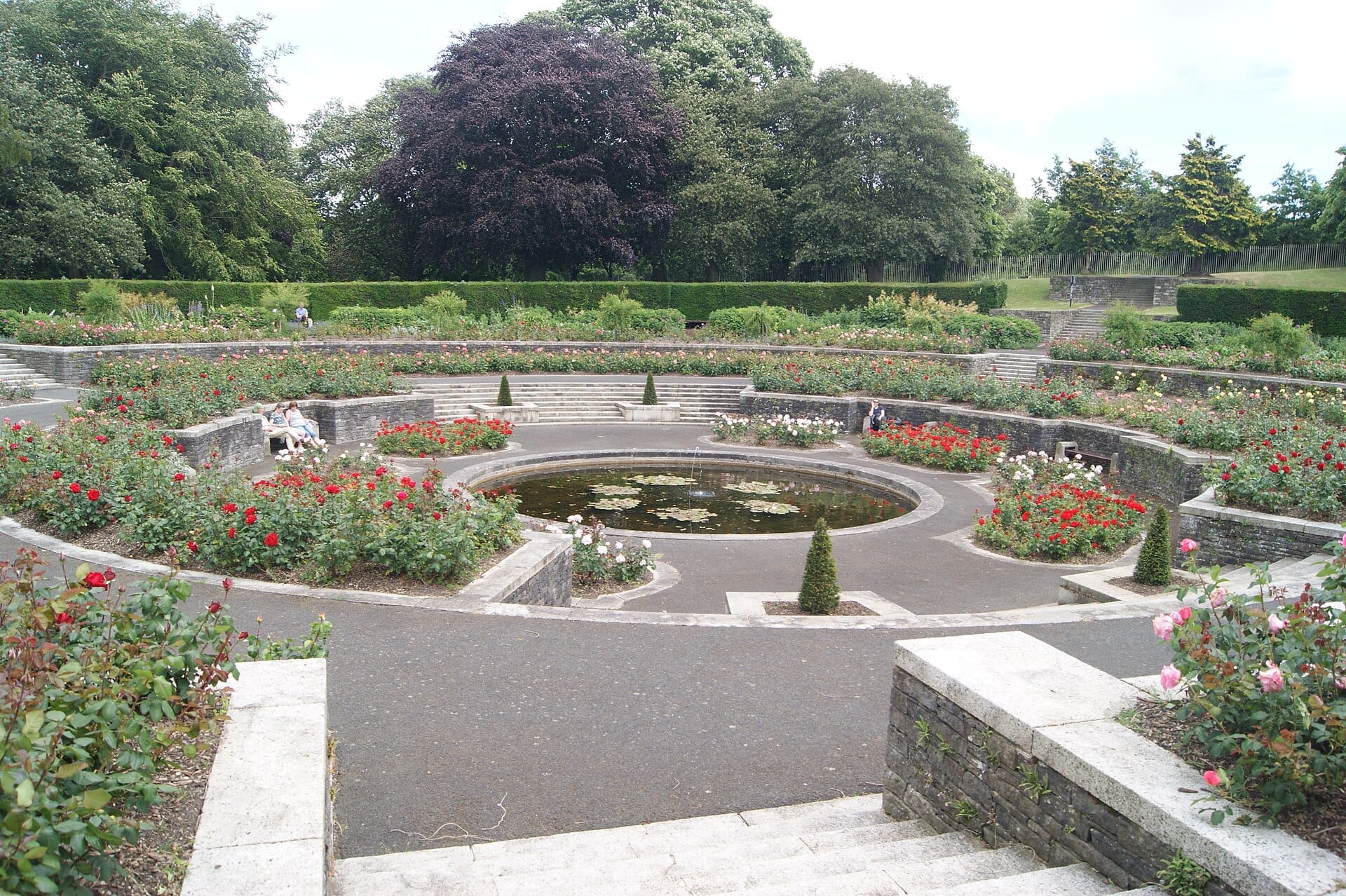
The gardens are not a single monument but a complete designed landscape: sunken rose gardens, long grass terraces, symmetrical paths, reflecting pools, stone pergolas, and four granite bookrooms containing illuminated manuscripts listing the names of the dead. Everything is formally composed, rooted in the Edwardian classical tradition that Lutyens brought to memorials across the Commonwealth. What makes this site unusual is its context: it sits in the Republic of Ireland, a state whose foundation was partly shaped by opposition to British rule, which meant the sacrifice of Irish soldiers in British uniform was politically uncomfortable for decades.
ℹ️ Good to know
The gardens were officially dedicated by church officials on 10 September 1988, and public access has gradually expanded, with renewed attention around the 90th anniversary of the Battle of the Somme in 2006. The long delay reflects the complex politics surrounding Irish participation in the First World War.
The History Behind the Silence
A national committee decided on 17 July 1919 to establish a permanent memorial for Irish soldiers who had died in the war. The Irish Free State sanctioned £50,000 for the memorial fund in 1929, and construction of the surrounding linear parkway (approximately 60 hectares in total) began in 1931. Lutyens was commissioned to design the memorial core, and work on the gardens proceeded through the 1930s, largely using labour drawn from unemployed workers during the Depression years.
The site was never formally inaugurated by the Irish state in the years that followed. The politics of commemorating men who had fought under the British flag sat uneasily with a newly independent nation whose defining myth centred on the Easter Rising of 1916. The gardens fell into neglect and were vandalised at several points. It was only after a restoration project and a broader shift in Irish public attitudes toward the complexity of its First World War history that the gardens were dedicated by church officials on 10 September 1988, with subsequent years bringing fuller public engagement and recognition.
That long arc from construction to official recognition gives the gardens an unusual weight. Visiting here is not just about standing in front of a monument; it is about understanding how a society eventually reclaims a part of its history it once found too difficult to hold. For more on how Dublin's history is interpreted through its public spaces, the Glasnevin Cemetery Museum and Kilmainham Gaol both sit in the same neighbourhood and offer powerful contrasts in how Irish sacrifice and resistance have been memorialised.
Tickets & tours
Hand-picked options from our booking partner. Prices are indicative; availability and final rates are confirmed when you complete your booking.
Wicklow and Glendalough day trip from Dublin with Powerscourt Gardens
From 65 €Instant confirmationFree cancellationGiant's Causeway, Dark Hedges, and Belfast Tour from Dublin
From 85 €Instant confirmationFree cancellationDublin self-guided audio tour
From 10 €Instant confirmationBird of Prey, Cliffs of Moher and Aillwee Cave from Dublin
From 201 €Instant confirmationFree cancellation
What You See When You Walk In
Entering from the Con Colbert Road gate, the formal geometry becomes apparent immediately. The gardens are structured around a central axis, with long rectangular sunken rose gardens flanked by wide grass terraces. The stone is pale and clean, and the planting is restrained: rose beds, low hedging, neat lawns. Lutyens used the same vocabulary here that he applied at the Thiepval Memorial in France and the Cenotaph in London. The overall atmosphere is one of contained grief rather than theatrical grandeur.
At the far ends of the main garden axis stand the four granite bookrooms, small domed pavilions that hold the illuminated memorial books containing the names of the 49,400 dead. Access to view the manuscripts inside is formally by arrangement with local management rather than open on a drop-in basis, but the exterior stonework is itself worth studying closely. The carving is precise and the proportions exact, with a weight and permanence that reflects Lutyens's understanding of how memorial architecture should feel against the body.
The River Liffey runs along the northern edge of the gardens, and there are points where you can look north across the water toward the wooded slopes on the opposite bank. On a still morning, the reflections in the garden pools and the sound of the river provide a sensory backdrop that photographs rarely capture. The stone underfoot is cool even in summer, and the paths are wide enough that even on busier weekend afternoons the formal geometry absorbs visitors without feeling crowded.
💡 Local tip
Arrive on a weekday morning for the best light on the stonework and the quietest conditions. The gardens face east-to-southeast, so morning light catches the granite bookrooms and pergola columns well. By midday in summer, the formal gardens can feel exposed and flat.
How the Gardens Change by Time and Season
The roses in the sunken gardens are at their fullest from late June through July. In high summer, the beds carry clusters of cream, red, and pale pink blooms, and the air in the lower garden has a detectable fragrance in the mornings. This is when the gardens are most photographed and most likely to attract visitors beyond the regular walkers and runners who use the surrounding parkway.
In autumn, the grasses along the terraces turn and the formal structure of the garden becomes more skeletal and, in some ways, more appropriate to the memorial function. The long views down the main axis feel starker without the rose bloom. Winter visits are quieter still: the gardens open from 08:00 on weekdays and later in the mornings at weekends, with closing times at dusk, and on a grey January morning, the place can feel entirely private. The stone takes on a darker hue in wet weather, and the pergola columns drip quietly into the grass below them. It is not a comfortable experience, but it is a significant one.
Spring brings the grounds maintenance teams back with energy, and from March onward the formal beds are prepared for the growing season. The gardens are managed by the Office of Public Works, and the level of upkeep is consistently high. Paths are clear, planting is structured, and the stone is kept clean. This level of care matters: neglect damaged the site's reputation for decades, and the current standard of maintenance is itself a form of official acknowledgement.
Practical Walkthrough and Visitor Intelligence
The gardens are reached via the Con Colbert Road entrance or the South Circular Road entrance near the Phoenix Park end. A car park is available close to the site. For those arriving by public transport, buses 51, 68, and 69 from Aston Quay in the city centre stop near the gardens. The journey takes roughly 15 to 20 minutes from the city centre depending on traffic.
The gardens sit within easy walking distance of Kilmainham Gaol and the Irish Museum of Modern Art (IMMA), which occupies the former Royal Hospital Kilmainham, itself an architecturally significant building. Combining all three in a single half-day gives a genuinely layered picture of the Kilmainham area, which holds more concentrated historical weight per square kilometre than almost anywhere else in Dublin.
Wear comfortable shoes with grip: the stone paths can be slick after rain, and the grass terraces are not always even. There are no cafes or food facilities within the gardens themselves, so bring water if you plan to spend time exploring the wider parkway. The nearest facilities are in the surrounding streets or back toward the city along the quays.
⚠️ What to skip
Opening hours are typically 08:00 on weekdays and later in the mornings at weekends, with closing times varying according to daylight. Verify current times on the Heritage Ireland website before visiting, particularly in winter months when daylight is short.
Photography and Accessibility
The gardens offer strong compositional opportunities for anyone interested in architectural photography. The long straight paths create natural leading lines toward the bookrooms and pergolas, and the symmetry of the layout is rewarding to work with. The low morning light in winter can be particularly dramatic, cutting across the pale granite and casting long shadows down the terraced lawns.
The main paths through the formal garden are paved and relatively level, making them accessible for most visitors. However, specific step-free access information for all areas of the site has not been fully documented in publicly available sources. Visitors with mobility requirements are advised to contact the Office of Public Works directly or check the Heritage Ireland website for up-to-date accessibility details before visiting.
The gardens are located in the Kilmainham neighbourhood, which also contains some of Dublin's most important historical sites. If you are building a broader itinerary for the area, the 3-day Dublin itinerary covers how to sequence Kilmainham alongside the city centre efficiently.
Who Should Think Twice
Visitors expecting the kind of high-stimulation experience offered by the Guinness Storehouse or an interactive museum will find the War Memorial Gardens slow and understated. There is no audio guide, no visitor centre, no exhibition to move through. The experience is almost entirely spatial and contemplative. Children, unless genuinely curious about gardens or history, may find little to engage with beyond the open grass areas.
If your time in Dublin is limited to a single day and you are prioritising a broad overview of the city, there are more central options. But if you have a second or third day, or if the First World War has personal family significance, this is one of the more rewarding places the city offers.
Insider Tips
- The bookrooms containing the illuminated manuscripts are not open on a drop-in basis. If viewing the names inside is important to you, contact the Office of Public Works in advance to arrange access.
- The gardens sit adjacent to a linear riverside parkway that extends along the Liffey. Arriving on foot or by bike along the river path from Heuston Station (about a 15–20-minute walk) gives you a better sense of the site's scale and riverside setting than arriving by road.
- The rose gardens are sunken below the main terrace level, which means they are largely invisible until you descend into them. Many visitors walk the upper terrace and miss the most intimate part of the design entirely.
- Early July visits catch both the peak rose bloom and the anniversary of the Battle of the Somme (1 July), when the gardens sometimes hold a small commemorative event. Check Heritage Ireland's calendar before visiting in late June or early July.
- Combine a visit with the nearby Irish Museum of Modern Art at the Royal Hospital Kilmainham: both institutions were designed for different kinds of official purpose and their architectural contrast, Lutyens's memorial formality against the 17th-century hospital courtyard, is worth thinking about as you move between them.
Who Is War Memorial Gardens, Islandbridge For?
- History and First World War enthusiasts seeking a serious, reflective memorial experience
- Architecture and landscape design followers interested in Lutyens's work outside the UK
- Photographers looking for formal geometric subjects in natural light
- Walkers and cyclists using the Liffey riverside routes through Kilmainham
- Visitors with Irish family connections to the First World War who want a place to pause
Nearby Attractions
Other things to see while in Kilmainham:
- Irish Museum of Modern Art (IMMA)
The Irish Museum of Modern Art occupies the Royal Hospital Kilmainham, one of Ireland's finest 17th-century buildings, set across 48 acres in Dublin 8. Admission to most exhibitions is free, making it one of the city's most rewarding cultural visits. The combination of architecture, contemporary art, and formal gardens creates an experience that goes well beyond a typical gallery.
- Kilmainham Gaol Museum
Kilmainham Gaol is a former Victorian prison in western Dublin where the leaders of the 1916 Easter Rising were executed. Now a state-managed museum, it offers guided tours through cold stone cells, a skylit Victorian wing, and a courtyard where Irish history reached some of its darkest turning points. Pre-booking is essential.