Glasnevin Cemetery Museum: Ireland's Most Revealing History Lesson
Glasnevin Cemetery Museum sits on 124 acres of ground that has absorbed Irish history since 1832. With over 1.5 million burials and a world-class visitor centre opened in 2010, it is one of the few places in Dublin where the full sweep of Irish political, social, and cultural life comes into focus in a single afternoon.
Quick Facts
- Location
- Finglas Road, Dublin 11 — approx. 3 km north of O'Connell Street
- Getting There
- Dublin Bus routes 40 or 140 from O'Connell Street; bicycle stands on site
- Time Needed
- 2–3 hours for museum and guided tour; 3–4 hours if walking the full grounds
- Cost
- Paid entry; prices vary by tour type and concession — check the Experience Glasnevin pages on dctrust.ie for current rates
- Best for
- History enthusiasts, Irish diaspora visitors, architecture admirers, curious independent travelers
- Official website
- www.dctrust.ie/experience-glasnevin/plan-your-visit.html
Why Glasnevin Is Unlike Any Other Cemetery in Europe
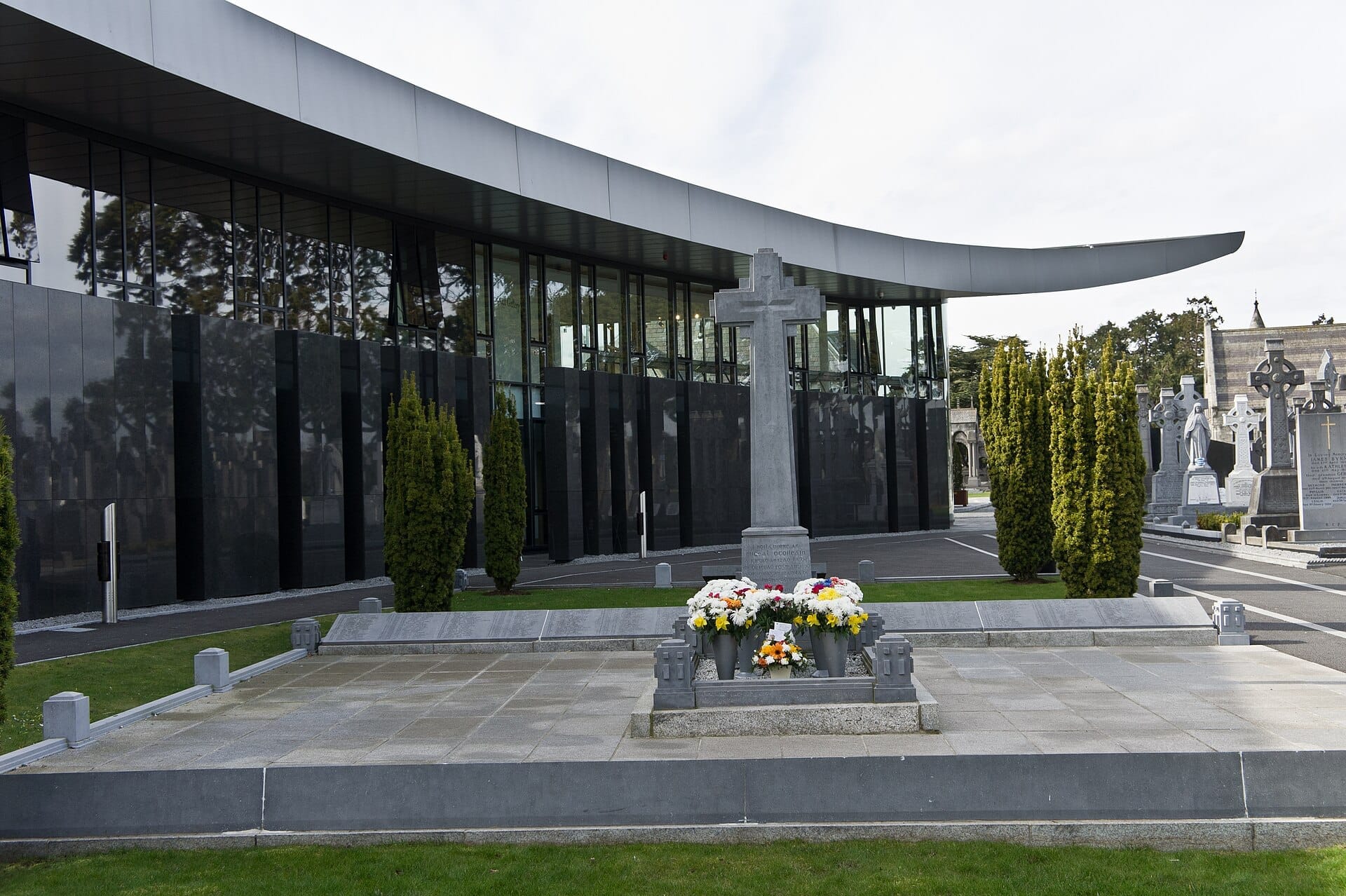
Glasnevin Cemetery Museum is not a somber duty visit. It is, quietly, one of the most absorbing history experiences in the entire country. Founded in 1832 by Daniel O'Connell as Ireland's first major cemetery open to all denominations, the 124-acre site holds more than 1.5 million burials. Parnell, de Valera, Michael Collins, Constance Markievicz, Brendan Behan: the names read like a rollcall of Irish history. But the cemetery is not only for the famous. The majority of those interred here are ordinary Dubliners, which is exactly what makes it so affecting.
The visitor centre that opened in March 2010 transformed what was already a significant site into a fully interpreted attraction. Its architecture is intentional: limestone walls, a circular tower form, and a design that references both the round towers of early Irish monasteries and the Victorian-era watch towers that once guarded the cemetery from body snatchers. Before embalming was common practice, medical schools paid well for fresh corpses, and Glasnevin responded with high walls, a watchdog pack, and armed guards. That history alone gives the site a texture most museums cannot manufacture.
💡 Local tip
Book guided tours in advance through dctrust.ie, especially on weekends and during summer. Walk-in availability exists, but tour spots fill quickly and the guided experience adds considerable depth to an otherwise sprawling site.
The Museum: What You'll Actually See Inside
The visitor centre opens daily at 10:00, with the cemetery grounds accessible from 09:00. The museum's permanent exhibition traces Irish history from the early nineteenth century through partition, independence, civil war, and into the twentieth century, using the graves and the buried as its narrative anchors. The approach is smart: instead of a conventional chronological layout, the story is told through individual lives, cross-referenced with political events. You follow people, not timelines.
Artifact displays are complemented by audio-visual elements, and the quality of interpretation is high. The database of burials is a genuine research tool: the cemetery holds records for all 1.5 million burials, and kiosk terminals in the centre allow visitors to search by name. For anyone with Irish ancestry, this is more than a tourist feature. It is a genealogical archive in a glass case. The last entry for the visitor centre is 17:00.
The museum sits comfortably alongside other major Dublin history institutions. If your interest runs deep, consider pairing it with the Kilmainham Gaol and the GPO Witness History exhibition on O'Connell Street, both of which cover overlapping periods from different angles.
Tickets & tours
Hand-picked options from our booking partner. Prices are indicative; availability and final rates are confirmed when you complete your booking.
Giant's Causeway, Dark Hedges, and Belfast Tour from Dublin
From 85 €Instant confirmationFree cancellationDublin self-guided audio tour
From 10 €Instant confirmationBird of Prey, Cliffs of Moher and Aillwee Cave from Dublin
From 201 €Instant confirmationFree cancellationGame of Thrones Studio tour with return transfer from Dublin
From 63 €Instant confirmationFree cancellation
The Guided Tours: History That Walks You Through the Graves
The Irish History Tour is the main guided offering and it runs outdoors through the cemetery itself. A knowledgeable guide moves the group between notable graves, pausing to explain the political context of who is buried where and why that matters. The route covers the Republican plot, the O'Connell Circle, the Victorian-era monuments, and the tower. Guides vary in style but the best of them can turn a marble headstone into the pivot point of an entire era.
The tower climb, available separately or as part of a combined ticket, gives elevated views across the cemetery and toward the city. It is not a panoramic summit experience: what you get is a closer look at the scale of the grounds, the geometry of the Victorian section, and on clear days a sense of how close the city presses in on all sides. The tower itself has thick stone walls and narrow stairs, so it is worth checking accessibility options if that is a concern.
People who book the history tour without reading much beforehand often leave saying it was the unexpected highlight of their Dublin trip. People who arrive expecting a short, casual wander and skip the tour sometimes find the grounds bewildering in their scale. The tour is the difference between the two experiences.
Walking the Grounds: Atmosphere at Different Times of Day
The cemetery grounds open at 09:00, a full hour before the museum. Morning visits have a distinct quality: gravel paths crunch underfoot, jackdaws work the older sections near the perimeter walls, and the early light hits the Victorian obelisks at angles that disappear by midday. There are very few other visitors at this hour, and the quiet is genuine rather than performed. The Victorian section, with its elaborate carved stonework and family tombs, rewards slow attention. The smell is cut grass and cold stone, occasionally the diesel drift from Finglas Road beyond the walls.
By late morning, school groups and guided tours begin arriving. The Republican plot attracts the most concentrated attention from visitors, particularly around the graves of Michael Collins and Éamon de Valera. By early afternoon in summer, the main paths are noticeably busy. If you want photographs of the major monuments without other visitors in frame, 09:30 on a weekday morning is your window.
The cemetery closes at 17:00. Late afternoon in autumn and winter has its own appeal: low light across the grounds, fewer visitors, and the kind of stillness that makes the scale of 1.5 million burials feel genuinely comprehensible rather than abstract.
ℹ️ Good to know
Wear flat, comfortable shoes. The paths mix gravel, flagstone, and uneven grass. Older sections of the cemetery have unlevel ground between monuments. This is not a place for heels or smooth-soled footwear.
Historical Context: Why O'Connell Founded It and What That Means
In the early nineteenth century, Irish Catholics faced major restrictions on performing full religious rites at their own gravesides. They were often buried in Church of Ireland churchyards under Protestant ceremony, or in anonymous plots outside city limits. Daniel O'Connell, the Catholic Emancipation campaigner, established Glasnevin in 1832 as a deliberate political act as much as a practical one: a cemetery where all denominations could bury their dead according to their own rites. The non-denominational principle has held for nearly two centuries.
That founding context shapes everything about the site. The Catholic majority sections, the Jewish section, the Protestant area, the Republican plot: the geography of the cemetery is a physical map of Irish social history. The fact that O'Connell himself is interred here, beneath a round tower that was rebuilt after a 1971 bombing, adds another layer. The original tower collapsed; the rebuilt one stands as a practical object lesson in how contested these grounds remain, even now.
For a broader understanding of Irish political and architectural history in this period, the Georgian Dublin architecture guide provides useful context on how the city was being physically shaped at precisely the time Glasnevin was founded.
Practical Notes: Getting There, Accessibility, and What to Expect
Glasnevin sits about 3 km north of O'Connell Street. Dublin Bus routes 40 and 140 serve stops near the cemetery from the city centre. The ride takes roughly 15 to 20 minutes depending on traffic. There is no Luas stop within walking distance, so the bus is the cleanest public transport option. Bicycle stands are available directly beside the museum for those cycling from the city.
The visitor centre is fully wheelchair accessible, and guided tours can be adapted for wheelchair users on request, including routing that avoids stairs. A drop-off area sits directly outside the centre. Visitors with a disability are entitled to one free companion ticket when requested in advance through the booking system.
Weather affects the outdoor experience significantly. The guided tour runs outside regardless of conditions, and Irish weather being what it is, a waterproof layer is worth bringing any time of year. The museum interior offers a dry alternative if conditions are poor, though the full value of the site is in the grounds. Photography is permitted throughout the cemetery. The most photogenic sections are the Victorian monuments in the older areas and the O'Connell Tower against an open sky.
⚠️ What to skip
This is an active cemetery. Funerals take place regularly, particularly on weekday mornings. Give private services a wide berth and keep noise low near ongoing ceremonies. This is basic courtesy, but worth stating clearly.
Who Should Think Twice Before Visiting
Glasnevin Cemetery Museum is not well suited to visitors with very limited time who are trying to cover multiple major attractions in a single day. The site rewards slow movement and genuine curiosity. Anyone who cannot commit at least two hours, or who has no interest in Irish history, will find the experience underwhelming. The guided tour covers a lot of ground on foot, which can be tiring on cold or wet days.
Young children are likely to disengage quickly unless specifically interested in history or storytelling. Families with kids might find Dublin Zoo in nearby Phoenix Park a more practical use of half a day, potentially combining both on the same trip if energy allows.
Insider Tips
- The burial database at the kiosk terminals is searchable by name and date. If you have Irish ancestry and even a rough idea of a name, spend ten minutes here before the tour. Finding a family name in the records changes the experience entirely.
- The café in the visitor centre is a good option for a mid-visit break, and it is considerably quieter than comparable spots in the city centre. Coffee and light food are available during opening hours.
- The Victorian section in the eastern part of the grounds is often bypassed by tour groups who concentrate on the Republican plot and the O'Connell Circle. It contains some of the most elaborate nineteenth-century funerary sculpture in Ireland and is worth exploring independently after a guided tour.
- If you plan to do the tower climb, do it at the start of your visit rather than the end. Energy and light are both better in the morning, and the climb is more enjoyable when you can still use the elevated view to orient yourself for the walk through the grounds.
- Parking is available at the site for up to 30 cars with a small exit fee, but the bus from O'Connell Street is genuinely faster and easier than driving from most central Dublin accommodation.
Who Is Glasnevin Cemetery Museum For?
- Irish diaspora visitors researching family history or wanting to connect with Irish heritage
- History enthusiasts with a specific interest in nineteenth and twentieth century Irish politics
- Photographers drawn to Victorian funerary architecture and monumental stonework
- Travelers who prefer depth over breadth and want one genuinely substantial experience per day
- Anyone doing a dedicated Dublin history itinerary alongside Kilmainham Gaol and the GPO
Nearby Attractions
Combine your visit with:
- Abbey Theatre
Founded in 1904 by W.B. Yeats and Lady Gregory, the Abbey Theatre is Ireland's National Theatre and one of the most historically significant stages in the English-speaking world. Sitting on Lower Abbey Street in the heart of Dublin city centre, it continues to produce new Irish work alongside classic plays that shaped a nation's identity.
- Blessington Street Basin
Once the Royal George Reservoir supplying water to Dublin's north side, Blessington Street Basin is now a free public park in Phibsborough. The central lake, Tudor gate lodge, and resident wildfowl make it one of the most quietly rewarding green spaces within walking distance of Dublin city centre.
- Casino Marino
Casino Marino is an 18th-century Neo-Classical pleasure house in north Dublin, designed by Sir William Chambers for the Earl of Charlemont. Despite its compact exterior, the building conceals 16 rooms across three floors — a feat of architectural illusion that continues to astonish visitors. Access is by guided tour only, with admission from €3 for children and students and €5 for adults.
- Clontarf Promenade
Clontarf Promenade stretches 4.5 kilometres along Dublin Bay from Fairview to the Bull Wall at Dollymount, offering open sea views, public art, and a marked cycle route along much of its length. It costs nothing to visit, runs along a flat sea wall path, and delivers some of the most expansive coastal scenery accessible from Dublin city centre.