Clontarf Promenade: Dublin's Finest Seafront Walk
Clontarf Promenade stretches 4.5 kilometres along Dublin Bay from Fairview to the Bull Wall at Dollymount, offering open sea views, public art, and a marked cycle route along much of its length. It costs nothing to visit, runs along a flat sea wall path, and delivers some of the most expansive coastal scenery accessible from Dublin city centre.
Quick Facts
- Location
- Clontarf Road, Clontarf, Dublin 3
- Getting There
- Dublin Bus routes along Clontarf Road; Clontarf Road DART station nearby but not directly on the seafront promenade
- Time Needed
- 45 min to 2 hours depending on distance walked
- Cost
- Free, no tickets required
- Best for
- Walkers, cyclists, families, sea-air seekers
What Is Clontarf Promenade?
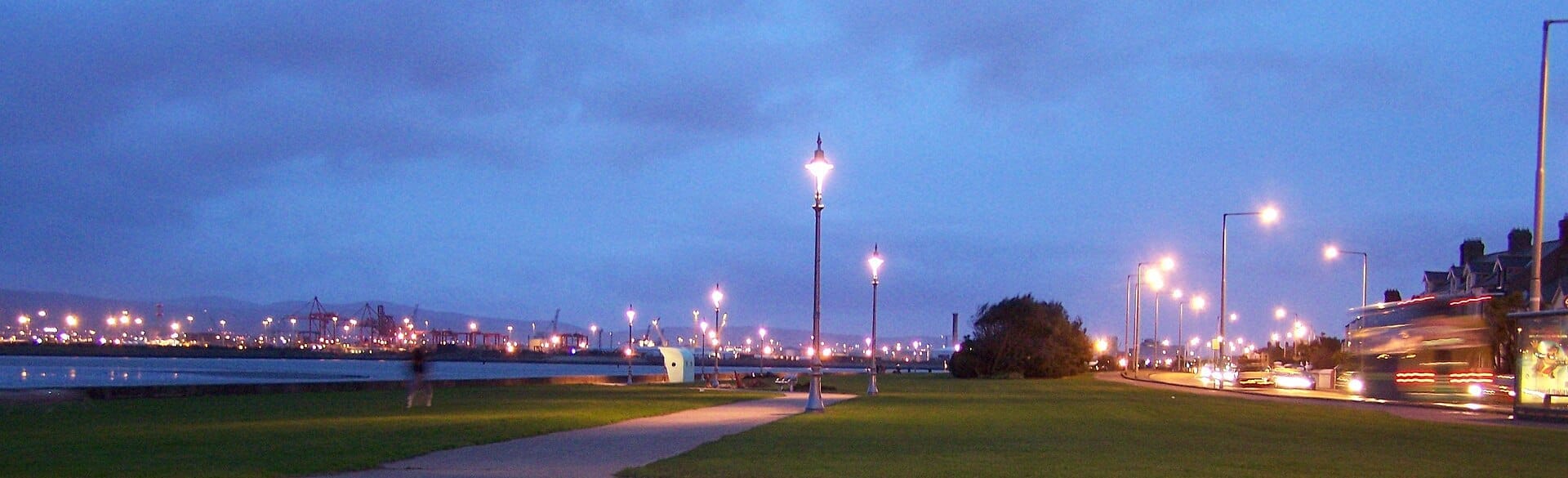
Clontarf Promenade is a 4.5-kilometre public seafront walkway running along the western edge of Dublin Bay, from Alfie Byrne Road near Fairview to the wooden bridge at Dollymount and the Bull Wall beyond. It is managed by Dublin City Council, free to use at any hour, and serves as the main coastal amenity for one of Dublin's most established northside suburbs.
The path sits on land largely reclaimed from the sea in the early 20th century. Dublin Corporation began landscaping the seafront over the following decades, gradually shaping the wide, flat promenade that exists today. A cycle route has since been added, making the route usable for both walkers and cyclists, though they share the same general corridor.
The promenade is not a manicured park or a ticketed attraction. It is an open sea wall path with grass verges, public benches, and unobstructed views across Dublin Bay toward Howth Head to the north and the Wicklow Mountains to the south. For context on how it fits into the city's wider coastal offer, see the Dublin beaches guide.
💡 Local tip
Bus routes along Clontarf Road drop you directly beside the promenade at multiple points. Check Transport for Ireland (TFI) for current route numbers and timetables before travel.
The Walk Itself: What You Actually See
The promenade feels wide and unhurried in a way that many urban seafronts do not. The path runs between Clontarf Road on one side and the sea wall on the other, with the bay opening up to the east. At low tide, the mudflats extending into the bay attract oystercatchers, curlews, and redshanks in significant numbers, particularly in the colder months. At high tide, the water comes close enough to the wall that you can hear it clearly on a breezy day.
The surface underfoot is firm and level throughout, making this one of the more accessible coastal walks near Dublin city centre. Grass strips run between the path and the road in places, and wooden benches appear at intervals along the route, most of them positioned to face the water rather than the road.
Three public sculptures break up the visual rhythm of the walk. Eamonn O'Doherty's Sails sculpture, installed in the late 1980s, rises from the seafront near the centre of the promenade: angular steel forms that reference the nautical history of the bay without being literal about it. The Alfie Byrne Memorial Seat by artist Brian O'Brien and Dublin Corporation commemorates the long-serving Lord Mayor of Dublin who served a record nine terms. The most striking and unexpected piece is the Maoi Stone Sculpture near Vernon Avenue, a replica Easter Island head gifted by the Government of Chile in the mid-2000s. It stops most first-time visitors in their tracks.
Tickets & tours
Hand-picked options from our booking partner. Prices are indicative; availability and final rates are confirmed when you complete your booking.
Giant's Causeway, Dark Hedges, and Belfast Tour from Dublin
From 85 €Instant confirmationFree cancellationDublin self-guided audio tour
From 10 €Instant confirmationBird of Prey, Cliffs of Moher and Aillwee Cave from Dublin
From 201 €Instant confirmationFree cancellationGame of Thrones Studio tour with return transfer from Dublin
From 63 €Instant confirmationFree cancellation
How the Experience Changes by Time of Day
Early mornings on weekdays, the promenade belongs to solo walkers, joggers, and dog owners. The light across Dublin Bay at dawn can be extraordinary, particularly in autumn and winter when low sun hits the water from a sharp angle and Howth Head turns a deep purple silhouette. The air smells of salt and seaweed, sharpened by the breeze that comes reliably off the bay.
Weekend mornings from around 9am onward see the path fill steadily with families, cyclists, and groups walking side by side. By mid-morning on a dry Saturday, the promenade between Vernon Avenue and the start of the Bull Wall is genuinely busy, though never so crowded as to feel unpleasant. The atmosphere is local and relaxed rather than tourist-facing.
Sunday afternoons in summer are the peak period. Children on bikes, couples with takeaway coffees from nearby cafes, older residents on the memorial benches: it functions as a communal outdoor living room for the surrounding area. If you want solitude or a clear photograph of the bay, come on a weekday morning or on any morning in November through February.
ℹ️ Good to know
The promenade faces east-northeast across Dublin Bay. Sunrise views from the sea wall are exceptional in clear weather, particularly between October and March when the sun rises at a lower angle over the bay.
Historical and Cultural Context
Clontarf, whose Irish name is Cluain Tarbh meaning 'meadow of the bulls', is most associated historically with the Battle of Clontarf in 1014, in which the High King of Ireland Brian Boru defeated a Viking and Leinster alliance on the shoreline of this bay. The battle ended Norse attempts to control Ireland politically, though Norse settlers continued to influence Dublin for generations afterward. Standing on the promenade, looking out toward where the battle is said to have taken place, gives the flat coastal landscape an unexpected weight.
The suburb itself developed primarily in the Victorian and Edwardian periods as a seaside residential area for prosperous Dubliners who wanted proximity to the sea without the noise of the city. Much of the architecture along Clontarf Road reflects that era. The land the promenade now sits on did not exist then: the reclamation works of the 1920s created it, adding terrain that was then landscaped over the following decades.
For a broader understanding of Dublin's relationship with its coastline, the Dollymount Strand lies at the northern end of this walk, accessible via the wooden bridge near the Bull Wall.
Getting There and Practical Navigation
The promenade runs along Clontarf Road, and Dublin Bus routes serving the Clontarf Road corridor stop at multiple points along its length. The walk is a continuous flat path, so you can begin at any point and walk in either direction. Most people starting from the city centre join the promenade around the Fairview end, near where Alfie Byrne Road meets Clontarf Road, and walk northeast toward Dollymount.
There is no formal car park directly on the promenade, but residential street parking is available along side roads off Clontarf Road, subject to local restrictions. Cycling to the promenade from the city is a reasonable option: the dedicated cycle track along the seafront connects to the wider Dublin cycling network. Check Dublin City Council or Transport for Ireland for current cycling route maps.
Toilets and café facilities are not consistently available along the full length of the promenade itself. There are cafes and restaurants along Clontarf Road at either end of the walk, but if you are walking the full 4.5 kilometres, plan accordingly. The promenade is open continuously, year-round, with no gates or entry controls.
⚠️ What to skip
On days with strong onshore winds, waves can wash over sections of the sea wall nearest to Dollymount. If conditions look rough, stay back from the wall edge and keep children close.
Photography and What to Bring
The view south from the middle section of the promenade, on a clear day, gives you the full arc of Dublin Bay with the Wicklow Mountains as a backdrop behind Dun Laoghaire and Dalkey. This is one of the few points in Dublin where you can see that entire panorama without obstruction. A wide-angle lens captures it best; telephoto lenses are useful for pulling in the detail of Howth Head across the water.
The Easter Island head sculpture near Vernon Avenue is consistently photogenic but tends to attract clusters of curious walkers throughout the day. Early morning gives you the best chance of photographing it alone. The Sails sculpture photographs well in low light, when the steel surface picks up colour from the sky.
Dress for a coastal walk regardless of the forecast: wind along the promenade is rarely absent, and even on dry days in summer, a light layer is useful. If you are combining this walk with a visit to Dollymount Strand at the far end, wear shoes you are comfortable walking on sand in.
Who Should Skip This
Visitors on a short city break focused on cultural attractions, museums, and restaurants will find the promenade is a detour rather than a destination unless they specifically want sea air and open sky. The walk has no cafes on the path itself, no ticketed experience, and no indoor component. In heavy rain, which Dublin produces reliably throughout the year, it offers minimal shelter and very little reason to persist.
If your time in Dublin is limited to two or three days and coastal walking is not a priority, the promenade can wait for a future visit. For structured cultural itineraries, see the 3 days in Dublin itinerary.
Insider Tips
- Walk from the Fairview end toward Dollymount rather than the reverse: the views across the bay open up progressively, and you arrive at the Bull Wall with a proper sense of reaching the coast.
- The mudflats visible at low tide between the promenade and the South Bull Wall are an important feeding ground for migratory wading birds. October to March is the best period for birdwatching here; bring binoculars.
- The Maoi Stone (Easter Island head replica) near Vernon Avenue is easy to walk past if you are not looking for it. It sits on the grass strip between the path and the road, not on the sea wall side.
- Weekday mornings between 7am and 9am are the quietest window for unobstructed photography and a genuinely solitary coastal walk, even in summer.
- Several independent cafes along Clontarf Road, just behind the promenade, are well-regarded by locals for coffee and breakfast. None are on the promenade path itself, so factor a detour into your timing.
Who Is Clontarf Promenade For?
- Walkers and joggers who want a flat, long sea-level route close to the city
- Cyclists looking for a dedicated coastal track with bay views
- Families wanting a free, open outdoor space without traffic
- Birdwatchers visiting Dublin in autumn or winter
- Photographers seeking wide Dublin Bay panoramas with the Wicklow Mountains as a backdrop
Nearby Attractions
Combine your visit with:
- Abbey Theatre
Founded in 1904 by W.B. Yeats and Lady Gregory, the Abbey Theatre is Ireland's National Theatre and one of the most historically significant stages in the English-speaking world. Sitting on Lower Abbey Street in the heart of Dublin city centre, it continues to produce new Irish work alongside classic plays that shaped a nation's identity.
- Blessington Street Basin
Once the Royal George Reservoir supplying water to Dublin's north side, Blessington Street Basin is now a free public park in Phibsborough. The central lake, Tudor gate lodge, and resident wildfowl make it one of the most quietly rewarding green spaces within walking distance of Dublin city centre.
- Casino Marino
Casino Marino is an 18th-century Neo-Classical pleasure house in north Dublin, designed by Sir William Chambers for the Earl of Charlemont. Despite its compact exterior, the building conceals 16 rooms across three floors — a feat of architectural illusion that continues to astonish visitors. Access is by guided tour only, with admission from €3 for children and students and €5 for adults.
- Croke Park Stadium & Museum
Croke Park is the 82,300-capacity home of the Gaelic Athletic Association, sitting in Drumcondra just north of Dublin city centre. Beyond match days, the stadium opens for guided tours and houses a museum dedicated to hurling, Gaelic football, and the cultural history that shaped modern Ireland.