Abbey Theatre: Where Irish Drama Found Its Voice
Founded in 1904 by W.B. Yeats and Lady Gregory, the Abbey Theatre is Ireland's National Theatre and one of the most historically significant stages in the English-speaking world. Sitting on Lower Abbey Street in the heart of Dublin city centre, it continues to produce new Irish work alongside classic plays that shaped a nation's identity.
Quick Facts
- Location
- 26/27 Lower Abbey Street, Dublin 1, D01 K0F1
- Getting There
- Multiple Dublin Bus routes on O'Connell Street; Luas Red Line stops within walking distance
- Time Needed
- 2–3 hours for an evening performance; shorter for daytime box office visits or lobby browsing
- Cost
- Ticket prices vary by production and seating tier; check individual event pages on the official site
- Best for
- Theatre lovers, literature fans, anyone curious about Irish cultural history
- Official website
- www.abbeytheatre.ie
What the Abbey Theatre Actually Is
The Abbey Theatre, officially Ireland's National Theatre (Irish: Amharclann na Mainistreach), opened its doors on 27 December 1904 at 26/27 Lower Abbey Street in Dublin's north inner city. More than a performance space, it was conceived as a cultural institution at a moment when Ireland was still under British rule, and the idea of a distinctly Irish theatre carrying Irish stories and Irish voices was itself a political act.
Its founders, the poet W.B. Yeats and the playwright Lady Gregory, wanted a stage that could reflect Irish life honestly rather than through the sanitised lens of Victorian melodrama. What followed was a century of controversy, premieres, riots, and some of the most celebrated plays in the English language. J.M. Synge's The Playboy of the Western World famously sparked audience protests on its 1907 opening night. Sean O'Casey's Dublin trilogy followed in the 1920s. The Abbey's history is, in many ways, a compressed account of modern Ireland itself.
ℹ️ Good to know
The original 1904 building was gutted by fire in 1951. The current building on the same site opened in July 1966. It houses the main Abbey auditorium (492 seats) as well as the smaller Peacock Theatre, which typically stages more experimental and emerging work.
The Building Itself: What to Expect on Arrival
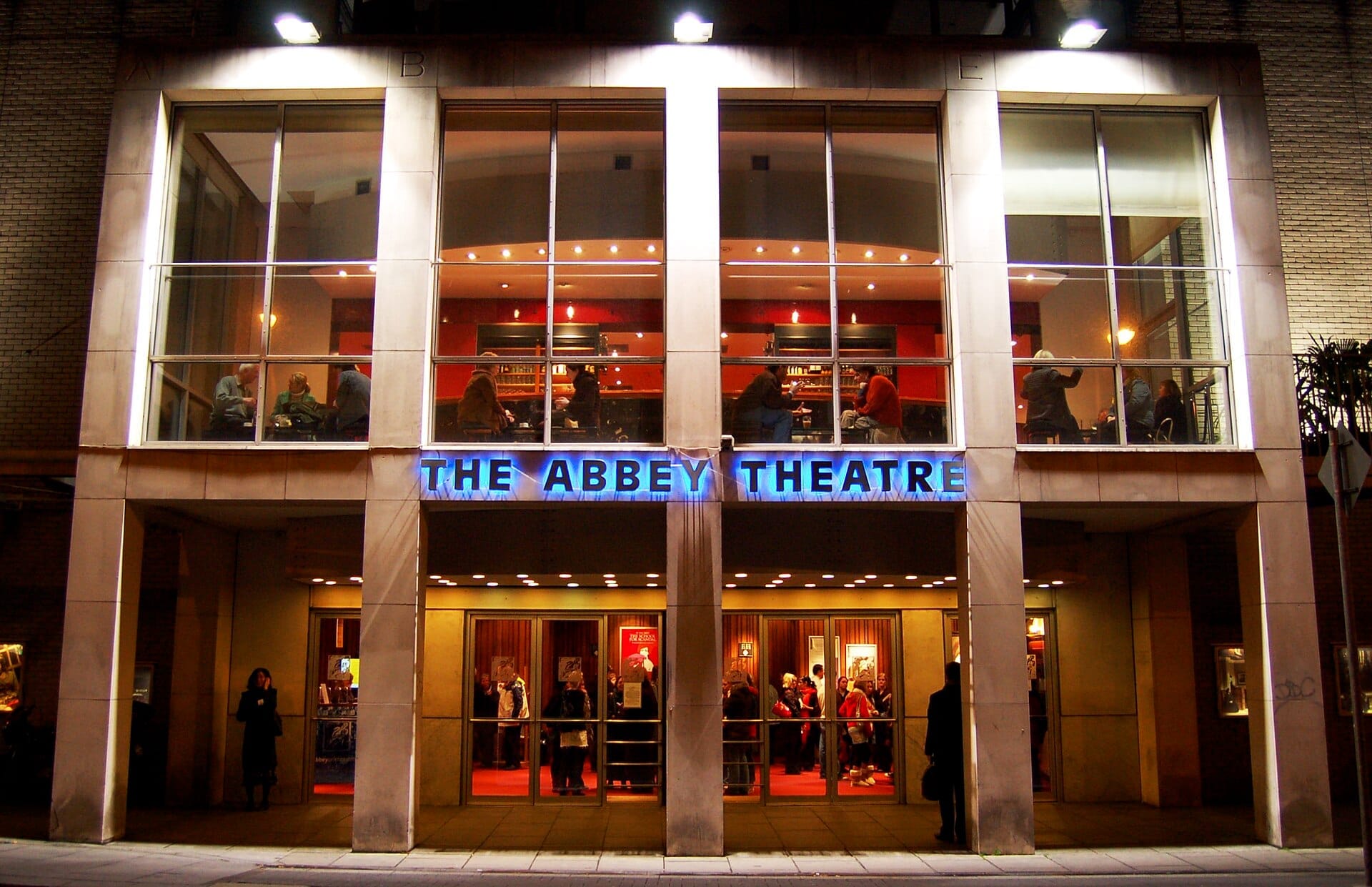
The current Abbey building is a product of 1960s civic modernism, which surprises visitors who expect something grander or older-looking. The exterior is clean and low-key: a rectangular structure in pale stone with a recessed entrance on Lower Abbey Street, just a short walk from the O'Connell Street junction. It doesn't shout for attention the way a Victorian opera house might. Some find this underwhelming; others appreciate the restraint.
Inside, the lobby opens up more generously than the street frontage suggests. There's a bar and foyer area where pre-show conversation tends to cluster, and display cases or boards often feature archival material, production photographs, or notes on the current season. The main auditorium seats 492 people across a traditional raked arrangement, giving good sightlines from most positions. The Peacock, accessible through the same building, is a more intimate black-box style space that programmes newer voices and riskier work.
The area around the Abbey sits between the busy commercial stretch of O'Connell Street to the west and the Docklands to the east. Lower Abbey Street itself is functional rather than scenic, but the theatre's location within a five-minute walk of the Ha'penny Bridge and the Liffey quays means it slots naturally into a day that combines culture with the city's riverside character.
Tickets & tours
Hand-picked options from our booking partner. Prices are indicative; availability and final rates are confirmed when you complete your booking.
Giant's Causeway, Dark Hedges, and Belfast Tour from Dublin
From 85 €Instant confirmationFree cancellationDublin self-guided audio tour
From 10 €Instant confirmationBird of Prey, Cliffs of Moher and Aillwee Cave from Dublin
From 201 €Instant confirmationFree cancellationGame of Thrones Studio tour with return transfer from Dublin
From 63 €Instant confirmationFree cancellation
The Programming: What You're Likely to See
The Abbey runs a full annual season with productions ranging from new commissions by Irish writers to revivals of canonical works by Beckett, O'Casey, Friel, and others. The programming leans toward serious drama rather than musicals or light entertainment, though the mix shifts with each season's artistic direction. Productions on the main stage tend to be fully realised, high-production-value stagings. The Peacock is where the theatre takes risks, often hosting shorter runs of debut work, community projects, or internationally co-produced pieces.
The theatre's connection to Irish literary culture is deep. If you're already exploring Dublin's literary trail, the Abbey is an essential part of that map. It's not a passive shrine to dead writers, though. The institution has spent the past decade making deliberate efforts to programme more women playwrights, more work in the Irish language, and more stories from communities that were historically absent from the national stage.
💡 Local tip
Check the Abbey's website well in advance if you're visiting during summer or around major festivals. Popular productions sell out faster than you'd expect, and the box office on the door is not always a reliable fallback.
Before and After the Show: The Experience Around It
An Abbey evening typically starts with the theatre's bar, which opens before performances and draws a mix of regular Dublin theatregoers, tourists, and arts industry people. The conversation in the pre-show foyer tends to be more engaged than you'll find before a mainstream West End-style show. People here generally know what they've booked and why.
Most main stage performances begin at 7:30 PM, though matinees run on selected days, and timing varies by production. Interval drinks are often pre-ordered at the bar to avoid queues. After the show, the surrounding streets offer options in both directions: north toward Parnell Street's range of restaurants, or south across the river toward Temple Bar and the city's denser concentration of late-night bars.
If you're combining the Abbey with other cultural visits, the GPO Witness History exhibition is a ten-minute walk along O'Connell Street and provides useful historical context for understanding why a national theatre mattered so much in early twentieth-century Ireland. The two work well together as a half-day cultural sequence.
Getting There and Practical Logistics
The Abbey sits on Lower Abbey Street in Dublin 1, close to the north bank of the Liffey. Multiple Dublin Bus routes operate on O'Connell Street, which is less than a two-minute walk away. The Luas Red Line runs through the city centre and connects to the wider network. Visitors staying in the south city or southwest can also walk across the river in ten to fifteen minutes from areas like Trinity College or Dame Street.
Taxis and app-based cab services operate across Dublin and can drop directly on Abbey Street. Parking in this part of the city centre is limited and expensive during evening hours, so arriving by public transport or on foot is far more straightforward.
💡 Local tip
The box office is typically open on weekdays and ahead of performances, but hours follow the production schedule. If you're visiting specifically to ask about tickets or tours, confirm current box office hours via the official website before you travel.
Visitors with specific accessibility requirements, including step-free access, hearing assistance loops, or audio description services, should contact the theatre directly through the official site. The Abbey has made statements about inclusive access, but the specifics of what is available for each production are best confirmed in advance rather than assumed.
Who This Is For, and Who Might Not Connect With It
The Abbey rewards visitors who arrive with some curiosity about Irish cultural and political history. If that context interests you, even a modest production here carries a weight that a comparable show elsewhere wouldn't have. Visitors following Dublin's broader cultural circuit often find the Abbey one of the most genuinely distinctive things they do in the city.
That said, the Abbey is not an all-ages attraction in the way that some Dublin landmarks are. Families with young children, visitors seeking primarily visual or outdoor experiences, or those with limited English will find less to engage with here. The programming is text-heavy, performed in English (and occasionally Irish), and assumes a certain baseline willingness to sit with serious drama for two or more hours.
There is also an honest caveat worth stating: not every Abbey production is exceptional. Like any working theatre, quality varies across the season. A visitor who books without researching the specific show may find themselves at a strong premiere or at a production that doesn't quite land. Reading reviews from Irish theatre critics, particularly in the Irish Times, before committing to a specific date is worth the five minutes it takes.
Photography and What You Can Capture
Photography inside the auditorium during performances is not permitted, which is standard practice. The lobby and exterior offer reasonable photographic interest, particularly the foyer displays, which often include archival images and production stills spanning decades. The exterior of the building is best photographed in the early evening before a show, when the entrance lights are active and the street is relatively clear of traffic.
For context-rich photography combining literary and architectural Dublin, consider pairing a visit here with a walk to the Garden of Remembrance, which is less than ten minutes north along Parnell Square. The juxtaposition of the national theatre and the national memorial garden tells a cohesive story about how Ireland has chosen to remember and represent itself.
Insider Tips
- The Peacock Theatre often has last-minute availability even when the main Abbey stage is sold out. If you're flexible about what you see, check both auditoriums when browsing the programme.
- Midweek performances are noticeably quieter in the bar and foyer, which makes for a more relaxed pre-show experience. Friday and Saturday nights draw larger, louder crowds.
- The Abbey's archive and historical records are not on general public display, but the theatre periodically hosts talks, readings, and open events that go well beyond a standard performance visit. These are often free or low-cost and worth tracking on the website.
- If you're visiting Dublin during late January, the theatre often programmes work connected to the anniversary of the Easter Rising. The historical resonance of these productions is considerably heightened by the institutional setting.
- Some productions include post-show discussions with the cast or creative team. These are usually listed on the event page and are free to ticket-holders. They're consistently illuminating if the subject matter interests you.
Who Is Abbey Theatre For?
- Theatre and performing arts enthusiasts who want to see work in its original cultural context
- Literary travellers exploring Ireland's dramatic tradition from Synge and O'Casey to contemporary voices
- Visitors on a longer Dublin stay who want to go beyond daytime sightseeing
- Anyone following a Dublin cultural or heritage itinerary who wants live performance to round it out
- Couples or solo travellers looking for a thoughtful evening with something to talk about afterward
Nearby Attractions
Combine your visit with:
- Blessington Street Basin
Once the Royal George Reservoir supplying water to Dublin's north side, Blessington Street Basin is now a free public park in Phibsborough. The central lake, Tudor gate lodge, and resident wildfowl make it one of the most quietly rewarding green spaces within walking distance of Dublin city centre.
- Casino Marino
Casino Marino is an 18th-century Neo-Classical pleasure house in north Dublin, designed by Sir William Chambers for the Earl of Charlemont. Despite its compact exterior, the building conceals 16 rooms across three floors — a feat of architectural illusion that continues to astonish visitors. Access is by guided tour only, with admission from €3 for children and students and €5 for adults.
- Clontarf Promenade
Clontarf Promenade stretches 4.5 kilometres along Dublin Bay from Fairview to the Bull Wall at Dollymount, offering open sea views, public art, and a marked cycle route along much of its length. It costs nothing to visit, runs along a flat sea wall path, and delivers some of the most expansive coastal scenery accessible from Dublin city centre.
- Croke Park Stadium & Museum
Croke Park is the 82,300-capacity home of the Gaelic Athletic Association, sitting in Drumcondra just north of Dublin city centre. Beyond match days, the stadium opens for guided tours and houses a museum dedicated to hurling, Gaelic football, and the cultural history that shaped modern Ireland.