GPO Witness History: Inside Ireland's Most Significant Building
The GPO Witness History Visitor Centre occupies the ground floor of Dublin's iconic General Post Office on O'Connell Street, the building where Irish rebels declared independence in 1916. Through immersive multimedia exhibits and free audio guides in six languages, it turns one of Europe's most consequential uprisings into a story you can follow room by room. For anyone trying to understand modern Ireland, this is where that story begins.
Quick Facts
- Location
- General Post Office, O'Connell Street Lower, Dublin 1, D01 F5P2
- Getting There
- Luas Abbey Street (~3 min walk) or Luas Jervis (~5 min walk)
- Time Needed
- 1.5 to 2 hours
- Cost
- Adults €15 | Seniors/Students €13 | Ages 6–13 €7.50 | Under 5 free | Family from €40
- Best for
- History enthusiasts, first-time Dublin visitors, families with older children
- Official website
- www.gpomuseum.ie
What Is the GPO Witness History Visitor Centre?
The GPO Witness History Visitor Centre is a permanent museum experience housed inside Dublin's General Post Office, the neoclassical landmark on O'Connell Street that has anchored Irish civic life since 1818. The museum opened in March 2016, timed precisely to the centenary of the Easter Rising, replacing a smaller predecessor that had closed in 2015. It was officially inaugurated by Taoiseach Enda Kenny and represents one of the most significant investments Ireland has made in interpreting its revolutionary history for a general audience.
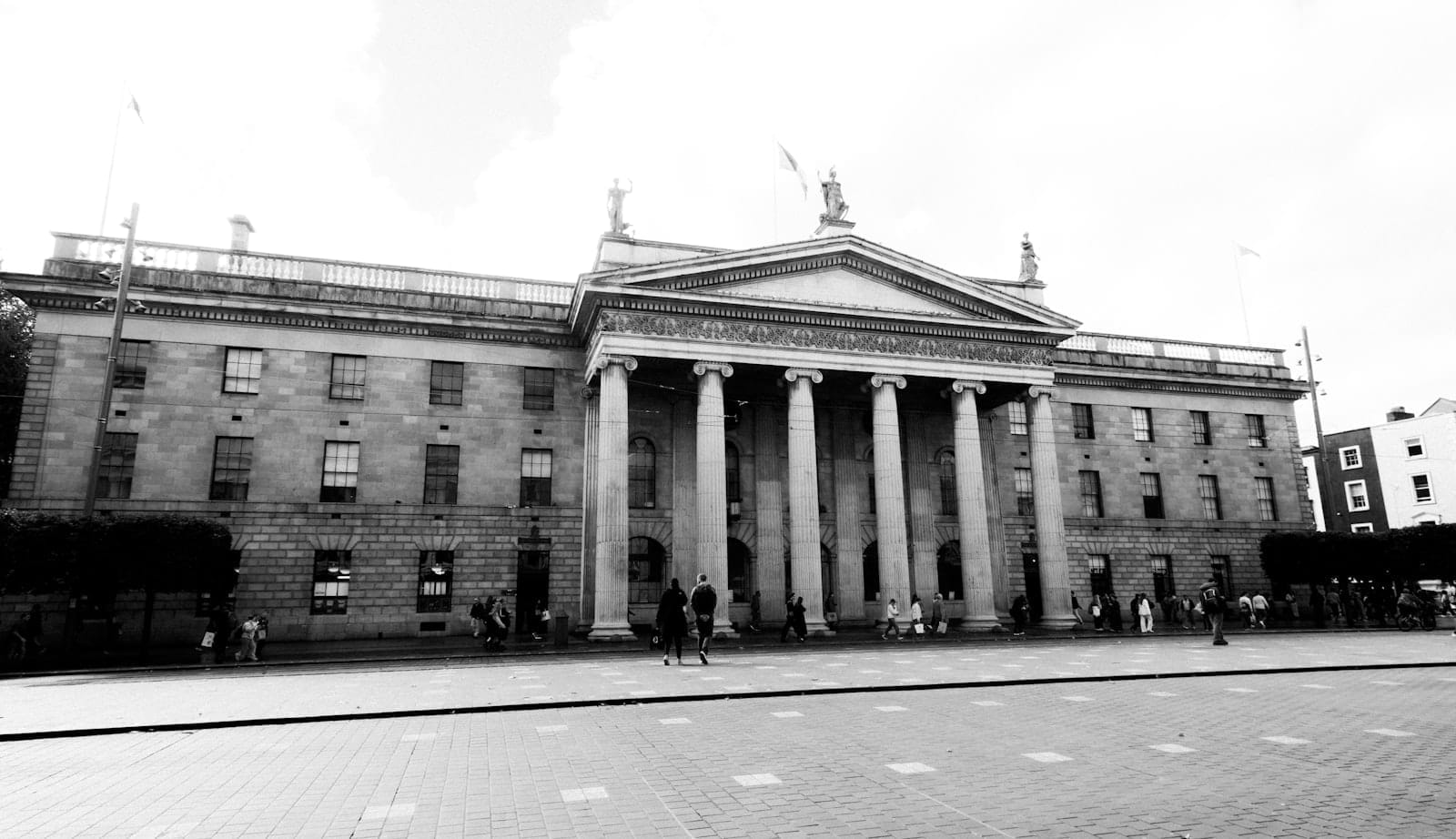
The subject matter is the 1916 Easter Rising, the armed rebellion in which Irish Volunteers and the Irish Citizen Army seized key buildings across Dublin and proclaimed an Irish Republic. The GPO served as the rebels' headquarters. When British forces shelled and retook the building after six days of fighting, the GPO was gutted by fire. The scars are still visible today: look at the original Ionic columns on the facade and you can see the pockmarks left by rifle and artillery fire more than a century ago.
ℹ️ Good to know
The GPO building is described as one of the oldest operational General Post Offices in the world, having functioned continuously (except during the Rising) since 1818. The working post office still operates on the ground floor alongside the museum entrance.
The Building Before You Enter
O'Connell Street is a wide, monument-lined boulevard that functions as Dublin's central axis, and the GPO sits roughly at its midpoint. The building's Portland stone facade, designed by architect Francis Johnston in the Greek Revival style, runs for approximately 67 metres along the street. When you arrive on a busy weekday morning, the post office counter is already open and there is a quiet hum of people buying stamps and parcels. The museum entrance is accessed through the main GPO lobby, which keeps the experience grounded in the building's present-day function rather than treating it as a sealed-off heritage site.
The original facade survived the 1916 shelling in structural terms, though the interior had to be extensively rebuilt. Looking up at the pediment, you can see the carved figures representing Hibernia, Mercury, and Fidelity, which date to the original construction. This detail is worth noting before you go inside: the exhibition will later reference the proclamation read on these steps on Easter Monday, 24 April 1916, and standing physically beneath that pediment gives the text a weight that no screen can replicate.
Tickets & tours
Hand-picked options from our booking partner. Prices are indicative; availability and final rates are confirmed when you complete your booking.
Exclusive private guided tour through the history of Dublin with a local
From 289 €Instant confirmationFree cancellationDublin Centuries of History Self-Guided Audio Tour
From 15 €Instant confirmationHistoric highlights of Dublin with Trinity College private walking tour
From 315 €Instant confirmationFree cancellationNorth Dublin's historical landmarks walking tour
From 0 €Instant confirmationFree cancellation
Inside the Exhibition: What You Actually Experience
The visitor centre occupies a purpose-built space beneath and behind the main post office hall. The exhibition is chronological and narrative-driven, moving from the political and social conditions of early 20th-century Ireland through the planning of the Rising, the six days of fighting in Easter Week, the executions of the leaders, and the long aftermath that led to Irish independence in 1922. Exhibits combine original artifacts, life-size reconstructions, soundscapes, and film projections.
One of the most effective elements is an immersive audio-visual sequence that recreates the atmosphere inside the GPO during the shelling. The room darkens, the temperature seems to drop, and the sound design conveys the chaos and confinement of those days without sensationalizing the violence. Visitors who have found other Dublin history museums too text-heavy consistently single out this sequence as the point where the Rising became real to them rather than abstract.
Free audio guides are available in six languages: Irish, English, German, French, Italian, and Spanish, subject to availability. If you read quickly and skip the audio, you could move through the exhibition in under an hour, but you would lose a significant part of what the centre does well. The audio content includes first-hand accounts and period recordings that add texture the panels alone cannot provide. Budget at least 90 minutes, or two hours if you are genuinely engaged with the period.
💡 Local tip
Ask for an audio guide in Irish if you have any knowledge of the language. The Irish-language narration uses a register that echoes the proclamations of the period and adds an extra layer of historical authenticity to the experience.
How the Experience Changes by Time of Day
The museum is almost always quieter in the first hour after opening. Arriving at 10:00 on a Tuesday or Wednesday typically means you will move through the early galleries without crowds, which matters because some of the key artifact cases and audio stations work best when you are the only person standing in front of them. Tour groups from Dublin's hop-on hop-off buses tend to arrive late morning, clustering around 11:30 to 12:30, so if you arrive at opening and move at a steady pace, you will likely exit before the main wave arrives.
Weekday afternoons are manageable, but the final admission is at 16:00, and visitors arriving at that time sometimes feel rushed through the later galleries. Saturday mornings attract a mix of domestic and international visitors and are generally busier than weekdays. The museum is closed on Sundays and on public holidays, including Christmas Eve. Always confirm current opening hours directly on the official website before visiting, as hours can vary around public holidays.
Practical Walkthrough: Getting There, Tickets, and Accessibility
O'Connell Street is easy to reach from most parts of central Dublin. The Luas Red Line stops at Abbey Street, roughly a three-minute walk south along the street, and at Jervis, roughly five minutes in the other direction. Numerous Dublin Bus routes stop directly on O'Connell Street. If you are staying near Grafton Street or St Stephen's Green, the walk across the Ha'penny Bridge and up O'Connell Street takes about 12 to 15 minutes and passes several landmarks worth noting for later.
Tickets are purchased inside the GPO. Current pricing: adults €15, seniors (65+) and students €13, ages 14–17 €12, ages 6–13 €7.50, under-5s free, family tickets (2 adults, 2 children) €40, and a larger family option (2 adults, 4 children) at €45. Prices are subject to change and should be confirmed on the official website before your visit.
Accessibility is reasonably well handled. A lift provides access to the lower exhibition level, and accessible toilet facilities are available. The audio guide format means visitors with visual impairments can engage meaningfully with the content, and the immersive sound and video elements work well across different abilities. The main O'Connell Street entrance has a flat threshold.
Historical Weight: Why This Building Matters
To understand why the GPO Witness History Visitor Centre carries a significance that most city museums cannot match, it helps to understand that this is not a building that commemorates something that happened elsewhere. The events being described took place in the rooms around you. Fourteen of the Rising's leaders were executed by British firing squad in Kilmainham Gaol within weeks of the surrender, and public sentiment in Ireland shifted dramatically in response to those executions, building the political momentum that led to the War of Independence. If you want to follow that thread, Kilmainham Gaol is the natural second stop on the same day.
The 1916 Rising also has a complicated relationship with Irish cultural identity that the exhibition handles with reasonable evenhandedness. It acknowledges civilian casualties and the destruction of much of O'Connell Street, and it contextualizes the proclamation's language within broader debates about nationalism, suffrage, and social equality. For visitors curious about how Ireland remembers this period more broadly, the Garden of Remembrance is a short walk north on Parnell Square and provides a quieter, more contemplative counterpoint.
Photography, Limitations, and Who Might Not Enjoy This
Photography is generally permitted inside the exhibition, though flash photography near sensitive artifacts is discouraged. The immersive film sequences are dark and not easy to photograph meaningfully anyway. The main post office hall and the exterior columns photograph well at any time of day, though the facade faces west and catches better light in the afternoon.
The exhibition is text-intensive in its first third, which can be a challenge for younger children or visitors with limited English who are relying on the audio guide alone. The museum is worth the admission price for adults with a genuine interest in Irish history, but visitors who are primarily looking for a quick landmark photo or who find 20th-century political history dry will likely find it less compelling than the interactive experiences at, for example, the Guinness Storehouse. The experience rewards engagement: the more you bring to it, the more you take away.
⚠️ What to skip
The museum is closed on Sundays and on public holidays, including Christmas Eve. It does not feature in all hop-on hop-off itineraries, so check in advance if you are relying on a tour bus schedule.
Insider Tips
- After exiting the museum, walk back through the main post office hall and look at the floor. The original counter layout has been retained and the working post office is architecturally continuous with the 1916-era space, which most visitors walk through without registering.
- The bullet holes and shell damage on the exterior columns are most clearly visible on the columns to the left of the main entrance when facing the building. Afternoon light makes them easier to photograph.
- If you are visiting around the Easter weekend, be aware that the GPO area hosts public commemorations that can draw large crowds. The museum experience itself is not necessarily better or worse during this period, but the surrounding streets will be significantly more crowded.
- Combine this visit with Kilmainham Gaol on the same day for a thematically complete picture of the Rising and its aftermath. Book Kilmainham in advance as it sells out, especially in summer.
- The exhibition's final section on the decades after 1916 is often overlooked by visitors who slow down in the Easter Week galleries. It covers the War of Independence and the Civil War with an honesty that makes it worth the time.
Who Is GPO Witness History Visitor Centre For?
- First-time visitors to Dublin who want grounding in modern Irish history before exploring the rest of the city
- History enthusiasts and students with an interest in 20th-century nationalism and independence movements
- Families with children aged 10 and above who can engage with narrative-driven multimedia exhibits
- Travelers combining the visit with Kilmainham Gaol and the Garden of Remembrance for a dedicated 1916 day
- International visitors from countries with their own histories of colonial independence who want comparative context
Nearby Attractions
Combine your visit with:
- Abbey Theatre
Founded in 1904 by W.B. Yeats and Lady Gregory, the Abbey Theatre is Ireland's National Theatre and one of the most historically significant stages in the English-speaking world. Sitting on Lower Abbey Street in the heart of Dublin city centre, it continues to produce new Irish work alongside classic plays that shaped a nation's identity.
- Blessington Street Basin
Once the Royal George Reservoir supplying water to Dublin's north side, Blessington Street Basin is now a free public park in Phibsborough. The central lake, Tudor gate lodge, and resident wildfowl make it one of the most quietly rewarding green spaces within walking distance of Dublin city centre.
- Casino Marino
Casino Marino is an 18th-century Neo-Classical pleasure house in north Dublin, designed by Sir William Chambers for the Earl of Charlemont. Despite its compact exterior, the building conceals 16 rooms across three floors — a feat of architectural illusion that continues to astonish visitors. Access is by guided tour only, with admission from €3 for children and students and €5 for adults.
- Clontarf Promenade
Clontarf Promenade stretches 4.5 kilometres along Dublin Bay from Fairview to the Bull Wall at Dollymount, offering open sea views, public art, and a marked cycle route along much of its length. It costs nothing to visit, runs along a flat sea wall path, and delivers some of the most expansive coastal scenery accessible from Dublin city centre.