Blessington Street Basin: Dublin's Quiet Reservoir Park
Once the Royal George Reservoir supplying water to Dublin's north side, Blessington Street Basin is now a free public park in Phibsborough. The central lake, Tudor gate lodge, and resident wildfowl make it one of the most quietly rewarding green spaces within walking distance of Dublin city centre.
Quick Facts
- Location
- Blessington Street, Phibsborough, Dublin 7
- Getting There
- Approx. 15-min walk from Upper O'Connell Street; several Dublin Bus routes serve Dorset Street nearby
- Time Needed
- 30–60 minutes
- Cost
- Free entry
- Best for
- Quiet walks, local birdwatching, escaping the city-centre crowds
What Is Blessington Street Basin?
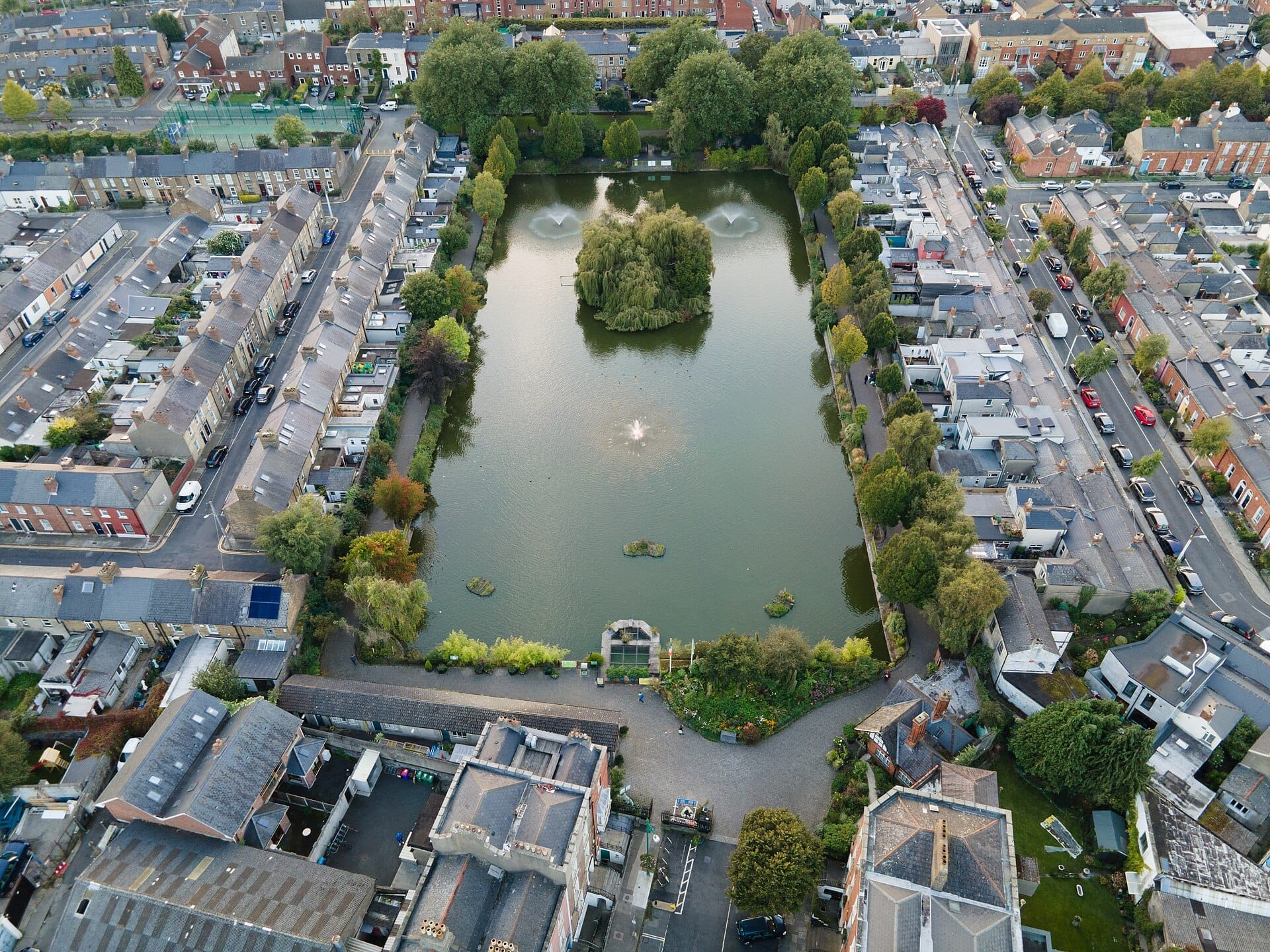
Blessington Street Basin is a walled public park in Phibsborough, Dublin 7, built around a large freshwater lake that was originally constructed in 1810 as the Royal George Reservoir. For most of the 19th century it supplied drinking water to Dublin's north side. After domestic supply ended around 1885, it continued serving Powers and Jameson distilleries until the 1970s. The reservoir could hold approximately 4 million gallons (around 15 million litres) of water at capacity — a fact that gives the perfectly rectangular lake its unusually sharp, almost architectural quality.
The site was refurbished and reopened as a public park in 1994. Today it is managed by Dublin City Council and offers free entry year-round. Despite sitting less than a kilometre from the top of O'Connell Street, it draws almost no tourist traffic — the visitors here are overwhelmingly local: Phibsborough residents walking dogs, office workers eating lunch on a bench, parents with young children watching the ducks.
ℹ️ Good to know
Opening hours: 10:00 daily year-round. Closing times vary seasonally, from as early as 17:00 in winter to as late as 22:00 in summer. Always check current times on Dublin City Council's website before visiting.
The Walk Around the Water
The park is compact — most visitors complete a full circuit of the lake in under 20 minutes — but the pace here is deliberately slow. A gravel and paved path follows the perimeter of the water, lined with mature trees whose roots have lifted sections of the path into gentle ridges. Benches face inward toward the lake, and the surrounding walls of red brick cut off most of the street noise within about 30 metres of the entrance gates.
The lake surface is where your attention settles. Moorhens and mallards are year-round residents, and in quieter early-morning visits you may notice coots nesting near the reedy margins. Swans appear occasionally. The water is still rather than flowing, and on calm days it mirrors the sky almost perfectly — at midday in summer, the reflection of clouds against the dark water is one of the more visually satisfying moments this park offers.
On the western edge of the park, a community garden and outdoor gym occupy a separate fenced area, and a small games section is available for younger children. These additions give the park a practical, neighbourhood-service character that distinguishes it from Dublin's more ceremonial green spaces.
Tickets & tours
Hand-picked options from our booking partner. Prices are indicative; availability and final rates are confirmed when you complete your booking.
Giant's Causeway, Dark Hedges, and Belfast Tour from Dublin
From 85 €Instant confirmationFree cancellationDublin self-guided audio tour
From 10 €Instant confirmationBird of Prey, Cliffs of Moher and Aillwee Cave from Dublin
From 201 €Instant confirmationFree cancellationGame of Thrones Studio tour with return transfer from Dublin
From 63 €Instant confirmationFree cancellation
The Gate Lodge and Architecture
The entrance from Blessington Street is framed by iron gates, and immediately to the right sits the gate lodge, built in 1811 in a Tudor-revival style that was fashionable for civic infrastructure at the time. The small cottage, with its gabled roofline and rough-cut stonework, sits incongruously against the red-brick terraces of Phibsborough — a reminder that this was once a significant piece of urban engineering, not a garden. It is not open to the public, but it photographs well from the path.
The basin's industrial origins place it in a particular tradition of Georgian and Regency-era Dublin infrastructure that is easy to overlook in favour of the city's more celebrated Georgian architecture. If that period interests you, the Georgian Dublin architecture guide provides useful context for understanding the city's 18th and 19th-century building programme, of which the Royal George Reservoir was a functional part.
How It Changes Through the Day
Early morning, roughly 10:00 to 11:00, is when the park is at its most atmospheric. The gates have just opened, the dog-walkers arrive first, and the light on the water is low and directional. The birds are most active in this window, feeding near the edges of the lake. Sound carries differently here in the morning: the cooing of wood pigeons, the soft knock of a gate, the occasional clatter of traffic on Dorset Street filtering over the walls.
Midday on a dry weekday brings a modest lunchtime crowd from local offices and the Phibsborough neighbourhood. Benches fill up but rarely overcrowd — the park simply does not attract the volume of visitors that Merrion Square or St Stephen's Green handle daily. Afternoons in summer extend into long golden light that catches the water at a low angle from the west, which is worth timing if you have flexibility.
Winter visits are shorter by necessity: early closing times mean the park often shuts well before dark in the core winter months. But winter mornings after frost are particularly clean here, the bare trees reflected in dark still water, the brick walls holding the cold in a way that feels deliberate. Dress for it.
Getting Here and Getting Around
The walk from Upper O'Connell Street takes approximately 15 minutes on foot, heading north along Parnell Square, then north on North Frederick Street as it becomes Blessington Street. You cross Dorset Street before reaching the iron entrance gates on the right. The route is straightforward and largely flat.
Multiple Dublin Bus routes serve Dorset Street and the surrounding Phibsborough area, making this an easy addition to a broader north Dublin itinerary. If you're planning a full day on the northside, it pairs naturally with a visit to the National Botanic Gardens in Glasnevin, roughly 20 minutes further north by bus. The Garden of Remembrance at Parnell Square is on the walking route between O'Connell Street and the basin, and worth pausing at on the way.
There is no dedicated car park at the basin. Street parking is available on surrounding residential streets, subject to Dublin City Council restrictions. For visitors combining several north Dublin attractions in one day, the most practical approach is to walk or use public transport.
💡 Local tip
Photography tip: The best reflections appear on calm, overcast mornings when wind is low. Position yourself on the south bank and shoot toward the north wall for the cleanest water-mirror effect. Midday summer sun can bleach the image; early morning or late afternoon light gives the water its most interesting colour.
Accessibility and Practicalities
The main path around the basin is largely level and suitable for pushchairs and mobility aids, though some sections have uneven paving where tree roots have shifted the ground. The community garden and games area include mixed surfaces. There are benches distributed around the park. No specific toilet facilities are mentioned in official Dublin City Council information, so plan accordingly before arriving. Visitors needing detailed accessibility information should contact Dublin City Council directly via the official park page.
If you're building a full itinerary for the day, the free things to do in Dublin guide lists other no-cost green spaces and attractions across the city, several of which can be paired with a visit to the basin on the same morning.
Is It Worth Your Time?
For a first-time visitor with three days in Dublin, this park probably does not make the cut over the Book of Kells, Kilmainham Gaol, or a walk along the Grand Canal. It is not a spectacle. There is no interpretive centre, no cafe, no gift shop. The historical significance is real but modest, and the park itself is small.
For a returning visitor, or someone spending a week or more in the city, it offers something Dublin's headline attractions cannot: genuine quiet, a working neighbourhood feeling, and a piece of the city's infrastructure history that most tourists never find. Pair it with the Smithfield Square area to the south for a longer half-day on foot through north Dublin's less-visited streets.
⚠️ What to skip
Who should skip this: If you have limited time in Dublin and are prioritising major historical or cultural attractions, Blessington Street Basin is not a priority. It also offers very little in heavy rain — the park has no covered shelter, and the experience relies entirely on the outdoor environment.
Insider Tips
- Arrive within the first 30 minutes of opening (10:00) for the calmest water and most active birdlife. By 11:30 on a dry day, dog-walkers and residents have already circulated through and the atmosphere shifts.
- The entrance gate from Blessington Street is the main and most practical access point. The iron gates and gate lodge make for a more interesting arrival than approaching from the back lanes.
- In summer, the trees on the north bank cast shade over the benches from mid-afternoon onward — useful if you want to sit for a while without direct sun.
- The community garden area at the western end of the park is a separate fenced section maintained by local volunteers. It changes seasonally and is worth looking at even from the perimeter path.
- Cross Dorset Street a minute before the basin entrance and look back south toward the city: the flat streetscape of Georgian brick terraces gives a sense of how continuous and uniform this neighbourhood's 19th-century development was.
Who Is Blessington Street Basin For?
- Returning visitors to Dublin who have covered the major attractions and want to explore residential neighbourhoods
- Photographers looking for calm water reflections and minimal crowds in an urban setting
- Walkers building a northside Dublin loop that takes in Phibsborough, Glasnevin, and the city centre
- Families with young children wanting a relaxed, safe green space without entry fees
- Anyone interested in Dublin's 19th-century civic infrastructure and industrial history
Nearby Attractions
Combine your visit with:
- Abbey Theatre
Founded in 1904 by W.B. Yeats and Lady Gregory, the Abbey Theatre is Ireland's National Theatre and one of the most historically significant stages in the English-speaking world. Sitting on Lower Abbey Street in the heart of Dublin city centre, it continues to produce new Irish work alongside classic plays that shaped a nation's identity.
- Casino Marino
Casino Marino is an 18th-century Neo-Classical pleasure house in north Dublin, designed by Sir William Chambers for the Earl of Charlemont. Despite its compact exterior, the building conceals 16 rooms across three floors — a feat of architectural illusion that continues to astonish visitors. Access is by guided tour only, with admission from €3 for children and students and €5 for adults.
- Clontarf Promenade
Clontarf Promenade stretches 4.5 kilometres along Dublin Bay from Fairview to the Bull Wall at Dollymount, offering open sea views, public art, and a marked cycle route along much of its length. It costs nothing to visit, runs along a flat sea wall path, and delivers some of the most expansive coastal scenery accessible from Dublin city centre.
- Croke Park Stadium & Museum
Croke Park is the 82,300-capacity home of the Gaelic Athletic Association, sitting in Drumcondra just north of Dublin city centre. Beyond match days, the stadium opens for guided tours and houses a museum dedicated to hurling, Gaelic football, and the cultural history that shaped modern Ireland.