Casino Marino: Dublin's Most Surprising Architectural Secret
Casino Marino is an 18th-century Neo-Classical pleasure house in north Dublin, designed by Sir William Chambers for the Earl of Charlemont. Despite its compact exterior, the building conceals 16 rooms across three floors — a feat of architectural illusion that continues to astonish visitors. Access is by guided tour only, with admission from €3 for children and students and €5 for adults.
Quick Facts
- Location
- Cherrymount Crescent, off Malahide Road, Marino, Dublin 3
- Getting There
- Approx. 3 miles north of city centre; accessible by Dublin Bus, car, bicycle, or on foot
- Time Needed
- 1 to 1.5 hours, including guided tour
- Cost
- Adult €5 / Senior & Group €4 / Child & Student €3 / Family €13
- Best for
- Architecture lovers, history enthusiasts, curious visitors who enjoy being genuinely surprised
- Official website
- heritageireland.ie/places-to-visit/casino-marino
What Is Casino Marino?
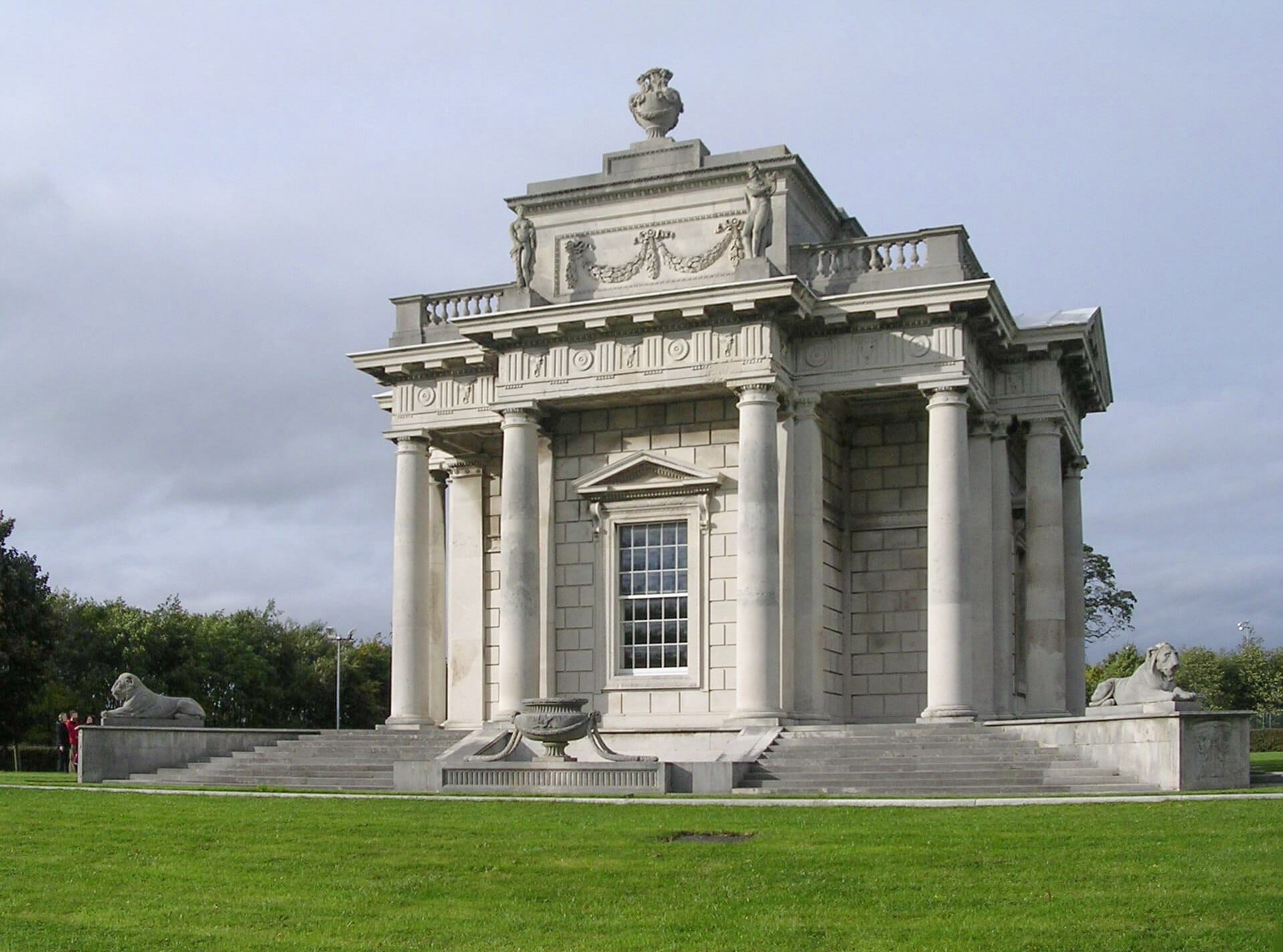
The name tends to mislead people at first. Casino Marino has nothing to do with gambling. In Italian, "casino" simply means "little house" or summer cottage, and that is exactly what the 1st Earl of Charlemont commissioned when he asked the architect Sir William Chambers to design a pleasure house on his estate at Marino, north Dublin, in the late 1750s. The result, completed around 1775, is widely regarded as one of the finest examples of Neo-Classical architecture in Ireland and arguably in Europe.
From the outside, the building reads as a single-storey Greek temple: a precisely proportioned stone structure with Doric columns, urns along the roofline, and a sense of serene restraint. It looks modest, almost small. Inside, it contains 16 rooms spread across three floors. This gap between external appearance and interior reality is not accidental — it is the whole point. Chambers and Charlemont went to extraordinary lengths to conceal the building's true complexity from the outside world.
⚠️ What to skip
Casino Marino is currently listed as closed on the Heritage Ireland website. Check heritageireland.ie for current status and available tour times before planning your visit.
The Architecture: Illusion as Design Philosophy
Sir William Chambers was one of the leading architects of 18th-century Britain, and Casino Marino is considered among his finest works. His challenge was to produce a building that looked like a compact classical pavilion while functioning as a fully equipped private retreat. He solved this through a series of deliberate visual tricks.
The hollow columns, for instance, serve as drainage pipes — rainwater runs down through them rather than via visible gutters, which would have broken the building's clean classical lines. The windows on the upper floor are disguised behind the decorative urns and balustrade, invisible from ground level. The roof, which appears flat from a distance, is actually curved to channel water away. Even the entrance steps are designed to make the building appear lower and wider than it is.
Inside, the craftsmanship is extraordinary. The floors feature inlaid timber parquet, the ceilings carry delicate plasterwork, and the principal rooms are fitted with carved marble fireplaces. The State Room, directly above the entrance vestibule, is the most impressive space: oval in plan with a domed ceiling and tall windows that flood the room with light. Each room is compact but meticulously finished, with no detail treated as unimportant.
For visitors already interested in 18th-century craftsmanship, comparing Casino Marino with the interiors at Dublin Castle gives a useful sense of how different patrons expressed wealth and taste in the same period.
Tickets & tours
Hand-picked options from our booking partner. Prices are indicative; availability and final rates are confirmed when you complete your booking.
Giant's Causeway, Dark Hedges, and Belfast Tour from Dublin
From 85 €Instant confirmationFree cancellationDublin self-guided audio tour
From 10 €Instant confirmationBird of Prey, Cliffs of Moher and Aillwee Cave from Dublin
From 201 €Instant confirmationFree cancellationGame of Thrones Studio tour with return transfer from Dublin
From 63 €Instant confirmationFree cancellation
Historical Context: The Earl of Charlemont and His Estate
James Caulfeild, 1st Earl of Charlemont, was one of the most cultured figures of 18th-century Dublin. He had spent years travelling in Europe, particularly in Italy and Greece, and returned to Ireland with a deep appreciation for classical architecture. Marino was his country estate, and the Casino was conceived as a statement piece: a building that would demonstrate his refinement and connect his Irish property visually and intellectually to the grand tradition of European classicism.
Charlemont was also a significant political figure, serving as commander of the Irish Volunteers and playing a role in the Patriot movement of the 1770s and 1780s. His town house in Dublin, Charlemont House, now forms part of what is today the Dublin City Gallery, The Hugh Lane, on Parnell Square. The Casino and the town house together paint a picture of a man who used architecture as a form of self-expression and civic statement.
The Hugh Lane Gallery, housed in Charlemont's former Parnell Square residence, holds a remarkable collection of Impressionist and modern Irish art. It is worth pairing with a visit to the Casino as part of a day focused on Charlemont's legacy. See the guide to Dublin City Gallery, The Hugh Lane for details.
What to Expect on the Guided Tour
Access to Casino Marino is by guided tour only. When it is open, daily public tours run at 10:00, 12:00, 14:00, and 16:00. Group and school tours run at 11:00, 13:00, and 15:00. Tours last roughly one hour and are led by trained guides from the Office of Public Works, Ireland's state heritage body.
The tour begins outside, where the guide explains the building's exterior geometry and the tricks Chambers used to compress so much space into such a refined shell. You then move inside, progressing through the entrance hall, the basement service rooms, the main principal rooms on the ground floor, and up to the State Room above. The guide covers both the architectural details and the social history: who used these rooms, how, and why a pleasure house of this kind mattered to a man of Charlemont's position.
The interior spaces are small. In some rooms, tour groups of more than eight or ten people fill the space almost completely. This is not a fault — it is a reminder of the building's original intimate scale. The rooms were never meant for large receptions; they were private, personal spaces. The effect is of being allowed into something that was always meant for a very small audience.
💡 Local tip
Book your tour slot in advance during summer months and public holidays. The limited room sizes mean each tour takes a small number of visitors, and popular time slots fill quickly.
Getting There and Practical Considerations
Casino Marino sits on Cherrymount Crescent, off the Malahide Road in Marino, Dublin 3, approximately three miles north of the city centre. Dublin Bus serves the Malahide Road corridor with several routes, making it straightforward to reach from O'Connell Street without a car. The Casino is not signposted in large letters; watch for the heritage brown signs along the Malahide Road.
The site has parking for visitors arriving by car. Cyclists will find the Malahide Road reasonably accessible, and there is secure bike parking at the site. Walking from the city centre is possible along the Royal Canal towpath and through Marino; pleasant on a dry day but not practical in heavy rain.
Accessibility at Casino Marino is limited. The guided tour involves uneven walkways, narrow staircases, and low ceilings in some areas. Heritage Ireland specifically flags challenging access, uneven surfaces, and the need to hold handrails on internal stairs. Only assistance dogs are permitted. Visitors with mobility difficulties should contact Heritage Ireland directly before booking to understand exactly which areas they can access.
If you are planning a broader itinerary around north Dublin, the Casino pairs naturally with the National Botanic Gardens in Glasnevin, roughly 20 minutes away by car or bus, for a half-day that covers both landscape and architecture.
What the Experience Actually Feels Like
Arriving at Casino Marino, particularly on a morning when the stone is dry and the light is coming from the east, the building looks almost too perfect to be real. It sits in a small area of parkland, elevated slightly from the surrounding road, and the formal geometry of the columns and pediment gives it a quality that feels displaced from its Dublin suburban surroundings. There is no queue, no large crowd, no gift shop megastructure. The approach is quiet.
Inside, what stays with most visitors is the contrast. You cross the threshold expecting the interior of a small chapel or entrance hall and instead find a layered, complex sequence of spaces: a tiled vestibule, a circular stairwell, a basement with fully fitted service rooms including a wine cellar, and then the State Room opening above you with its oval shape and morning light. The smell is cool stone and old timber, the particular atmosphere of a building that has been meticulously preserved rather than renovated out of character.
On overcast days, the light inside is dimmer and the rooms feel more intimate, perhaps closer to how they were experienced by candlelight in the 18th century. On bright days, the State Room is the standout: the windows catch the sky and the plasterwork ceiling reads clearly. Photography is possible in most areas but the limited natural light in some rooms means a camera with good low-light performance will serve you better than a phone.
Visitors spending a full day exploring Dublin's architectural and historical heritage might also consider Dublin's Georgian architecture, which provides broader context for the period in which Casino Marino was built.
Who Might Not Enjoy This Attraction
Casino Marino is a specialist interest rather than a mainstream crowd-pleaser. Visitors looking for a large-scale, immersive historical experience with lots of exhibits, interactive elements, or a broad narrative sweep may find an hour-long tour of a single small building unsatisfying. Children under 10 tend to find the tour slow, and the tight interior spaces with strict guidance about not touching surfaces can be frustrating for very young visitors.
The seasonal and tour-only format also means this is not the kind of place you can drop into spontaneously. If you arrive outside tour hours or during a closure period, there is very little to see from outside. Always verify current opening status before making the trip from the city centre.
Insider Tips
- The 10:00 morning tour tends to attract the fewest visitors. If you want the rooms to yourself and a more relaxed pace, book the first slot of the day.
- The basement service rooms, including the original kitchen and wine cellar, are often the most surprising part of the tour for visitors who expected only grand reception spaces. Pay attention to how much operational infrastructure Chambers hid underground.
- The exterior of the building is most photogenic from the south-east corner in morning light, when the columns cast long shadows across the facade. Afternoon light flattens the detail.
- The site is on Heritage Ireland's OPW card scheme, which covers free or reduced entry to a range of Irish heritage sites. If you plan to visit multiple OPW properties during your trip, the heritage card typically pays for itself within two or three visits.
- The Marino area surrounding the Casino contains one of Dublin's most intact examples of a planned Garden City-era housing estate, Marino Estate, built in the 1920s. The short walk through the estate streets after your tour is architecturally interesting in a completely different way.
Who Is Casino Marino For?
- Architecture enthusiasts who want to see Neo-Classical design at its most precise and inventive
- History visitors interested in 18th-century Irish cultural and political life beyond the usual rebellion narratives
- Travellers who prefer quiet, specialist attractions over crowded headline sites
- Photographers looking for a photogenic classical building without the tourist crowds
- Anyone who has already done the major central Dublin attractions and wants something genuinely different
Nearby Attractions
Combine your visit with:
- Abbey Theatre
Founded in 1904 by W.B. Yeats and Lady Gregory, the Abbey Theatre is Ireland's National Theatre and one of the most historically significant stages in the English-speaking world. Sitting on Lower Abbey Street in the heart of Dublin city centre, it continues to produce new Irish work alongside classic plays that shaped a nation's identity.
- Blessington Street Basin
Once the Royal George Reservoir supplying water to Dublin's north side, Blessington Street Basin is now a free public park in Phibsborough. The central lake, Tudor gate lodge, and resident wildfowl make it one of the most quietly rewarding green spaces within walking distance of Dublin city centre.
- Clontarf Promenade
Clontarf Promenade stretches 4.5 kilometres along Dublin Bay from Fairview to the Bull Wall at Dollymount, offering open sea views, public art, and a marked cycle route along much of its length. It costs nothing to visit, runs along a flat sea wall path, and delivers some of the most expansive coastal scenery accessible from Dublin city centre.
- Croke Park Stadium & Museum
Croke Park is the 82,300-capacity home of the Gaelic Athletic Association, sitting in Drumcondra just north of Dublin city centre. Beyond match days, the stadium opens for guided tours and houses a museum dedicated to hurling, Gaelic football, and the cultural history that shaped modern Ireland.