Ha'penny Bridge: Dublin's Most Recognisable Crossing
Standing since 1816, the Ha'penny Bridge is a slender cast-iron arch over the River Liffey that connects Temple Bar on the south bank to Liffey Street on the north. Free to cross at any hour, it offers one of Dublin's most photographed vantage points and a genuine sense of the city's history underfoot.
Quick Facts
- Location
- 60 Wellington Quay, Temple Bar, Dublin — between Merchant's Arch (south) and Liffey Street (north)
- Getting There
- Short walk from any city-centre bus route on the quays; no DART or Luas stop is directly adjacent, but the entire city centre is within 15 minutes on foot
- Time Needed
- 10–20 minutes to cross and linger; allow longer if you plan to photograph at golden hour or explore the quayside
- Cost
- Free — the half-penny toll was abolished in 1919
- Best for
- City walkers, photographers, history enthusiasts, and anyone crossing between Temple Bar and the north city
- Official website
- www.visitdublin.com/ha-penny-bridge
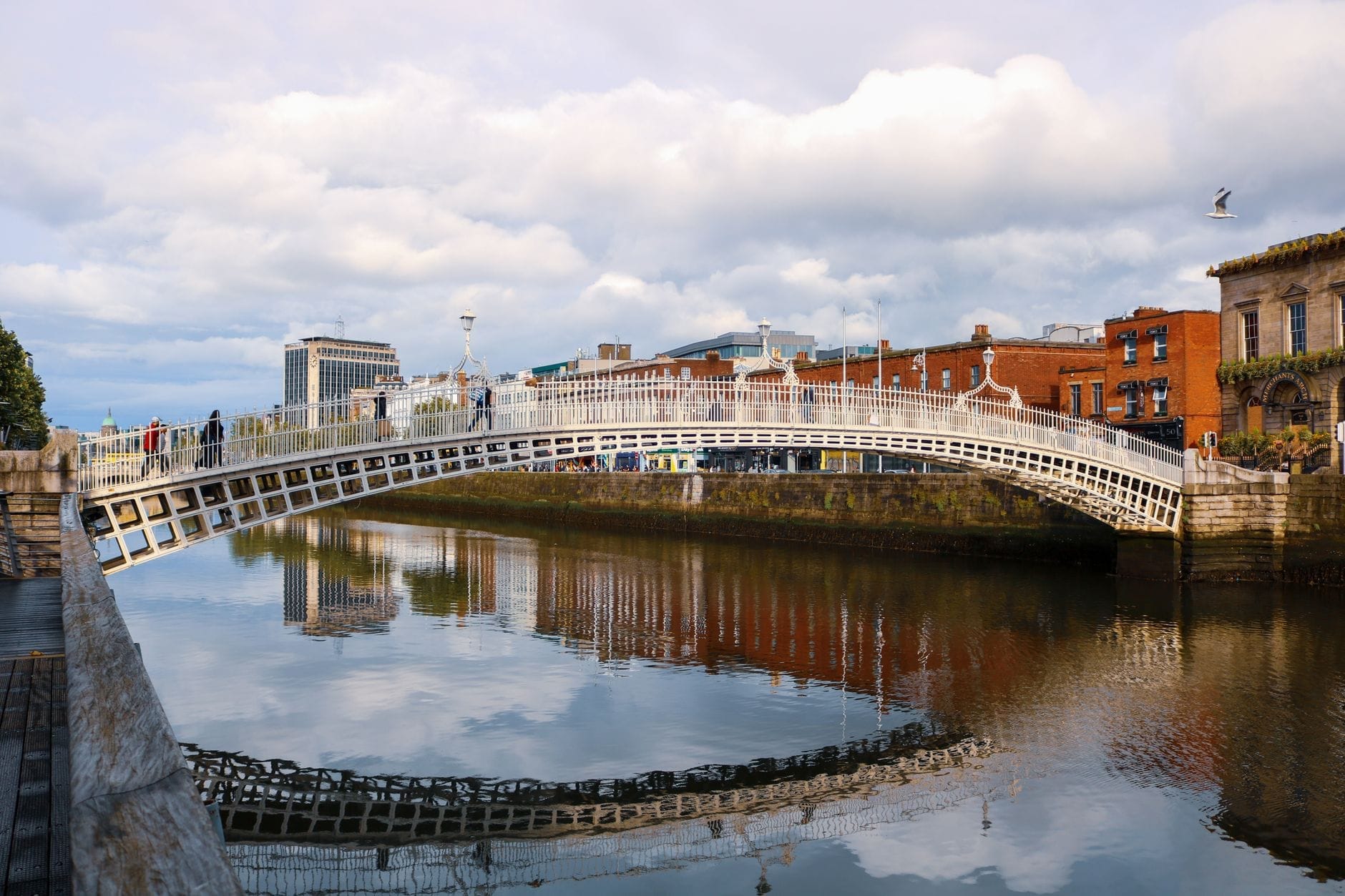
What Is the Ha'penny Bridge?
The Ha'penny Bridge is a single-span pedestrian bridge over the River Liffey in central Dublin, officially named Liffey Bridge (Irish: Droichead na Leathphingine or Droichead na Life) but universally known by the nickname it earned from the half-penny toll once charged to cross it. Constructed of cast iron cast in Shropshire, England, and assembled on site, it opened in May 1816, making it one of the oldest surviving cast-iron bridges in the world. At 43 metres long and about 3.7 metres wide, it is narrow enough that two groups passing in opposite directions must shuffle sideways at busy moments.
It sits at the geographic and symbolic heart of Dublin, linking the cobbled lanes of Temple Bar on the south bank with Liffey Street on the north. That crossing point matters: before this bridge existed, passengers relied on ferrymen who themselves lobbied against its construction, fearing for their livelihoods. The city built it anyway, and the ferrymen's compensation was the toll that gave the bridge its lasting name.
ℹ️ Good to know
The bridge is open at all hours and costs nothing to cross. No ticket, no queue, no booking required — simply walk up the steps from either quay.
History and Architecture
When the bridge opened in 1816 it was called Wellington Bridge, a nod to the Duke of Wellington who was born in Dublin. After Irish independence it was officially renamed Liffey Bridge in 1922, though Dubliners have always preferred the half-penny nickname. The half-penny toll itself was abolished in 1919, so the name outlasted the charge by more than a century.
The ironwork was fabricated by the Coalbrookdale Company in Shropshire, a foundry closely associated with the early industrial revolution in Britain. The sections were shipped to Dublin and bolted together on site. Three ornamental lamp standards rise from the arch, and the white-painted railings feature a delicate repeating pattern that photographs distinctly against the grey Liffey water. The bridge was restored extensively in 2001, stripped back and repainted a lighter shade to reflect its original white appearance, and the lamps were converted to electric fittings that echo the old gas-light style.
The arch itself is shallow and graceful rather than dramatic. From the quayside below you can appreciate the engineering: a single span with no central pier, allowing river traffic to pass freely beneath. From the bridge deck the view downstream toward the Custom House and the Samuel Beckett Bridge, and upstream toward the Four Courts dome, is one of the most compelling urban panoramas Dublin offers at eye level.
Tickets & tours
Hand-picked options from our booking partner. Prices are indicative; availability and final rates are confirmed when you complete your booking.
Bridges of Dublin walking tour
From 28 €Instant confirmationFree cancellationGiant's Causeway, Dark Hedges, and Belfast Tour from Dublin
From 85 €Instant confirmationFree cancellationDublin self-guided audio tour
From 10 €Instant confirmationBird of Prey, Cliffs of Moher and Aillwee Cave from Dublin
From 201 €Instant confirmationFree cancellation
What the Visit Actually Feels Like
The approach from the south comes through Merchant's Arch, a stone passage barely wide enough for two people abreast that leads from Temple Bar's cobbled heart directly to the bridge steps. The arch frames the bridge perfectly before you even reach it. In the evening that tunnel can smell of damp stone and frying food from the surrounding restaurants, and emerging from it onto the bridge feels like stepping onto a stage above the river.
The bridge deck itself is textured cast iron underfoot, worn smooth in the centre where feet have passed for over two centuries. The railings are chest height and solid enough to lean against comfortably while watching the Liffey move beneath you. Seagulls work the water below regardless of the season. On overcast days, which Dublin provides in abundance, the river surface turns pewter-grey and the white ironwork stands out sharply against it.
On the north side you arrive at Liffey Street Lower, which runs directly into Henry Street and the main shopping district north of the river. This makes the bridge genuinely functional, not just decorative. Thousands of Dubliners use it daily as a practical shortcut. If you are exploring the Grafton Street area and want to reach the north city without going around to O'Connell Bridge, the Ha'penny Bridge is the fastest pedestrian route.
How the Experience Changes by Time of Day
Early morning, roughly 7am to 9am, is the most peaceful window. Commuters cross at pace but the bridge is never so crowded that it feels uncomfortable. The Liffey is at its most still, and the lamp standards are sometimes still lit as daylight builds. Photographers who want the bridge to themselves, or close to it, should aim for this window.
By mid-morning the tourist flow builds steadily. Groups stop in the middle to photograph back toward Merchant's Arch or downriver, and the narrow width becomes apparent. Peak hour for foot traffic runs roughly 11am to 6pm on weekends and in summer. It is never impassable, but the stop-and-photograph behaviour of visitors slows the crossing meaningfully during these windows.
Evening is when the bridge earns its reputation as a photogenic landmark. As the quayside lights reflect in the Liffey and the lamp standards glow amber, the ironwork takes on a warmth it lacks during the flat light of midday. The best photography light typically arrives in the 30 to 45 minutes after sunset, when the sky retains enough colour to balance the artificial light. Bring a wide-angle lens or use a phone in portrait mode to capture the arch in full without cropping out the lamp standards.
💡 Local tip
For reflection shots of the bridge in the water, position yourself on the north quay (Bachelors Walk) and shoot back toward Merchant's Arch. The angle from street level captures the arch and its mirror in one frame.
Practical Walkthrough: Getting There and Moving On
The bridge is in Dublin's city centre and walkable from almost every central landmark. From Trinity College it is roughly a 10-minute walk west along Dame Street and then north through Temple Bar. From O'Connell Street on the north bank, walk west along the quays for about 5 minutes. There is no dedicated parking nearby and no reason to drive; the quayside roads are busy and the bridge itself is pedestrian-only.
The surrounding area rewards exploration on foot. On the south side, Merchant's Arch opens into Temple Bar Square, with the Temple Bar pub and a cluster of independent shops a short walk away. On the north side, the Custom House is a 10-minute walk east along the quays, and The Spire on O'Connell Street is roughly the same distance north.
Accessibility note: the bridge has steps on both approaches and no ramp alternative. The structure dates to 1816 and has not been retrofitted with step-free access. Visitors who use wheelchairs or pushchairs should use O'Connell Bridge or the Millennium Bridge, both of which are flat and accessible.
⚠️ What to skip
The bridge is 3.66 metres wide. In peak summer and at weekends, groups stopping to photograph can create a genuine bottleneck. If you are in a hurry or travelling with young children, crossing at off-peak hours is significantly easier.
Is It Worth Your Time?
For most visitors to Dublin, yes, with a clear-eyed understanding of what it is. The Ha'penny Bridge is a beautiful piece of industrial-era ironwork in a central location, and crossing it gives a real sense of the city's layers of history. It takes less than five minutes to cross and requires no planning. If you are already in Temple Bar or walking the quays, there is no reason not to include it.
That said, it is a bridge, not a museum or a view tower. The experience is the crossing itself and the views along the river from the arch. If you are combining it with a walking tour of Dublin's city centre or planning a full day around the quaysides, it fits naturally into the route. If you are making a special trip across the city solely to see the bridge, temper your expectations accordingly.
Travellers who are sensitive to crowds and discomfort in tight spaces may find the bridge frustrating at peak times. The narrowness is inherent to the original design and will not change. Those expecting sweeping panoramas should note that the river views from the bridge are pleasant but limited in scope, the bridge deck sits quite close to water level, and the surrounding buildings are not dramatic. The charm is in the detail and the history, not the scale.
Insider Tips
- The best unobstructed photograph of the bridge itself is taken from the north quay (Bachelors Walk), standing back about 20 metres from the bridge approach. From here the full arch, lamp standards, and Merchant's Arch beyond are visible in a single frame.
- Merchant's Arch on the south side is worth pausing in. The stone vaulted passage connects the bridge directly to Temple Bar and contains a small second-hand book stall most days. It is one of the few covered passages in the old city and often overlooked by visitors heading straight to the bridge.
- The bridge is at its least crowded on weekday mornings before 9am and on winter weekend mornings before 10am. If you want to stand in the middle and photograph downriver without negotiating around tour groups, arrive early.
- Looking downstream (east) from the bridge on a clear day, you can see the dome of the Custom House and, further, the cables of the Samuel Beckett Bridge. Looking upstream (west), the Four Courts dome is visible. Both directions offer a natural orientation to Dublin's riverside landmarks.
- The 2001 restoration returned the bridge to a lighter shade of white reflecting its original colour. It had previously been painted in darker tones over the decades. The current white finish is historically accurate to the early 19th-century appearance.
Who Is Ha'penny Bridge For?
- City walkers moving between Temple Bar and the north city who want a more characterful route than O'Connell Bridge
- Photographers targeting the classic Dublin riverside shot, particularly around sunset
- History and architecture enthusiasts interested in early 19th-century cast-iron engineering
- First-time visitors to Dublin wanting a quick, tangible connection to the city's past without buying a ticket
- Travellers building a self-guided quayside walk linking the Custom House, Four Courts, and Temple Bar
Nearby Attractions
Other things to see while in Temple Bar:
- Chester Beatty Library
Housed within the grounds of Dublin Castle, the Chester Beatty Library holds one of the finest collections of manuscripts, rare books, and decorative arts in the world, spanning cultures from ancient Egypt to imperial Japan. Entry is normally free, but the museum is closed to the public from 15 June through December 2026 for Ireland's EU Council Presidency. Check chesterbeatty.ie before visiting.
- Dublin Castle
Dublin Castle stood at the centre of British rule in Ireland from 1204 until 1922, when Michael Collins accepted the handover of power in its courtyard. The State Apartments, Gothic Chapel Royal, and underground Viking excavations are normally open to visitors off Dame Street, but the entire campus is closed to the public from 15 June through December 2026 for Ireland's EU Council Presidency. Check dublincastle.ie before planning a visit.
- The Temple Bar Pub
With its crimson facade, wall-to-wall whiskey bottles, and live Irish music running through the day and into the early hours, The Temple Bar Pub is the pub most visitors picture when they think of Dublin. Whether that's a reason to go or a reason to look elsewhere depends on what you want from a night out.