The Spire of Dublin: What to See, Know, and Expect at the Monument of Light
Standing 120 metres tall on O'Connell Street, the Spire of Dublin is the city's most visible landmark and costs nothing to visit. This guide covers its history, how it looks at different times of day, how to get there, and whether it's worth your time.
Quick Facts
- Location
- O'Connell Street Upper, Dublin 1 (central reservation)
- Getting There
- Abbey Street Luas stop (Red Line); multiple Dublin Bus routes on O'Connell Street; Connolly Station a short walk east
- Time Needed
- 15–30 minutes to view and photograph; can combine with wider O'Connell Street walk
- Cost
- Free – public monument in a public street
- Best for
- Architecture, photography, orientation, first-time visitors
- Official website
- www.visitdublin.com/the-spire
What Is the Spire of Dublin?
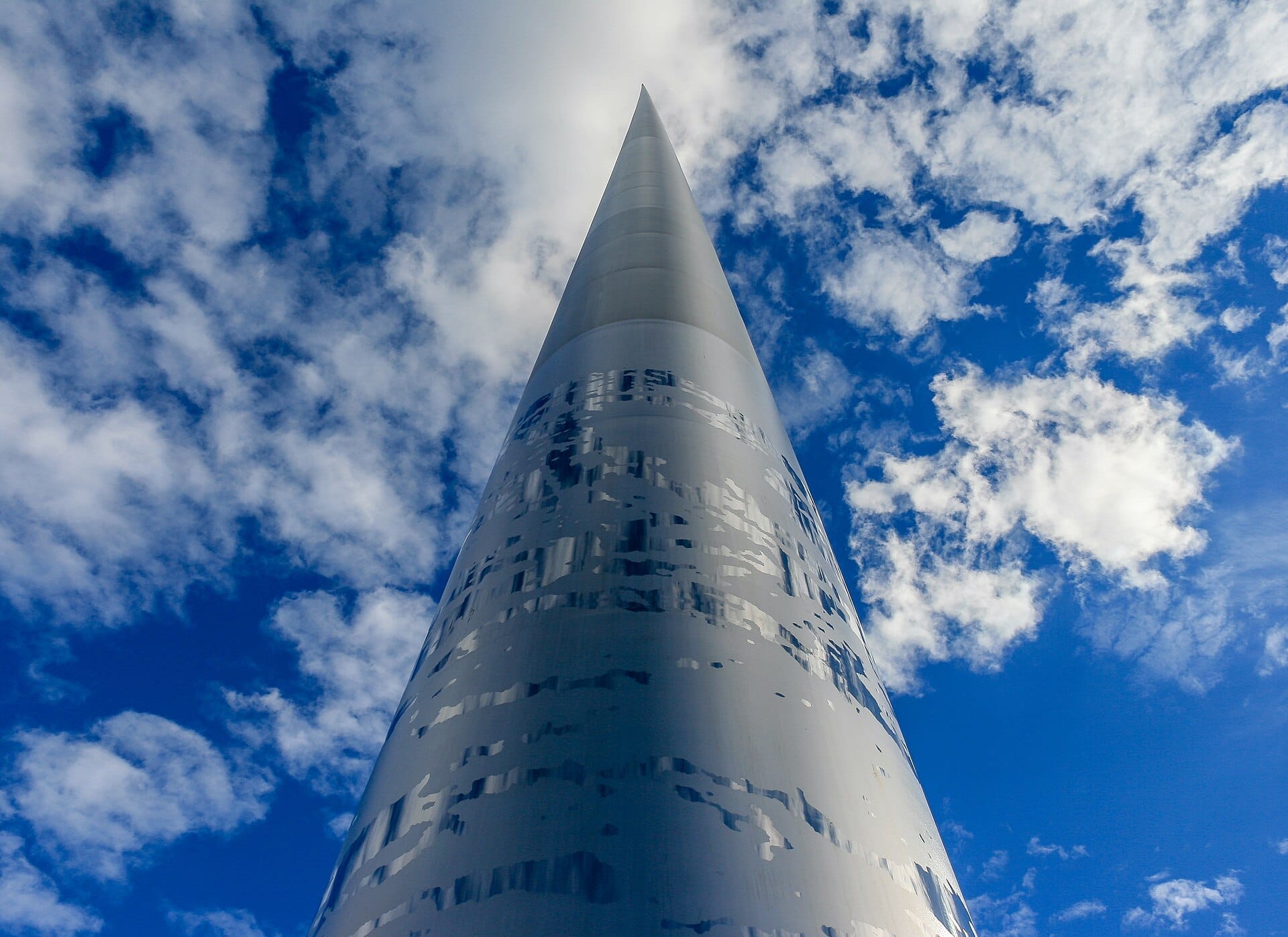
The Spire of Dublin, officially named the Monument of Light (An Túr Solais in Irish), is a 120-metre stainless steel pin rising from the central reservation of O'Connell Street in Dublin city centre. It is a prominent modern sculpture in Ireland. Its base diameter is 3 metres, and it tapers to roughly 15 centimetres at the apex, giving it a needle-like silhouette that is visible from across the city on clear days.
The monument is a public artwork in a public street. There is no entrance, no viewing platform, and no ticket booth. You simply walk up to it, look up, and decide what you think. That directness is either its strength or its weakness depending on what you came expecting.
ℹ️ Good to know
The Spire is free and accessible 24 hours a day, every day of the year. No booking, no tickets, no queues.
History and Context: Why Is There a Giant Spike on O'Connell Street?
The Spire stands on the site of Nelson's Pillar, a column erected in 1809 to commemorate Admiral Horatio Nelson. The pillar was a controversial presence on a Dublin thoroughfare already laden with political symbolism: O'Connell Street is named for Daniel O'Connell, the 19th-century Irish nationalist leader, and sits close to the General Post Office (GPO), the focal point of the 1916 Easter Rising. Nelson's Pillar was destroyed by a bomb in March 1966, during the 50th anniversary commemorations of the Rising, and the stump was demolished by the Irish Army shortly after.
The site sat without a permanent replacement for decades. In 1999, Dublin Corporation commissioned an international design competition for a major new monument on O'Connell Street. The winning design came from London-based architect Ian Ritchie, whose firm Ritchie Studio conceived the elongated stainless steel cone as a symbol of Ireland's ambitions at the start of a new century. Construction began in 2002; the first section was installed on 18 December 2002, and the final section completed the structure on 21 January 2003.
The choice of an abstract form rather than a figurative statue was deliberate, and not without debate. It avoided the question of whose image should mark Ireland's capital at the turn of the millennium. For a broader sense of how Dublin's public monuments reflect the city's layered history, the Garden of Remembrance a few minutes' walk north offers a contrasting, deeply figurative approach to national commemoration.
Tickets & tours
Hand-picked options from our booking partner. Prices are indicative; availability and final rates are confirmed when you complete your booking.
Gin or vodka making with spirit tasting and cocktail masterclass
From 130 €Instant confirmationFree cancellationGiant's Causeway, Dark Hedges, and Belfast Tour from Dublin
From 85 €Instant confirmationFree cancellationDublin self-guided audio tour
From 10 €Instant confirmationBird of Prey, Cliffs of Moher and Aillwee Cave from Dublin
From 201 €Instant confirmationFree cancellation
What It Actually Looks Like Up Close
From a distance, the Spire reads as a clean vertical line against the sky. Up close, the material changes the experience entirely. The stainless steel surface has a finely brushed texture at the base, cool and slightly reflective to the touch on overcast days. On sunny mornings the lower sections pick up the pale Dublin light and scatter it in a low shimmer. The seams between the eight steel sections are subtle but visible if you are looking for them, giving the structure a quietly industrial quality that photographs tend to soften.
Standing directly beneath it and looking up is disorienting in a way that repays the few seconds it takes. The taper is so gradual and the height so extreme that the apex appears to dissolve rather than terminate. On days with fast-moving cloud cover, the upper third appears to sway slightly against the sky, though the structure itself is fixed. On windy days you can sometimes hear a faint resonance from the steel, a low, almost subsonic hum that pedestrians walking past rarely notice.
Time of Day: How the Experience Changes
Early morning, before the city fully wakes, is the most rewarding time to visit if photography is your goal. O'Connell Street empties enough by around 7am that you can photograph the Spire from the southern end of the street with the GPO in the mid-ground and little pedestrian interference. The light from the east, coming across the Liffey, catches the steel at a low angle and gives the surface a warmer tone than you get at midday.
By mid-morning the street fills with commuters, delivery vehicles, and Dublin Bus routes, and the Spire becomes a meeting point and a backdrop rather than a focal object. Groups gather at its base throughout the afternoon. The base functions informally as one of Dublin's default rendezvous spots, on a par with the Molly Malone statue further south.
After dark the Spire is illuminated, and the effect is distinct from the daytime version. The upper sections catch the city's ambient light and glow faintly against the sky, while the base glows more strongly under the street lighting. It is worth seeing at night even if only briefly, particularly on a clear night when the tip is visible against a dark sky. During major events on O'Connell Street the Spire is sometimes colour-lit to mark occasions.
💡 Local tip
For the cleanest daytime photograph, stand at the southern end of O'Connell Street Lower and shoot north. You get the full height of the Spire with the neoclassical facade of the GPO to the left and the street's Georgian scale on both sides.
Getting There and Getting Around
The Spire sits on O'Connell Street Upper, Dublin 1, in the heart of the city centre. It is reachable on foot from almost every part of the inner city in under 20 minutes. The Abbey Street Luas stop (Red Line) is the closest tram stop, roughly two minutes' walk from the monument. Connolly Station, serving DART coastal rail and mainline intercity trains, is a 7-10 minute walk east. Multiple Dublin Bus routes run along O'Connell Street itself.
If you are planning a wider walking tour of Dublin's main landmarks, the Spire pairs naturally with the GPO Witness History exhibition directly across the street, which tells the story of the 1916 Easter Rising from inside the building that was its headquarters. The two stops together take under two hours.
Accessibility is not an issue here. The central reservation of O'Connell Street is at street level, with pedestrian crossings on both sides. There is no step, barrier, or entrance to navigate. The monument is purely external, so there is nothing to enter or climb.
Is the Spire Worth Your Time? An Honest Assessment
The Spire divides opinion among visitors and Dubliners alike, and has done since it was erected. It has accumulated a string of affectionate and unflattering nicknames over the years, among them the Stiletto in the Ghetto, the Stiffy by the Liffey, and the Pin in the Bin. These names reflect a genuine ambivalence: the structure is abstract, offers nothing to do or see beyond its own form, and sits on a street that, depending on the day, can feel worn and commercially chaotic.
That said, as a piece of public sculpture it is genuinely impressive in scale and more interesting in person than in photographs. If you are already walking O'Connell Street, which most visitors to Dublin city centre will do, the Spire costs you nothing in time or money. As a standalone destination, it is harder to justify more than 15 minutes.
Visitors who want a fuller understanding of what O'Connell Street represents in Irish history will get significantly more from the GPO Witness History exhibition across the road, or from the Kilmainham Gaol in the west of the city. The Spire is a landmark, not an experience in the curatorial sense.
⚠️ What to skip
O'Connell Street can be busy with traffic and pedestrians throughout the day. Watch for cyclists in the bus lane when crossing to the central reservation, especially during peak commute hours.
Photography Tips
The Spire's height creates challenges for standard smartphone cameras, which tend to produce barrel distortion when pointed straight up. A wide-angle lens handles the extreme vertical better. The most flattering angle is from 50-100 metres south, at street level, using the architecture of O'Connell Street as a frame. Avoid midday in summer when the steel reflects white and loses texture.
If you want a longer photography walk through Dublin's landmarks and monuments, the Dublin walking tours guide covers several self-guided routes that pass the Spire and continue to other photogenic city-centre locations.
Insider Tips
- Stand directly underneath the Spire and look straight up for about 30 seconds. The taper and height create a genuinely vertiginous effect that photographs cannot replicate. Most visitors walk past without doing this.
- On windy days, listen at the base for the low resonance the steel produces. It is more audible when traffic on O'Connell Street is light, typically early morning or Sunday.
- The Spire is a useful city-centre orientation marker. It is tall enough to be visible from many parts of Dublin's north inner city, and using it as a compass point helps you navigate without checking your phone constantly.
- The base of the Spire is an informal meeting point for locals and is busiest at weekday lunchtimes. If you are meeting someone there, specify which side of the central reservation, as the base is wider than it looks from a distance.
- For the best night photograph, come on a clear weeknight rather than a weekend, when O'Connell Street traffic and pedestrian flow are lighter and the street lighting creates a cleaner reflection on the steel.
Who Is The Spire (Monument of Light) For?
- First-time visitors to Dublin wanting to orient themselves on O'Connell Street
- Architecture and design enthusiasts interested in contemporary public sculpture
- Photographers seeking Dublin's most dramatic vertical subject
- Travellers combining a visit with the GPO Witness History exhibition across the street
- Anyone on a tight budget: the Spire is completely free and takes no advance planning
Nearby Attractions
Combine your visit with:
- Abbey Theatre
Founded in 1904 by W.B. Yeats and Lady Gregory, the Abbey Theatre is Ireland's National Theatre and one of the most historically significant stages in the English-speaking world. Sitting on Lower Abbey Street in the heart of Dublin city centre, it continues to produce new Irish work alongside classic plays that shaped a nation's identity.
- Blessington Street Basin
Once the Royal George Reservoir supplying water to Dublin's north side, Blessington Street Basin is now a free public park in Phibsborough. The central lake, Tudor gate lodge, and resident wildfowl make it one of the most quietly rewarding green spaces within walking distance of Dublin city centre.
- Casino Marino
Casino Marino is an 18th-century Neo-Classical pleasure house in north Dublin, designed by Sir William Chambers for the Earl of Charlemont. Despite its compact exterior, the building conceals 16 rooms across three floors — a feat of architectural illusion that continues to astonish visitors. Access is by guided tour only, with admission from €3 for children and students and €5 for adults.
- Clontarf Promenade
Clontarf Promenade stretches 4.5 kilometres along Dublin Bay from Fairview to the Bull Wall at Dollymount, offering open sea views, public art, and a marked cycle route along much of its length. It costs nothing to visit, runs along a flat sea wall path, and delivers some of the most expansive coastal scenery accessible from Dublin city centre.