The Temple Bar Pub: What to Expect at Dublin's Most Famous Pub
With its crimson facade, wall-to-wall whiskey bottles, and live Irish music running through the day and into the early hours, The Temple Bar Pub is the pub most visitors picture when they think of Dublin. Whether that's a reason to go or a reason to look elsewhere depends on what you want from a night out.
Quick Facts
- Location
- 46–48 Temple Bar, Dublin D02 N725 — south bank of the River Liffey, Temple Bar district
- Getting There
- Walk from Tara Street DART station (5 min) or O'Connell Street (10 min on foot). The Ha'penny Bridge puts you steps away from Temple Bar Street.
- Time Needed
- 30 minutes for a drink and a look around; 2+ hours if you stay for live music
- Cost
- No admission fee. Drinks priced at standard central Dublin pub rates — expect to pay more than in neighbourhood pubs.
- Best for
- First-time visitors to Dublin, Irish music fans, whiskey explorers, and anyone who wants to experience the city's pub culture in one concentrated dose
- Official website
- thetemplebarpub.com
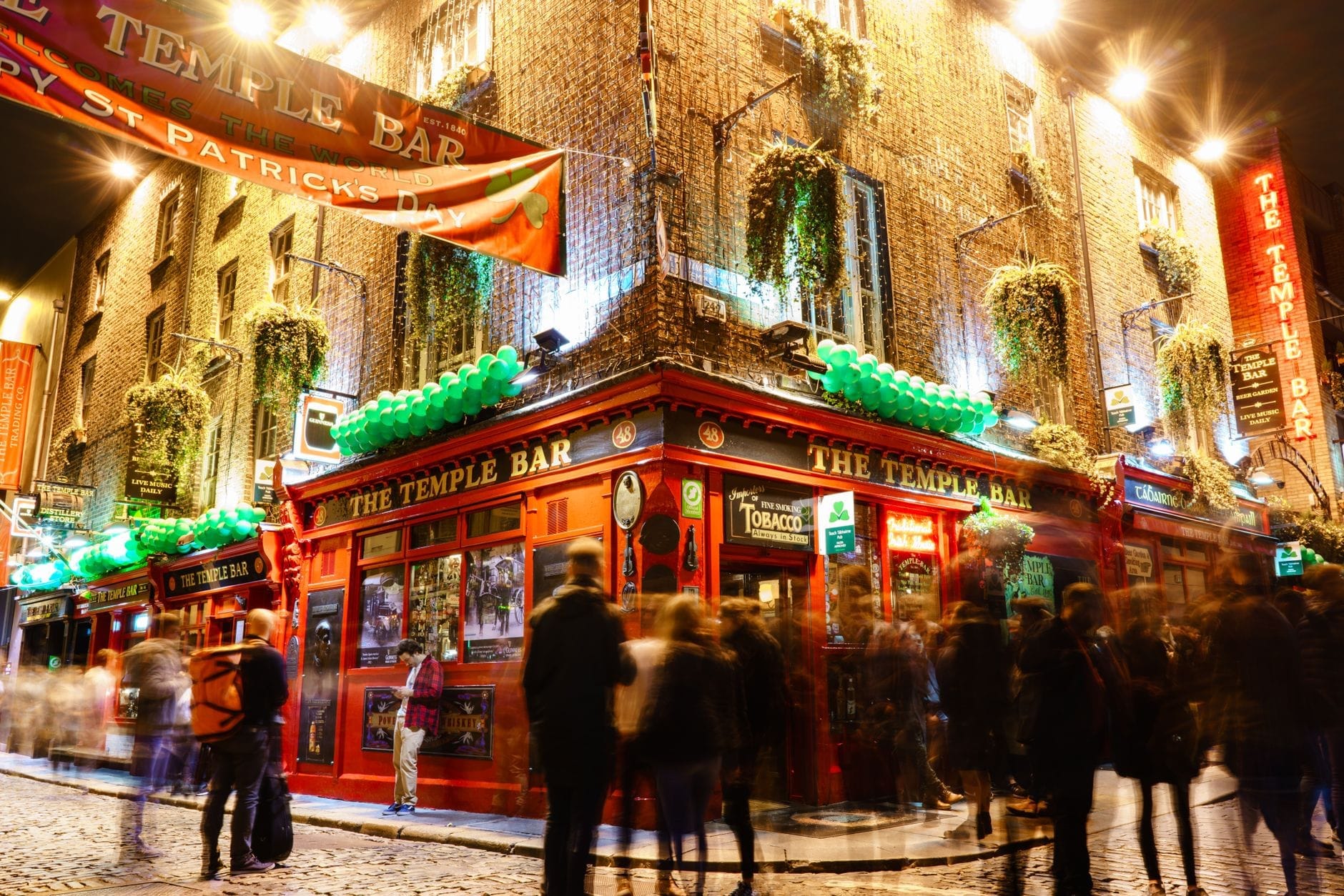
What The Temple Bar Pub Actually Is
The Temple Bar Pub is a large, multi-room traditional Irish pub occupying a corner position on Temple Lane South in the heart of Dublin's cultural quarter. It is, by almost any measure, the most photographed pub in the country: the ruby-red exterior, hand-painted lettering, and barrels stacked outside make it instantly recognisable from a hundred travel photographs. That fame comes with crowds, premium pricing, and a lot of first-timers, which is worth knowing before you arrive.
The pub claims a history stretching back to 1840, though this date is cited more in travel writing than in official sources, so treat it as part of the pub's lore rather than a verified founding year. What is certain is that the building has been a pub for a very long time and that it sits in one of the oldest parts of central Dublin, in a district that takes its name from the area around it.
ℹ️ Good to know
The name 'Temple Bar' refers to the wider cultural quarter, not just this pub. The area itself was named after Sir William Temple, an early 17th-century provost of Trinity College Dublin, whose house and gardens once occupied this part of the south bank. The pub and the district share a name, which causes genuine confusion for first-time visitors.
If you want to understand the broader neighbourhood before you visit, the Temple Bar area guide covers the cultural quarter in full, including galleries, cobbled laneways, and quieter corners most visitors never reach.
The Interior: More Space Than It Looks From Outside
Step inside and the pub opens up considerably. The interior is dense with objects: whiskey bottles covering entire walls, framed black-and-white photographs of Dublin through the decades, vintage advertising signs, and a wooden bar running most of the length of the main room. It is a deliberate aesthetic, designed to feel accumulated rather than designed, though the effect is well-executed.
There are multiple rooms and levels, which means even on a busy night there is usually somewhere to find a seat if you are patient. The main bar area is the loudest and most crowded. Side rooms and upper areas tend to be quieter and slightly less frenetic, though 'quiet' is relative on a Friday or Saturday evening.
The whiskey selection is genuinely extensive. The pub stocks a wide range of Irish whiskeys, including single malts, single pot stills, blends, and limited releases that you would struggle to find in a standard Dublin pub. If whiskey is your interest, this is a legitimate reason to visit regardless of the tourist-heavy crowd.
Tickets & tours
Hand-picked options from our booking partner. Prices are indicative; availability and final rates are confirmed when you complete your booking.
2-hour doughnut tour of Dublin's downtown with Temple Bar
From 60 €Instant confirmationFree cancellationGiant's Causeway, Dark Hedges, and Belfast Tour from Dublin
From 85 €Instant confirmationFree cancellationDublin self-guided audio tour
From 10 €Instant confirmationBird of Prey, Cliffs of Moher and Aillwee Cave from Dublin
From 201 €Instant confirmationFree cancellation
Live Music: When It Works and When It Doesn't
The pub promotes live Irish music as a constant feature, running through the day and into the small hours. In practice, this means a rotating cast of musicians performing traditional and folk music, sometimes two or three sessions in a single day. The quality varies: afternoon sessions tend to be more relaxed and genuinely musical, while evening performances cater increasingly to the crowd's appetite for recognisable songs.
The best time to catch music in a setting that still feels like a pub rather than a show is mid-afternoon on a weekday, roughly between 2pm and 5pm. By 7pm on any night from Thursday through Sunday, the main bar is packed to the point where the music becomes background noise beneath the crowd.
💡 Local tip
If live traditional music is a priority for your Dublin visit, consider combining The Temple Bar Pub with a stop at The Cobblestone in Smithfield, which has a quieter, more session-focused atmosphere and a crowd of locals who actually play. The two pubs represent different ends of the Dublin trad music experience.
When to Go and What to Expect at Different Times
The pub opens at 10:30am on weekdays and Saturdays, and at 12:30pm on Sundays. The kitchen opens from 10:30am on weekdays and Saturdays, and from 12:30pm on Sundays, following the same hours. Mornings are the exception to the crowded rule: before noon on a weekday, the pub is calm enough to actually look at the interior, read the old photographs on the walls, and have a conversation with the bar staff. The craft of the room is easier to appreciate when you are not being jostled.
Afternoons from roughly 1pm onwards see the tourist traffic increase steadily. By 4pm on any day from late spring through early autumn, the exterior is surrounded by people photographing the facade, and the interior is running at high capacity. Evenings from Thursday to Saturday push the pub to its loudest: closing time extends to 2:30am on Thursday, Friday, and Saturday nights, and the energy in the main bar is unmistakably late-night.
Sunday afternoons have their own particular character. The pub stays open late into the night, but the afternoon session, from about 2pm to 6pm, often draws a slightly more relaxed crowd than the Saturday night crush. It is not a locals' pub on any day, but Sundays lean closer to that feel than the weekend evenings.
⚠️ What to skip
Do not arrive expecting to walk straight to the bar on a weekend evening. The queue for drinks can be long, the noise level is high, and personal space is limited. If you are visiting Dublin primarily for its pub culture, planning at least one evening in a less central neighbourhood pub will give you a very different and arguably more authentic experience.
Photography, the Facade, and the Surrounding Area
The exterior of The Temple Bar Pub is one of the most photographed subjects in Dublin. The combination of the red and gold paint, the hand-lettered signs, the flower boxes, and the gas-style lanterns creates a composition that photographs well at almost any hour. Morning light from the east catches the facade cleanly before the street fills with people. The golden hour before sunset does something warm to the red paintwork that makes for particularly good images.
If you want a clear shot of the exterior without crowds in the foreground, arrive before 10am. By 10:30am when the pub opens, other photographers and early visitors begin to gather. The street itself, Temple Bar Street, is cobbled and narrow, which limits your shooting distance, so a wider lens works better than a telephoto in this context.
The pub sits roughly a two-minute walk from the Ha'penny Bridge, Dublin's most iconic pedestrian river crossing, which makes a natural pairing for a morning walk. Cross the bridge from the north side, turn left along the quays, and you reach Temple Bar Street in under five minutes.
Food and Drink: What to Order
The kitchen serves Irish pub food: traditional dishes like beef and Guinness stew, fish and chips, and Irish breakfast. The food is reliable rather than remarkable, but it is consistently available and the portion sizes are generous. It is a practical option if you are in the area and hungry, not a destination meal.
The Guinness, predictably, is well-kept. Pints here cost more than in most Dublin pubs outside the immediate tourist centre, which is the trade-off for the location and atmosphere. The whiskey menu is the most interesting part of the drinks list: ask the bar staff about single pot still Irish whiskeys, which are a specifically Irish category, made from a mash of malted and unmalted barley, and distinct from Scotch malt whisky.
For a deeper look at Irish whiskey culture in Dublin, the Irish Whiskey Museum is a short walk away on Grafton Street and provides the historical and production context that makes a whiskey order at the bar considerably more interesting.
Accessibility and Practical Notes
The Temple Bar district is pedestrianised in significant parts, which makes it easy to navigate on foot. However, the cobbled streets in the immediate area can be uneven, which is worth noting for anyone with mobility considerations. Specific accessibility information for the pub itself, including step-free entry and accessible facilities, was not confirmed in official sources at the time of writing. Contact the pub directly before visiting if this is relevant to your plans.
The nearest DART station is Tara Street, approximately a 5-minute walk across the river. If you are arriving by Luas, the Red Line stops at Jervis, a 10-minute walk away. For a broader overview of getting around central Dublin by public transport, the getting around Dublin guide covers all main options including day passes and the TFI 90-minute transfer fare.
Insider Tips
- The corner of the bar closest to the Temple Lane South entrance is a slightly less congested spot to order, even on busy nights. Most people crowd toward the main door on Temple Bar Street.
- Ask specifically about single pot still Irish whiskeys rather than ordering by brand name. The staff generally know the category well and can suggest bottles you would not find in a standard pub.
- The upstairs room offers some relief from the noise of the ground floor on busy evenings and is worth checking before you decide the pub is too loud to stay in.
- The exterior photographs best in the 30 minutes after sunrise, when the light is directional, the street is empty, and the red paint reads clearly against a blue sky. Return for a drink later, but get your shot early.
- Opening at 10:30am means The Temple Bar Pub is one of the few central Dublin pubs where you can have a quiet morning coffee or early lunch in a genuine pub setting before the late-night crowd and closing times of 1:30am on early weekdays and 2:30am on busier nights.
Who Is The Temple Bar Pub For?
- First-time visitors to Dublin who want to see and photograph the most iconic pub in the city
- Whiskey enthusiasts interested in exploring a well-stocked selection of Irish whiskeys in one sitting
- Travellers who want live traditional Irish music without having to hunt for a session
- Groups looking for a central meeting point with enough space to accommodate different arrival times
- Anyone building a morning itinerary around the Temple Bar area before the afternoon crowds arrive
Nearby Attractions
Other things to see while in Temple Bar:
- Chester Beatty Library
Housed within the grounds of Dublin Castle, the Chester Beatty Library holds one of the finest collections of manuscripts, rare books, and decorative arts in the world, spanning cultures from ancient Egypt to imperial Japan. Entry is normally free, but the museum is closed to the public from 15 June through December 2026 for Ireland's EU Council Presidency. Check chesterbeatty.ie before visiting.
- Dublin Castle
Dublin Castle stood at the centre of British rule in Ireland from 1204 until 1922, when Michael Collins accepted the handover of power in its courtyard. The State Apartments, Gothic Chapel Royal, and underground Viking excavations are normally open to visitors off Dame Street, but the entire campus is closed to the public from 15 June through December 2026 for Ireland's EU Council Presidency. Check dublincastle.ie before planning a visit.
- Ha'penny Bridge
Standing since 1816, the Ha'penny Bridge is a slender cast-iron arch over the River Liffey that connects Temple Bar on the south bank to Liffey Street on the north. Free to cross at any hour, it offers one of Dublin's most photographed vantage points and a genuine sense of the city's history underfoot.