Trinity College Dublin: Ireland's Oldest University and Its Famous Library
Founded in 1592 on the site of a medieval priory, Trinity College Dublin sits at the heart of the city and draws visitors for its cobblestoned Front Square, Georgian architecture, and the celebrated Book of Kells exhibition. Entry to the outdoor campus is free, though the Old Library requires a ticket.
Quick Facts
- Location
- College Green, Dublin 2 — right in the city centre, between Grafton Street and O'Connell Bridge
- Getting There
- Served by multiple Dublin Bus routes along College Green and Dame Street; closest Luas stops are Westmoreland (Red Line) and St. Stephen's Green (Green Line); Pearse and Tara Street DART/rail stations are a 10–15 min walk
- Time Needed
- 45 minutes for a campus walk; 2–3 hours if including the Book of Kells and Old Library
- Cost
- Campus entry is free. Admission charges apply for the Old Library / Book of Kells exhibition — check tcd.ie for current prices and booking
- Best for
- History lovers, architecture enthusiasts, first-time Dublin visitors, bookish travellers
- Official website
- www.tcd.ie
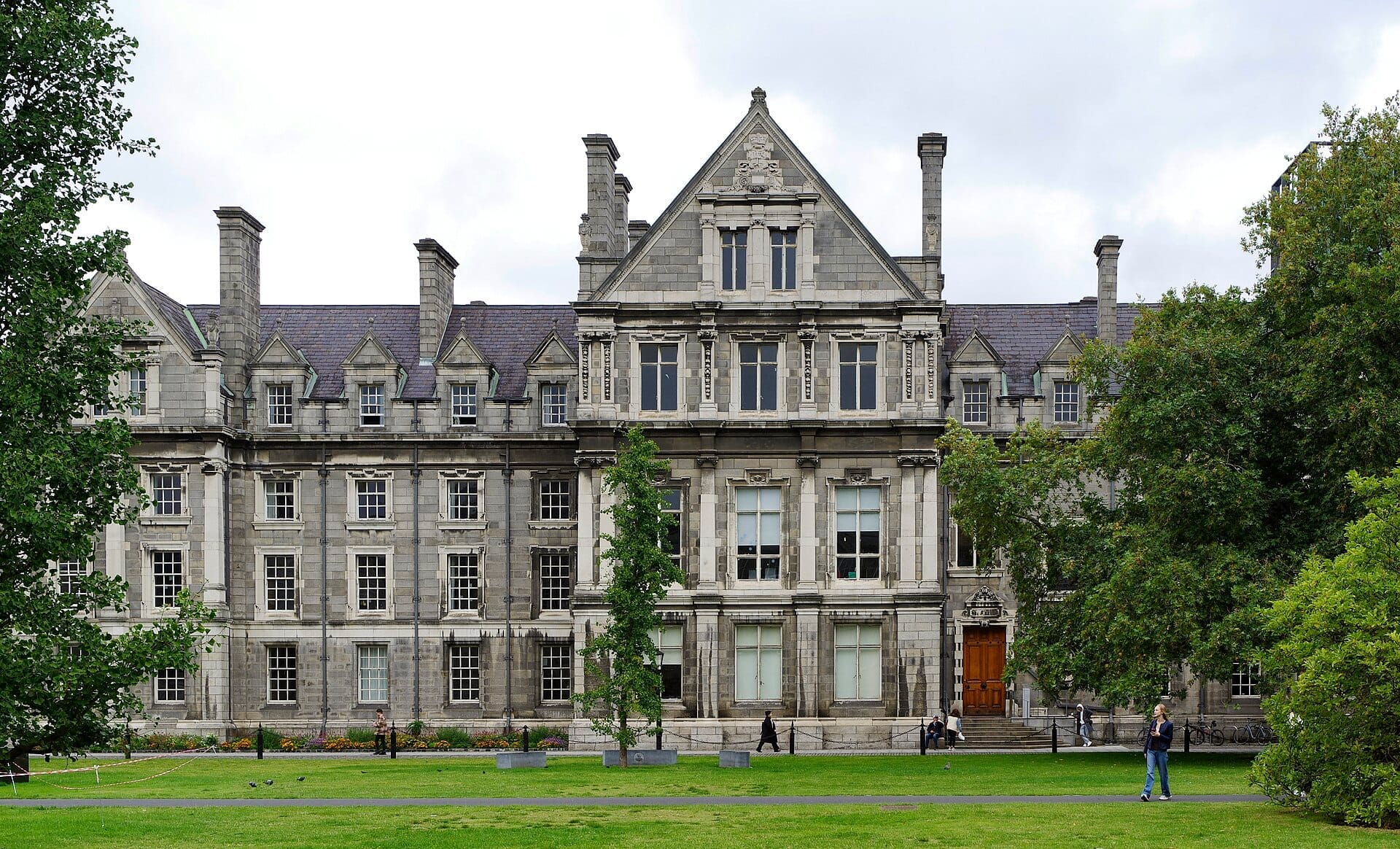
What Trinity College Dublin Actually Is
Trinity College Dublin is Ireland's oldest and most prominent university, founded by royal charter in 1592 when Dublin Corporation granted the site of the former Augustinian Priory of All Hallows at College Green to the new institution. It is the sole constituent college of the University of Dublin, though 'Trinity College Dublin' is the name almost everyone uses. More than four centuries later, it still operates as a working university with roughly 20,000 students, which means that wandering its grounds puts you inside an active academic community, not a museum replica of one.
For visitors, Trinity offers two very different experiences. The outdoor campus — its cobblestoned squares, Georgian facades, and shaded paths — is free to enter and takes about 45 minutes to explore at a relaxed pace. The Old Library, which houses the Book of Kells, requires a separate paid ticket and is the main draw for most first-time visitors. Both are worth your time, but they reward different interests.
💡 Local tip
Book your Old Library / Book of Kells tickets online at tcd.ie before you arrive. Walk-up availability is limited, especially in summer, and the queue for unclaimed tickets can be long. Prices and availability change seasonally, so check the official page close to your visit.
The Campus: What You See When You Walk In
You enter through the main gate on College Green, a Palladian archway flanked by two limestone statues: Edmund Burke and Oliver Goldsmith, both Trinity alumni. Passing through the arch, you step from one of Dublin's busiest junctions into Front Square, and the contrast is immediate. Traffic noise drops. The ground shifts from asphalt to centuries-worn cobblestone. On weekday mornings, students cycle across the square with coffee cups balanced in their hands, while groups of visitors fan out in all directions with phone cameras raised.
The buildings framing Front Square date primarily from the 18th century, and the architectural coherence is striking. The Examination Hall (1791) and the Chapel (1798), designed by William Chambers and completed by Christopher Myers, face each other across the square in near-perfect symmetry. The Campanile, a freestanding bell tower at the centre of the square, was designed by Charles Lanyon and erected in 1853. On overcast mornings, the whole scene takes on a particular quality: grey stone against grey sky, the bell tower slightly backlit, crowds thinner and quieter than they will be by midday.
Behind Front Square lies Parliament Square, and beyond that the quieter Fellows' Square and the Arts and Social Sciences Building. The further you walk from the main gate, the more the campus shifts from visitor attraction to working university. Library Square, flanked by the Old Library on one side, is where most tourists spend their time. The surrounding area also includes a small Victorian-era Museum Building with a remarkable Venetian Gothic interior, worth a look on its own.
Tickets & tours
Hand-picked options from our booking partner. Prices are indicative; availability and final rates are confirmed when you complete your booking.
Historic highlights of Dublin with Trinity College private walking tour
From 315 €Instant confirmationFree cancellationGiant's Causeway, Dark Hedges, and Belfast Tour from Dublin
From 85 €Instant confirmationFree cancellationDublin self-guided audio tour
From 10 €Instant confirmationBird of Prey, Cliffs of Moher and Aillwee Cave from Dublin
From 201 €Instant confirmationFree cancellation
The Book of Kells and the Old Library
The Old Library is Trinity's most visited interior space, and the Book of Kells is the reason most people come. The manuscript dates to around 800 CE and is an illuminated gospel book produced by Insular monks, probably at the monastery of Kells in County Meath and possibly begun on the Scottish island of Iona. It is regarded as one of the finest surviving examples of medieval manuscript art in Europe. Only two of its four volumes are displayed at any one time, with one opened to show the text and the other to show a major decorative page.
The exhibition leading up to the manuscript cases provides solid context: the history of illuminated manuscripts, the techniques used, the tools, the pigments. It takes approximately 20–30 minutes to move through this section before you reach the manuscripts themselves. The display cases are low-lit to protect the vellum, which means visibility can be challenging in a crowd. Arrive at opening time or in the late afternoon to avoid the peak flow of tour groups.
The Long Room, directly above the Book of Kells exhibition, is the second half of the attraction and, for many visitors, the more memorable part. It is a barrel-vaulted gallery roughly 65 metres in length, lined with dark oak shelving stacked to the ceiling with hundreds of thousands of books. Marble busts of luminaries including Jonathan Swift, John Milton, and Aristotle line the central aisle. The Long Room also houses one of the oldest surviving harps in Ireland, the Trinity College Harp, which became the model for the harp emblem used on Irish coinage and state symbols.
ℹ️ Good to know
The Long Room occasionally closes for private events or academic functions. If your visit specifically targets this space, check tcd.ie for any closures before booking.
How the Campus Changes Through the Day
Early mornings, roughly before 9 am, are the calmest window. The main gate is open, but tour groups haven't arrived, and the light on the east-facing facades of Front Square is often particularly clean in spring and summer. You have a reasonable chance of walking the full length of the campus without navigating around selfie sticks. This is the best time for photography.
By late morning, visitor numbers build steadily. The area around the Old Library entrance fills with queues, and Front Square becomes crowded enough that a sense of the campus's daily academic rhythm is harder to read. Between noon and 2 pm on weekdays during term time, the campus is at its most alive: students eating on the grass in front of the Campanile, staff moving between buildings, the college shop and café active. For anyone interested in the university as a living institution rather than a backdrop for photographs, this is actually an interesting time to visit, even if it's louder.
Late afternoons from around 4 pm onward tend to see a second wave of visitor calm. Tour groups dissipate, and the long evening light in summer (Dublin's latitude means full light until 10 pm in June and July) gives the limestone buildings a warmer, more photogenic tone. If you're visiting in autumn or winter, mid-morning offers the best natural light and the most manageable crowds.
Notable Alumni and Cultural Weight
Trinity's alumni list reads like a selection of the English-language literary canon: Jonathan Swift, Oliver Goldsmith, Oscar Wilde, Bram Stoker, Samuel Beckett, and more recently, other prominent Irish writers. It also produced politicians, scientists, and philosophers whose influence extended well beyond Ireland. Edmund Burke studied here. George Berkeley, the philosopher, graduated from Trinity in 1707. Ernest Walton, who was part of the team that first split the atom experimentally, was a Trinity graduate.
This concentration of literary and intellectual heritage makes Trinity a natural stop for anyone following Dublin's literary trail. The James Joyce connection is indirect but present: Joyce set key scenes of Ulysses in the surrounding streets, and the college's Elizabethan character forms part of the intellectual landscape he was both shaped by and rebelling against.
Practical Details Worth Knowing
The campus sits directly on College Green, which is one of Dublin's main traffic junctions and well connected by public transport. Multiple Dublin Bus routes stop on College Green and Dame Street (which runs along the south side of the campus). The nearest Luas stops are Westmoreland on the Red Line and St. Stephen's Green on the Green Line. Pearse Station (DART and suburban rail) is roughly a 10–15 minute walk east. In practical terms, you will almost certainly walk past or through Trinity at some point during any extended stay in central Dublin, since it lies between Grafton Street to the south and O'Connell Bridge to the north.
Trinity College is immediately adjacent to the St. Stephen's Green and Grafton Street area, and a visit to the campus pairs naturally with time on Grafton Street or a walk through Stephen's Green. The National Museum of Ireland (Archaeology) on Kildare Street is a 10-minute walk and is free to enter, making it an excellent complement to a Trinity visit for anyone interested in Irish history.
Photography inside the Old Library and the Book of Kells exhibition is restricted. Non-flash photography is permitted in the Long Room, but specific rules are posted at the entrance and can change. On the outdoor campus, photography is unrestricted. Wear comfortable shoes: the cobblestones in Front Square and Library Square are uneven and can be slippery when wet, which in Dublin is often.
Accessibility: Trinity states a commitment to accessible routes and services across campus. The cobblestone areas present some mobility challenges, and accessible path alternatives exist. Visitors with specific mobility, visual, or hearing access needs are advised to contact Trinity's disability and access services in advance via tcd.ie for the most current guidance, since campus infrastructure changes periodically.
⚠️ What to skip
Trinity is a working university. Some buildings, courtyards, and facilities may be closed to the public during examinations (typically May–June), conferral ceremonies, or private events. Check the university calendar on tcd.ie if your visit timing is inflexible.
Is It Worth Your Time? An Honest Assessment
The outdoor campus is one of the most architecturally coherent spaces in Dublin city centre, and it costs nothing to walk through. Even without entering any paid attraction, a 30-minute circuit through Front Square, past the Campanile, and around Library Square gives you a clear sense of why Trinity holds the place it does in Dublin's cultural geography. That alone is worth a half-hour.
The Book of Kells exhibition is more contested. The manuscript itself is extraordinary, but the viewing conditions — low light, crowds, limited dwell time at the cases — mean that visitors expecting a profound encounter with a 1,200-year-old artifact sometimes come away underwhelmed. The Long Room, on the other hand, consistently exceeds expectations. It is one of the most impressive interiors in Ireland, full stop. If the combined ticket price feels steep for a short visit, it is worth knowing that the Long Room tends to be the element visitors say they would pay for again; the Book of Kells is the name they came for but the Long Room is the thing they remember.
Visitors who are pressed for time and focused on Irish history in a more concentrated form might prefer to prioritize the National Museum of Ireland (Archaeology) or the Chester Beatty Library instead — both are free to enter and offer exceptional collections without the crowd pressure that comes with Trinity's peak hours.
Insider Tips
- The Museum Building (inside the campus, near the Engineering and Science area) contains a spectacular Venetian-Romanesque interior with a carved stone staircase and exotic fossils embedded in the walls. It is often empty of visitors and free to enter during opening hours.
- If you want the Long Room to yourself, book the first entry slot of the day and go directly upstairs, skipping the ground-floor Book of Kells exhibition to do it afterward. By the time you come back down, the initial crowd will have moved through.
- The college park, a large green space at the back of the campus, is used for cricket and other sports. It is open to the public and provides a genuinely quiet contrast to the tourist-heavy Front Square area. Worth a 10-minute detour.
- The 1937 Reading Room near Nassau Street is a beautiful curved neoclassical space often overlooked by visitors. Access depends on current events and term dates, but the exterior and vestibule are frequently accessible.
- On Nassau Street, which runs along the south wall of Trinity, a series of iron gates offer views directly into the campus without entering. This is the best external vantage point for photographing the Long Room building's rear elevation.
Who Is Trinity College Dublin For?
- First-time visitors to Dublin who want the most compressed sense of the city's historical and cultural depth in a single stop
- Lovers of medieval manuscripts, rare books, and historic libraries
- Architecture enthusiasts interested in 18th-century Georgian and Palladian design
- Literary travellers tracing the lives of Swift, Wilde, Beckett, and other Trinity-connected writers
- Families with older children who can engage with the exhibition content and appreciate the campus atmosphere
Nearby Attractions
Other things to see while in Trinity College & College Green:
- Book of Kells & Old Library
The Book of Kells Experience at Trinity College Dublin puts two of Ireland's most extraordinary things in one visit: an illuminated 9th-century gospel manuscript and a 65-metre Georgian library housing 200,000 ancient books. Here is exactly what to expect, when to go, and how to make the most of limited time.
- Irish Whiskey Museum
Housed in a historic building opposite Trinity College, the Irish Whiskey Museum takes visitors through four centuries of distilling tradition via guided tours, tasting sessions, and immersive exhibits. It is one of the most focused whiskey experiences in Dublin city centre, combining education with genuine sensory pleasure.