National Gallery of Ireland: What to Know Before You Visit
Founded in 1854 and opened to the public in 1864, the National Gallery of Ireland houses one of Europe's most accessible national collections, with free entry to permanent galleries, works spanning seven centuries, and a location at the heart of Georgian Dublin on Merrion Square West.
Quick Facts
- Location
- Merrion Square West, Dublin 2 (entrances on Merrion Square West and Clare Street)
- Getting There
- Central Dublin; walk from St Stephen's Green or Grafton Street in under 10 minutes. Dublinbikes stations at both entrances. Multiple Dublin Bus routes stop on Merrion Square and Clare Street.
- Time Needed
- 1.5–3 hours for a focused visit; 2–4 hours if you browse thoroughly
- Cost
- Free entry to the permanent collection; some temporary exhibitions charge an admission fee
- Best for
- Art lovers, rainy-day visits, Georgian Dublin architecture walks, solo travellers, families with older children
- Official website
- www.nationalgallery.ie
What the National Gallery of Ireland Actually Is
The National Gallery of Ireland is the country's primary fine art museum, located on Merrion Square West in Dublin 2. It holds over 16,300 artworks spanning painting, sculpture, drawing, and print from the medieval period through the twentieth century. Entry to the permanent collection is free, which makes it one of the most generous institutions of its kind in Europe.
The gallery was founded by Act of Parliament in 1854 and officially opened on 30 January 1864, making it a contemporary of other great Victorian-era institutions like the National Portrait Gallery in London and the predecessor collections of the Musée d'Orsay in Paris. It sits within a cluster of cultural buildings on the east side of Merrion Square: the Natural History Museum is a short walk away, and the National Museum of Ireland (Archaeology) is not far along Kildare Street.
The surrounding streets are among the finest examples of Georgian urban planning in Ireland. If you are new to that architectural tradition, the Georgian Dublin architecture guide gives useful context before or after your visit.
The Collection: What You Will Actually See
The permanent collection is arranged across interconnected wings, broadly by school and period. The Irish collection is the institutional heart of the gallery, and it is genuinely strong, tracing Irish painting from the 18th century through Jack B. Yeats, whose expressive, thickly layered canvases dominate a dedicated wing. Yeats left a significant part of his estate to the gallery, which helps explain the depth of that holding.
The European collection includes works by Caravaggio (The Taking of Christ, one of the gallery's most-discussed acquisitions), Vermeer, Fra Angelico, El Greco, Poussin, and Rembrandt. The Caravaggio was rediscovered in a Dublin Jesuit house in 1990, having been unrecognised for decades, and its story is genuinely worth reading about before you arrive. It hangs in the Baroque galleries and draws consistent attention.
British and Spanish holdings are solid rather than exceptional, but the overall breadth is impressive for a national collection of this size. The works are well-lit and clearly labelled, and the gallery provides free maps at both entrance desks. Free guided tours run regularly, and audio guides may be available separately.
💡 Local tip
If you have limited time, head directly to the Shaw Room on the ground floor for a sense of the Victorian building itself, then go to the Baroque galleries for the Caravaggio and to the Yeats wing for the Irish collection. That circuit covers the three most distinctive parts of the gallery in under an hour.
Tickets & tours
Hand-picked options from our booking partner. Prices are indicative; availability and final rates are confirmed when you complete your booking.
Giant's Causeway, Dark Hedges, and Belfast Tour from Dublin
From 85 €Instant confirmationFree cancellationDublin self-guided audio tour
From 10 €Instant confirmationBird of Prey, Cliffs of Moher and Aillwee Cave from Dublin
From 201 €Instant confirmationFree cancellationGame of Thrones Studio tour with return transfer from Dublin
From 63 €Instant confirmationFree cancellation
How the Experience Changes by Time of Day
Mornings, especially midweek, are the quietest time to visit. The light in the older wings, which relies partly on top-lit roof glazing, is also at its most even in the late morning hours. School groups arrive most frequently on weekday mornings during term time, which can fill specific gallery rooms with noise and movement. If you prefer silence and space around the paintings, midweek afternoons or Saturday mornings before midday tend to work well.
The gallery is open seven days a week, with Monday hours from 11:00 to 17:30; check the official website for the current full weekly schedule, as hours vary by day and may be subject to occasional change. The gallery is a popular choice on rainy Dublin days, so expect higher foot traffic during wet weather regardless of the time.
⚠️ What to skip
Check the official website at nationalgallery.ie before visiting to confirm current opening hours and any temporary exhibition closures. Some rooms are occasionally closed for conservation work or events.
The Building: Three Wings, One Complex
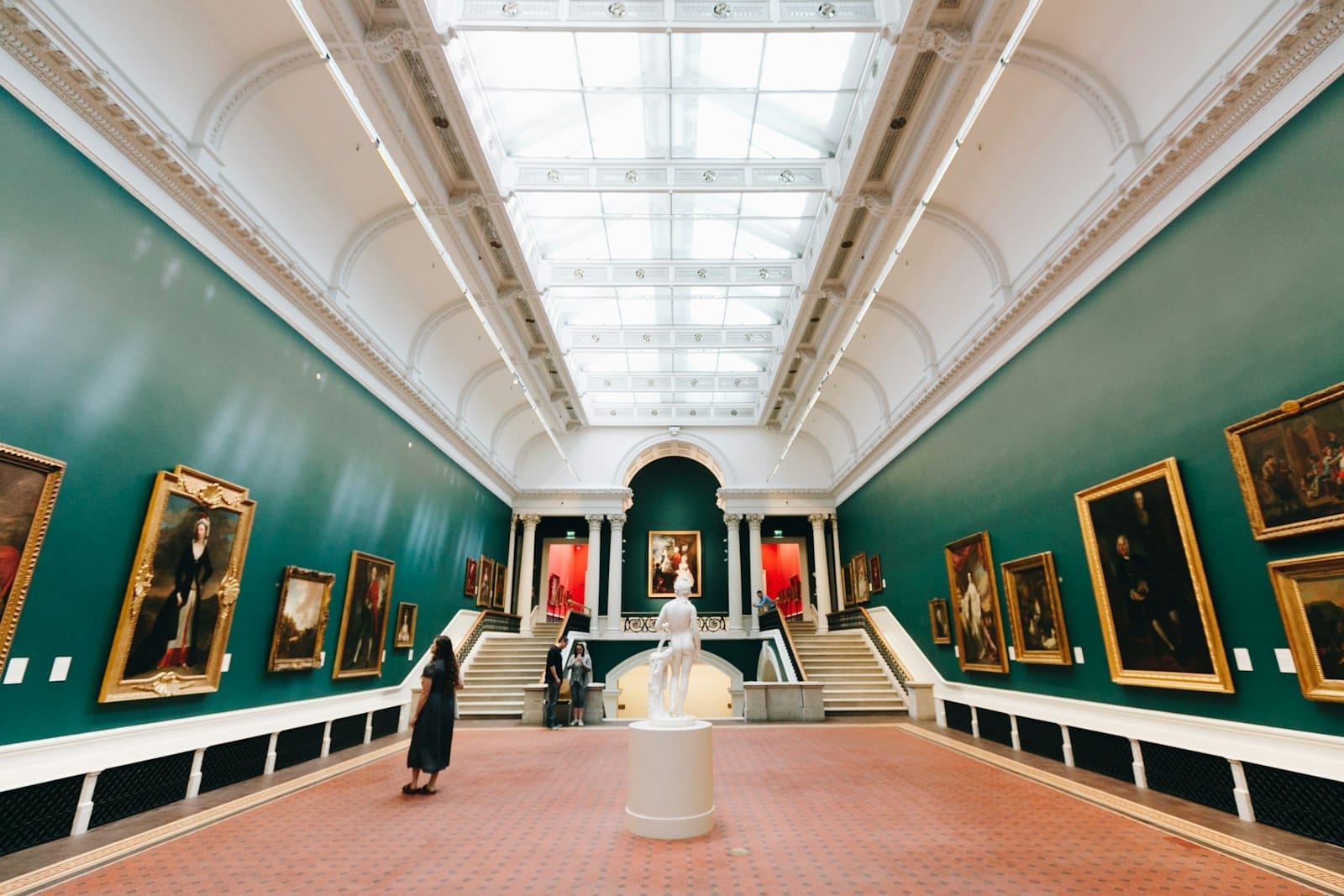
The gallery occupies three connected wings built at different periods. The original Dargan Wing (named after railway engineer William Dargan, whose fundraising efforts helped establish the institution) opened in 1864. The Milltown Wing followed in 1903, built to house the Milltown collection of Old Masters donated by Countess Milltown. The most recent addition is the Millennium Wing, which opened in 2002 on Clare Street and introduced a modern glass-and-stone facade to the complex.
Entering from the Merrion Square side, you step into the older Victorian fabric of the building, with high ceilings, marble floors, and the kind of institutional solidity that signals seriousness without intimidation. The Clare Street entrance via the Millennium Wing has a lighter, more contemporary feel and leads directly to the café and temporary exhibition spaces on the ground level.
The Shaw Room, a grand Victorian gallery on the ground floor named in honour of George Bernard Shaw (who left a portion of his royalties to the gallery), is one of the most photographed interior spaces in Dublin, even by people who are not especially interested in the paintings it contains. It repays a slow walk through.
Practical Walkthrough: Getting There and Getting Around
The gallery is a 10–12 minute walk from Grafton Street, cutting through Merrion Square Park or along Nassau Street. It is also reachable by several Dublin Bus routes stopping on Merrion Square; the Dublinbikes scheme has docking stations directly outside both entrances, making it a practical option if you are cycling between sites.
Bag storage is available at the cloakroom near the main entrance, which is useful if you are carrying a daypack. Photography of the permanent collection is generally permitted for personal, non-commercial use, but tripods and flash are not allowed. The gallery café in the Millennium Wing serves light meals, snacks, and pastries and is a useful midpoint break if you plan a longer visit.
The gallery sits within easy reach of other significant institutions in this part of the city. The National Museum of Ireland (Archaeology) is a short walk away on Kildare Street and is also free to enter, making the combination a full and cost-effective cultural afternoon.
ℹ️ Good to know
Dublinbikes stations at both entrances make cycling here from elsewhere in the city centre straightforward. The hire scheme is pay-as-you-go and requires card registration at a docking station or via the scheme’s app.
Temporary Exhibitions and the Wider Programme
The gallery runs a regular programme of temporary exhibitions, talks, and family events throughout the year. Temporary exhibitions sometimes carry an admission fee; others are free. The exhibitions tend to focus on Irish art, European masters, or thematic cross-collection surveys, and the quality is consistently high relative to the institution's scale.
If you are visiting Dublin with a specific cultural interest in Irish literature and art, the gallery connects naturally to the broader Dublin literary trail, since figures like Yeats, Shaw, and Joyce are threaded through both the collection and the city's history.
The online events calendar is the most reliable way to check what is showing during your visit. Booking ahead is recommended for any paid temporary exhibition during peak visitor periods, roughly April through September and the Christmas period.
Who Should Skip It (and Who Should Not)
Visitors primarily interested in Irish history rather than visual art may find the gallery less immediately engaging than institutions like Kilmainham Gaol or the GPO Witness History exhibition, which deal more directly with the political and social narrative of the country. The gallery is also not the right choice if you are travelling with very young children who are not already comfortable in quiet, structured museum environments; the Millennium Wing café aside, there is limited sensory stimulation for very young visitors.
For everyone else, especially those with an interest in European painting, Irish art, or the Georgian context of the city, this is one of Dublin's most rewarding and least crowded major cultural sites. The free admission makes it easy to visit for an hour without pressure, and the collection justifies much longer.
Insider Tips
- The Caravaggio room in the Baroque galleries can get crowded when tour groups pass through. Arrive at opening time on a weekday and you may have it almost to yourself for a few minutes, which is a genuinely different experience.
- The Clare Street entrance via the Millennium Wing is less busy than the Merrion Square entrance and gets you to the café and temporary exhibition spaces faster. Use it if you are starting with a temporary show.
- Free guided tours of the permanent collection run regularly, especially at weekends, and are often excellent. Check the gallery's website or ask at the desk when you arrive; times vary by season.
- The gallery shop in the Millennium Wing has a better-than-average selection of Irish art books, prints, and exhibition catalogues. It is worth browsing even if you do not buy.
- Merrion Square Park, directly across the road, is a pleasant 10-minute rest stop after a visit and includes the Oscar Wilde statue near the northwest corner, which is free to see and worth a look.
Who Is National Gallery of Ireland For?
- Art lovers who want to see major European Old Masters without museum crowds or entrance queues
- Rainy-day visitors looking for a free, unhurried indoor experience in central Dublin
- Travellers interested in Irish cultural identity as expressed through painting and sculpture
- Georgian Dublin architecture enthusiasts combining this with a Merrion Square walk
- Solo travellers or couples who want a quiet, self-paced cultural afternoon
Nearby Attractions
Other things to see while in St Stephen's Green & Grafton Street:
- George's Street Arcade
Built in 1881 as Ireland's first purpose-built shopping centre (later rebuilt after an 1892 fire), George's Street Arcade is a red-brick Victorian market hall on South Great George's Street, Dublin 2. Free to enter and open daily, it houses a mix of vintage clothing, records, antiques, food stalls, and independent retailers beneath a soaring glazed roof.
- Grafton Street
Grafton Street is Dublin's most recognisable shopping street, running 500 metres through the heart of the city from St Stephen's Green to College Green. Pedestrianised in the early 1980s, it draws everyone from commuters and coffee-seekers to tourists and street musicians. Entry is free and the street is open daily.
- Iveagh Gardens
Tucked behind the National Concert Hall on Clonmel Street, Iveagh Gardens is a free, formally designed Victorian park covering around 5 acres in the heart of Dublin 2. Opened to the public after years of restoration, it offers fountains, a rosarium, a cascade waterfall, and woodland walks with a fraction of the foot traffic you'll find at nearby St. Stephen's Green.
- Little Museum of Dublin
Housed in a Georgian townhouse at 15 St. Stephen's Green, the Little Museum of Dublin distills over a century of city life into a compact series of rooms and thousands of donated artefacts. Entry is by guided tour only, making this one of Dublin's most intimate and unexpectedly absorbing cultural experiences.