Budapest's Jewish Quarter occupies the inner section of District VII (Erzsébetváros) on the Pest side of the Danube. It combines Europe's largest synagogue, sobering WWII memorials, and a dense street-level culture of ruin bars, street art, and covered markets into one of the city's most layered and walkable neighborhoods.
The Jewish Quarter is where Budapest's history hits hardest and its nightlife runs latest. Centuries of Jewish cultural life, wartime tragedy, post-communist decay, and a wave of creative reinvention have all left marks on the same few square kilometers of inner Pest, producing a neighborhood that is impossible to reduce to a single mood.
Orientation
The Jewish Quarter sits in the inner portion of District VII, known officially as Erzsébetváros, on the flat eastern bank of the Danube. The core area is broadly enclosed by Király utca to the north, Erzsébet körút to the east, Dohány utca to the south, and Károly körút to the west. The streets most central to the quarter's identity are Dohány utca, Kazinczy utca, and Rumbach Sebestyén utca, all of which run roughly parallel through a dense grid of 19th-century apartment blocks.
Geographically, this places the quarter in a privileged position. It sits immediately east of District V (Belváros), Budapest's administrative and shopping core, and just south of the grand tree-lined Andrássy út in District VI. The inner ring road, Erzsébet körút, forms a hard eastern boundary. Everything within those borders can be covered on foot in under twenty minutes, though the density of what you encounter will slow you down considerably.
For travelers already familiar with other parts of central Pest, the quarter functions as a direct eastward extension of the city center. Walk east from the St. Stephen's Basilica area for about fifteen minutes and you will cross into it almost imperceptibly, the architecture growing slightly denser, the streets a little narrower, the mix of languages on café menus shifting to include Hebrew and Yiddish lettering alongside Hungarian.
Character & Atmosphere
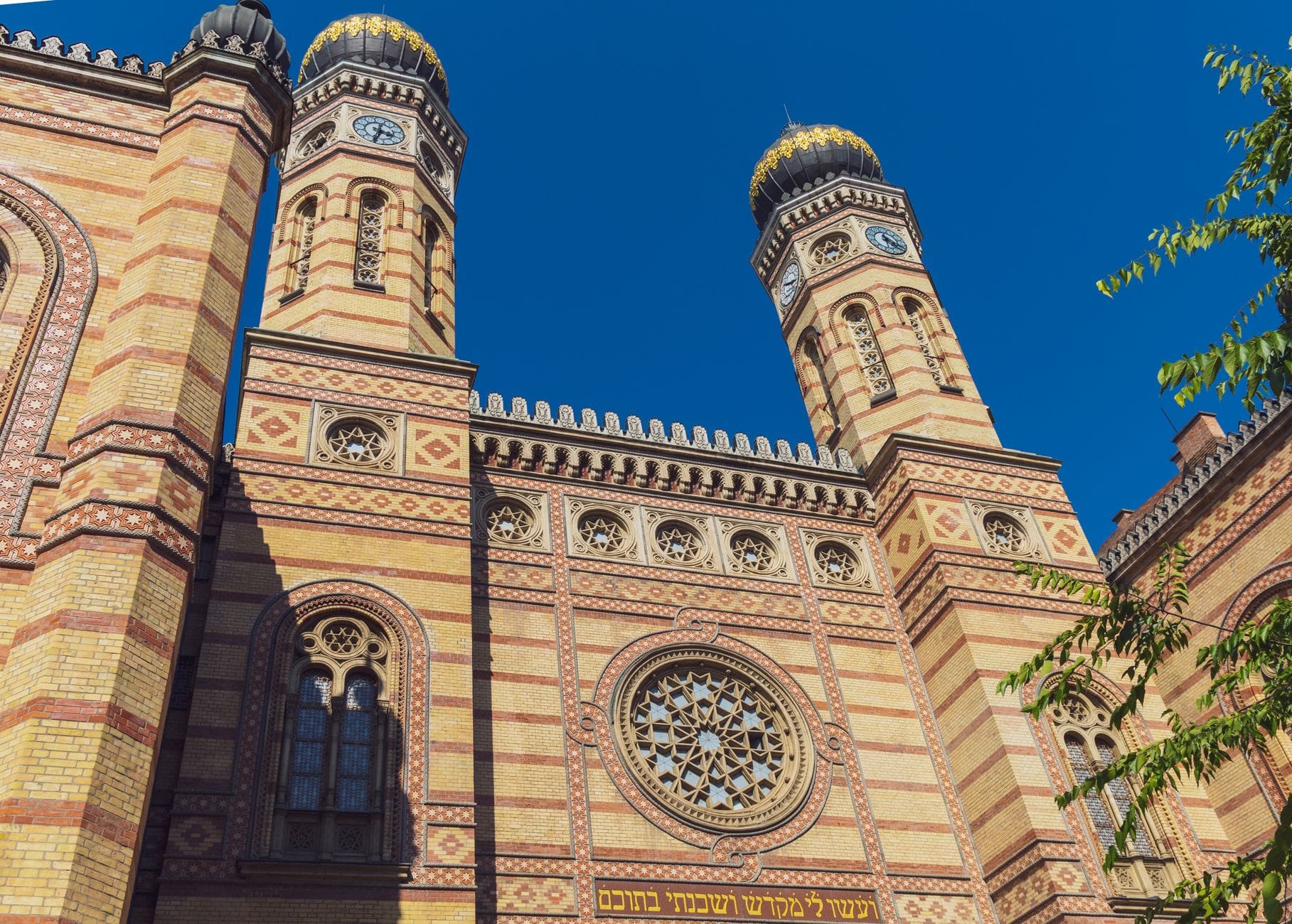
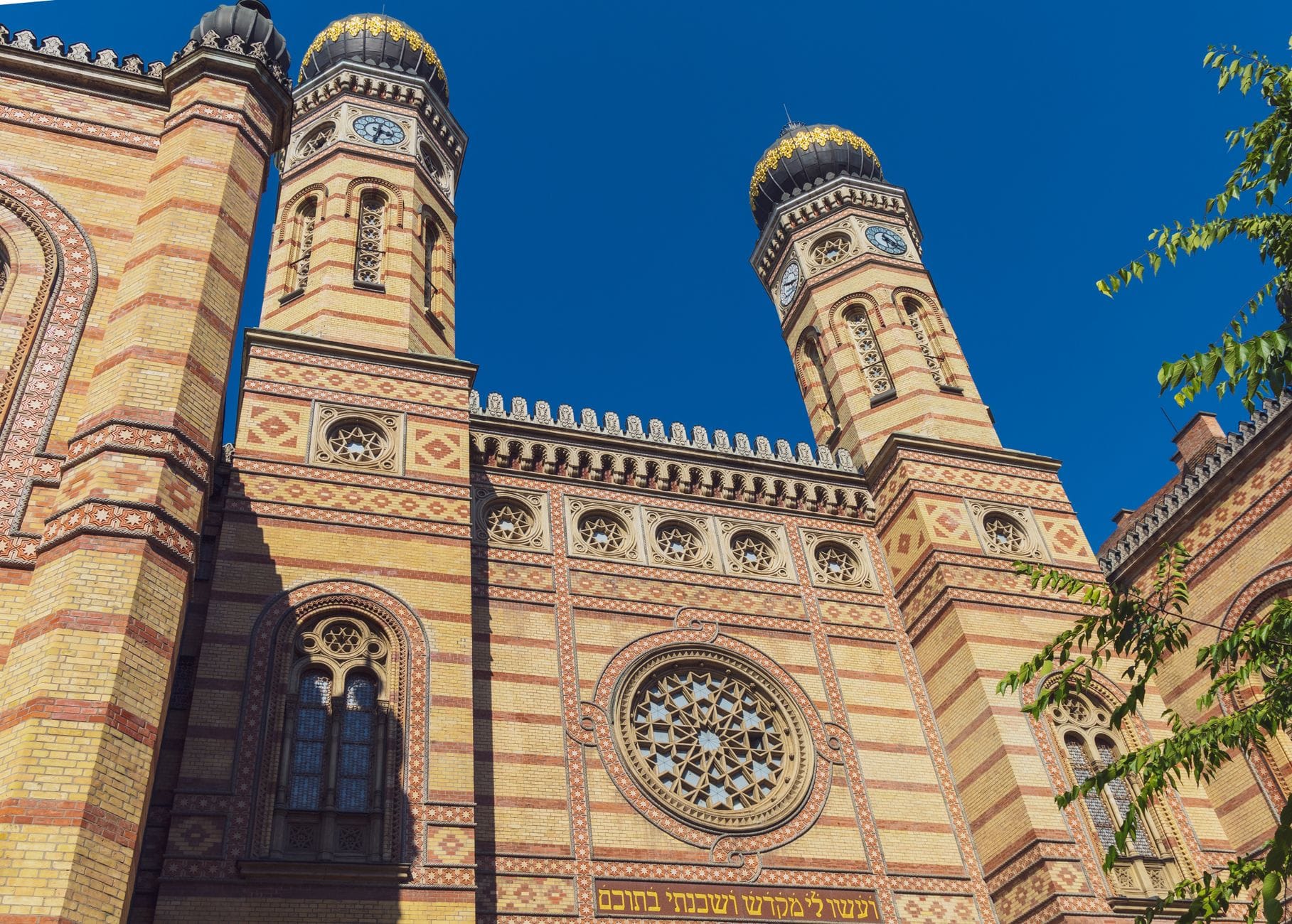
The Jewish Quarter has an unusual double life, and the two halves of it rarely overlap. In the mornings, the neighborhood belongs to locals and early-rising visitors. The Klauzál tér covered market pulls in regulars buying produce and bread before 9am. The synagogues open for tours once the street is still quiet, and the light on Dohány utca at that hour, angled and sharp from the east, catches the ornate brickwork of the Great Synagogue in a way that photographs rarely capture. On weekday mornings, you can stand outside the building without a queue.
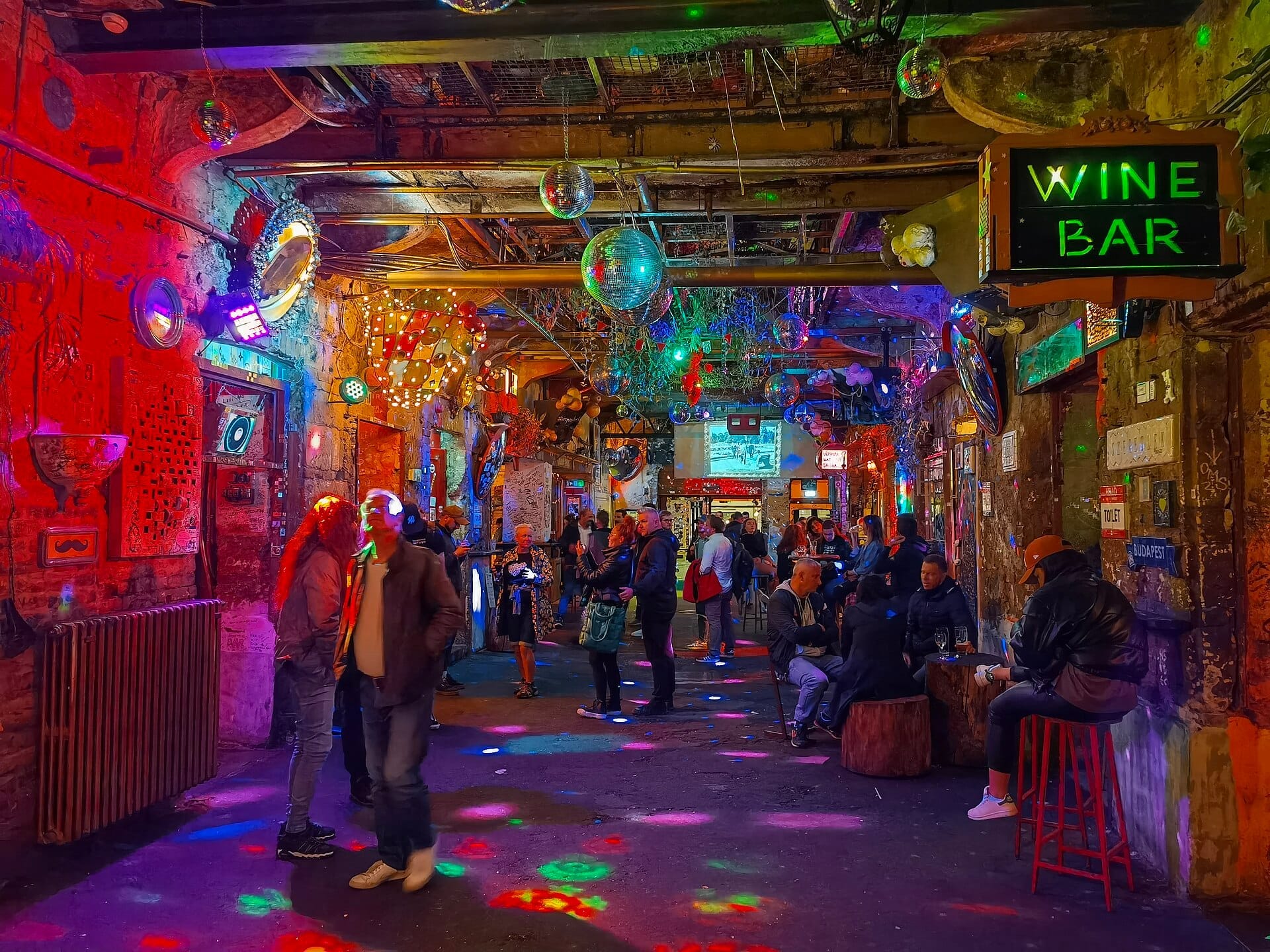
By early afternoon the tone shifts. Tour groups arrive, the main streets around the Great Synagogue fill with organized walking tours, and the cafés on Kazinczy utca begin to draw a younger crowd. The architecture here rewards slow attention: the residential buildings along Dob utca and Kertész utca feature elaborate entrance gates and deep internal courtyards, and several of them are now occupied by the ruin bars that put this neighborhood on the international map in the 2000s. The courtyards in particular tell a layered story, with peeling walls, art installations, and potted plants coexisting in spaces that were neglected for decades after the war.
After dark, the neighborhood becomes something else entirely. From around 9pm, the streets around Kazinczy utca and the surrounding blocks fill with bar-goers from across Budapest and visitors from across Europe. The ruin bar scene here is not a niche attraction; it is the dominant nightlife engine of the city, and on weekends in particular, the foot traffic between venues can make certain stretches feel overwhelmingly crowded. For travelers who value quiet evenings, this is an important detail. The same streets that feel contemplative at 8am are noisy until 3am or later.
⚠️ What to skip
The nightlife concentration in the Jewish Quarter makes it a poor choice for light sleepers. Hotels on Kazinczy utca and the streets immediately around the main ruin bars can be significantly affected by noise on Thursday, Friday, and Saturday nights. If you need quiet, look for accommodation on the quieter northern streets closer to Király utca, or consider a nearby district.
What to See & Do
The single most significant site in the quarter is the Dohány Street Great Synagogue, which is the largest synagogue in Europe and the second-largest in the world. Built in 1859 in Moorish Revival style, it can hold over 3,000 worshippers and remains an active congregation as well as a major museum complex. The site includes the Hungarian Jewish Museum, the Heroes' Temple, a memorial park, and the Tree of Life sculpture by Imre Varga, a weeping willow whose metal leaves are inscribed with the names of victims. Plan at least ninety minutes for the full complex. For context on Budapest's history and the role this community played in shaping it, the Budapest history guide provides essential background.
Two blocks north on Rumbach Sebestyén utca stands the Rumbach Street Synagogue, designed by Viennese architect Otto Wagner in 1872 in an Islamic-influenced style with octagonal towers and intricate tilework. It serves a different congregation from the Great Synagogue and has a quieter, more intimate feel. Further into the quarter on Vasvári Pál utca, the third synagogue in the area is a Neo-Gothic and Neo-Renaissance structure that serves as an active synagogue and community centre.
Beyond the synagogues, the quarter contains a number of sobering WWII memorials. The Carl Lutz Memorial on Dob utca honors the Swiss diplomat who issued protective passes to tens of thousands of Hungarian Jews during the Arrow Cross period of 1944-1945. Walking these streets with awareness of what happened here, in courtyards and doorways that still exist, gives the neighborhood a gravity that its nightlife scene can obscure.
The ruin bar scene, while controversial among those who feel it overshadows the neighborhood's memorialization, is also a genuine cultural phenomenon worth understanding. Szimpla Kert on Kazinczy utca is one of the earliest and most influential ruin bars, opened in the early 2000s in a derelict factory building and still the most visited. It operates as a daytime café and farmers market on Sunday mornings, which is arguably the best time to see it without the crowds. For a broader look at the ruin bar phenomenon, the Budapest ruin bars guide covers the full context.
Great Synagogue (Dohány utca): Europe's largest, with museum and memorial garden
Rumbach Street Synagogue: Otto Wagner's 1872 Islamic-influenced design
Klauzál tér: the covered market square and local social hub
Carl Lutz Memorial: WWII-era diplomatic hero honored on Dob utca
Kazinczy utca courtyard buildings: some of the best surviving pre-war residential architecture
Szimpla Kert: the original ruin bar, best visited Sunday morning for the market
Eating & Drinking
The food scene in the Jewish Quarter runs from excellent to tourist-trap, sometimes within the same block. The neighborhood's most authentic eating experience is the Klauzál tér market hall, which operates on regular weekly schedules and draws more local shoppers than visitors. The square surrounding it has several lunch spots and lángos (deep-fried dough) vendors that represent honest, low-cost Budapest eating.
For kosher options, the quarter has a small but genuine cluster of kosher restaurants and delis, mostly concentrated around Kazinczy utca and Dob utca. These are not large or flashy establishments, but they represent a living community rather than a heritage attraction. The broader Budapest food guide covers the city's wider eating culture, but the Jewish Quarter merits specific mention for its unique combination of traditional Hungarian Jewish cuisine and contemporary café culture.
The café scene on Kazinczy utca and the surrounding streets is well-developed and increasingly high quality. Specialty coffee has arrived firmly in the quarter, with several independent roasters and third-wave cafés operating alongside older establishments. Prices here are generally mid-range by Budapest standards, though venues immediately adjacent to the Great Synagogue on Dohány utca tend to charge more for the location.
Drinking options are, unsurprisingly, the quarter's strongest suit. Beyond the landmark ruin bars, there are wine bars, cocktail lounges, and small craft beer spots spread through the streets. The distinction between bar and café blurs throughout the day, with many places serving coffee in the morning and beer by evening without changing their format. Street food courts occupy several former courtyards, offering cheap, informal eating that functions as both a nightlife accompaniment and a daytime lunch option.
💡 Local tip
If you want to eat well and cheaply, visit Klauzál tér market before noon on a weekday. The lunch vendors around the square offer some of the most honest Hungarian food in central Pest at prices significantly below what you will find on the tourist-facing streets nearer the Great Synagogue.
Getting There & Around
The Jewish Quarter is well served by public transport, though its central location means walking from adjacent neighborhoods is often the simplest option. Metro line M2 (the red line) stops at Astoria, which sits at the southwestern corner of the quarter at the junction of Károly körút and Rákóczi út. From Astoria station, the Great Synagogue on Dohány utca is under two minutes on foot.
Metro line M1 (the yellow line, which runs along Andrássy út) provides access from the north, with the Vörösmarty utca stop roughly a ten-minute walk from the heart of the quarter. Trams 47 and 49 run along Károly körút on the western boundary, connecting the quarter to Liberty Bridge and the southern waterfront. For transit across the wider city, the getting around Budapest guide explains the full BKK network including passes and ticketing.
Within the quarter itself, everything is walkable. The distance from the Great Synagogue on Dohány utca to Szimpla Kert on Kazinczy utca is about 300 meters. The full extent of the quarter, from Károly körút to Erzsébet körút, takes around fifteen minutes to walk at a normal pace. There is no need for taxis or ride-hailing within the neighborhood during the day, though late-night transport back to other areas is worth planning, as the Metro closes around midnight.
ℹ️ Good to know
Budapest's metro closes around midnight. If you are spending an evening in the ruin bar district, check the night bus routes (marked 'É' on the BKK network) in advance, or budget for a licensed taxi back to your accommodation. Verify current schedules via BKK before traveling.
Where to Stay
Staying in the Jewish Quarter makes the most sense for travelers who want immediate access to both the cultural sites and the nightlife, and who can tolerate urban noise. The best accommodation positioning within the quarter is toward the northern streets, particularly around Király utca and the blocks between Dob utca and Király utca, where foot traffic diminishes enough to allow sleep. For a broader look at Budapest's accommodation options across all neighborhoods, the where to stay in Budapest guide gives a district-by-district comparison.
The quarter has a range of options from budget hostels, which cluster here partly due to the ruin bar proximity, through mid-range boutique hotels occupying renovated pre-war buildings, to a handful of upscale properties. Several of the boutique hotels have made creative use of the surviving courtyard architecture, with room layouts that incorporate original ironwork staircases and mosaic floors. This is an area where the character of the building itself can be part of the experience.
Travelers prioritizing quiet, family-friendly surroundings, or a residential feel will find the Jewish Quarter a difficult fit. For those purposes, the northern end of District VI near Andrássy út, or the southern parts of District V near the Inner City, offer more balanced options without sacrificing central access. The Jewish Quarter's accommodation sweet spot is the independent traveler or couple who plans to be out late and wants to roll back to their hotel without a long journey.
Honest Drawbacks
The neighborhood's success as a nightlife destination has created real tensions with the preservation of its historical character. The ruin bar concentration brings high foot traffic, significant litter on weekend mornings, and a party-tourist demographic that can feel jarring on streets lined with Holocaust memorials. This is not a hidden contradiction; it is openly debated among Budapest residents and urban planners.
The main tourist strips around the Great Synagogue and Kazinczy utca have also attracted a predictable wave of souvenir shops, overpriced cafés, and guided tour saturation. Visiting on a summer weekend afternoon, particularly the stretch of Dohány utca between Astoria and the synagogue, can feel overwhelming. The quarter rewards visitors who arrive early, explore streets off the main axes, and treat the ruin bars as an evening coda rather than the primary purpose.
For travelers who find the combination of memorial sites and nightlife uncomfortable, or who want a quieter cultural experience, the ruin bars of Budapest can also be sampled from a base elsewhere. And if the density of this district feels like too much, the broader Budapest hidden gems guide points toward quieter neighborhoods with less tourist saturation.
TL;DR
The Jewish Quarter in District VII combines Europe's largest synagogue, significant WWII memorial sites, and Budapest's most concentrated nightlife zone within a compact, walkable area of inner Pest.
Best suited to travelers who want cultural depth during the day and late-night atmosphere in the evening, and who can tolerate urban noise particularly on weekends.
The core of the quarter is easily reached on foot from Astoria (M2) in under two minutes, and the entire area can be walked end to end in fifteen minutes.
Drawbacks include significant weekend noise around the ruin bar district, a tourist-heavy main strip near the Great Synagogue, and a jarring tonal contrast between the party scene and the memorial landscape.
Visit the Great Synagogue early on a weekday, explore the quieter residential streets away from Kazinczy utca, and save Szimpla Kert for a Sunday morning market visit rather than a peak Saturday night.
Budapest punches well above its weight as a museum city. From a world-class collection of Old Masters to underground WWII hospitals and open-air Communist statues, these are the museums that make Budapest worth dedicating serious time to.
Budapest rewards visitors in every season, but the timing of your trip shapes everything from what you pay to how crowded the sights are. This guide breaks down every month so you can match your priorities, whether that's mild weather, low prices, major festivals, or the city's legendary Christmas markets.
Budapest is one of Europe's great Art Nouveau cities, with a distinct national style that sets it apart from Vienna or Paris. This guide covers the key buildings, the architects behind them, how to explore the city's Szecesszió heritage on foot, and what to watch out for along the way.
The Budapest Card bundles unlimited public transport with free museum entry, one free thermal bath visit at Lukács, and a free Danube river cruise into one pass. But at up to €129, it only pays off under specific conditions. Here's a clear breakdown of who should buy it, who should skip it, and how to activate it correctly.
Budapest food is hearty, affordable, and deeply underrated. This guide covers the essential dishes to try, where to find them, what things actually cost in 2026, and how to avoid the tourist traps that pass off mediocre goulash stew as the real thing.
Budapest rewards those who look beyond the Parliament and Chain Bridge. From ancient Roman ruins in Óbuda to a Cold War bunker beneath Castle Hill, this guide points you toward the city's most overlooked and underrated experiences.
Budapest carries more than 2,000 years of history across its two riverbanks. This guide traces the city's major eras, from Roman legions to Habsburg grandeur and Cold War upheaval, and shows you exactly where to see that history in person.
December transforms Budapest into one of Europe's most atmospheric winter destinations, with free Christmas markets, steaming thermal baths, and far fewer crowds than summer. This guide covers weather realities, the two flagship markets, pricing, crowd patterns, and practical tips for getting the most from a winter visit.
Three days is exactly enough time to get a serious handle on Budapest. This itinerary splits the city logically across both banks of the Danube, covers the unmissable sights without rushing, and leaves room for the thermal baths, Jewish Quarter, and a proper evening out.
Budapest punches well above its weight in the luxury travel market. Five-star hotels cost 40-60% less than comparable properties in Vienna or Paris, the thermal spa culture is unmatched in Europe, and the fine dining scene has quietly matured into something genuinely world-class. This guide covers where to stay, where to soak, and where to eat at the top end of the market.
Budapest after dark is one of Europe's most distinct nightlife scenes, built around crumbling courtyards, thermal bath parties, and riverfront venues that keep going until sunrise. This guide covers the key districts, best venues, realistic drink prices, and how to navigate the city's nights without the common tourist mistakes.
Budapest's ruin bars are unlike anything else in Europe: abandoned buildings transformed into labyrinthine bars, galleries, and gardens. This guide covers the best venues, realistic prices, transport logistics, and seasonal tips to help you experience them properly.
Budapest is one of Central Europe's safer capitals, but petty crime, taxi overcharging, and bar bill scams catch many visitors off guard. This guide breaks down exactly what to watch for, where the risks concentrate, and how to handle each situation confidently.
Budapest rewards shoppers across every budget, from paprika and Tokaji wine at the Great Market Hall to luxury boutiques on Andrássy Avenue and Soviet-era curiosities at Ecseri flea market. This guide covers where to go, what to buy, and how to avoid overpaying on Váci Street.
Budapest sits on top of nearly 130 natural hot springs, and its thermal baths are among the most atmospheric in Europe. This guide cuts through the hype: which baths are actually open in 2026, what you'll realistically pay, how to avoid peak crowds, and which options suit your budget and travel style.
Everything you need to plan the Budapest to Prague journey, whether you want the comfort of a direct train, the cheapest bus fare, or the fastest flight. Includes prices, schedules, booking tips, and what to expect on each route.
Budapest is one of Europe's most photogenic cities, and knowing where to look changes everything. This guide covers the best panoramic viewpoints, hilltop terraces, and elevated bars where the city reveals itself in full.
Budapest rewards families with an impressive range of kid-friendly experiences: a century-old zoo, a narrow-gauge railway run by children, interactive science centers, and a car-free island with playgrounds and bike rentals. This guide covers the best family activities in Budapest, with practical advice on what works for different ages, what to skip, and how to plan your days efficiently.
Budapest sits at the center of one of Central Europe's best rail networks, putting medieval towns, thermal lake resorts, and even Vienna within easy reach. This guide covers the top day trips from Budapest with exact transport options, realistic fares, and clear assessments of what each destination is actually worth your time.
Budapest rewards budget travelers generously. From sweeping hilltop panoramas to centuries-old bridges and grand market halls, some of the city's most memorable experiences cost absolutely nothing. This guide covers the best free things to do in Budapest, organized so you can plan a full day without opening your wallet.
Budapest has one of Central Europe's most comprehensive public transport networks, run by BKK. This guide covers every mode of transport, ticket types with current prices, how to avoid fines, and the best ways to get from the airport to the city center.
Budapest is one of Central Europe's most rewarding cities, but it's not for everyone. This guide breaks down exactly what you get: the UNESCO-listed landmarks, thermal baths, food scene, and nightlife, alongside the real drawbacks, seasonal trade-offs, and practical logistics you need to know before booking.
Budapest is one of Europe's most atmospheric cities for couples, combining grand architecture, thermal spa culture, candlelit river cruises, and sweeping hilltop views. This guide covers the best romantic experiences in Budapest, from free sunset walks to splurge-worthy dinner cruises, with practical advice on timing, cost, and what to skip.
Budapest rewards visitors with an unusually rich mix of history, architecture, and culture packed into a compact, walkable city. This guide covers the best things to do in Budapest — from iconic landmarks and thermal baths to underrated neighborhoods — with practical advice on what is worth your time and what is not.
Budapest divides naturally into distinct neighborhoods, each with its own character, price range, and practical trade-offs. This guide breaks down the best areas to stay based on what you actually want from your trip, from walkable sightseeing bases to quieter hillside retreats.