Great Synagogue (Dohány Street Synagogue): Europe's Largest, and Worth Every Minute
The Great Synagogue on Dohány Street is the largest synagogue in Europe and a defining landmark of Budapest's historic Jewish Quarter. Built between 1854 and 1859 in an ornate Moorish Revival style, it combines a working house of worship with a Jewish museum, a Holocaust memorial garden, and an emotionally resonant cemetery. Allow at least 90 minutes to do it justice.
Quick Facts
- Location
- Dohány utca 2, District VII (Erzsébetváros), Budapest
- Getting There
- Metro M2 to Astoria, or walk 8 min from Deák Ferenc tér (M1/M2/M3)
- Time Needed
- 90 minutes to 2.5 hours depending on guided tour
- Cost
- From 8,500–13,000 HUF for adults depending on ticket type; verify current prices at greatsynagogue.hu
- Best for
- History lovers, architecture enthusiasts, those tracing Jewish heritage in Central Europe
- Official website
- www.greatsynagogue.hu
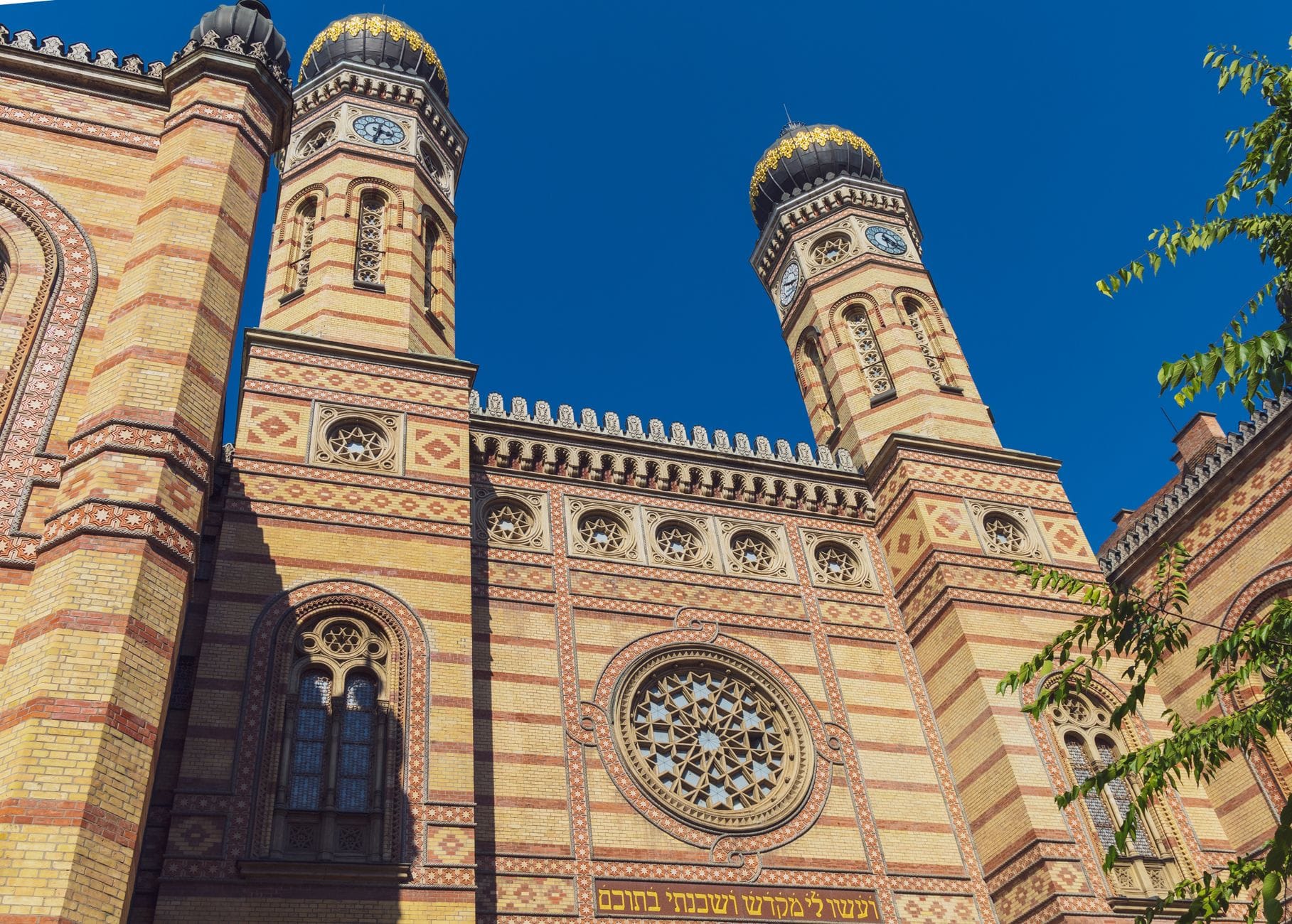
What You're Actually Looking At
The Great Synagogue, known in Hungarian as the Dohány utcai zsinagóga, is not a sight you stumble across unprepared and leave unaffected. Standing at the corner of Dohány Street and Wesselényi Street in Budapest's District VII, its twin onion-domed towers rise 44 metres above the pavement and announce themselves from two blocks away. The facade is striped in yellow and red brick in the Moorish Revival style, with geometric tile inlay that catches the afternoon light in ways that feel almost theatrical. At 26 metres wide with a capacity of roughly 2,964 people, it is the largest synagogue in Europe and the second largest in the world.
This is not a museum that happens to be housed in a religious building. The synagogue is still an active house of worship for the Neolog Jewish congregation of Budapest. That dual identity matters: the atmosphere inside shifts depending on whether a service has recently taken place, and the building carries a weight that pure tourist attractions rarely manage.
ℹ️ Good to know
The site covers four connected elements: the main synagogue hall, the Hungarian Jewish Museum, the Raoul Wallenberg Memorial Garden (with a Holocaust memorial and cemetery), and the Heroes' Temple. A single ticket covers all of them. Do not skip the garden, which many visitors underestimate.
Architecture and Historical Context
Construction ran from 1854 to 1859 under Austrian architect Ludwig Förster, who drew on the Moorish and Byzantine influences that were fashionable in Central European synagogue design during the mid-19th century. The choice was partly political: Jewish communities seeking social acceptance often chose architectural styles that signalled refinement without competing directly with Christian church traditions. The result in Budapest is a building that reads as culturally distinct but unmistakably European.
The interior reinforces this ambition. The main prayer hall has tiered seating across a floor and two gallery levels, with ornate ironwork along the gallery rails, elaborate ceiling rosettes, and an enormous pipe organ above the Torah ark. That organ has around 4,500 pipes and was played by Franz Liszt and Camille Saint-Saëns during the building's early decades — a detail that reflects how the Neolog congregation deliberately positioned itself at the intersection of Jewish observance and Hungarian civic culture. For more on the broader Jewish Quarter context, the Jewish Quarter neighbourhood guide covers the surrounding area in detail.
The Heroes' Temple, attached to the main building, was added in 1931 as a memorial to Hungarian Jewish soldiers killed in World War One. It is smaller and quieter than the main hall, and often overlooked by visitors moving quickly through the complex.
Tickets & tours
Live prices and dates from our booking partner. If you book, we may earn a commission at no extra cost to you.
The Memorial Garden: The Part That Stays With You
Behind the synagogue, through a passage from the museum building, lies the Raoul Wallenberg Memorial Garden. During the winter of 1944 to 1945, the area served as a mass burial site for Jews who died in the Budapest Ghetto, which had its boundary wall running directly against the synagogue's rear facade. More than 2,000 people were buried here. The cemetery remains, with modest stone markers, and the setting is sobering in a way that resists description.
The most photographed feature is the Imre Varga weeping willow sculpture installed in 1991. Cast in metal, its drooping leaves are engraved with the names of victims. The tree has become a symbol of the memorial internationally, and on weekdays it is rarely without visitors standing in silence at its base. The garden was named after Raoul Wallenberg, the Swedish diplomat who saved tens of thousands of Hungarian Jews during 1944 by issuing Swedish protective passports.
💡 Local tip
Visit the memorial garden before or after the main synagogue tour, not between them. Many visitors rush through it at the end of a longer tour when their attention is already spent. It deserves quiet and unhurried time.
What It Feels Like at Different Times of Day
The synagogue opens at 10:00 Sunday through Friday (it is closed on Saturdays for Shabbat) and select Jewish holidays. Arriving at opening time on a weekday gives you the best chance at the main hall without the shoulder-to-shoulder crowds that form by 11:30 in high summer. The morning light enters through the rose windows on the western facade and sweeps across the gallery seating, picking out the gold leaf detail on the ark. By early afternoon, the hall is frequently full of tour groups moving in clusters.
Summer extended hours run until 20:00 (last entry around 19:30), and the late afternoon slot from around 17:00 onward is consistently less crowded than midday. The light inside is more artificial at that hour, but the atmosphere is calmer and you can actually stop and look at things without being nudged forward. Winter hours are shorter, often closing by 15:30–16:00, which means late-afternoon visits are less practical in January and February.
Fridays have reduced hours year-round, with closure around 14:00 or 16:00 depending on the season, to allow preparation for Shabbat. Always check the current schedule on the official site before visiting on a Friday. The synagogue also closes on Jewish holidays, which fall on different dates each year.
The Jewish Museum and What It Covers
The Hungarian Jewish Museum is housed in the building directly beside the synagogue and is included in the standard ticket. Its collection covers Jewish religious life in Hungary from early settlement through the 19th-century emancipation period and into the 20th century. Ritual objects, Torah scrolls, ceremonial textiles, and documents make up much of the permanent collection.
A specific section is dedicated to the Hungarian Holocaust, presenting documentary evidence of the deportations of 1944, when approximately 437,000 Hungarian Jews were deported to Auschwitz-Birkenau in under two months, one of the fastest and most systematic deportation campaigns of the war. The museum contextualises this within Hungarian politics and the Arrow Cross regime. Visitors familiar with the broader subject from the Terror Háza (House of Terror) will find this a valuable companion perspective, focused specifically on Jewish experience rather than the wider story of political repression.
The museum rooms are not large and can feel cramped during peak visitor times. The labelling is in Hungarian and English throughout. Allow 30 to 45 minutes if you read the panels carefully; less if you are doing a visual sweep.
Getting There and Practical Logistics
The easiest approach is Metro Line M2 (red line) to Astoria, from where the synagogue is a short 3–5 minute walk north along Károly körút. Alternatively, all three metro lines converge at Deák Ferenc tér, and the synagogue is a 7–10 minute walk from there. Trams 47 and 49 also stop near Astoria. If you are combining this with other District VII sights, the Jewish Quarter is compact and walkable; the Rumbach Street Synagogue and Kazinczy Street Synagogue are both within a few minutes on foot.
Ticket pricing has fluctuated between sources and has been revised upward in recent years. The most reliable current figures require checking directly at the ticket office or on the official website before your visit. Guided tours in multiple languages are available and included in higher-tier ticket packages; they typically run around 45 minutes and are led through the synagogue and memorial garden with a knowledgeable guide. For independent visitors, the audio guide is a reasonable alternative.
⚠️ What to skip
Dress code: shoulders and knees must be covered to enter the main synagogue hall. Scarves and wraps are available at the entrance if needed. Men are expected to wear a kippah (head covering); disposable ones are provided free of charge at the entrance.
Photography is generally permitted in the synagogue and gardens but should be done respectfully. Avoid using flash near the ark and memorial areas. If you are visiting Budapest on a broader itinerary, the 3-day Budapest itinerary pairs this well with an afternoon walk along Andrássy Avenue to the Opera House.
Honest Assessment: Is the Hype Warranted?
Yes, with one caveat. The synagogue itself is genuinely extraordinary: its scale, condition, and the density of history it contains make it one of the most significant cultural sites in Central Europe. The memorial garden is unexpectedly moving. The museum is informative if slightly modest in scale.
The caveat is the crowds. During the summer peak from June through August, the main hall can feel uncomfortably full by mid-morning. The experience at 10:15 in April is meaningfully better than at 11:30 in July. If your primary interest is the architecture, you may find the visit more rewarding outside peak season. If you are visiting Budapest primarily for its thermal baths and nightlife, this may not be the right fit — but if you have any interest in Jewish history, European history more broadly, or architecture, skipping this would be a genuine loss. Those with no tolerance for emotionally heavy content should be aware that the memorial garden and museum are not light experiences. The Budapest history guide provides useful background on the events referenced throughout the site.
Insider Tips
- Book tickets online in advance during summer. The queue at the ticket window on busy days can take 20 to 30 minutes and the difference between arriving with a ticket and without one is significant.
- The wrought-iron gate on Wesselényi Street offers one of the best exterior views of the main facade. Most visitors approach from Dohány Street and miss this angle entirely.
- The pipe organ has been restored and is occasionally played during special concerts. Check the official website for scheduled events — a concert in that hall is a genuinely rare experience.
- The small cafe near the museum entrance is a reasonable place to decompress after the memorial garden. It is quieter than the coffee shops on Dohány Street and gives you a moment to sit within the complex.
- Combined or discounted tickets may be available through the Budapest Card, which covers public transport and offers reduced admission to several major attractions. Verify current terms at the official Budapest Card site before purchasing.
Who Is Great Synagogue (Dohány Street Synagogue) For?
- Travellers with a serious interest in Jewish history, the Holocaust, and Central European history
- Architecture enthusiasts drawn to 19th-century Moorish Revival design
- Those tracing family heritage in Hungary or the broader Ashkenazi Jewish world
- Visitors wanting to understand Budapest beyond its thermal baths and party scene
- Travellers pairing a half-day here with a walk through the wider Jewish Quarter
Nearby Attractions
Other things to see while in Jewish Quarter (VII. District):
- Budapest Pinball Museum
Tucked into a basement in northern Pest, the Budapest Pinball Museum packs more than 130 fully playable pinball machines into roughly 500 square metres of underground space. Admission covers unlimited play, making it one of the most engaging interactive attractions in the city for adults and older kids alike.
- Szimpla Kert
Szimpla Kert is the ruin bar that launched a cultural movement. Set inside a crumbling former apartment building on Kazinczy utca in District VII, it draws everyone from curious tourists to loyal locals with its chaotic decor, cheap drinks, Sunday farmers' market, and genuinely unpredictable energy.
Planning a trip? Discover personalized activities with the Nomado app.