Szimpla Kert: Budapest's Original Ruin Bar Explained
Szimpla Kert is the ruin bar that launched a cultural movement. Set inside a crumbling former apartment building on Kazinczy utca in District VII, it draws everyone from curious tourists to loyal locals with its chaotic decor, cheap drinks, Sunday farmers' market, and genuinely unpredictable energy.
Quick Facts
- Location
- Kazinczy utca 14, District VII (Jewish Quarter), Budapest
- Getting There
- Tram 4/6 along Nagykörút with a short walk from Oktogon or Blaha Lujza tér; M2 to Blaha Lujza tér or M2/M3 to Deák Ferenc tér (10–15-min walk)
- Time Needed
- 1–3 hours depending on visit type (bar, market, or event)
- Cost
- Free entry; drinks and food priced in HUF at the bar
- Best for
- Nightlife, cultural curiosity, Sunday morning market browsing
- Official website
- szimpla.hu
What Is Szimpla Kert?
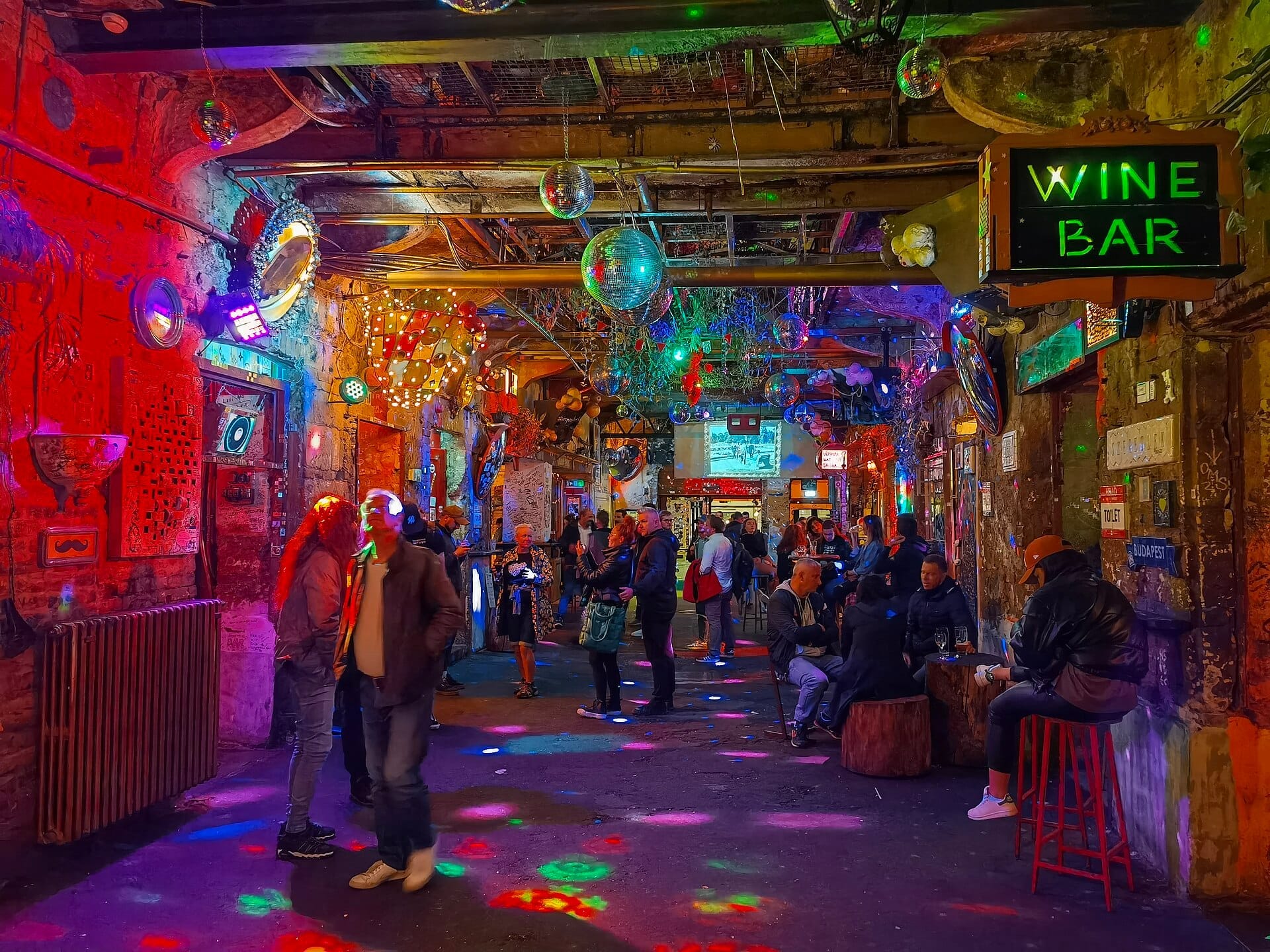
Szimpla Kert is not just a bar. It is the original ruin pub, the venue that defined a genre, and the reason Budapest became shorthand for a particular kind of night out. Founded in 2002 in a smaller location in the Jewish Quarter, it moved to its current home at Kazinczy utca 14 in 2004, occupying a derelict apartment building that had been left to decay after the Second World War and the decades of Soviet-era neglect that followed. The building was not renovated so much as colonized: patched, painted, stuffed with salvaged furniture, bicycle parts, bathtubs converted into seating booths, old televisions, hand-painted murals, and film projectors. The result looks like a flea market swallowed a bar and decided to stay open until 4 in the morning.
The concept behind ruin bars was born from necessity. In the early 2000s, young Budapestians were using cheap, abandoned inner-city buildings for informal gatherings. Szimpla formalized this into a business, and the idea spread rapidly. Today there are dozens of ruin bars across the city, but Szimpla remains the one that started it all. For anyone interested in Budapest's ruin bar scene, this is the essential starting point — not because it is the wildest, but because it is the one that made everything else possible.
ℹ️ Good to know
Entry is free at all times. You pay only for what you drink or eat. Tipping around 10% is customary in Hungarian bars and restaurants.
The Space: What You Actually See When You Walk In
The entrance on Kazinczy utca gives little away: a narrow doorway, some handwritten signs, a queue on busy weekend evenings. Step inside and the space opens dramatically into a large inner courtyard surrounded by the crumbling facade of the old residential building. Tables are scattered across the courtyard, open to the sky. The walls are covered in layers of murals, political slogans, and abstract art, some faded by years of rain and sun, others freshly added. Upstairs galleries ring the courtyard on multiple levels, accessible via tight staircases that feel more like backstage corridors than public spaces.
Each room has its own character. One might have a functioning Trabant car converted into a seating booth. Another has mismatched armchairs arranged around a projection screen showing old films with no sound. A garden room opens onto a planted area with string lights overhead. There is no consistent design logic, and that is entirely the point. The chaos is deliberate, accumulated over years of additions and experiments. Nothing matches, and nothing tries to.
Accessibility is limited. The courtyard and ground-floor bar areas are relatively navigable, but the upper levels involve steep staircases and uneven surfaces typical of a building that was never designed as a public venue. Visitors with limited mobility should expect to access only part of the space. No formal accessibility policy is published by the venue; contact Szimpla directly before visiting if this is a concern.
Tickets & tours
Live prices and dates from our booking partner. If you book, we may earn a commission at no extra cost to you.
Budapest Guided E-Scooter Tour by Night
From 60 €Instant confirmationFree cancellationHalf-day tour to Princess Sissi's Godollő royal palace from Budapest
From 41 €Instant confirmationFree cancellationHalf-Day Countryside Wine Tour from Budapest
From 95 €Instant confirmationFree cancellation4 Course Dinner cruise with Operetta and Folk show
From 81 €Instant confirmationFree cancellation
How the Experience Changes by Time of Day
Sunday mornings are the most surprising time to visit. From 9:00, Szimpla hosts a farmers' market in its courtyard: local producers selling vegetables, artisan cheeses, breads, jams, honey, and craft products. The crowd is entirely different from the nighttime one — families with children, older locals doing their weekly shop, young professionals browsing over coffee. The space feels warm and purposeful rather than theatrical. If you want to understand Szimpla as a community venue rather than a tourist attraction, Sunday morning is when that version of it is most clearly on display.
Weekday afternoons (opening at 15:00 Monday through Friday) attract a quieter mix: students working on laptops, small groups meeting for early drinks, the occasional tourist exploring the space without the crowd pressure. The light comes through the open courtyard differently in the afternoon, illuminating details in the murals that are invisible under nighttime lighting. This is a genuinely good time for photography. The bar runs normally, but there is no queue and no noise threshold to overcome when having a conversation.
Friday and Saturday nights after 21:00 are what most visitors expect and what most travel writing describes. The courtyard fills steadily, the indoor rooms become loud and close, and the mix of nationalities is pronounced — you will hear English, German, French, Italian, and Hungarian in roughly equal measure. This is when Szimpla is at its most internationally famous, and also when it is hardest to find a seat, hardest to get to the bar, and hardest to have any kind of conversation. It is worth being honest: peak weekend nights at Szimpla can feel more like an airport departure lounge than a bar, particularly in summer. If nightlife atmosphere is what you are after, arriving before 20:00 or choosing a Thursday evening offers a noticeably better version of the experience.
💡 Local tip
Saturday from 12:00 gives you several hours before the evening crowd builds. You can explore the space, eat something from the bar menu, and understand the layout before it becomes difficult to move around.
Historical and Cultural Context
Szimpla Kert sits in District VII, historically the center of Budapest's Jewish community. The quarter's dense urban fabric of apartment courtyards, narrow streets, and ornate early 20th-century buildings survived the Second World War structurally, but decades of under-investment left many properties in advanced decay by the 1990s. This physical context is inseparable from what ruin bars became: the spaces were available precisely because they had been neglected, and the aesthetic of controlled decay that defines Szimpla is partly a response to that specific urban history.
The Jewish Quarter today is a layered place. The Great Synagogue on Dohány utca is a five-minute walk from Szimpla's front door. The streets between them contain memorial plaques, small museums, kosher restaurants, and the kind of organic street art that accumulates in places where something happened. Understanding this context does not require any special preparation, but it does change how you read Szimpla's location. The ruin bar did not appear in a vacuum. It appeared in a neighborhood that was already accustomed to making something out of what remained.
Szimpla itself has evolved beyond drinking. It hosts film screenings, live music, art installations, community debates, and occasional political events. The Sunday market is probably the clearest expression of this ambition: an attempt to be a neighborhood institution rather than merely a tourist attraction. Whether it succeeds is a fair question. By most measures it remains deeply tourist-facing on weekend nights. But the market, the cultural programming, and the community-oriented events that appear on its calendar suggest something more considered than a simple cash operation.
Getting There and Practical Details
The most efficient public transport option is usually tram 4 or 6 along Nagykörút to Oktogon or Blaha Lujza tér, followed by a short walk into the Jewish Quarter. From the M2 metro line, Blaha Lujza tér is one of the nearest stations, about a ten-minute walk west along Rákóczi út and then north. From Deák Ferenc tér, where metro lines M1, M2, and M3 intersect, the walk east through the Jewish Quarter takes around fifteen minutes and passes several points of interest along the way.
The surrounding streets are worth treating as part of the visit. Kazinczy utca itself has other bars and restaurants. Nearby ruin bars like Fogasház and Ellátó Kert are a short walk away. If you are spending an evening in the area, it is straightforward to make Szimpla one stop among several rather than the sole destination.
Opening hours as listed: Monday through Friday from 15:00 to 04:00, Saturday from 12:00 to 04:00, Sunday from 09:00 to 04:00. These hours are consistent across multiple current sources, including TripAdvisor and dedicated ruin bar guides, but can shift for private events or holidays. Check the official website at szimpla.hu before visiting if timing is critical.
⚠️ What to skip
On peak summer weekends, queues can form at the entrance after 22:00. There is no formal guest list system for general entry, but occasional events may restrict access. Arriving earlier avoids this entirely.
Photography and Practical Tips
Szimpla photographs extremely well in the right conditions. The afternoon light through the open courtyard is flattering for architecture and detail shots. At night, the string lights, projection screens, and neon accents create a moody, layered look, but the crowd density makes framing difficult. A wide-angle lens handles the courtyard better than a telephoto. Many visitors photograph the space freely; be aware of other people's comfort and avoid photographing individuals without acknowledgment.
Cash in Hungarian forint is useful but not strictly required at most times. Cards are accepted at the bar, but having some HUF makes things faster and is essential for the Sunday market, where individual producers may not have card readers. The bar serves a range of Hungarian and international beers, palinka (Hungarian fruit brandy), and cocktails alongside food. It is not a budget nightclub, but it is considerably cheaper than comparable venues in Western European cities.
Who Should Think Twice
Szimpla is genuinely not for everyone, and it is worth being direct about this. If you find very loud, crowded spaces draining, a Friday or Saturday night visit in July or August will be uncomfortable rather than enjoyable. If you are looking for a refined cocktail bar experience with attentive service, this is the wrong address. The bar service is functional rather than polished, the toilets are famously imperfect, and the noise level in peak hours makes conversation nearly impossible.
Visitors who arrive expecting a rough-edged local institution and find instead a venue packed primarily with international tourists may also feel let down. This is a real tension in what Szimpla has become. It remains a significant cultural site and a well-run community space, but it is no longer a place where you will stumble into something undiscovered. If that matters to you, the Sunday market or a quiet weekday afternoon visit offers a more authentic version of the experience than Saturday at midnight.
For context on the broader district and how Szimpla fits into it, the Jewish Quarter page covers the neighborhood's full range of attractions, including quieter and less tourist-facing options.
Insider Tips
- The Sunday farmers' market (from 09:00) is the least-crowded and most locally attended time to visit. Go for coffee and fresh produce, stay to walk the space without a crowd.
- The upstairs rooms empty out noticeably earlier in the evening than the courtyard and ground-floor bar. If you arrive at 20:00 on a weekend, you can often find seats upstairs that disappear within an hour.
- Szimpla occasionally hosts film screenings, cultural events, and political discussions that are not widely advertised internationally. Check the calendar at szimpla.hu before visiting — these events offer a very different experience from standard bar nights.
- Tram 4 or 6 along the Grand Boulevard and the M2 or M3 metro from central hubs like Deák Ferenc tér or Astoria all offer quick access; choose based on where you are staying, as journey times are similar from most central Pest departure points.
- The courtyard smells strongly of cigarette smoke on busy nights — smoking is banned indoors in Hungarian hospitality venues but allowed in designated outdoor areas, and many people smoke in Szimpla’s open courtyard. If this is a concern, note that the open courtyard disperses it better than the enclosed indoor rooms.
Who Is Szimpla Kert For?
- First-time visitors to Budapest wanting to understand the ruin bar concept from its origin point
- Sunday morning shoppers looking for a weekly farmers' market with local producers
- Architecture and urban decay enthusiasts interested in adaptive reuse of historic buildings
- Travelers who want a drink in an unusual setting without paying a cover charge
- Anyone curious about how a neighborhood like the Jewish Quarter has transformed since the early 2000s
Nearby Attractions
Other things to see while in Jewish Quarter (VII. District):
- Budapest Pinball Museum
Tucked into a basement in northern Pest, the Budapest Pinball Museum packs more than 130 fully playable pinball machines into roughly 500 square metres of underground space. Admission covers unlimited play, making it one of the most engaging interactive attractions in the city for adults and older kids alike.
- Great Synagogue (Dohány Street Synagogue)
The Great Synagogue on Dohány Street is the largest synagogue in Europe and a defining landmark of Budapest's historic Jewish Quarter. Built between 1854 and 1859 in an ornate Moorish Revival style, it combines a working house of worship with a Jewish museum, a Holocaust memorial garden, and an emotionally resonant cemetery. Allow at least 90 minutes to do it justice.
Planning a trip? Discover personalized activities with the Nomado app.