Liberty Bridge (Szabadság híd): Budapest's Most Photogenic Crossing
Liberty Bridge is Budapest's shortest and arguably most striking central bridge, a 333-metre Art Nouveau iron structure painted green and crowned with mythological Turul birds. Free to cross at any hour, it connects Fővám tér on the Pest side with Szent Gellért tér on the Buda side, and doubles as one of the city's favourite informal gathering spots on warm evenings.
Quick Facts
- Location
- Connects Fővám tér (Pest, 1093) and Szent Gellért tér (Buda, 1111) over the Danube
- Getting There
- Metro M4 to Fővám tér; Trams 47, 48, 49 to Fővám tér / Szent Gellért tér
- Time Needed
- 20–40 minutes to walk across and back; longer if you linger on the railings
- Cost
- Free — no ticket required, open 24 hours year-round
- Best for
- Sunset views, photography, casual evening strolls, linking Gellért Bath to the Market Hall
What Liberty Bridge Actually Is
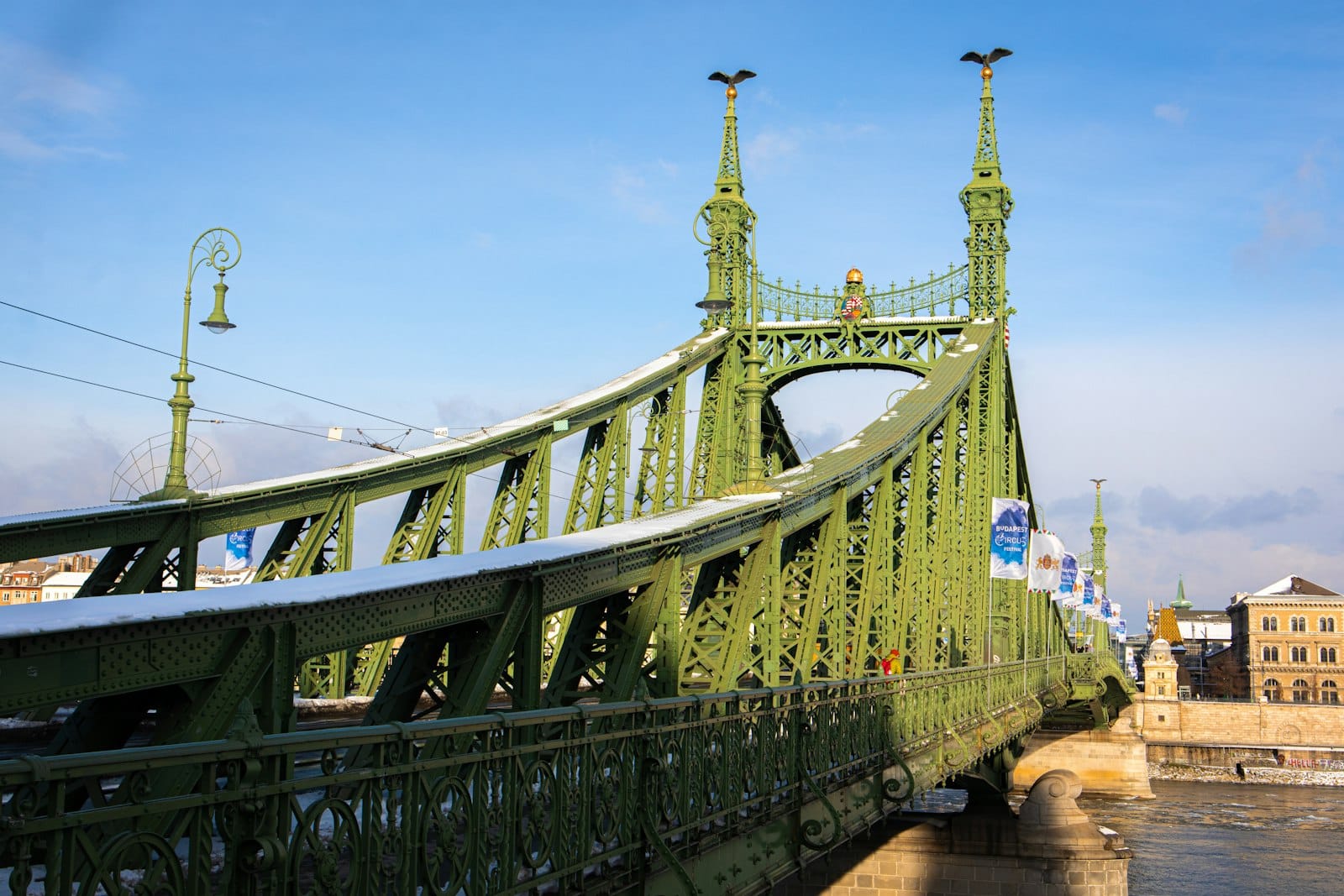
Liberty Bridge, known in Hungarian as Szabadság híd, is a 333.6-metre iron bridge spanning the Danube in central Budapest. It is the city's shortest bridge in the central zone, and also one of its most visually distinctive: painted in a deep verdigris green, with ornate Art Nouveau iron latticework and four pylons topped by bronze Turul birds, the mythological eagle of Hungarian folklore. Tram tracks run down its centre, sharing the 20.1-metre-wide deck with two lanes of road traffic and pedestrian walkways on both sides.
Unlike several of Budapest's larger crossings, this bridge carries a clear sense of human scale. You can see from one bank to the other in a few minutes of walking, and the ironwork is close enough to touch as you pass. That accessibility is part of why it has become a place people actually spend time on, rather than just crossing.
💡 Local tip
The bridge is free to walk at any time of day or night. No ticket, no gate. Simply head to Fővám tér (Metro M4, or Trams 47/48/49) and step on.
A Brief History: From the Millennium to Reconstruction
The bridge was built to mark Hungary's millennium celebrations and opened on 4 October 1896 as Ferenc József Bridge, named after Emperor Franz Joseph I of Austria-Hungary. It was the third road bridge built over the Danube in Budapest, and it was designed to be both functional and ceremonial: a piece of infrastructure that announced the city's ambitions as a modern European capital.
The original structure was destroyed during World War II, when retreating German forces blew up Budapest's Danube bridges in late 1944 and January 1945. The city rebuilt it quickly after the war, and the reconstructed bridge reopened on 20 August 1946, a date chosen deliberately: it is Hungary's national holiday, St. Stephen's Day. At that reopening, it received its current name, Szabadság híd, meaning Liberty Bridge or Freedom Bridge.
The postwar reconstruction followed the original design closely, which is why the bridge today still reads as a late 19th-century structure rather than a 1940s one. For more on how this wartime destruction shaped the city's bridges and fabric, the Budapest history guide provides useful context.
Tickets & tours
Live prices and dates from our booking partner. If you book, we may earn a commission at no extra cost to you.
Budapest Guided E-Scooter Tour by Night
From 60 €Instant confirmationFree cancellationHalf-day tour to Princess Sissi's Godollő royal palace from Budapest
From 41 €Instant confirmationFree cancellationHalf-Day Countryside Wine Tour from Budapest
From 95 €Instant confirmationFree cancellationWalking tour of Pest
From 10 €Instant confirmationFree cancellation
The Architecture: Green Iron and Turul Birds
The bridge's ironwork falls into a style that blends structural pragmatism with decorative ambition. The latticed side trusses and the pointed arches of the pylons echo Gothic cathedral architecture, but everything is executed in riveted steel. The green paintwork is not incidental: it gives Budapest's riverfront landmarks a shared visual character across the city.
At the top of each of the four pylons sits a bronze Turul bird with wings outstretched. The Turul is a mythological hawk or eagle that appears throughout Hungarian national iconography, associated with the origin myth of the Árpád dynasty. On the bridge, the birds face the Danube as if surveying the crossing. At close range, from the pedestrian walkway, you can look up and see them against the sky with some clarity, particularly from the central span.
The bridge's Art Nouveau and historicist sensibility connects it to a broader wave of ambitious architecture from the same Millennial period. The Budapest Art Nouveau guide covers many of the buildings from this same era that still define the city's streetscape.
The Experience: How the Bridge Changes Through the Day
In the morning, the bridge is a commuter route. Trams rattle across regularly, and the pedestrian walkways carry people moving purposefully between Buda and Pest. The light falls from the east, meaning the Pest embankment glows while Gellért Hill sits in shadow. It is a good time for photography looking west, with the hill as a backdrop and relatively few other people on the walkway.
By midday and into the afternoon, tourist foot traffic picks up noticeably. The walkways are narrow enough that groups slow things down, and the tram noise and road traffic can feel intrusive if you are trying to stand still for long. In summer, the iron structure absorbs heat, and the open span offers almost no shade. A hat and water are advisable between June and August.
The bridge transforms in the evening. As the sun drops toward Gellért Hill, the western sky turns orange and pink behind the hill's silhouette, and the bridge lights begin to pick out the ironwork in amber. This is when locals come: students from the nearby Corvinus University, couples, groups with cans of beer and nowhere particular to be. They sit on the bridge's railings and parapet ledges, which is an informal habit rather than an official sanctioned activity. The atmosphere is relaxed and unhurried in a way that few central Budapest spaces manage at that hour.
After dark, the bridge is fully illuminated and the views up and down the Danube are unobstructed. To the north you can see the lit outline of the Chain Bridge and, further, the Parliament. To the south, the river opens toward quieter districts. Noise drops, and foot traffic thins to scattered walkers and cyclists.
ℹ️ Good to know
Sunset from the Pest side of the bridge, looking west toward Gellért Hill, is among the best free viewpoints in the city. Arrive 20 minutes before local sunset time for the best light on the ironwork.
What's At Each End: Making the Most of the Crossing
The Pest end of the bridge opens directly onto Fővám tér, a square anchored by the Central Market Hall, Budapest's largest covered market. The market's neo-Gothic red brick exterior faces the bridge across a short stretch of road. It is a natural pairing: cross the bridge, then spend an hour among the spice stalls, paprika vendors, and ground-floor butchers before heading further into Pest. The Corvinus University of Budapest also fronts Fővám tér, giving the area a younger, less tourist-saturated energy than some parts of the inner city.
The Buda end opens onto Szent Gellért tér, dominated by the Gellért Hotel and the entrance to the Gellért Thermal Bath. The bath's ornate Secessionist facade is immediately visible as you step off the bridge. From this square, stairs and paths lead up Gellért Hill, a 235-metre volcanic rock outcrop topped by the Citadel and the Liberty Statue. The climb takes around 20–30 minutes at a moderate pace and rewards with panoramic views over both sides of the city.
Practical Information for Visitors
Getting here is straightforward. Metro line M4 stops directly at Fővám tér on the Pest side. Trams 47, 48, and 49 also stop at Fővám tér and at Szent Gellért tér on the Buda side, meaning you can arrive at one end and depart from the other without retracing your steps. Tram 2, which runs along the Pest embankment, stops nearby as well.
The pedestrian walkways run along both sides of the bridge, separated from the tram track and road lanes by a low kerb. The surfaces are generally even along the span. Both Fővám tér and Szent Gellért tér are served by accessible metro and tram infrastructure, though the bridge walkways themselves involve standard kerb transitions at each end.
Photography is unrestricted. The best angles for capturing the bridge's full length are from the Danube embankment on either side, or from the river itself if you are on one of the sightseeing boats. From the bridge, the most photogenic shots are looking up at the Turul birds against the sky, or looking downstream toward the Chain Bridge with the Parliament visible beyond it.
⚠️ What to skip
In winter, the iron deck and walkways can become slippery when wet or icy. The bridge is exposed to river winds that make the temperature feel significantly colder than it reads. Layer accordingly between November and March.
If this is your first time orienting yourself around Budapest's river crossings, the getting around Budapest guide explains the tram and metro network in practical terms.
Is Liberty Bridge Worth Your Time?
It depends entirely on what you expect from it. If you are hoping for an enclosed observation deck, a museum experience, or any kind of structured attraction, this is not that. It is a public bridge. Its value is in the crossing itself, the views it frames, and the buildings at either end.
Visitors who feel underwhelmed are usually those who made a special journey just to see the bridge and found it shorter and less dramatic than photos suggested. The people who remember it are those who folded it into a longer route: market to bridge to bath, or hill to bridge to dinner in Pest. Used as a link between things rather than a destination in itself, it consistently delivers.
Travellers looking for the city's most dramatic elevated views might get more from climbing Gellért Hill itself or checking the Budapest viewpoints guide for alternatives. But for free, at sunset, with nowhere urgent to be, Liberty Bridge is exactly the right kind of place.
Insider Tips
- The east-facing pedestrian walkway (river-right as you cross from Pest) gets slightly better afternoon light for photos of the ironwork and is marginally less crowded than the west walkway, which faces the Gellért Hotel.
- Locals sit on the bridge railings most warm evenings from April through September. If you want to join them, arrive before 8pm in spring or 9pm in summer to find space. Bring your own drinks — there are no vendors on the bridge itself, but convenience stores line Fővám tér a two-minute walk away.
- The tram that crosses the bridge (lines 47/49) gives you a moving view of the river from track level for a standard transit fare. It is a 90-second ride that many visitors overlook entirely.
- For the clearest photos of the Turul birds at the top of the pylons, position yourself on the walkway near the first or third span, not the centre, and look upward at a slight angle. A wide-angle lens or phone ultra-wide captures the full silhouette best in morning or late afternoon light.
- The Great Market Hall closes on Sundays, so if you are planning a market-then-bridge-then-bath route, Sunday is the day to rearrange: do Gellért first, then cross, then explore Fővám tér square even if the market is shut.
Who Is Liberty Bridge (Szabadság híd) For?
- Photographers hunting riverside Architecture and golden-hour ironwork shots
- Travellers linking the Great Market Hall with Gellért Hill in a single logical walk
- Couples looking for a low-key evening spot with Danube views and no entry fee
- Visitors with limited mobility doing a flat, accessible Danube crossing
- Anyone building a half-day Buda waterfront itinerary between the bath, the hill, and the market
Nearby Attractions
Other things to see while in Buda Waterfront & Gellért Hill:
- Citadella & Liberty Statue
Perched atop Gellért Hill, the Citadella fortress and the 40-metre Liberty Statue together form one of Budapest's most recognizable silhouettes. Entry to the outdoor grounds is free and the site operates daily within posted opening hours rather than being open around the clock, making it one of the most accessible major landmarks in the city.
- Gellért Thermal Bath & Hotel
The Gellért Thermal Bath is Budapest's most celebrated historic spa, housed in a sweeping Art Nouveau complex at the foot of Gellért Hill. Opened in 1918 and fed by natural geothermal springs, it combines soaking culture with genuine architectural grandeur. Note: the bath is closed for major renovation from October 2025, with a planned reopening sometime in 2028.
- Lukács Thermal Bath
Tucked along the Buda waterfront near Margaret Bridge, Lukács Thermal Bath has been drawing locals to its mineral-rich waters for centuries. Less theatrical than Széchenyi, less crowded than Gellért, it offers a quieter, more genuine introduction to Budapest's thermal bathing culture.
- Rudas Thermal Bath
Built during the Ottoman occupation and still drawing visitors after 450 years, Rudas Thermal Bath combines a 16th-century domed Turkish pool with a modern rooftop pool overlooking the Danube. It is quieter and more architecturally striking than its famous rivals, and it operates late-night sessions on weekends.
Planning a trip? Discover personalized activities with the Nomado app.