Central Market Hall (Nagy Vásárcsarnok): Budapest's Great Indoor Market
The Central Market Hall, known locally as Nagy Vásárcsarnok, is Budapest's largest historic covered market hall. Built in 1897 to a design by architect Samu Petz, it fills three floors with fresh produce, Hungarian specialties, folk crafts, and street food. Entry is free, and it sits steps from the Liberty Bridge in the heart of Pest.
Quick Facts
- Location
- Vámház körút 1–3, Budapest 1093 (Fővám tér, Pest side)
- Getting There
- Metro M4 – Fővám tér (direct); Trams 2, 47, 48, 49 – Fővám tér stop
- Time Needed
- 45 minutes to 1.5 hours depending on how much you shop
- Cost
- Free entry; costs apply only to purchases
- Best for
- Food lovers, souvenir hunters, architecture admirers, early risers
- Official website
- piaconline.hu/en/central-market-hall
What the Central Market Hall Actually Is
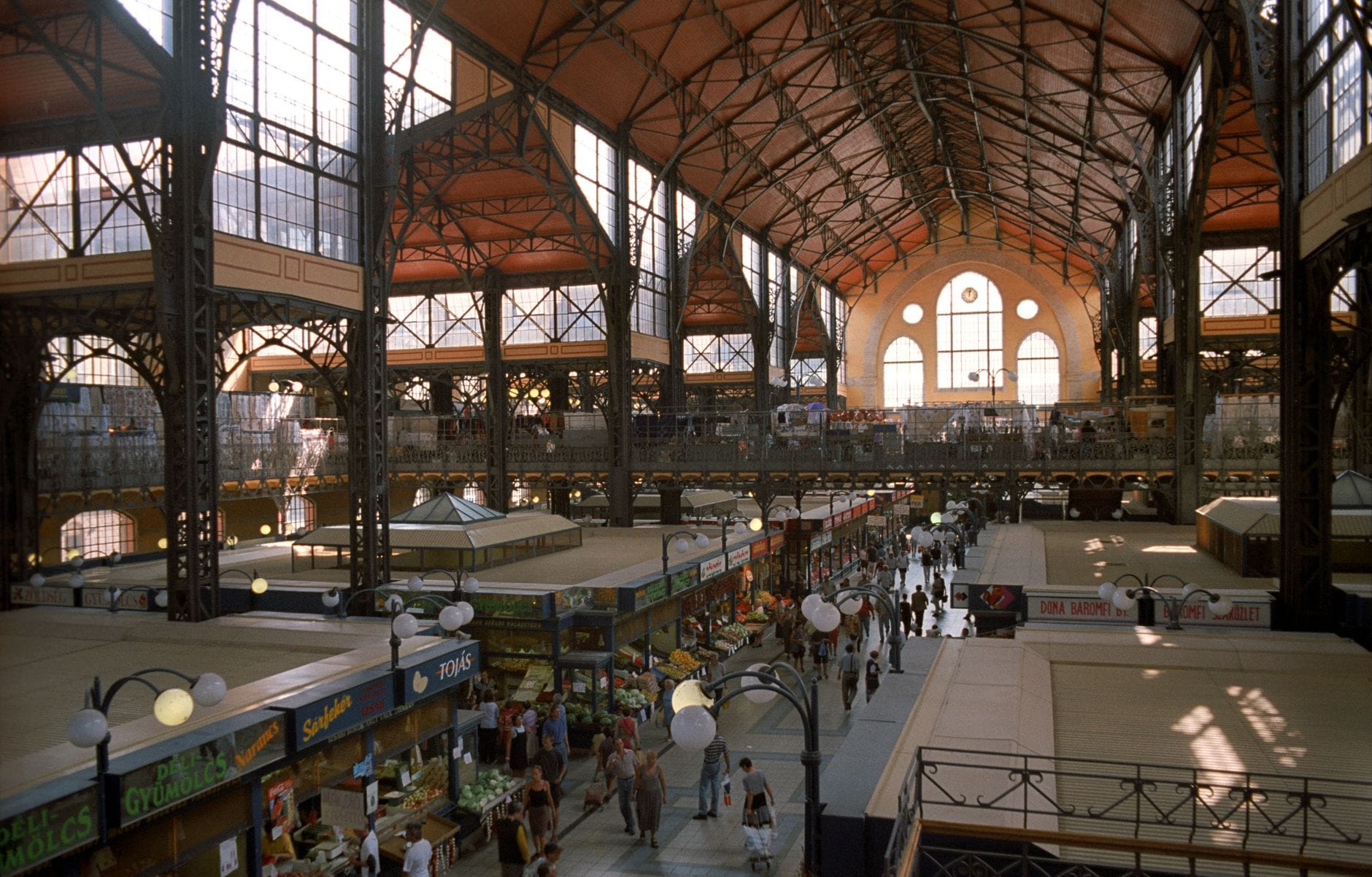
The Central Market Hall, or Nagy Vásárcsarnok, is the largest covered market hall in Budapest, a city that developed a network of market halls during the late 19th century to modernize its food supply. This one, at Fővám tér on the southern end of Váci utca, is the grandest of them all. Designed by architect Samu Petz and opened in 1897, it stretches across three levels and fills a wrought-iron and brick frame that feels closer to a railway terminus than a place to buy peppers.
It is simultaneously a working market used by local Budapestians and a major tourist attraction. Both things are true at once, and which experience you get depends almost entirely on when you arrive. That tension between the two functions is the central thing to understand before you visit.
💡 Local tip
Opening hours: Monday 06:00–17:00, Tuesday–Friday 06:00–18:00, Saturday 06:00–15:00. Closed Sundays and public holidays. Arrive before 09:00 on a weekday for the most authentic local market atmosphere.
The Architecture: Why the Building Itself is Worth Seeing
From the outside, the hall presents a long, low-slung facade along Vámház körút, with a tiled Zsolnay ceramic roof in deep red, green, and yellow that catches even flat winter light. The Zsolnay tilework is the same manufacturer responsible for the roof of the Hungarian Parliament and several other landmark Budapest buildings, and up close the geometric patterning is more intricate than it appears from street level. The main entrance is flanked by towers that give the structure a faintly ecclesiastical silhouette.
Step inside and the scale becomes clear immediately. The central nave rises through three floors of cast-iron balconies, with natural light filtering through the roof structure. This is a good moment to stand still and look up before the crowds thicken. The hall's bones belong to the same era of confident urban infrastructure as the Hungarian Parliament Building, though the market's ambitions were entirely practical rather than symbolic.
The hall was heavily damaged during World War II and fell into disrepair during the Communist decades, when state-controlled food distribution made large covered markets less central to daily life. A comprehensive restoration completed in 1994 returned much of its original character, including the roof tiles and ironwork. What you see today is a well-preserved reconstruction rather than an untouched original, but the spatial experience is genuine.
Tickets & tours
Hand-picked options from our booking partner. Prices are indicative; availability and final rates are confirmed when you complete your booking.
Budapest Private City Tour with Culinary Walk in the Central Market Hall
From 305 €Instant confirmationFree cancellationEscape Tour self-guided, interactive city challenge in Budapest
From 30 €Instant confirmationBudapest Guided E-Scooter Tour by Night
From 60 €Instant confirmationFree cancellationHalf-day tour to Princess Sissi's Godollő royal palace from Budapest
From 41 €Instant confirmationFree cancellation
Floor by Floor: What You'll Find Where
The ground floor is the working market. Produce vendors occupy the main hall: stalls of paprika in every grade and grind, strings of dried peppers hanging from frames, large wheels of mangalica salami wrapped in white mold, jars of acacia and forest honey, pickled vegetables in enormous glass barrels, fresh bread rolls, and seasonal fruits and vegetables. The smell at ground level shifts as you walk: sweet paprika dust near the spice stalls, the sharp brine of pickles, the faint animal smell near the butchers and fish counters at the far end.
Local shoppers do their weekly buying here on weekday mornings. You will see elderly women with wheeled trolleys moving purposefully past stalls, negotiating without theatrics. The vendors know their regulars. If you arrive on a Saturday after 10:00, this quiet efficiency is mostly replaced by tour groups following umbrella-carrying guides, which changes the atmosphere considerably.
The upper gallery, reached by stairs or a lift, is oriented entirely toward tourists. Embroidered tablecloths, hand-painted ceramics, carved wooden objects, linen shirts, and paprika gift sets fill the stalls. Quality varies sharply. Some vendors stock genuinely handmade folk items; others sell the same mass-produced pieces found in airport duty-free stores. If you are buying embroidery or ceramics as gifts, look for items that feel irregular and hand-finished rather than perfectly uniform.
The upper level also has a row of food counters serving lángos, the deep-fried dough topped with sour cream and cheese that has become the standard tourist snack of Budapest. The queues here can stretch to twenty minutes on busy mornings. It is good, but not so exceptional that the wait is always justified.
The basement level holds a small supermarket and additional food stalls, including imported goods and basic groceries. Most visitors skip it entirely, and there is no particular reason to descend unless you need everyday supplies.
When to Go and What to Expect at Different Hours
The gap between a 07:30 visit and an 11:00 visit is significant. Early on a Tuesday or Wednesday, the hall is mostly locals: vendors setting up the last of their stock, pensioners buying vegetables, the occasional chef from a nearby restaurant. The light through the iron-framed roof is clean and directional, the noise level is moderate, and you can actually stop at a stall and ask about the difference between two grades of paprika without feeling rushed.
By mid-morning on a weekend, the dynamic shifts. The hall fills quickly, the main nave becomes slow-moving, and the lángos queue defines the pace of the upper floor. Saturday mornings are the busiest single period of the week. If this is your only option, come right at opening at 06:00, when the market is still functioning on its own terms.
ℹ️ Good to know
The market closes entirely on Sundays and on public holidays. Monday hours are shorter (until 17:00). Check the official site before visiting on or around Hungarian national holidays.
What to Buy: The Honest Version
Paprika is the most practical purchase. Hungarian paprika from market stalls is genuinely better than what most visitors have access to at home, and the vendors at the Central Market Hall typically stock more variety than supermarkets: sweet (édes), hot (erős), smoked (füstölt), and semi-sweet (félédes), in tins or woven fabric bags designed for luggage. It is a good idea to check that the packaging is sealed tightly before buying if you plan to carry it in your bag. For more context on Hungarian food culture, the Budapest food guide covers what to look for beyond the market.
Pick wines and pálinka (Hungarian fruit brandy) from the ground floor vendors if you want to drink them locally, but note that carrying liquids through airport security may complicate your return journey. Salami is vacuum-sealed by most stalls and is more carry-on-friendly than it sounds.
For souvenirs on the upper floor, the embroidered items with visible hand-stitching irregularities and the hand-painted Herend-style ceramics represent better value and quality than the printed-fabric items and mass-produced decorative paprika sets. Prices are not fixed, and polite negotiation on larger purchases is accepted by most vendors, particularly later in the day on Saturday when they are motivated to reduce stock.
Getting There and Practical Notes
The Central Market Hall sits at Fővám tér, directly at the Pest end of the Liberty Bridge. Metro line M4 stops at Fővám tér station, which is the most direct route from Keleti or Kelenföld. Trams 2, 47, and 49 all stop at Fővám tér as well. The market is also at the southern end of Váci utca, so walking south from the Váci utca shopping street brings you directly to the main entrance.
Entry is free at all times. There is no bag check, no security line, and no queue for entry on weekday mornings. Weekends occasionally see brief bottlenecks at the main door during peak hours. Large wheeled suitcases are technically permitted but create friction in the narrow stall aisles, particularly on the ground floor during busy periods.
The building has level access at the main entrance on Vámház körút, and a lift connects the floors. For specific accessibility needs, contact market management at +36 1 366 3300 before your visit, as internal layout and lift availability are not fully documented in public sources.
💡 Local tip
Photography is freely permitted throughout the building. The upper balcony offers a strong overhead angle of the entire ground floor, with the ironwork framing the produce stalls below. Early morning gives the best light through the roof.
Is It Worth It? An Honest Assessment
For most visitors to Budapest, the Central Market Hall is worth an hour of their time, particularly if the visit is timed for a weekday morning. The architecture is genuinely impressive, the ground floor produce section gives a clearer sense of Hungarian food culture than any restaurant, and the paprika selection is a practical reason to visit. It sits close enough to other central Pest attractions that it fits easily into a broader morning, especially if you are already walking the 3-day Budapest itinerary.
The honest caveat: if you visit on a Saturday mid-morning expecting a quiet local market, you will be disappointed. The tourist volume on weekends has changed the character of the upper floor substantially, and the ground floor, while still functional, feels less like a local institution and more like a managed experience. This does not make it bad, but it is worth calibrating expectations.
Visitors who find crowded indoor spaces uncomfortable, or who have no interest in food or crafts, may find that the building itself is not enough to justify the visit over other central Budapest attractions. Those who are specifically interested in Art Nouveau and late-19th-century civic architecture might prefer to note that the exterior and interior structure are worth fifteen minutes of attention, even without buying anything.
If the market feels too busy, the surrounding Pest city center has several quieter alternatives nearby, including the Inner City Parish Church and the riverside promenade along the Danube.
Insider Tips
- The ground floor fish counter at the far (eastern) end of the hall is used almost exclusively by local shoppers and is one of the quieter corners even on busy days. It gives a better sense of the market's working-market function than the main spice stalls.
- Vacuum-sealed Hungarian salami from the ground floor vendors is a legitimate carry-on item for most international flights. Ask the vendor to seal the packet tightly and keep the receipt, as some EU airports require proof of origin for meat products.
- The upper floor lángos stalls at the left side of the balcony (as you face the main hall) typically have shorter queues than the central counters. The product is identical.
- If you are serious about buying embroidered textiles, come on a weekday when vendors have time to show you the full range and explain the regional differences between Kalocsa and Matyó embroidery styles. On Saturdays they are too busy to do anything but process sales.
- The rooftop tiles are best photographed from the middle of Liberty Bridge looking back toward the Pest bank, particularly in late afternoon when the Zsolnay ceramics catch the low sun.
Who Is Central Market Hall (Nagy Vásárcsarnok) For?
- Food lovers who want to buy Hungarian paprika, honey, or salami directly from vendors
- Architecture enthusiasts interested in late-19th-century civic market hall design
- Early-morning visitors who want to observe Budapest's working market culture before tourist hours
- Families with older children looking for an indoor, sensory-rich environment
- Travelers on a budget who want a free attraction that also doubles as a place to assemble a picnic
Nearby Attractions
Other things to see while in Pest City Center (V. District):
- Chain Bridge (Széchenyi Lánchíd)
The Széchenyi Chain Bridge (Széchenyi lánchíd) is one of the oldest and most recognizable bridges in Budapest, linking the historic Pest riverfront with the foot of Castle Hill. Free to cross at any hour, it rewards visitors with sweeping Danube views and a walk through 175 years of Hungarian history.
- Hungarian National Museum
The Hungarian National Museum is the oldest national history museum in Hungary, tracing the country's story from prehistoric times through the 20th century. Housed in a commanding neoclassical building from 1847, it anchors Budapest's Pest district and offers one of the most complete windows into Hungarian identity available to visitors.
- Hungarian Parliament Building
Rising from the Pest bank of the Danube in a symphony of Gothic spires and terracotta stone, the Hungarian Parliament Building is the defining landmark of Budapest. Built between 1885 and 1904, it houses the Holy Crown of Hungary and opens its gilded interior to guided tours on most days. This guide covers everything you need to visit well.
- Inner City Parish Church (Belvárosi Plébániatemplom)
The Belvárosi Plébániatemplom stands at Március 15. tér, a short walk from the Danube, quietly containing two thousand years of history beneath a single roof. Roman ruins, Ottoman prayer niches, Gothic vaulting, and Baroque twin towers make this one of the most architecturally complex buildings in the Hungarian capital.