Hungarian Parliament Building (Országház): The Complete Visitor Guide
Rising from the Pest bank of the Danube in a symphony of Gothic spires and terracotta stone, the Hungarian Parliament Building is the defining landmark of Budapest. Built between 1885 and 1904, it houses the Holy Crown of Hungary and opens its gilded interior to guided tours on most days. This guide covers everything you need to visit well.
Quick Facts
- Location
- Kossuth tér 1-3, 1055 Budapest (District V, Pest bank)
- Getting There
- Metro M2 to Kossuth Lajos tér, or Tram 2 along the Danube embankment
- Time Needed
- 1.5–2.5 hours including queuing and tour
- Cost
- Paid entry; check current ticket rates at parlament.hu before visiting
- Best for
- History lovers, architecture fans, first-time Budapest visitors
- Official website
- www.parlament.hu/web/visitors/house-of-parliament
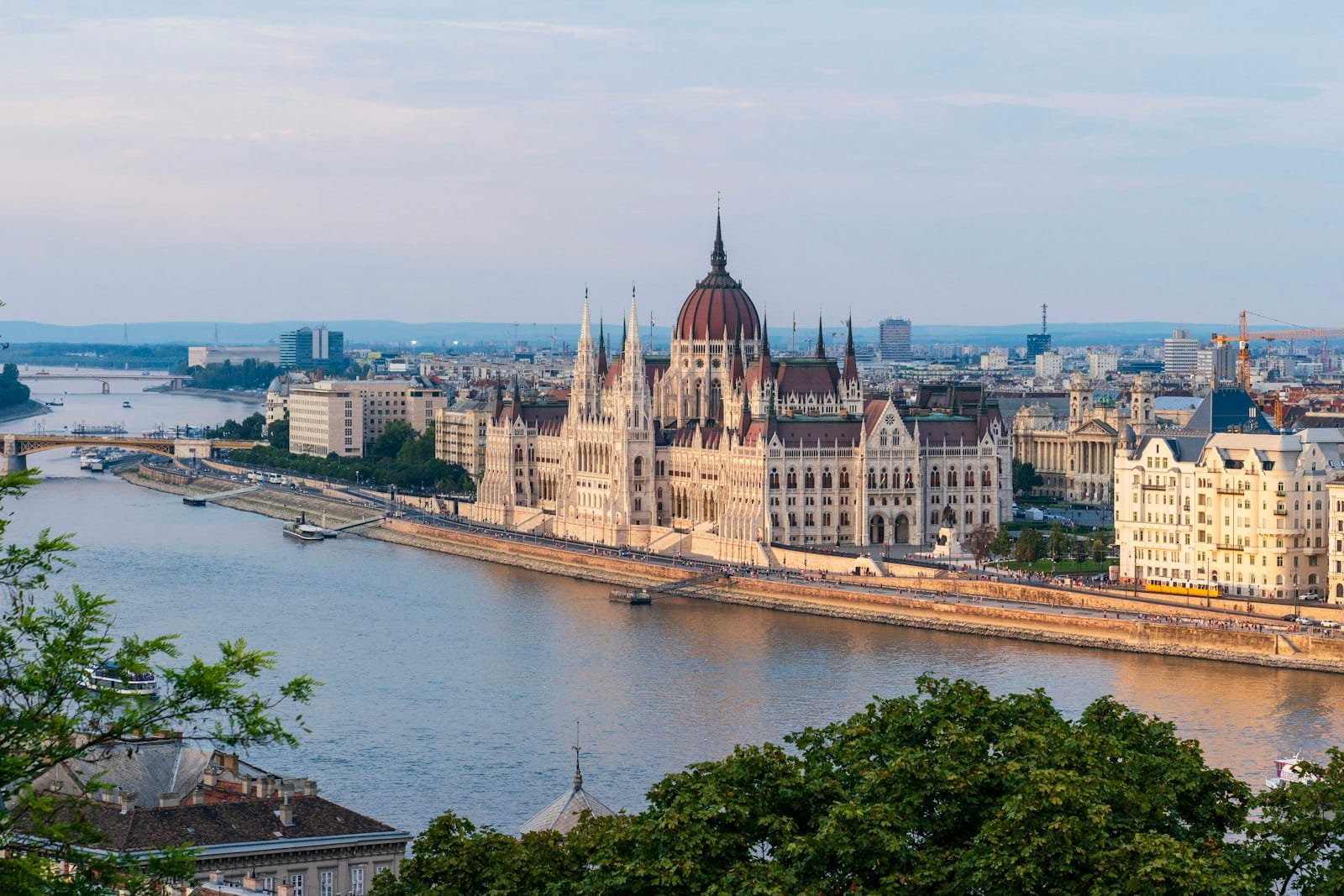
What You're Looking At: Scale, Stone, and Skyline
The Hungarian Parliament Building, known in Hungarian as Országház (literally 'House of the Nation'), dominates the Pest riverbank with a silhouette that has become inseparable from Budapest itself. Constructed between 1885 and 1904 to designs by architect Imre Steindl, the building blends Gothic Revival structure with Renaissance and Baroque decorative elements — an ambitious hybrid that somehow coheres into something genuinely grand. At roughly 268 metres long and featuring a central dome rising to 96 metres (chosen to match the year of Hungary's founding by the Magyar tribes in 896), the building is a landmark of extraordinary scale.
From the embankment side, the façade unfolds across your entire field of vision: hundreds of spires, pointed turrets, arched windows, and terracotta-coloured limestone trimmed in white. The stone has been cleaned and restored in sections over the decades, so the colour shifts slightly across the building's length, which is actually easier to appreciate up close than in photographs. Count the statues if you have patience: there are 90 on the exterior alone, representing Hungarian rulers and military leaders.
💡 Local tip
The best exterior view of the building is from the Buda side of the river, particularly from the tram stop near the Chain Bridge or from the embankment south of Batthyány tér. Early morning light catches the limestone façade directly and crowds on both banks are thinner before 9am.
The Parliament sits on Kossuth Lajos Square (Kossuth Lajos tér), which is itself worth a few minutes of your time. The square is flanked by statues of Hungarian statesmen, including Ferenc Rákóczi II and Lajos Kossuth himself, and the surrounding neoclassical ministry buildings complete the civic gravity of the space. It connects to the broader Pest city center, making it easy to combine with other sights on foot.
Inside the Building: What the Guided Tour Shows You
Visitors enter Országház on guided tours; there is no independent, self-guided access to the interior. Tours run at regular intervals and last approximately 45 minutes to one hour. Groups gather at the Visitor Centre entrance, and guides lead you through a carefully choreographed sequence of the building's most ceremonial spaces.
The Grand Staircase is the first thing that stops most visitors in their tracks. A sweeping double staircase ascends beneath the dome, its vaulted ceiling covered in gold leaf and its walls lined with frescoed murals. The red carpet, the carved stone banisters, the diffused light filtering through stained glass — it reads as pure theatre, and it is intended to. The architects wanted every person entering to feel the weight of the institution.
The Dome Hall is where the tour reaches its emotional peak. At its centre, behind glass and under controlled climate and light, sits the Holy Crown of Hungary (Szent Korona), along with the coronation orb, sceptre, and sword. These are not replicas. The crown itself dates in various parts to the 11th and 12th centuries and has an outsized symbolic role in Hungarian national identity. Photography is permitted in most of the tour, but regulations around the crown jewels should be confirmed on arrival.
The tour also passes through the Upper House Hall, and portions of the route may be adjusted if the legislature is in session. Check the official site in advance if you are visiting during parliamentary periods.
⚠️ What to skip
Tours can sell out on busy days, particularly in summer and around national holidays. Book tickets through the official website (parlament.hu) in advance. On-site ticket purchase is sometimes possible, but queues can be long and tour slots fill up.
Tickets & tours
Live prices and dates from our booking partner. If you book, we may earn a commission at no extra cost to you.
Walking tour of Pest
From 10 €Instant confirmationFree cancellationHungarian wine tasting tour in Budapest
From 54 €Instant confirmationFree cancellationBudapest all-in-one walking tour
From 39 €Instant confirmationFree cancellationEssence tour of Budapest on MonsteRoller
From 45 €Instant confirmationFree cancellation
How the Experience Changes by Time of Day
The first tours of the day, around 8am, move through quieter corridors with noticeably smaller groups. The light inside the dome is softer in the morning, and the Dome Hall in particular feels less compressed without 30 people jostling for photographs. If you have any sensitivity to crowds, an early slot is genuinely different from a midday one.
From roughly 10am to 2pm, the building draws its peak visitor numbers. Tour groups from cruise ships and organized coach tours tend to cluster in this window. The square outside fills with people eating lunch on the steps or posing for photos. It is not unpleasant, but it does shift the atmosphere from contemplative to festive.
Late afternoon, particularly from around 4pm onwards, sees another lull. The low-angle western sun illuminates the dome's stained glass from inside, casting coloured light down onto the Grand Staircase in a way that earlier tours do not get. If you are visiting primarily for photography, a late afternoon slot in spring or autumn is difficult to improve on.
After dark, the building is illuminated and the reflection in the Danube is one of Budapest's most photographed night images. You will not be inside at this hour, but the embankment walk along the Pest bank between the Parliament and the Chain Bridge is a worthwhile evening stroll. The building's floodlighting turns the limestone a warm amber.
Getting There and Practical Logistics
The most straightforward approach is the M2 (red) metro line to Kossuth Lajos tér. The station is right by the square in front of the building. Tram 2 runs along the Danube embankment and stops a short walk from the Parliament, which is useful if you are coming from the Chain Bridge and want to combine a riverside walk with your visit.
Walking from the city centre is also practical. From Vörösmarty tér or Deák Ferenc tér, the walk takes around 15–20 minutes through the Lipótváros (Leopold Town) district. For a broader overview of navigating the city, the getting around Budapest guide covers public transport options in detail.
Visitor entrance is at Gate X on the southern side of the building, facing Kossuth Lajos tér. Bag screening and security checks are standard on entry, so arrive a few minutes before your tour slot. Large bags and luggage are not permitted inside. The building is reported to have accessibility provisions, but specific details should be confirmed directly with the official visitors office before planning an accessible visit.
ℹ️ Good to know
The Parliament is closed to visitors on some Hungarian national holidays and during certain state events. Plan accordingly.
Historical and Cultural Context
The decision to build a permanent home for the Hungarian parliament came in the wake of the Austro-Hungarian Compromise of 1867, which established the dual monarchy and gave Hungary a degree of political autonomy it had not had for centuries. The ambition behind Országház was inseparable from the politics of the moment: Hungary wanted a parliament building that would stand visually and symbolically alongside the great legislative buildings of Europe. Architect Imre Steindl won the design competition in 1882, and work began three years later.
Construction took nearly two decades and involved over a thousand workers at peak periods. Steindl himself did not live to see the formal inauguration; he died in 1902, and the building was completed in 1904. The timing means the building straddles two eras: it was conceived in the optimism of the late 19th century and completed at the threshold of the 20th, a period when Hungary was about to enter decades of upheaval — two world wars, the dissolution of the Austro-Hungarian Empire, occupation, and authoritarian rule.
The building was used continuously through much of this turbulence, though its democratic function was suspended during the communist period. Understanding this history adds weight to a visit, particularly if you pair it with a stop at the Terror Háza museum, which documents the 20th-century authoritarian periods in depth.
Today, Országház functions as a working legislature. The National Assembly of Hungary meets here for regular sessions, and the building's dual identity as political workplace and cultural monument creates occasional friction: tour routes can be curtailed during active sessions, and the visitor experience is shaped around the needs of a functioning institution.
Photography and What to Expect Visually
Interior photography is generally permitted during tours, though flash is prohibited in some areas and the crown jewels display area has specific rules that guides will communicate on site. A wide-angle lens (or the widest setting on your phone) is genuinely useful inside the Grand Staircase and Dome Hall, as the spaces are tall and the architectural details are spread across large vertical surfaces.
For exterior shots, the Danube embankment on the Buda side gives the most complete view of the full façade. A boat tour along the river gives you a moving perspective that no fixed point on either bank can replicate. Early morning and the hour before sunset are optimal for avoiding harsh shadows across the stone. Winter visits offer one unexpected advantage: the bare trees along Kossuth tér no longer obstruct square-level shots, and on clear cold days the low sun creates strong directional light across the exterior stonework.
The Parliament appears on the back of the 10,000 Hungarian forint note and on countless postcards, which means many visitors arrive with a fixed image in mind. The building usually exceeds that image in person. If you want to understand how it fits into Budapest's wider visual identity, the Budapest views and viewpoints guide lists the best vantage points across the city.
Who Should Skip This Attraction
Visitors who dislike structured guided tours will find the experience frustrating. There is no option to explore independently, linger in the dome longer than the tour schedule allows, or revisit a room you found particularly interesting. The pace is set by the guide and the group, and that is non-negotiable.
Travelers with very limited time in Budapest may also want to weigh the opportunity cost. The queue, security screening, waiting for your tour slot, and the tour itself can consume two to three hours of a short trip. If your priority is breadth rather than depth, the exterior view from the Buda bank is striking and free, and the time might be better spent elsewhere. That said, the interior, particularly the Dome Hall with the Holy Crown, is genuinely not reproducible from outside and is among the more historically significant spaces in Central Europe.
Insider Tips
- Book your ticket online at least a day or two ahead during summer (June–August) and around the August 20 national holiday period — tours sell out entirely, and same-day availability at the gate is not guaranteed.
- Check the official ticket page for current pricing and any concession categories before assuming a standard rate applies to you.
- After your tour, walk south along the Danube embankment toward the Shoes on the Danube memorial, which is a fifteen-minute walk and a powerful contrast in register: from ceremonial grandeur to quiet memorial.
- The square outside Kossuth Lajos tér often hosts political demonstrations — if you see a gathering, it is part of Hungarian civic life, not necessarily a disruption to avoid.
- Tram 2 running along the Pest embankment gives you a moving window-seat view of the Parliament's full river-facing façade at no extra cost — ride it from Jászai Mari tér down toward Fővám tér for the full panorama.
Who Is Hungarian Parliament Building For?
- First-time visitors to Budapest who want to understand the city's historical and political identity
- Architecture enthusiasts drawn to Gothic Revival and late 19th-century civic design
- History travelers interested in the Austro-Hungarian Empire, Hungarian nationhood, and the story of the Holy Crown
- Photographers seeking the most dramatic daylight and dusk reflections on the Danube
- Travelers pairing a cultural morning with a riverside walk and nearby Pest landmarks
Nearby Attractions
Other things to see while in Pest City Center (V. District):
- Central Market Hall (Nagy Vásárcsarnok)
The Central Market Hall, known locally as Nagy Vásárcsarnok, is Budapest's largest historic covered market hall. Built in 1897 to a design by architect Samu Petz, it fills three floors with fresh produce, Hungarian specialties, folk crafts, and street food. Entry is free, and it sits steps from the Liberty Bridge in the heart of Pest.
- Chain Bridge (Széchenyi Lánchíd)
The Széchenyi Chain Bridge (Széchenyi lánchíd) is one of the oldest and most recognizable bridges in Budapest, linking the historic Pest riverfront with the foot of Castle Hill. Free to cross at any hour, it rewards visitors with sweeping Danube views and a walk through 175 years of Hungarian history.
- Hungarian National Museum
The Hungarian National Museum is the oldest national history museum in Hungary, tracing the country's story from prehistoric times through the 20th century. Housed in a commanding neoclassical building from 1847, it anchors Budapest's Pest district and offers one of the most complete windows into Hungarian identity available to visitors.
- Inner City Parish Church (Belvárosi Plébániatemplom)
The Belvárosi Plébániatemplom stands at Március 15. tér, a short walk from the Danube, quietly containing two thousand years of history beneath a single roof. Roman ruins, Ottoman prayer niches, Gothic vaulting, and Baroque twin towers make this one of the most architecturally complex buildings in the Hungarian capital.
Planning a trip? Discover personalized activities with the Nomado app.