Hungarian National Museum: Hungary's Story in One Building
The Hungarian National Museum is the oldest national history museum in Hungary, tracing the country's story from prehistoric times through the 20th century. Housed in a commanding neoclassical building from 1847, it anchors Budapest's Pest district and offers one of the most complete windows into Hungarian identity available to visitors.
Quick Facts
- Location
- Múzeum körút 14–16, District VIII, Budapest
- Getting There
- M3 to Kálvin tér (3-min walk) or M2 to Astoria (5-min walk); trams 47 and 49 to Kálvin tér
- Time Needed
- 2–3 hours for a thorough visit; 90 minutes if focused on the permanent collection
- Cost
- From 3,500 Ft (adults); free for under-6s and over-70s; Budapest Card holders enter free. Verify current prices at mnm.hu
- Best for
- History enthusiasts, architecture lovers, families with older children, first-time Budapest visitors
- Official website
- mnm.hu/en
What the Hungarian National Museum Actually Is
The Hungarian National Museum (Magyar Nemzeti Múzeum) is Hungary's oldest national history museum, and it makes no attempt to be subtle about its ambition. Founded in 1802 when Count Ferenc Széchényi donated his private collection of manuscripts, maps, and coins to the Hungarian state, the institution was conceived as a custodian of national identity at a time when Hungary was fighting to define itself within the Habsburg Empire.
The current building, designed by architect Mihály Pollack and constructed between 1837 and 1847, is itself part of the experience. Its monumental neoclassical facade, wide stone steps, and columned portico were deliberate statements of civic permanence and cultural pride. The museum’s permanent exhibition opened in 1848 and became immediately symbolic: it was on the steps of this building that the poet Sándor Petőfi reportedly read his National Song on March 15, 1848, sparking the Hungarian Revolution against Habsburg rule. That date, March 15, remains a national holiday, and the museum gardens are often the site of commemorations.
For visitors exploring central Pest, the museum sits on Múzeum körút, one of the inner ring boulevards that forms the backbone of the Pest city center. It is a short walk from the Great Synagogue and within easy reach of the main shopping and café strips.
💡 Local tip
The museum is closed on Mondays. Tuesday through Sunday, doors open at 10:00 and close at 18:00, with last admission at 17:00. Check mnm.hu before visiting, as hours may change on national holidays.
The Building: Neoclassical Architecture Worth Stopping For
Before you step inside, spend a few minutes with the exterior. Mihály Pollack's design draws on the Greek Revival vocabulary popular in the 1830s and 1840s across Europe, but the scale here is unusually confident. Eight Corinthian columns front the main portico, and the building's wings extend on either side with restrained symmetry. The stone used for the facade has developed a warm, slightly weathered tone over nearly two centuries, making it feel rooted rather than imposing.
The garden surrounding the museum is a genuine public space, not just a formal forecourt. Stone benches line the paths, and on warm afternoons local residents sit there alongside tourists. It is quieter than the street-level bustle of nearby Váci Street, and the contrast makes the museum feel like it occupies a different pace of city entirely.
If you have a broader interest in Budapest's architectural heritage, the museum pairs naturally with a walk along the Hungarian State Opera House and the grand boulevard of Andrássy Avenue, both of which reflect the same late-19th-century ambition to build a capital worthy of a major European nation.
Tickets & tours
Live prices and dates from our booking partner. If you book, we may earn a commission at no extra cost to you.
Hungarian wine tasting tour in Budapest
From 54 €Instant confirmationFree cancellationHungarian dinner with Danube River cruise
From 55 €Instant confirmationFree cancellationBudapest Guided E-Scooter Tour by Night
From 60 €Instant confirmationFree cancellationHalf-day tour to Princess Sissi's Godollő royal palace from Budapest
From 41 €Instant confirmationFree cancellation
Inside: What the Permanent Collection Covers
The core of the museum is its permanent historical exhibition, which runs chronologically from prehistoric Hungary through the Roman period, the Magyar conquest of the Carpathian Basin in 895, the medieval Kingdom of Hungary, the Ottoman occupation, Habsburg rule, and into the 20th century. The final sections address the two world wars and the communist era, though coverage of the post-1945 period has at times felt more cautious than the pre-20th-century galleries. If that era interests you specifically, the Terror House on Andrássy Avenue provides a more focused and visceral account.
Among the standout objects in the collection is the coronation mantle of the Hungarian kings, a silk vestment from the 11th century embroidered with extraordinary precision and considered one of the finest surviving examples of Romanesque textile work in Europe. The Holy Crown of Saint Stephen (the actual crown) is housed in the Hungarian Parliament Building, but the museum holds related regalia and artifacts that place it in context. Roman-era finds from the Pannonia region are also well represented, with mosaic floors, bronze figurines, and everyday objects that make the ancient past feel concrete.
The layout across two main floors is generally logical, though some label translation into English is more thorough in certain galleries than others. Bring patience for the medieval and early modern sections, where context is sometimes assumed rather than explained. Audio guides are available and worth considering if you want to move efficiently through the collection rather than piecing together the narrative yourself.
ℹ️ Good to know
EU citizens aged 6–26 and 62–70 pay half price. Children under 6 and visitors over 70 enter free. On the third Saturday of every month, EU citizens under 26 enter the permanent exhibitions at no charge. Verify all prices at mnm.hu before your visit.
When to Visit and How the Experience Changes by Time of Day
The museum is quietest on weekday mornings, particularly Tuesday through Thursday. Arriving at 10:00 when the doors open gives you the first floor almost entirely to yourself, and the quality of natural light through the tall windows in the main halls is notably good in the morning hours. By early afternoon, organized school groups begin to move through, and the sound level rises considerably in the Roman and medieval galleries.
Weekend afternoons, especially between 13:00 and 16:00, are the busiest periods. Families with children dominate the ground floor, and some of the display cases in the prehistoric section can become crowded. If you are visiting on a Saturday with the intention of studying individual artifacts closely, arriving at opening time makes a measurable difference.
Weather affects the decision to visit primarily in the sense that a rainy day in Budapest pushes more people indoors. On grey, wet days in shoulder season, expect slightly longer queues at the ticket desk. The museum itself is climate-controlled and comfortable year-round, making it a reasonable choice on days when outdoor exploration is unpleasant.
For a full picture of how to structure your Budapest days around weather and season, the best time to visit Budapest guide covers the trade-offs between the spring and autumn shoulder seasons and the busier summer months in practical detail.
Getting There and Practical Logistics
The museum's address is Múzeum körút 14–16, in District VIII. The most straightforward approach by public transport is the M3 metro line to Kálvin tér, a three-minute walk from the museum entrance. Alternatively, Astoria on the M2 line is a five-minute walk in the opposite direction along the körút. Trams 47 and 49, which run frequently along the inner ring road, also stop at Kálvin tér.
The building's main entrance is up a wide external staircase, which is part of the architectural drama but presents a genuine challenge for visitors with limited mobility. The museum has alternative access arrangements, but checking directly with the museum before visiting is advisable if step-free access is required.
The cloakroom just inside the entrance is free to use and strongly recommended: the galleries are spread across two floors and several wings, and carrying a large bag through narrow display corridors becomes tiring quickly. Photography without flash is generally permitted in the permanent galleries, though always confirm with staff near temporary exhibitions, where rules sometimes differ.
How It Fits Into a Budapest Itinerary
The Hungarian National Museum is a logical pairing with other central Pest attractions. The Great Synagogue is less than 10 minutes' walk north along Dohány Street, and the two together make a coherent half-day focused on Budapest's layered history. The Central Market Hall is about 15 minutes on foot south toward the Danube, offering an obvious lunch stop before or after.
Visitors following a three-day itinerary in Budapest often place the National Museum on day one or two, when the appetite for context and history is strongest. For a structured approach to sequencing the city's major attractions, the Budapest 3-day itinerary provides a practical framework.
The museum is not the right choice for visitors primarily interested in art. The permanent collection is historical and archaeological, not fine art. Paintings and decorative arts are better served by the Museum of Fine Arts in City Park or the Hungarian National Gallery in Buda Castle. If you arrive expecting a visual art experience, you will find the collection somewhat text-heavy and object-focused by comparison.
⚠️ What to skip
The museum is closed every Monday. Several national holidays also result in closures. Always check mnm.hu for the current schedule before planning your day around a visit.
Insider Tips
- The garden to the front of the building is a legitimate destination on its own in warm weather. Locals use it as a shortcut and a rest stop, and it is one of the few genuinely calm outdoor spaces in this part of Pest. Sitting there for 15 minutes before or after the museum is not wasted time.
- The ticket desk can have a modest queue at peak times, but the museum sells tickets online through mnm.hu. Buying in advance saves a short wait and lets you walk straight to the entrance.
- The coronation mantle gallery is one of the quieter areas of the museum even on busy days, partly because it requires navigating through several earlier rooms to reach it. The object itself, a silk embroidery from around 1031, is extraordinary in person and worth the effort to find.
- If you hold a Budapest Card, your entry to the permanent collection is included. The card also covers public transport, so you can take metro lines such as the M3 to Kálvin tér without any additional cost. The card pays for itself quickly if you are visiting multiple museums in a short trip.
- The museum shop near the exit stocks a better-than-average selection of books on Hungarian history in English, including academic titles not easily found in general bookshops. If you are interested in reading more after your visit, it is worth browsing even if you buy nothing.
Who Is Hungarian National Museum For?
- First-time Budapest visitors who want historical context before exploring the rest of the city
- History and archaeology enthusiasts with a specific interest in Central European medieval and early modern periods
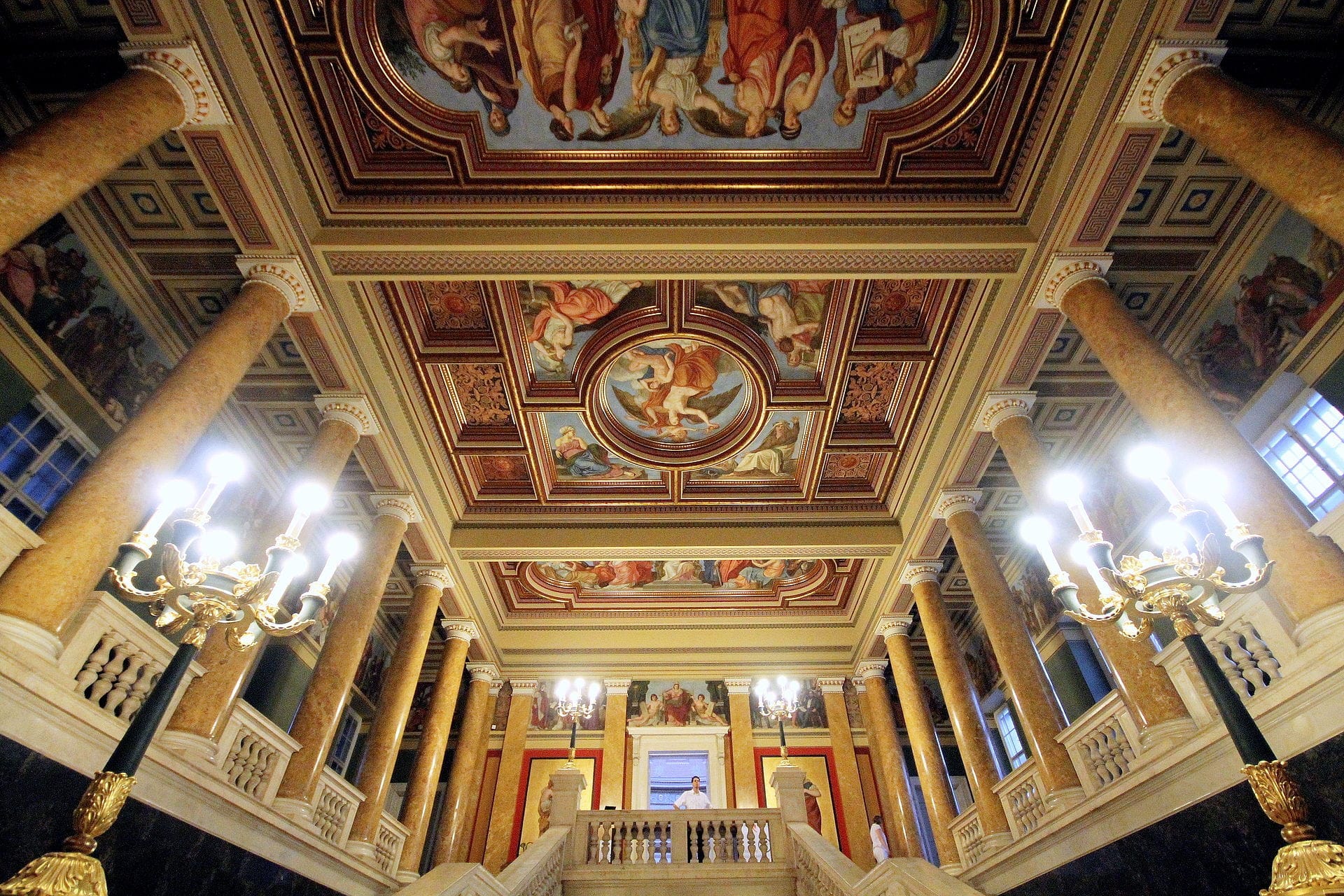
- Architecture followers who appreciate neoclassical civic buildings and want to see one of Budapest's finest 19th-century interiors
- Families with children aged 10 and above who can engage with object-based historical displays
- Travelers on a budget, particularly EU citizens under 26 who can enter free on the third Saturday of each month
Nearby Attractions
Other things to see while in Pest City Center (V. District):
- Central Market Hall (Nagy Vásárcsarnok)
The Central Market Hall, known locally as Nagy Vásárcsarnok, is Budapest's largest historic covered market hall. Built in 1897 to a design by architect Samu Petz, it fills three floors with fresh produce, Hungarian specialties, folk crafts, and street food. Entry is free, and it sits steps from the Liberty Bridge in the heart of Pest.
- Chain Bridge (Széchenyi Lánchíd)
The Széchenyi Chain Bridge (Széchenyi lánchíd) is one of the oldest and most recognizable bridges in Budapest, linking the historic Pest riverfront with the foot of Castle Hill. Free to cross at any hour, it rewards visitors with sweeping Danube views and a walk through 175 years of Hungarian history.
- Hungarian Parliament Building
Rising from the Pest bank of the Danube in a symphony of Gothic spires and terracotta stone, the Hungarian Parliament Building is the defining landmark of Budapest. Built between 1885 and 1904, it houses the Holy Crown of Hungary and opens its gilded interior to guided tours on most days. This guide covers everything you need to visit well.
- Inner City Parish Church (Belvárosi Plébániatemplom)
The Belvárosi Plébániatemplom stands at Március 15. tér, a short walk from the Danube, quietly containing two thousand years of history beneath a single roof. Roman ruins, Ottoman prayer niches, Gothic vaulting, and Baroque twin towers make this one of the most architecturally complex buildings in the Hungarian capital.
Planning a trip? Discover personalized activities with the Nomado app.