Széchenyi Chain Bridge: Budapest's Most Iconic Crossing
The Széchenyi Chain Bridge (Széchenyi lánchíd) is one of the oldest and most recognizable bridges in Budapest, linking the historic Pest riverfront with the foot of Castle Hill. Free to cross at any hour, it rewards visitors with sweeping Danube views and a walk through 175 years of Hungarian history.
Quick Facts
- Location
- Széchenyi Lánchíd, 1051 Budapest — connecting Széchenyi István tér (Pest) and Clark Ádám tér (Buda)
- Getting There
- Tram 2 to Széchenyi István tér (Pest side); buses and trams to Clark Ádám tér (Buda side); short walk from the Deák Ferenc tér metro hub (M1, M2, M3).
- Time Needed
- 20–40 minutes for a leisurely crossing; longer if you linger for photos or combine with the Castle Hill Funicular
- Cost
- Free — no ticket required, open 24 hours a day, year-round
- Best for
- Sunset walks, panoramic photography, history enthusiasts, and anyone connecting Pest to Castle Hill
What Is the Chain Bridge?
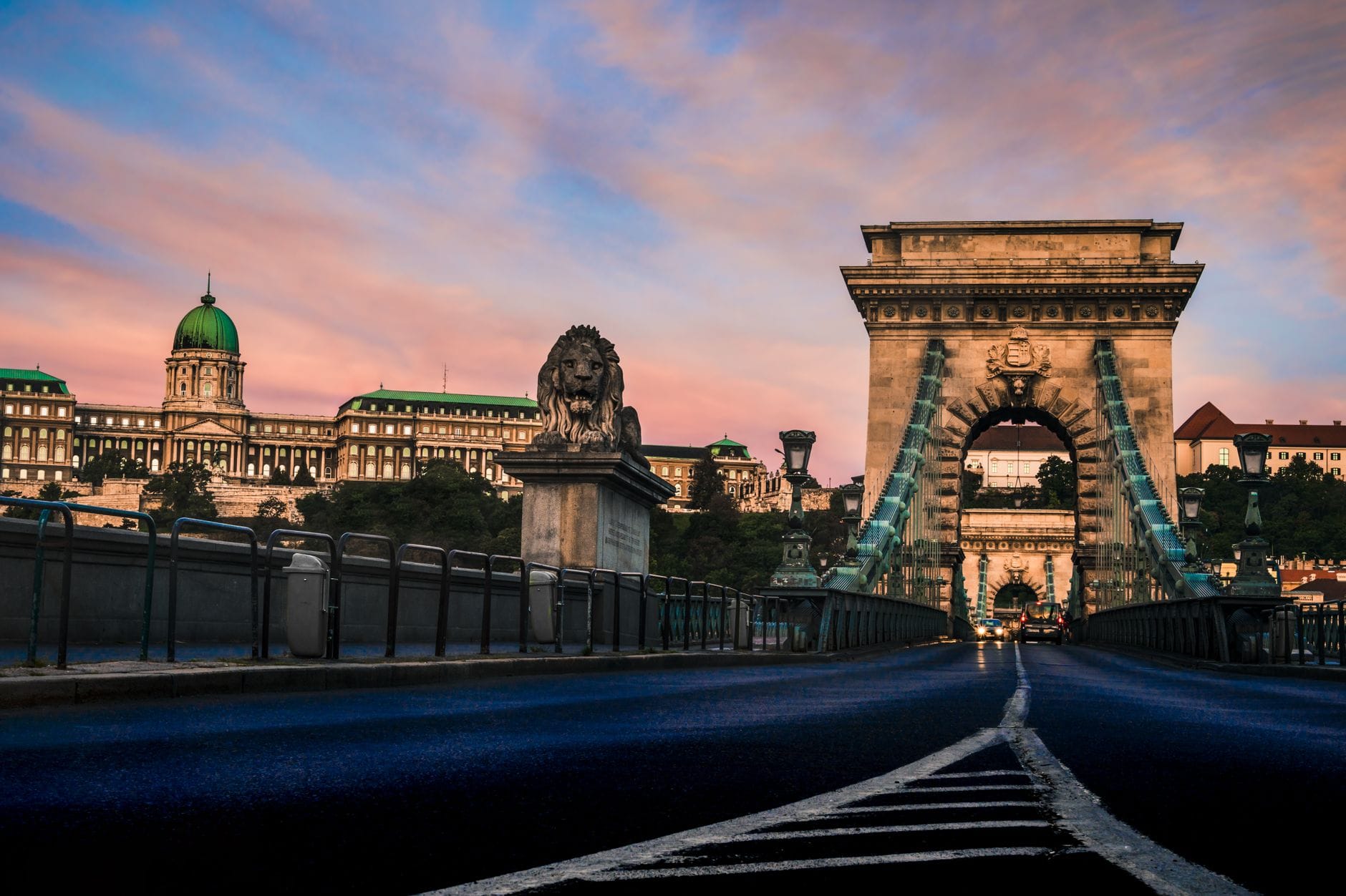
The Széchenyi Chain Bridge, known locally as Széchenyi lánchíd, is a suspension bridge spanning approximately 375 metres across the Danube River in the heart of Budapest. Opened on 20 November 1849, it was the first permanent bridge ever built to connect Buda and Pest, two cities that had, until then, relied on seasonal pontoon crossings and ferries. That single engineering achievement did more than solve a transport problem: it accelerated the economic and cultural unification of the two banks, and ultimately the creation of a unified Budapest in 1873.
The bridge is free to cross on foot at any hour of the day or night, which makes it one of the most accessible major landmarks in the city. For a broader look at how it fits into the full Budapest experience, see our complete guide to things to do in Budapest.
ℹ️ Good to know
The Chain Bridge is permanently closed to private cars following its most recent renovation. It is open to pedestrians, cyclists, buses, taxis, and motorcycles. Confirm current vehicular access via BKK (Centre for Budapest Transport) before visiting if you are planning to drive.
A Short History Worth Knowing
The bridge was conceived largely through the determination of Count István Széchenyi, a Hungarian reformer who became stranded on the Pest bank when winter ice broke up the pontoon bridge, delaying his journey to his father's funeral. That frustration reportedly catalysed years of advocacy for a permanent crossing. The engineering was entrusted to English designer William Tierney Clark, and Scottish engineer Adam Clark was hired to supervise construction on the ground from 1839 to 1849.
The two stone lion sculptures that guard each entrance, created by sculptor János Marschalkó, became immediate symbols of the city. The bridge's 48-metre-tall stone towers support two chains of wrought iron links, a design that was considered remarkably modern for its era. The circular plaza at the Buda end still bears Adam Clark's name: Clark Ádám tér.
In January 1945, retreating German forces blew up every bridge in Budapest. The Chain Bridge collapsed into the Danube along with all the others. Reconstruction began in 1947, and in a deliberate act of symbolic continuity, the rebuilt bridge was reopened on 20 November 1949 — exactly the 100th anniversary of the original inauguration. The lion sculptures were restored to their original positions.
Understanding this history transforms a walk across the bridge into something more than sightseeing. It connects directly to the broader arc of Budapest's turbulent 20th century, which is covered in detail in our Budapest history guide.
Tickets & tours
Live prices and dates from our booking partner. If you book, we may earn a commission at no extra cost to you.
Janos hill tower visit by chairlift in Budapest
From 39 €Instant confirmationFree cancellationBudapest Guided E-Scooter Tour by Night
From 60 €Instant confirmationFree cancellationHalf-day tour to Princess Sissi's Godollő royal palace from Budapest
From 41 €Instant confirmationFree cancellationHalf-Day Countryside Wine Tour from Budapest
From 95 €Instant confirmationFree cancellation
The Experience: Walking the Bridge at Different Times
The crossing itself takes about ten minutes at a normal walking pace, but very few people actually walk at a normal pace here. The pedestrian walkways run along both outer edges of the bridge's 14.5-metre width, separated from the central traffic lanes by a low railing. Underfoot, the pavement is stone-grey and solid; the ironwork chains rise at a steep angle from the pylons and you can feel the faint vibration of passing buses through the soles of your shoes.
Early morning, roughly 7am to 9am, the bridge belongs almost entirely to commuters. Cyclists move quickly, the Pest bank behind you is starting to fill with office workers, and the light on the Buda hillside, still slightly cool and pale, catches the stone of the Royal Palace in a way that midday heat flattens completely. This is not the most dramatic time, but it is the most peaceful.
Midday in summer brings heat reflected off the pale stonework of the towers and the Danube glittering below. The southern chain, closer to the inner city, frames the dome of St. Stephen's Basilica from certain angles on the Pest approach. Tourist numbers peak between 10am and 3pm; the bridge walkways can become slow-moving during this window, which is not necessarily a problem since the views improve the longer you pause.
Sunset and the first hour of darkness are when the bridge performs at its best. The lions are lit from below, casting upward shadows across their blank stone faces. The chain pylons glow amber against a darkening sky. Looking east toward Pest, the illuminated dome of the Parliament building appears above the river. Looking west toward Buda, the floodlit terraces of the Royal Palace sit above the treeline. In winter, when river fog occasionally drifts low over the Danube, the scene becomes genuinely otherworldly.
💡 Local tip
For the best photographs of the bridge itself, cross it and then walk down to the riverside promenade on either bank. The Pest side offers the classic composition with Castle Hill behind the bridge. The Buda side, near Clark Ádám tér, puts you directly beneath the south tower for dramatic upward shots of the chains.
Getting There and Starting Points
From the Pest side, the most straightforward approach is Tram 2, which runs along the Danube embankment and stops at Széchenyi István tér, the square directly in front of the bridge's eastern entrance. This is also a pleasant walk from Deák Ferenc tér (metro hub for lines M1, M2, M3), about ten minutes south along the river.
From the Buda side, buses serve Clark Ádám tér at the western entrance. The lower station of the Castle Hill Funicular (Budavári Sikló) is located just steps from the Buda bridgehead, making the Chain Bridge a natural first leg of a Buda Castle itinerary: cross on foot, then ride the funicular up to the Palace district.
If you are planning a full day on this side of the river, our guide to Castle Hill covers everything from Matthias Church to the hospital tunnels built into the bedrock below the Palace.
What to Watch Out For
The bridge is exposed to all weather. In winter, when temperatures in Budapest drop below freezing, the metal railings become ice-cold to the touch and the walkways can be slippery after frost or light snow. Wind funnels along the river corridor with more force than you expect; a mid-weight jacket that you thought was sufficient on the Pest embankment may feel thin by the time you reach mid-span. Pack accordingly from October through March.
Summer heat poses the opposite challenge. There is zero shade on the bridge. Stone and iron absorb heat through the morning and radiate it back in the afternoon. A 15-minute crossing in July midday sun will feel considerably longer. Water, sunglasses, and sun protection are not optional in peak summer.
⚠️ What to skip
The Chain Bridge is one of the most photographed structures in Budapest, and the Pest approach plaza fills with group tours from mid-morning onwards. If you prefer to cross without navigating around tour groups, aim for before 9am or after 7pm.
Accessibility is reasonable but not fully documented. The bridge connects at street level on both sides, which avoids stairs, but the surface condition and precise arrangements for wheelchair users are best confirmed directly via the BKK transport authority before your visit.
Combining the Bridge with the Surrounding Area
The Chain Bridge sits at the centre of a dense cluster of significant sites. On the Pest side, Széchenyi István tér leads into the inner city, with the Four Seasons Hotel (housed in the 1906 Art Nouveau Gresham Palace) immediately beside the bridge entrance. A five-minute walk north reaches the Hungarian Parliament Building, best viewed from the riverbank.
On the Buda side, beyond Clark Ádám tér, the Castle Hill Funicular rises to the Royal Palace terrace. If you prefer to walk up, a series of stairways and cobbled lanes ascend through the Castle District. The walk takes 15–20 minutes and passes several quiet courtyards most visitors miss entirely.
The Chain Bridge is also one of Budapest's best-known viewpoints. For a systematic look at where to see the city from above, consult our roundup of Budapest views and viewpoints.
Insider Tips
- The Hungarian zero kilometre stone, from which all Hungarian road distances are officially measured, sits in Clark Ádám tér on the Buda side. It is a small sculptural marker near the tunnel entrance. Worth a photograph if you know to look for it.
- The walkways on both sides of the bridge offer slightly different perspectives. The south-facing walkway gives you the better angle on the Gellért Hill and Citadel; the north-facing walkway puts Parliament in your sightline. Walk out on one side and return on the other.
- The bridge is particularly photogenic during Budapest's occasional winter fogs, typically in November and December, when the Buda towers disappear into low cloud from the Pest side. Check the weather forecast: a foggy morning can produce extraordinary photographs.
- If you are visiting in late spring or early autumn and plan to be near the bridge after dark, bring a warm layer regardless of the daytime temperature. River air drops noticeably cooler after sunset, and the best evening light lingers long enough that you will want to stay.
- The lions at each of the four pylon bases have become a minor urban legend: an often-repeated story claims they were sculpted without tongues, causing the sculptor to throw himself into the Danube in shame. This is a myth — the lions do have tongues, visible on close inspection. It makes for a good reason to examine them up close.
Who Is Chain Bridge (Széchenyi Lánchíd) For?
- First-time visitors who want to understand Budapest's geography by physically crossing from Pest to Buda
- Photographers, especially at golden hour or in winter atmospheric conditions
- History enthusiasts interested in 19th-century engineering and the city's wartime destruction and reconstruction
- Travellers combining a Pest riverfront walk with a visit to Buda Castle or the Castle Hill Funicular
- Anyone looking for a free, no-planning-required activity that works at any time of day
Nearby Attractions
Other things to see while in Pest City Center (V. District):
- Central Market Hall (Nagy Vásárcsarnok)
The Central Market Hall, known locally as Nagy Vásárcsarnok, is Budapest's largest historic covered market hall. Built in 1897 to a design by architect Samu Petz, it fills three floors with fresh produce, Hungarian specialties, folk crafts, and street food. Entry is free, and it sits steps from the Liberty Bridge in the heart of Pest.
- Hungarian National Museum
The Hungarian National Museum is the oldest national history museum in Hungary, tracing the country's story from prehistoric times through the 20th century. Housed in a commanding neoclassical building from 1847, it anchors Budapest's Pest district and offers one of the most complete windows into Hungarian identity available to visitors.
- Hungarian Parliament Building
Rising from the Pest bank of the Danube in a symphony of Gothic spires and terracotta stone, the Hungarian Parliament Building is the defining landmark of Budapest. Built between 1885 and 1904, it houses the Holy Crown of Hungary and opens its gilded interior to guided tours on most days. This guide covers everything you need to visit well.
- Inner City Parish Church (Belvárosi Plébániatemplom)
The Belvárosi Plébániatemplom stands at Március 15. tér, a short walk from the Danube, quietly containing two thousand years of history beneath a single roof. Roman ruins, Ottoman prayer niches, Gothic vaulting, and Baroque twin towers make this one of the most architecturally complex buildings in the Hungarian capital.
Planning a trip? Discover personalized activities with the Nomado app.