Castle Hill Funicular (Budavári Sikló): The 90-Second Ride Up to Buda Castle
The Budavári Sikló has been hauling passengers from the Danube bank to the top of Castle Hill since 1870, making it one of Europe's oldest passenger funiculars. The ride takes just 90 seconds, but the views over the Chain Bridge and the Pest skyline make it worth every forint.
Quick Facts
- Location
- Lower station: Clark Ádám tér, District I (Buda side of Chain Bridge). Upper station: Szent György tér, Buda Castle.
- Getting There
- Buses 16 and 105 to Clark Ádám tér. Upper station served by buses 16, 16A, and 116.
- Time Needed
- The ride itself is 90 seconds. Allow 10–20 minutes for queuing in peak season, plus your time exploring Castle Hill.
- Cost
- Adult return HUF 5,500 / one-way HUF 4,500. Children (3–14) return HUF 3,000 / one-way HUF 2,000. Under 3 free. Cash (HUF only) at the ticket window; card payment may also be available.
- Best for
- First-time visitors, families with young children, anyone who wants the classic Danube panorama without the uphill climb.
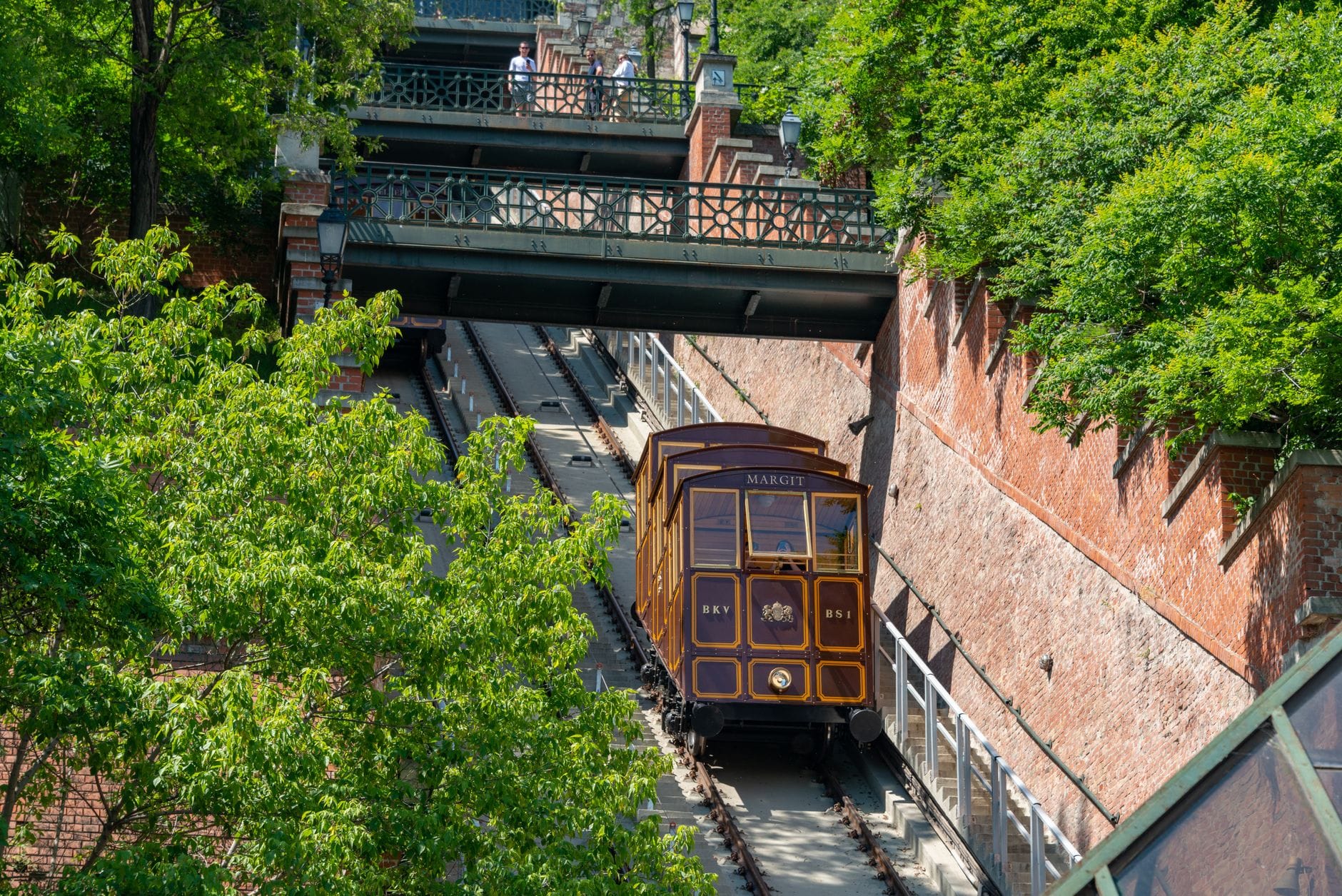
What the Budavári Sikló Actually Is
The Castle Hill Funicular, known in Hungarian as the Budavári Sikló, is a short cable-powered railway that connects Clark Ádám tér at river level to Szent György tér on top of Castle Hill. The track is 95 metres long, rises 51 metres, and runs at roughly a 31% gradient. The journey takes roughly 90 seconds. It is not a scenic railway or a heritage museum ride in the traditional sense — it is a working piece of public transport that also happens to be over 150 years old and listed as part of a UNESCO World Heritage Site.
The funicular opened on 2 March 1870, constructed between 1868 and 1869, and is among the 19th‑century passenger funiculars in Europe. It was badly damaged during World War II and sat derelict for decades before being reconstructed and reopened in 1986. The cars in use today reflect the 19th-century aesthetic of the original but are modern rebuilds. In 1987, the entire Buda Castle ensemble — including the funicular — was inscribed on the UNESCO World Heritage List.
⚠️ What to skip
The funicular is closed for scheduled maintenance on selected Mondays and during occasional maintenance weeks. If your visit falls on a Monday, check in advance for planned closures. On public holidays, maintenance is usually moved to the next working day.
The Ride: What to Expect Step by Step
You buy your ticket at the cashier window inside the lower station at Clark Ádám tér, right beside the entrance to the Buda Castle Tunnel. Tickets are sold at both stations, and payment is accepted in Hungarian forints; card payment may be available, but having cash is advisable. If you arrive without forints, there are ATMs and exchange offices a short walk away on the Pest side of the Chain Bridge.
The two cars operate on a counterbalance system: one descends as the other ascends. When the doors open, you file into a compact wooden-panelled car. There are windows on both sides, but the uphill-facing side is where you want to stand. As the car climbs, the Chain Bridge and the full sweep of the Pest skyline reveal themselves at an angle that no viewpoint on the hill quite replicates — you are level with the treetops one moment and suddenly above the roofline the next. The whole ascent is over before most people have finished raising their phone to take a photo.
At the top, the car deposits you at Szent György tér, a few steps from the entrance to Buda Castle and within easy walking distance of the Presidential Palace. If you choose the one-way ticket, the staircase and footpaths descending back to Clark Ádám tér are well-maintained and take about 10 to 15 minutes on foot.
Tickets & tours
Hand-picked options from our booking partner. Prices are indicative; availability and final rates are confirmed when you complete your booking.
Private Buda Castle walking tour
From 195 €Instant confirmationFree cancellationBuda Castle District Tour on MonsteRoller
From 50 €Instant confirmationFree cancellationPrivate Buda Castle walking tour and Danube river cruise with Margaret Island
From 292 €Instant confirmationFree cancellationBuda Castle 3-hour tour with a friendly historian
From 68 €Instant confirmationFree cancellation
Time of Day and Crowds
Mornings before 10:00 are noticeably quieter. The queue at the lower station rarely extends outside the building, and the cars depart on demand rather than on a fixed timetable — typically every 5 to 10 minutes depending on how quickly passengers fill up. In the first hour after opening, you can often board within a single cycle.
Between late morning and mid-afternoon in summer, the queue can stretch along the pavement outside. On days when large cruise groups or school tours are in the area, the wait can stretch to 30 minutes or more. The funicular's capacity is small by design, so the line moves in visible bursts rather than continuously. Bring water if you are visiting in July or August — the lower station area gets direct sun and there is little shelter.
Early evening, around 18:00 to 20:00, brings a second wave of visitors coming up to watch sunset from Castle Hill. The light at this hour is excellent for photography both during the ride and from the top. The funicular runs until 22:00, with the ticket office closing at 21:50, and the last hour of operation is often surprisingly calm. Riding up as dusk falls and the city lights begin to appear below is a genuinely different experience from the daytime run.
💡 Local tip
For the best light and shortest queues, arrive at the lower station between 08:00 and 09:30 on a weekday morning, or after 19:00 on a clear evening in spring or autumn.
Historical and Cultural Context
The funicular was originally built to serve the residents and officials who lived and worked on Castle Hill — climbing the steep hillside on foot or by carriage was slow and exhausting. Its construction in the late 1860s reflected a broader wave of modernisation sweeping through the city, the same era that produced the Chain Bridge and ultimately led to the unification of Buda, Óbuda, and Pest into Budapest in 1873. The funicular was part of the infrastructure that made Castle Hill a viable administrative and residential centre rather than an isolated hilltop fortress.
The wartime destruction of the original funicular was part of a wider pattern of devastation across Castle Hill. The reconstruction that culminated in the 1986 reopening was a deliberate act of civic restoration, restoring a piece of pre-war Budapest life to a hill that had spent decades as a restricted zone under the communist government. Today the funicular operates under BKK, Budapest's public transport authority, which treats it as both a heritage service and a functional link between the river bank and the castle plateau.
Practical Walkthrough: Getting There and Moving On
The lower station sits directly at Clark Ádám tér, the circular square at the Buda end of the Chain Bridge. If you are crossing from Pest on foot via the Chain Bridge, the funicular entrance is visible immediately after you clear the bridge approach on your left. Trams 19 and 41 run along the Buda riverfront and stop at Clark Ádám tér. Buses 16 and 105 also serve the square. There is no Metro station close by on the Buda side — from the Pest Metro network you would cross the bridge on foot or by tram.
From the upper station at Szent György tér, you are within a two-minute walk of Buda Castle and the Hungarian National Gallery. Matthias Church and Fisherman's Bastion are a 10-minute walk north along the castle plateau. The upper station is also served by buses 16, 16A, and 116 if you prefer to return downhill by bus rather than on foot or by funicular.
The BKK Budapest Card does not cover funicular travel — the funicular uses its own separate ticketing system. Verify this before your visit, as bundled ticket arrangements can change.
ℹ️ Good to know
Operating hours: Daily 08:00–22:00 (ticket office closes at 21:50). Closed on selected Mondays and during occasional maintenance weeks for scheduled maintenance. Phone: +36 1 201 9128.
Photography Tips and Sensory Notes
The best shots during the ride itself are taken from a standing position near the upper windows of the ascending car, looking back toward the Danube and the Pest skyline. The car window glass is usually clean but not optically perfect, so shooting at an angle to minimise reflections helps. The incline is steep enough that wide-angle phone cameras will distort the horizon unless you tilt your phone to compensate.
The mechanical sounds of the funicular — the low hum of the cable, the subtle lurch as the car begins moving, the squeal of the wheels on the rail at the steepest point — are part of the experience. The lower station smells faintly of machine oil and old wood in warm weather. It is a sensory combination that reads as authentically old even if the cars are not the originals.
From the upper station, the panorama looking east across the Danube toward Pest is one of the cleaner viewpoints on Castle Hill, though Fisherman's Bastion further north offers a more elevated and compositionally dramatic angle for photography.
Is It Worth It?
The funicular costs more than the practical alternative, which is simply walking up the hill or taking a bus. HUF 5,500 for an adult return is a meaningful sum for a 90-second ride, and anyone who is comfortable with moderate inclines will find the staircase and footpath a perfectly good option. The question is whether you value the experience itself — the heritage of riding one of Europe's oldest funiculars, the specific viewing angle during the ascent, and the small pleasure of arriving at the castle plateau in an unhurried, slightly theatrical way.
For families with young children, it is almost certainly worth it: small children find the ride exciting in a way the footpath cannot replicate, and it removes the logistics of carrying strollers up steep steps. For travellers on a tight budget, the free alternative is entirely viable and should not be dismissed. The funicular is not the only way to see Castle Hill, and it is honest to say that the view from the top is the same either way.
If budget is a concern, the free things to do in Budapest guide covers the walking alternatives and other no-cost options across the city.
Insider Tips
- Ride one-way up and walk back down via the castle walls and the staircase that descends toward Clark Ádám tér. The descent takes about 12 minutes and passes through quiet parts of the castle district that most visitors skip entirely.
- The ticket booth primarily accepts Hungarian forints, and card payment may not always be available. Withdraw cash before you arrive — the nearest ATMs are on the Pest side of the Chain Bridge, a five-minute walk away.
- If you see a queue stretching outside the lower station, check whether you can save the funicular for the return trip and reach the upper station first by taking bus 16, 16A, or 116, which drops you directly at the upper station on Szent György tér.
- The car on the uphill side fills faster because everyone gravitates toward the front. Boarding early and moving toward the rear of the car actually gives you a cleaner, unobstructed view back toward the Danube.
- Check the week number before visiting on a Monday. The funicular is closed on Mondays of odd-numbered weeks. A quick online search for 'current week number' takes five seconds and saves a wasted trip.
Who Is Castle Hill Funicular (Budavári Sikló) For?
- First-time visitors to Budapest who want the full Castle Hill arrival experience
- Families with young children who want a short, memorable ride
- Photographers looking for the elevated Danube angle during the ascent
- Travellers with limited mobility who want to avoid the steep hill climb
- Anyone visiting in the evening to catch the lit-up Pest skyline from the upper station
Nearby Attractions
Other things to see while in Castle Hill (Várhegy):
- Buda Castle (Budavári Palota)
Buda Castle, known in Hungarian as Budavári Palota, is the historic royal palace complex crowning Castle Hill on the Buda side of the Danube. The grounds are free and open around the clock, while the palace buildings house the Hungarian National Gallery and Budapest History Museum. A UNESCO World Heritage Site since 1987, it anchors the western skyline that defines Budapest.
- Fisherman's Bastion (Halászbástya)
Fisherman's Bastion is a neo-Romanesque terrace on Castle Hill with seven fairy-tale towers and an unobstructed panorama over the Danube and Pest. The lower terraces are free to enter at any hour, making it one of the few world-class viewpoints in Europe you can visit without spending a forint. But timing your visit carefully makes the difference between a genuine experience and a crowded selfie queue.
- Hospital in the Rock (Sziklakórház)
Carved into the limestone beneath Buda Castle in the 1930s, the Hospital in the Rock is a remarkably preserved underground surgical hospital and Cold War nuclear bunker. Guided tours lead visitors through 2,300 square metres of tunnels, operating theatres, and wax figure displays that recreate wartime medical conditions with uncomfortable accuracy.
- Hungarian National Gallery
The Hungarian National Gallery (Magyar Nemzeti Galéria) occupies three wings of Buda Castle and houses the country's most comprehensive collection of Hungarian art, from medieval altarpieces to 20th-century masterworks. Set on Castle Hill above the Danube, it combines serious art history with one of the most dramatic building settings in Central Europe.