Hospital in the Rock: Budapest's Secret Underground Hospital and Nuclear Bunker
Carved into the limestone beneath Buda Castle in the 1930s, the Hospital in the Rock is a remarkably preserved underground surgical hospital and Cold War nuclear bunker. Guided tours lead visitors through 2,300 square metres of tunnels, operating theatres, and wax figure displays that recreate wartime medical conditions with uncomfortable accuracy.
Quick Facts
- Location
- Lovas út 4/C, Budapest 1012 — beneath Castle Hill, a short walk southwest of Matthias Church
- Getting There
- Take Bus 16 or 16A to Castle Hill, or ride the Castle Hill Funicular from Clark Ádám tér. Walk southwest along Tóth Árpád sétány toward Lovas út.
- Time Needed
- Guided tours run approximately 60 minutes. Allow extra time if you plan to linger at Castle Hill afterward.
- Cost
- Adult approx. 6,000 HUF; student/senior approx. 3,000 HUF; family approx. 15,000 HUF. Budapest Card holders receive a discount (from approx. 2,800 HUF). Verify current prices at sziklakorhaz.eu before visiting.
- Best for
- History enthusiasts, WWII and Cold War visitors, curious travelers, older children and teens
- Official website
- www.sziklakorhaz.eu
What Is the Hospital in the Rock?
The Hospital in the Rock Nuclear Bunker Museum — Sziklakórház Atombunker Múzeum in Hungarian — occupies a labyrinth of tunnels and chambers carved into the limestone bedrock directly beneath Buda Castle. Guided tours lead visitors through more than 2,300 square metres of museum space within a natural cave system that extends for roughly 10 kilometres beneath Castle Hill, including tunnels, operating theatres, and wax figure displays that recreate wartime medical conditions with uncomfortable accuracy. It opened to the public as a permanent museum on 11 March 2008.
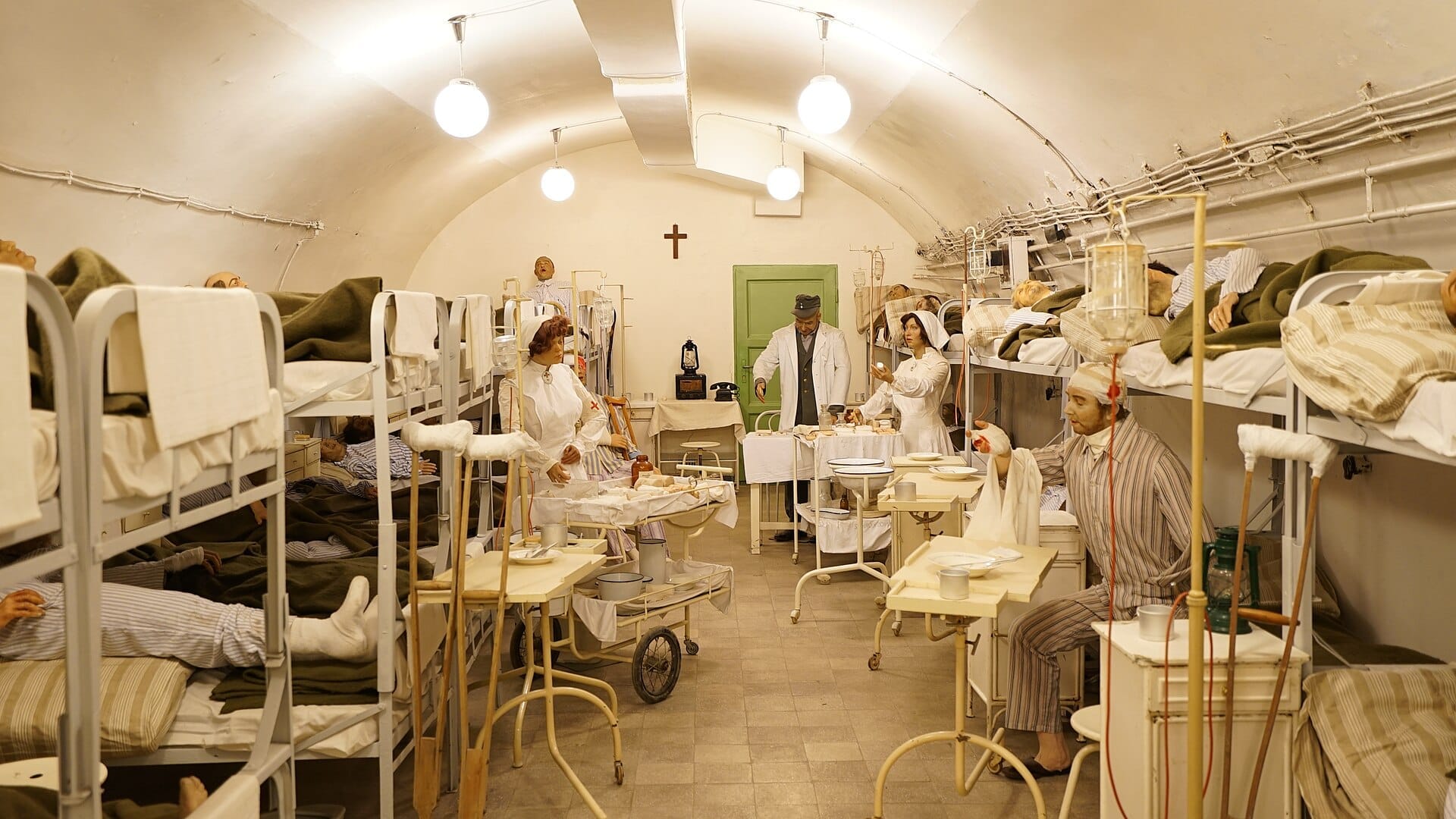
What separates this attraction from a typical history museum is texture, literally. The ceilings are raw rock, the corridors narrow to the point where two visitors must turn sideways to pass each other, and the air carries a faint mineral dampness that no exhibition designer could fake. The wax figures populating the operating theatres and wards are unnervingly lifelike, modelled in mid-procedure with surgical detail that some visitors find genuinely unsettling.
ℹ️ Good to know
Entry is by guided tour only. Tours depart at regular intervals throughout the day in both Hungarian and English. Arrive early or book ahead, especially on weekends and in peak summer months when capacity fills quickly. Check sziklakorhaz.eu for the current schedule.
A History Built Into the Rock Itself
Castle Hill sits on a porous limestone plateau riddled with natural cavities that Budapest's residents have exploited for centuries. The hospital complex was developed during the 1930s, when Hungarian authorities recognised that the existing natural caverns could be reinforced and expanded into a functioning medical facility capable of surviving aerial bombardment. Construction proceeded quietly, classified and hidden from public view.
By 1944, with Allied bombing campaigns intensifying and the Soviet front advancing toward Hungary, the facility was put into operation as an emergency surgical hospital. During the Siege of Budapest (late 1944 to early 1945), one of the most destructive urban battles of the entire European war, the underground wards filled rapidly. A space designed for around 60 patients was handling around 600 at peak periods. Surgeons operated continuously, often without adequate supplies, in conditions the museum reconstructs with deliberate fidelity.
After the war the facility was decommissioned, then quietly reactivated during the Cold War as a nuclear bunker. It was maintained in strict secrecy — most Budapest residents had no idea it existed — and was kept on standby readiness through much of the communist period. For deeper context on how WWII and its aftermath shaped the city's identity, the Terror Háza museum on Andrássy Avenue offers a powerful and very different perspective on the same era.
Tickets & tours
Live prices and dates from our booking partner. If you book, we may earn a commission at no extra cost to you.
Budapest Guided E-Scooter Tour by Night
From 60 €Instant confirmationFree cancellationHalf-day tour to Princess Sissi's Godollő royal palace from Budapest
From 41 €Instant confirmationFree cancellationHalf-Day Countryside Wine Tour from Budapest
From 95 €Instant confirmationFree cancellation4 Course Dinner cruise with Operetta and Folk show
From 81 €Instant confirmationFree cancellation
The Tour Experience: Room by Room
The tour begins at a nondescript entrance on Lovas út, on the quieter western slope of Castle Hill. Nothing on the street suggests the scale of what is below. You descend through a series of reinforced doors into corridors where the temperature drops noticeably — around 10 to 12 degrees Celsius year-round — and the ceiling presses lower than you expect.
The wartime hospital section covers multiple rooms: admissions areas, a blood bank room, operating theatres with period surgical instruments laid out on trays, a maternity ward, and a dentist's room whose equipment looks brutal by modern standards. Each space is populated by wax figures mid-task. The guide's narration provides medical and historical context, but the rooms do much of the storytelling on their own. Period sounds — radio broadcasts, distant explosions — play through the audio system at certain points.
The Cold War section has a different atmosphere: starker, more industrial, with decontamination chambers, radiation monitoring equipment, and gas masks arranged in rows. The transition between the two eras, moving from the chaotic urgency of the wartime wards into the eerily methodical readiness of the nuclear bunker, is one of the tour's more effective moments.
💡 Local tip
Wear a light jacket regardless of the season outside. The tunnels maintain a constant temperature of around 10–12°C, and an hour underground in a summer T-shirt becomes uncomfortable quickly.
Practical Walkthrough: Getting There and What to Expect
The entrance at Lovas út 4/C sits on the southwestern side of Castle Hill, below the promenade of Tóth Árpád sétány. It is walkable from Matthias Church in about five minutes, heading southwest past the old Honvéd officers' quarters. From the Danube side, the Castle Hill Funicular deposits you near Buda Castle, from where a ten-minute walk along the hill's western edge brings you to the entrance.
Bus lines 16 and 16A run directly to the castle district from central Pest. The 16A stops at Dísz tér, the main square on the hill, from which the walk is straightforward. Taxis and rideshares can drop you at the foot of Lovas út, though the street itself is pedestrian-access only at the entrance end.
Mobility note: the museum is located entirely underground and involves walking through uneven tunnel floors, steps, and low-clearance passages. It is not suitable for wheelchairs or visitors with significant mobility limitations. Anyone uncertain should contact the museum directly at info@hospitalintherock.com or +36 70 701 0101 before visiting.
Photography inside the tunnels is generally permitted, but the low light requires a phone or camera that handles dim interiors well — expect to rely on available light in most rooms. If you are combining this visit with a broader Castle Hill itinerary, Fisherman's Bastion and the Hungarian National Gallery are both within easy walking distance and complement a half-day on the hill.
When to Visit and Who Should Skip It
The museum's underground location means outside weather is essentially irrelevant to the experience itself. A rainy afternoon in Budapest is actually an ideal time to visit — you stay dry, and the gloomy atmospheric conditions aboveground suit the subject matter. In July and August, tours fill up faster and the entrance area can get crowded before each departure; arriving at opening time or on a weekday morning is the most reliable way to avoid waiting.
The Hospital in the Rock is one of Budapest's more serious historical experiences. It does not soften its subject. If you are traveling with very young children, the wax figure recreations — which include injury detail and surgical scenes — may be distressing. Parents should assess this honestly before booking. Older children and teenagers, particularly those with an interest in history, typically engage well with the content. For family-oriented alternatives on Castle Hill, Buda Castle offers more varied and age-adjustable experiences.
Visitors who prefer self-guided exploration, who find guided group formats frustrating, or who have limited time on Castle Hill may want to weigh this against other options. The tour runs to a fixed schedule and pace — you cannot linger in individual rooms or return to sections. If the guided format doesn't suit you, this one is genuinely difficult to appreciate without it, because the room-by-room historical narration is central to the experience.
⚠️ What to skip
The wax figure displays include medically graphic content: wounded soldiers, surgical procedures, and casualty scenes recreated in clinical detail. Some visitors find these distressing. This is not an attraction to enter expecting a sanitised presentation of history.
Is It Worth Your Time?
Budapest has no shortage of compelling history to engage with, and the risk of over-scheduling a city trip is real. The Hospital in the Rock justifies its place on a well-planned itinerary because it offers something architecturally and experientially unique: the physical space is the exhibit. No amount of photographs or documentary footage replicates what it feels like to stand in a room where wartime surgery was performed, under a ceiling of raw limestone, in near silence.
It takes roughly one hour, costs a reasonable amount by European museum standards, and pairs efficiently with a Castle Hill morning that also covers Matthias Church and Fisherman's Bastion. For visitors following a three-day Budapest itinerary, this works particularly well as a morning stop before crossing back to Pest in the afternoon. The Budapest 3-day itinerary breaks down how to sequence Castle Hill alongside the city's other major draws without exhausting yourself.
If Hungarian history and the WWII-to-Cold War arc are subjects you want to explore thoroughly, consider combining this visit with the Hungarian National Museum in Pest, which covers the full sweep of the country's history with more contextual depth. Together, they form a coherent historical pairing across a single day.
Insider Tips
- Book tickets online in advance, especially for English-language tours on weekends — the tours have limited capacity and sell out faster than the queue at the entrance suggests.
- The entrance on Lovas út is easy to miss. Look for the small sign and reinforced door set into the rock face, not a grand museum entrance. If you reach Tóth Árpád sétány, you have gone slightly too far uphill.
- The Budapest Card includes a discounted entry rate. If you are visiting multiple paid attractions across two or three days, the card can pay for itself quickly — check the current terms at the official Budapest Card site.
- Tour groups from cruise and coach excursions tend to arrive mid-morning. The 10:00 and 11:00 tours are the most crowded on weekdays. The early afternoon slot, around 13:00 or 14:00, often has smaller groups and a more relaxed pace.
- If you are particularly interested in the Cold War section, mention this to your guide at the start. Some guides adjust the amount of time spent in each section based on group interest, and the nuclear bunker rooms reward more thorough explanation.
Who Is Hospital in the Rock (Sziklakórház) For?
- History and military history enthusiasts, especially those with interest in WWII and the Cold War
- Travelers who want to understand Budapest beyond its famous facades and thermal baths
- Older teenagers and school-age groups studying 20th-century European history
- Visitors looking for an indoor activity that works regardless of weather
- Architecture and urban exploration fans drawn to Budapest's subterranean infrastructure
Nearby Attractions
Other things to see while in Castle Hill (Várhegy):
- Buda Castle (Budavári Palota)
Buda Castle, known in Hungarian as Budavári Palota, is the historic royal palace complex crowning Castle Hill on the Buda side of the Danube. The grounds are free and open around the clock, while the palace buildings house the Hungarian National Gallery and Budapest History Museum. A UNESCO World Heritage Site since 1987, it anchors the western skyline that defines Budapest.
- Castle Hill Funicular (Budavári Sikló)
The Budavári Sikló has been hauling passengers from the Danube bank to the top of Castle Hill since 1870, making it one of Europe's oldest passenger funiculars. The ride takes just 90 seconds, but the views over the Chain Bridge and the Pest skyline make it worth every forint.
- Fisherman's Bastion (Halászbástya)
Fisherman's Bastion is a neo-Romanesque terrace on Castle Hill with seven fairy-tale towers and an unobstructed panorama over the Danube and Pest. The lower terraces are free to enter at any hour, making it one of the few world-class viewpoints in Europe you can visit without spending a forint. But timing your visit carefully makes the difference between a genuine experience and a crowded selfie queue.
- Hungarian National Gallery
The Hungarian National Gallery (Magyar Nemzeti Galéria) occupies three wings of Buda Castle and houses the country's most comprehensive collection of Hungarian art, from medieval altarpieces to 20th-century masterworks. Set on Castle Hill above the Danube, it combines serious art history with one of the most dramatic building settings in Central Europe.
Planning a trip? Discover personalized activities with the Nomado app.