Matthias Church (Mátyás-templom): Castle Hill's Gothic Crown
Standing at the heart of Buda's Castle District since the 13th century, Matthias Church is one of Hungary's most architecturally layered landmarks. Its Neo-Gothic exterior hides centuries of royal coronations, Ottoman conversion, and obsessive 19th-century restoration. Here is what the experience is actually like, and how to make the most of it.
Quick Facts
- Location
- Szentháromság tér 2, 1014 Budapest, District I (Castle Hill)
- Getting There
- Bus 16 from Deák Ferenc tér or 16A/116 from Széll Kálmán tér (M2 metro); or Castle Hill Funicular from Clark Ádám tér, then ~12 min walk
- Time Needed
- 60–90 minutes for interior, treasury, and square
- Cost
- Adults ~1,800 HUF / Students & Seniors ~1,200 HUF / Under 6 free. Free with Budapest Card 72h Plus. Verify current rates.
- Best for
- Architecture lovers, history enthusiasts, and photography
- Official website
- matyas-templom.hu/en
What Matthias Church Actually Is
Matthias Church, officially the Church of the Assumption of the Buda Castle (Nagyboldogasszony-templom), sits on Holy Trinity Square in the heart of Castle Hill, directly in front of Fisherman's Bastion. It is a Roman Catholic church that has been in continuous use since the 13th century, serving as the coronation site for multiple Hungarian kings and, for a period of around 145 years, as an Ottoman mosque. What visitors encounter today is largely the result of a meticulous Neo-Gothic restoration completed between 1874 and 1896, though the building's bones go back considerably further.
The church is not a ruin or a museum piece. Masses are held regularly, and the building functions as both an active parish and a ticketed cultural attraction. This dual identity shapes the visiting experience: you move through a working sacred space while reading about medieval stonework and examining treasury displays. Some visitors find that combination meaningful; others find it slightly awkward. It helps to know before you arrive.
ℹ️ Good to know
Opening hours: Monday–Friday 09:00–17:00, Saturday 09:00–12:00 (some sources say until 13:00), Sunday 13:00–17:00. The church is closed for tourist visits on 24–25 December. Hours can shift around liturgical events and weddings — check the official site before visiting.
Seven Centuries of History in One Building
The first church on this site was founded in the mid-13th century, and Gothic construction phases continued from 1255 through roughly 1500. The building you see is therefore not a single architectural vision but a palimpsest: Romanesque foundations, Gothic nave proportions, and a 19th-century restoration that interpreted all of it through the lens of Victorian Gothic Revival. Architect Frigyes Schulek led that restoration, which was completed in time for Hungary's millennium celebrations in 1896 — the same wave of national pride that produced Heroes' Square and the Palace of Art.
Three royal coronations of particular significance took place here. Charles I was crowned in 1309, establishing the Angevin line. Emperor Franz Joseph I and Empress Elisabeth were crowned King and Queen of Hungary in 1867, the ceremony that formalized the Austro-Hungarian Compromise. Charles IV followed in 1916 in what proved to be the last coronation on Hungarian soil. These were not ceremonial afterthoughts but constitutional acts, and the church's position at the literal highest point of Buda was entirely deliberate.
The Ottoman chapter is easy to overlook but shaped the building materially. After the fall of Buda in 1541, the church was converted into the main Friday mosque of the city and used as such until the Habsburg reconquest in 1686. During that period, the figurative frescoes were plastered over, the interior was whitewashed, and furnishings were stripped. Schulek's 19th-century restoration revealed fragments of the earlier medieval decoration beneath layers of plaster, and those fragments directly informed the new fresco cycles painted across the interior. You can read more about Budapest's layered past in the city's history guide.
Tickets & tours
Live prices and dates from our booking partner. If you book, we may earn a commission at no extra cost to you.
The Architecture: What to Look For
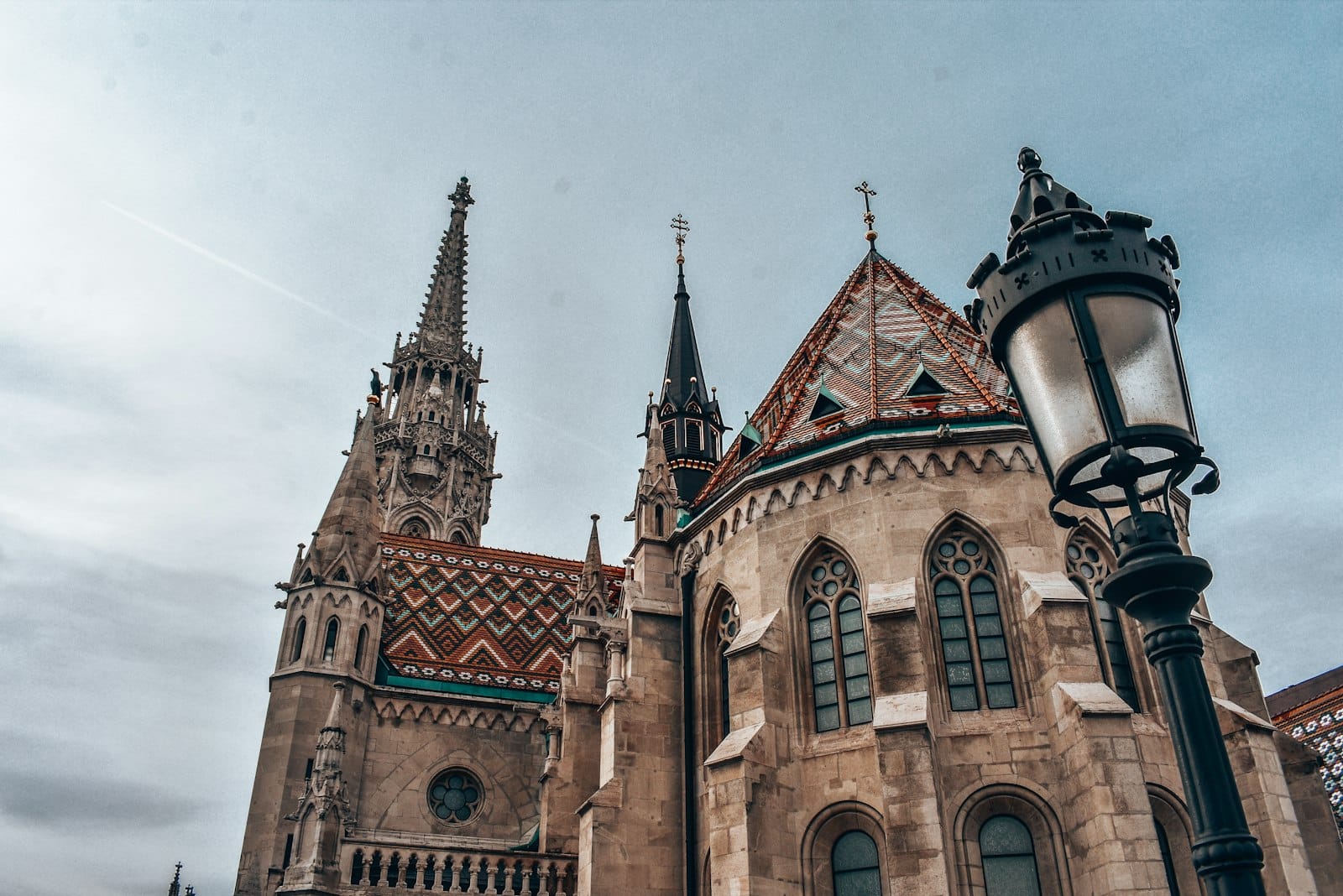
The exterior is immediately recognizable because of the roof. The Zsolnay ceramic tiles, manufactured in the southern Hungarian city of Pécs, cover the main roof in a geometric diamond pattern of deep green, gold, and rust. On a clear morning the tiles catch the light differently than any conventional slate or lead roof, shifting between matte and almost metallic depending on the angle. The south tower, known as the Béla Tower, dates from the 13th century and is one of the oldest surviving structural elements on Castle Hill.
Step back from the main entrance to take in the full facade before going in. The rose window above the portal, the carved tympanum, and the layered stone tracery all belong to Schulek's restoration rather than medieval original work — but the craftsmanship is serious, not approximated. If you are already interested in Budapest's Art Nouveau architecture, the Zsolnay tilework here is worth noting as an example of the same ceramic tradition applied in a Gothic context.
Inside, the nave is tall, relatively narrow, and covered from floor to vaulted ceiling in painted geometric and floral patterns by artists Bertalan Székely and Károly Lotz. This is not subtle decoration: the walls are saturated in deep reds, blues, and ochres, with every visible surface carrying pattern. Visitors who expect bare medieval stone will be surprised. The effect is closer to a Moorish-influenced interior than to a Northern European Gothic church, and that contrast with the exterior Gothic vocabulary is one of the building's genuine curiosities.
The Visit: Time of Day and What Changes
Morning visits on weekdays, between 09:00 and 10:30, tend to be significantly quieter than midday or afternoon slots. By 11:00, the square outside fills with tour groups arriving from the Fisherman's Bastion direction, and the narrow entrance corridor becomes congested. The church absorbs crowds reasonably well once inside, but the treasury and the upper gallery areas feel cramped when more than a handful of people are present simultaneously.
On Saturday mornings the church closes at noon or shortly after for preparations, and Sunday afternoon openings from 13:00 follow morning masses. Both these windows offer smaller crowds but more restricted time. If your schedule is flexible, a Tuesday or Wednesday morning is the most comfortable visiting experience.
Light enters the interior mainly through the stained glass windows on the south side. Mid-morning in summer produces the best interior light for photography, when the colored glass casts patterns across the painted columns. In overcast conditions the interior feels considerably darker and the frescoes lose some of their saturation — worth bearing in mind if photography is a priority.
💡 Local tip
Photography tip: The interior is dimly lit in places. A wide-aperture lens and a raised ISO will serve you better than a flash. Tripods are generally not permitted. For the exterior roof tiles, mid-morning light from the south side of the square produces the clearest detail in the Zsolnay patterns.
Getting There and Practical Walkthrough
Castle Hill has no metro access. The most direct public transport option is bus 16 from Deák Ferenc tér or bus 16 or 116 from Széll Kálmán tér (M2 metro, trams 4 and 6). Both routes drop passengers close to the square. Alternatively, the Castle Hill Funicular runs from Clark Ádám tér near the Chain Bridge to the upper castle plateau, from where the church is roughly a 10–15 minute walk through the castle grounds. The funicular is an experience in itself but adds cost and occasionally has queues.
The streets immediately around the church are cobblestone throughout, with some uneven sections near the square. The uphill approach from the funicular involves a gentle incline with no significant steps on the main path. Specific interior accessibility features, including any ramps or lifts, are not detailed in publicly available sources and should be confirmed directly with the church before visiting.
Tickets are purchased at the church entrance. The sightseeing admission includes the main nave, the treasury, and a small museum area with royal regalia replicas and ecclesiastical artifacts. Budget around 60 to 90 minutes for a thorough visit, including time on the square before and after. Holders of the Budapest Card 72h Plus enter free; if you are planning multiple attractions across a 72-hour period, the card may represent genuine value.
Most visitors combine Matthias Church with Fisherman's Bastion immediately next door, and then continue along the castle plateau to Buda Castle and the Hungarian National Gallery. This combination covers the main Castle Hill circuit in a half-day.
Dress Code and Practical Considerations
As an active Catholic church, modest dress is expected. Shoulders and knees should be covered. The church does not appear to provide cover-ups at the entrance, so come prepared if you are visiting on a hot summer day in light clothing. The interior temperature stays relatively cool year-round due to the stone construction, which is a minor advantage in July and August.
Masses take place on specific days and times. During a service, the tourist entrance may be closed or restricted to the rear of the nave. If you arrive during an active mass, you can usually wait a short time or return later. Wedding ceremonies are frequent on Saturday mornings, which is one reason the Saturday hours are reduced. Checking the church's official calendar before a Saturday visit saves a wasted trip.
⚠️ What to skip
Avoid the Castle Hill area entirely on Sunday mornings, when tour buses peak and Holy Trinity Square can feel genuinely overcrowded. The 13:00–17:00 Sunday window is quieter, but confirm hours haven't shifted due to liturgical events.
Honest Assessment: Is It Worth Your Time?
The exterior and roof are as impressive as any photograph suggests, and the frescoed interior is genuinely unusual: few Gothic-framework churches in Central Europe have this degree of saturated wall decoration. The treasury contains interesting objects for those with an interest in ecclesiastical history, though it is modest by comparison with major cathedral treasuries elsewhere in Europe.
What the church is not: a vast cathedral experience, a comprehensive historical museum, or a space that rewards extended contemplation in the way that, say, an unrestored medieval building might. The heavy 19th-century intervention means that despite the genuine age of the structure, almost everything visible dates from the 1874–1896 restoration period. Visitors who care most about authentically medieval fabric may find that context slightly deflating once they understand it.
For travelers on a tight schedule, the church pairs naturally with a free walk around the exterior of Fisherman's Bastion and a clear view across the Danube toward Parliament. If you are building a full day on the Buda side, the 3-day Budapest itinerary covers how to sequence Castle Hill alongside other key sites without backtracking.
Insider Tips
- The view of the church's Zsolnay tile roof is actually better from the upper terrace of Fisherman's Bastion than from street level. Walk up to the highest tower terrace and look back down and south.
- If a wedding is taking place, the gates to the church square often close temporarily for the ceremony. The wait is usually under 30 minutes, and the courtyard reopens as soon as the bridal party moves inside.
- The treasury is a separate room often overlooked by visitors moving quickly through the nave. It contains medieval stone fragments, replicas of the Hungarian coronation regalia, and original ecclesiastical metalwork. Allow at least 15 minutes here.
- Visiting in December between Advent Sunday and 23 December gives you the bonus of the Castle Hill Christmas market on Holy Trinity Square, which wraps around the church exterior. The combination of the market and the lit-up facade in the evening is one of the better winter scenes in Budapest.
- If you plan to attend a concert rather than a sightseeing visit, check the church's events calendar. Organ concerts and choral performances are held periodically in the evening and offer a completely different atmosphere than a daytime tourist visit, often at comparable or lower cost to the standard admission.
Who Is Matthias Church (Mátyás-templom) For?
- Architecture and design enthusiasts interested in Gothic Revival and Zsolnay ceramics
- History-focused travelers tracing Hungarian royal and Habsburg history
- Photographers, particularly those shooting exterior detail and cityscape compositions
- Visitors combining Castle Hill into a half-day cultural walk
- Travelers visiting in December who want to pair the church with the Castle Hill Christmas market
Nearby Attractions
Other things to see while in Castle Hill (Várhegy):
- Buda Castle (Budavári Palota)
Buda Castle, known in Hungarian as Budavári Palota, is the historic royal palace complex crowning Castle Hill on the Buda side of the Danube. The grounds are free and open around the clock, while the palace buildings house the Hungarian National Gallery and Budapest History Museum. A UNESCO World Heritage Site since 1987, it anchors the western skyline that defines Budapest.
- Castle Hill Funicular (Budavári Sikló)
The Budavári Sikló has been hauling passengers from the Danube bank to the top of Castle Hill since 1870, making it one of Europe's oldest passenger funiculars. The ride takes just 90 seconds, but the views over the Chain Bridge and the Pest skyline make it worth every forint.
- Fisherman's Bastion (Halászbástya)
Fisherman's Bastion is a neo-Romanesque terrace on Castle Hill with seven fairy-tale towers and an unobstructed panorama over the Danube and Pest. The lower terraces are free to enter at any hour, making it one of the few world-class viewpoints in Europe you can visit without spending a forint. But timing your visit carefully makes the difference between a genuine experience and a crowded selfie queue.
- Hospital in the Rock (Sziklakórház)
Carved into the limestone beneath Buda Castle in the 1930s, the Hospital in the Rock is a remarkably preserved underground surgical hospital and Cold War nuclear bunker. Guided tours lead visitors through 2,300 square metres of tunnels, operating theatres, and wax figure displays that recreate wartime medical conditions with uncomfortable accuracy.
Planning a trip? Discover personalized activities with the Nomado app.