Fisherman's Bastion (Halászbástya): Budapest's Most Photogenic Viewpoint
Fisherman's Bastion is a neo-Romanesque terrace on Castle Hill with seven fairy-tale towers and an unobstructed panorama over the Danube and Pest. The lower terraces are free to enter at any hour, making it one of the few world-class viewpoints in Europe you can visit without spending a forint. But timing your visit carefully makes the difference between a genuine experience and a crowded selfie queue.
Quick Facts
- Location
- Szentháromság tér 5, Budapest 1014 (Castle Hill, District I)
- Getting There
- Bus 16, 16A, or 116 to Szentháromság tér; or Castle Hill Funicular from Chain Bridge
- Time Needed
- 45–90 minutes for the terrace; allow half a day if combining with Castle Hill
- Cost
- Lower terraces: free, 24/7. Upper towers: approx. HUF 1,500–1,700 adults, HUF 850 students (verify current prices before visiting)
- Best for
- Panoramic views, photography, architecture lovers, early-morning walkers
- Official website
- www.budavar.hu/halaszbastya
What Fisherman's Bastion Actually Is
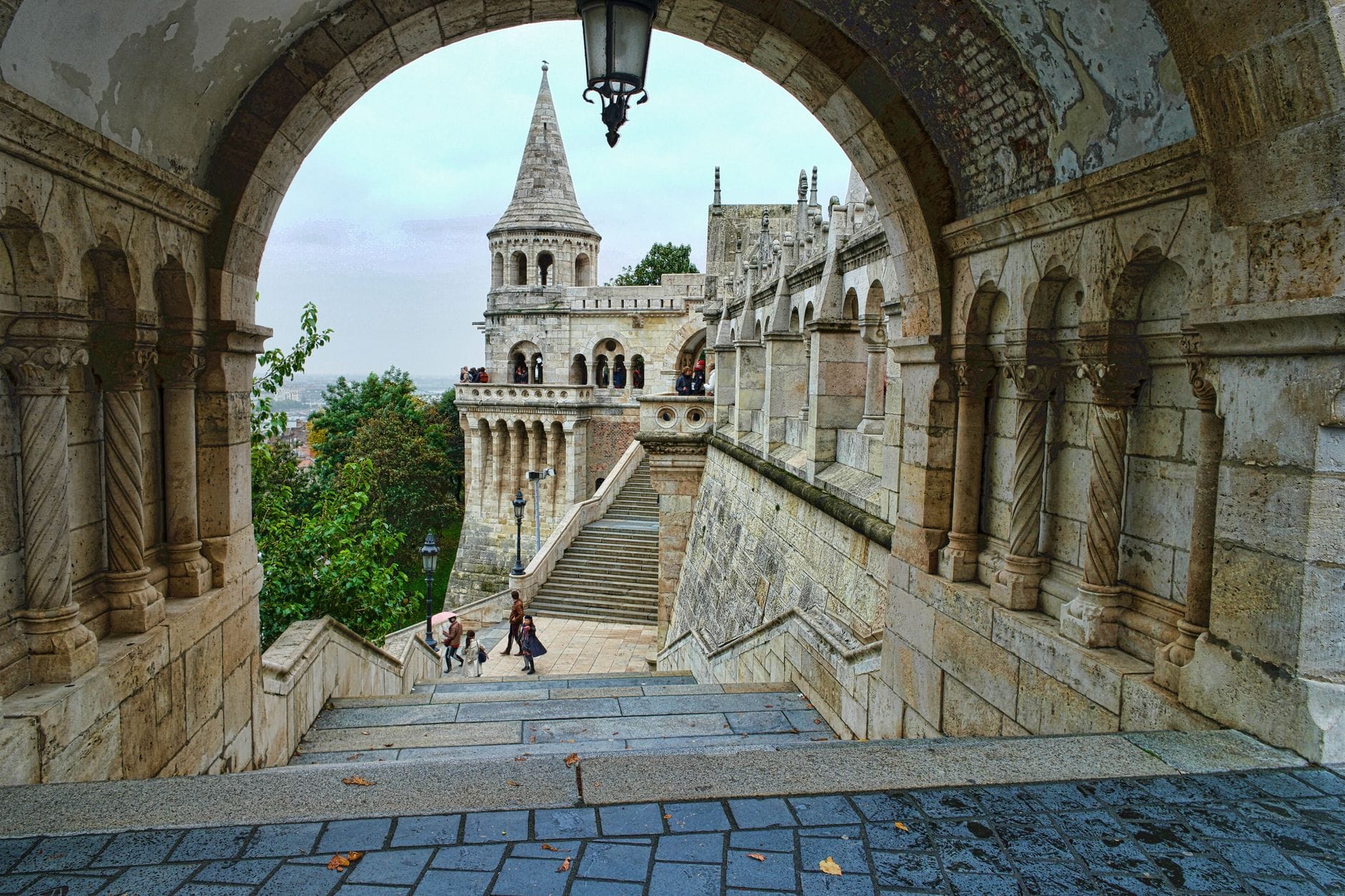
Fisherman's Bastion, known in Hungarian as Halászbástya, is a neo-Romanesque terrace and viewing gallery built between 1895 and 1902 on the northern edge of Castle Hill in Budapest's historic District I. Designed by Frigyes Schulek, the same architect who oversaw the restoration of the adjacent Matthias Church, it was constructed as a decorative element for Hungary's millennium celebrations marking 1,000 years of Magyar settlement in the Carpathian Basin. It never served any military purpose.
The structure features seven conical towers, each one representing one of the seven Magyar tribal chiefs who led the Hungarian people into the Carpathian Basin in 895 AD. That symbolism is baked into every turret. The towers sit atop a series of arched white limestone terraces that cascade down the hillside, framing views of the Danube, the Chain Bridge, and the flat expanse of Pest on the opposite bank.
Despite looking ancient, Halászbástya is not a medieval structure. Its romantic, storybook silhouette was designed to evoke medieval Hungary, not to replicate it. Knowing this actually makes the architecture more interesting: Schulek was creating a deliberate fantasy in stone, and he succeeded completely.
The View: What You See and When It's Best
💡 Local tip
Arrive before 9:00 AM or after 7:00 PM (in summer) to experience the lower terraces without crowds. The view is the same. The experience is completely different.
The panorama from the main terrace faces almost due east. On a clear day you can see the Hungarian Parliament Building directly across the river, its neo-Gothic spires reflected in the Danube, with Margaret Island visible to the north and the Liberty Bridge to the south. On the far bank, Pest spreads out as a dense, flat grid of 19th-century apartment blocks interrupted by church towers and the occasional modern high-rise. It is one of the most complete urban panoramas in Central Europe.
Morning light, roughly 7:00 to 9:30 AM, hits the Parliament and the Pest riverfront at a low angle that turns the stonework amber and gold. This is when photographers come for the clean shots. By mid-morning on any day between April and October, tour groups arrive in force and the narrow terrace walkways become difficult to navigate without bumping into someone's selfie stick. Midday in summer is the most crowded and the harshest light for photography.
Late afternoon, around 4:00 to 6:00 PM, brings softer light from the west and a gradual thinning of the crowds. After 7:00 PM in summer, when the ticket windows for the upper towers close, many visitors leave, and the lower terraces take on a more relaxed atmosphere. Sunset from here, with the Parliament lit in warm orange and the Danube turning silver, is genuinely worth lingering for.
Winter visits are underrated. Snow on the white limestone towers with the Danube grey and still below makes for striking photographs, and the crowds shrink dramatically. Wrap up properly: the terrace is fully exposed to wind coming off the river.
Weather significantly affects the experience here. Fog or heavy overcast eliminates most of the view from the upper towers while barely affecting the immediate architecture. Before visiting primarily for the panorama, check the forecast. For more guidance on when conditions are favorable throughout the year, see our best time to visit Budapest guide.
Tickets & tours
Hand-picked options from our booking partner. Prices are indicative; availability and final rates are confirmed when you complete your booking.
Budapest Guided E-Scooter Tour by Night
From 60 €Instant confirmationFree cancellationHalf-day tour to Princess Sissi's Godollő royal palace from Budapest
From 41 €Instant confirmationFree cancellationHalf-Day Countryside Wine Tour from Budapest
From 95 €Instant confirmationFree cancellation4 Course Dinner cruise with Operetta and Folk show
From 81 €Instant confirmationFree cancellation
Free Access vs. Ticketed Towers: What the Money Gets You
The lower terraces, including the main viewing gallery and the ground-level walkways between the arches, are free to enter at any hour of the day or night. This is not a minor access tier: the free area includes the primary panoramic viewpoint and gives you full sight lines across the Danube. For most visitors, this is sufficient.
Paid tickets are required to climb into the upper observation areas and the tower interiors during opening hours, approximately 9:00 AM to 9:00 PM in summer and 9:00 AM to 7:00 PM in winter (verify exact times before visiting, as these are subject to seasonal change). Admission for adults is approximately HUF 1,700; students pay around HUF 850. These prices should be confirmed at the ticket booth or on the official Budavar website before your visit, as they are updated periodically.
The upper towers add modest elevation above the main terrace and allow you to look down onto the terrace itself, which creates interesting compositional angles for photography. The tower interiors are stone spiral staircases: narrow, steep, and with low ceilings in places. They are not suitable for anyone with mobility issues or claustrophobia, and the view from the top is only marginally better than from the free terrace below. Outside ticketed hours, the entire site reverts to free access, which means arriving early in the morning or later in the evening costs nothing.
ℹ️ Good to know
The lower terraces are accessible by wheelchair. The upper turrets are not: there is no lift, and the spiral staircases cannot accommodate wheelchairs or pushchairs.
How to Get There
Fisherman's Bastion sits at the top of Castle Hill, so getting there requires either climbing or riding. From the Buda side of the Danube, buses 16, 16A, and 116 run from Széll Kálmán tér (a major metro and tram hub on the Buda side) to Szentháromság tér, which deposits you directly in front of the Bastion and Matthias Church. This is the easiest approach from central Buda.
From the Pest side, the most scenic approach is to cross the Chain Bridge on foot, then take the Castle Hill Funicular from Clark Ádám tér up to Buda Castle. From the top of the funicular, it is a 10-minute walk north through the castle complex to reach the Bastion. This route passes through the castle grounds and gives you a sense of the full Castle Hill area before arriving at the viewpoint.
There is also a pedestrian staircase climbing up from the Danube promenade, though it is steep and not well-signposted. It is best used by those who prefer to walk and know the route already. Taxis and ride services can drop you at Szentháromság tér directly, which is the simplest option if you are coming from farther away or carrying luggage.
The Surrounding Context: Castle Hill as a Whole
Fisherman's Bastion is not a standalone attraction. It is physically connected to Matthias Church, the ornate medieval Gothic church whose multicolored Zsolnay tile roof is visible from the Bastion terraces. Together, the two structures define the northern part of Castle Hill's Buda Castle District, a UNESCO World Heritage Site. The square between them, Szentháromság tér, contains an 18th-century baroque plague column and functions as the main gathering point for visitors to the area.
To the south, Buda Castle and the Hungarian National Gallery anchor the other end of the hill. Walking the full length of Castle Hill from the Bastion to the castle takes about 20 minutes at a leisurely pace. If you are planning a half-day on Castle Hill, the Bastion works well as either the starting or ending point of that loop.
Directly below the Bastion on the hillside, there is a small café terrace with outdoor seating. The prices are noticeably higher than anywhere further from the viewpoint, as is standard for any site with captive foot traffic. There are better value options a short walk away on the less-touristed streets of the Castle District.
If Castle Hill as a whole interests you, our guide to Budapest's history gives useful context for the layers of occupation, destruction, and rebuilding the hill has experienced, which makes the architecture make considerably more sense.
Photography at Fisherman's Bastion: Practical Notes
This is one of the most photographed spots in Hungary, and the challenge is producing an image that does not look identical to the thousands already online. The standard shot faces east from the main terrace with the Parliament in the background. It is a great photo, but it requires patience: someone is almost always standing in the frame between 9:00 AM and 7:00 PM.
The more interesting compositional possibilities are the arched walkways themselves, which create strong repeating frames, the staircase railings with the river visible between the stones, and the view of Matthias Church's tiled roof from the upper terrace level. These shots require getting away from the main viewing platform and exploring the side walkways, which most visitors skip.
💡 Local tip
For the Parliament reflection shot, position yourself on the lower terrace at the far southern end. This angle reduces crowds in frame and puts the full length of the Parliament building in view. Golden hour before sunset is ideal.
A tripod is useful in the early morning and evening when light levels drop, but the walkways are narrow and other visitors will need to squeeze past. Be considerate about where you set up. In summer, a 24–70mm equivalent focal length covers most of the key compositions without needing to change lenses constantly.
Insider Tips
- The lower terraces are open all night at no charge. Arriving around midnight on a weekday in shoulder season (April or October) gives you the entire structure almost to yourself, with the Parliament lit up across the river. This is consistently more impressive than a daytime visit.
- Bus 16A runs a more limited schedule but connects from Deák Ferenc tér on the Pest side directly to Szentháromság tér, making it easier to combine a Castle Hill morning with an afternoon in central Pest without backtracking.
- The equestrian statue of Saint Stephen in front of the Bastion is a useful orientation landmark. If you are lost on Castle Hill, asking locals or checking against the statue's position will quickly tell you where you are relative to the Bastion and Matthias Church.
- Ticketed tower hours end earlier than you might expect in winter (around 7:00 PM). If you are planning to pay for upper access and are arriving by late afternoon in November or December, confirm current hours before making the trip to avoid being turned away at the ticket booth.
- The stone on the terrace floors becomes extremely slippery when wet. Smooth-soled shoes are a genuine hazard after rain. Wear footwear with grip, especially if visiting in autumn or after a summer shower.
Who Is Fisherman's Bastion (Halászbástya) For?
- Photographers and travelers who plan around light conditions and are willing to visit at non-standard hours
- Architecture enthusiasts interested in Hungarian historicist design and the work of Frigyes Schulek
- Visitors combining a full Castle Hill day with Matthias Church, Buda Castle, and the National Gallery
- Budget travelers: the free lower terrace access makes this one of the finest viewpoints in Central Europe at zero cost
- Couples looking for an evening Danube panorama with the Parliament illuminated across the water
Nearby Attractions
Other things to see while in Castle Hill (Várhegy):
- Buda Castle (Budavári Palota)
Buda Castle, known in Hungarian as Budavári Palota, is the historic royal palace complex crowning Castle Hill on the Buda side of the Danube. The grounds are free and open around the clock, while the palace buildings house the Hungarian National Gallery and Budapest History Museum. A UNESCO World Heritage Site since 1987, it anchors the western skyline that defines Budapest.
- Castle Hill Funicular (Budavári Sikló)
The Budavári Sikló has been hauling passengers from the Danube bank to the top of Castle Hill since 1870, making it one of Europe's oldest passenger funiculars. The ride takes just 90 seconds, but the views over the Chain Bridge and the Pest skyline make it worth every forint.
- Hospital in the Rock (Sziklakórház)
Carved into the limestone beneath Buda Castle in the 1930s, the Hospital in the Rock is a remarkably preserved underground surgical hospital and Cold War nuclear bunker. Guided tours lead visitors through 2,300 square metres of tunnels, operating theatres, and wax figure displays that recreate wartime medical conditions with uncomfortable accuracy.
- Hungarian National Gallery
The Hungarian National Gallery (Magyar Nemzeti Galéria) occupies three wings of Buda Castle and houses the country's most comprehensive collection of Hungarian art, from medieval altarpieces to 20th-century masterworks. Set on Castle Hill above the Danube, it combines serious art history with one of the most dramatic building settings in Central Europe.