Hungarian National Gallery: Hungary's Art Legacy Inside a Royal Palace
The Hungarian National Gallery (Magyar Nemzeti Galéria) occupies three wings of Buda Castle and houses the country's most comprehensive collection of Hungarian art, from medieval altarpieces to 20th-century masterworks. Set on Castle Hill above the Danube, it combines serious art history with one of the most dramatic building settings in Central Europe.
Quick Facts
- Location
- Szent György tér 2, Budapest 1014 – inside Buda Castle, Castle Hill (District I)
- Getting There
- Bus 16, 16A or 116 to Szentháromság tér; or take the Castle Hill Funicular from Clark Ádám tér, then walk south through the castle courtyard
- Time Needed
- 2 to 3 hours for permanent collections; allow a full half-day if a temporary exhibition is running
- Cost
- Verify current prices at en.mng.hu.
- Best for
- Art history enthusiasts, architecture lovers, and anyone wanting to understand Hungarian cultural identity in depth
- Official website
- en.mng.hu
What the Hungarian National Gallery Actually Is
The Hungarian National Gallery, known in Hungarian as the Magyar Nemzeti Galéria, is the country's primary museum of fine art produced by Hungarian artists. Founded in 1957, it spans medieval stone carvings, Gothic altarpiece panels, Baroque portraiture, the large-format Romantic and Realist canvases of the 19th century, and Hungarian Modernism up to the late 20th century. In scope, it is the closest thing Hungary has to a national artistic autobiography.
The collection is not international in the way that Paris's Louvre or Vienna's Kunsthistorisches Museum is. It focuses almost entirely on art made by Hungarians or art rooted in the Hungarian historical experience. That focus is also its strength: you come away with a coherent sense of how Hungarian painters and sculptors responded to the great movements of European art on their own terms, filtered through centuries of political turbulence, foreign occupation, and national revival.
💡 Local tip
The gallery is open Tuesday to Sunday, 10:00 to 18:00 (last entry 17:00). It is closed on Mondays. The Dome Hall can be accessed with a valid exhibition ticket, weather permitting, roughly until 17:00. Always confirm hours on the official site before your visit, as they can change around public holidays.
The Building: A Palace Before It Was a Gallery
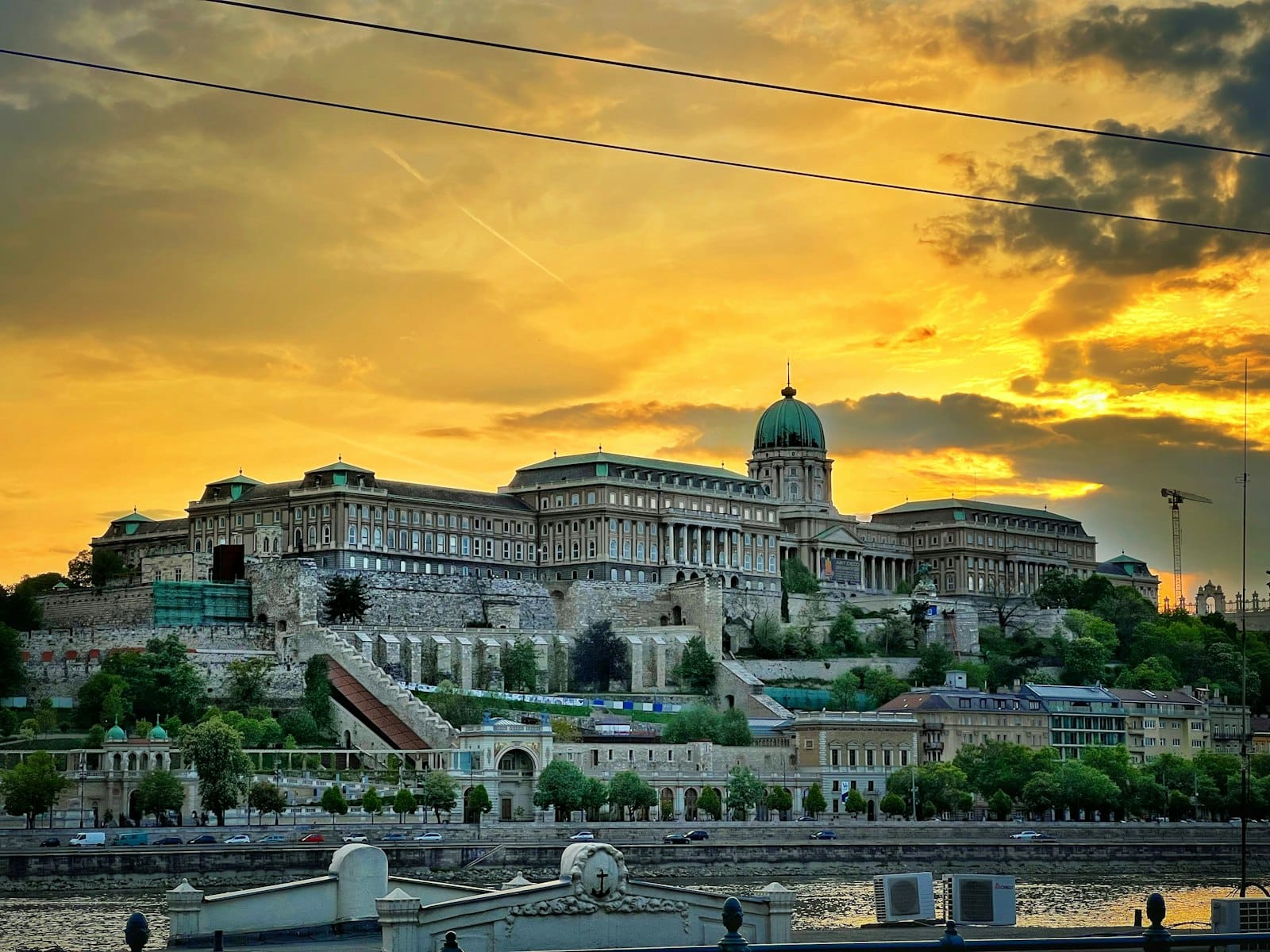
Before you look at a single painting, the building itself demands attention. The gallery occupies the central and southern wings of Buda Castle, a sprawling Neo-Baroque palace complex. The palace was heavily damaged in World War II and later reconstructed, with a history that reaches back from a medieval fortress to a Habsburg ceremonial seat.
The setting onCastle Hill gives the gallery an altitude and grandeur that few art museums anywhere can match. Standing in the main courtyard on a clear morning, with the river glittering below and the rooftops of Pest stretching to the horizon, you are already in a composition before you step through the door. This is both the gallery's greatest asset and a mild distraction: it can be genuinely hard to focus on interiors when the panorama keeps pulling you back to the windows.
The Dome Hall at the top of the central building is worth a separate mention. It sits beneath the iconic cupola and offers a panoramic view of the city when open. On calm days it opens to visitors; on windy or rainy days it closes, so treat access as a bonus rather than a certainty.
Tickets & tours
Live prices and dates from our booking partner. If you book, we may earn a commission at no extra cost to you.
Hungarian wine tasting tour in Budapest
From 54 €Instant confirmationFree cancellationHungarian dinner with Danube River cruise
From 55 €Instant confirmationFree cancellationBudapest Guided E-Scooter Tour by Night
From 60 €Instant confirmationFree cancellationHalf-day tour to Princess Sissi's Godollő royal palace from Budapest
From 41 €Instant confirmationFree cancellation
Navigating the Permanent Collection
Medieval and Renaissance Stoneworks
The ground-floor rooms hold the oldest material in the museum: carved stone fragments, capitals, and relief panels recovered from medieval Hungarian churches and palaces, many of them destroyed during the Ottoman occupation of Hungary in the 16th and 17th centuries. The pieces are not flashy, but for anyone interested in medieval European art or Romanesque sculpture, they are genuinely rare survivals. Labels are available in English, though the information is somewhat sparse compared to the upper floors.
Gothic Altarpiece Panels
The late-Gothic collection is the most internationally significant section of the permanent display. Hungary's position on medieval trade and pilgrimage routes produced a remarkable flowering of painted altarpiece panels in the late 15th and early 16th centuries, and the gallery holds the largest and best-preserved group of these works anywhere. The colors remain startling: deep crimsons, ultramarine blues, and gold backgrounds that were meant to glow by candlelight in now-vanished churches. Allow more time here than you think you need.
19th-Century Painting: The Emotional Core
Most visitors find the 19th-century halls the most immediately affecting part of the museum. This was the era of Hungarian national awakening, and the paintings carry that weight. Mihály Munkácsy's large-format canvases depicting peasant life, courtroom drama, and religious subjects are among the most technically accomplished works in the collection. Viktor Madarász's historical scenes and László Paál's landscape paintings from the Barbizon tradition give a sense of how Hungarian artists were in constant dialogue with Paris and Vienna while trying to define something distinctly their own.
The sheer scale of some works in these rooms is worth noting: several canvases run three or four meters wide and fill entire walls. They were painted for public exhibition and patriotic effect, and they still have that quality. You feel the ambition.
20th-Century Works
The upper floors cover Hungarian art through the Communist period and into the late 20th century. This section is less consistently presented and can feel fragmented compared to the cohesive 19th-century rooms below. Some of the Socialist Realist works from the 1950s are interesting as historical documents rather than aesthetic achievements. The early Hungarian Modernists, including artists who worked within the orbit of Paris's avant-garde movements before World War II, are represented but not exhaustively. If contemporary Hungarian art is your primary interest, the Ludwig Museum on the Pest side of the river covers that territory more thoroughly.
How the Experience Changes by Time of Day
Arriving when the gallery opens at 10:00 on a weekday gives you the medieval and Gothic floors almost entirely to yourself. The light in the ground-floor rooms is controlled and consistent throughout the day, which matters less than in the upper floors, where south-facing windows can create significant glare on large canvases in the early afternoon, particularly in summer.
Midday to 14:00 tends to be the busiest period, particularly in summer and on weekends, when tour groups move through the 19th-century halls. The audio guide is worth taking if you want context rather than crowd-following; it lets you set your own pace and skip rooms that don't interest you.
Late afternoon, from around 15:30 onward, the museum quiets considerably. The light on the Dome terrace is warmer and better for photography. The café and shop are open, and you can take your time in the upper floors without competition for viewing space in front of major works.
ℹ️ Good to know
Photography is generally permitted without flash in the permanent collection rooms. Check signage in temporary exhibition spaces, as rules may differ. Tripods are not permitted.
Practical Details for Your Visit
The gallery sits inside Buda Castle's complex, accessed from the main courtyard off Szent György tér. The most straightforward approach from central Pest is to cross the Chain Bridge on foot and take the Castle Hill Funicular from Clark Ádám tér up to the castle grounds, then walk south along the terrace to the gallery's main entrance. Alternatively, buses 16, 16A, and 116 run directly to Szentháromság tér on Castle Hill from Széll Kálmán tér metro station.
The building is wheelchair accessible. Lifts connect the main floors, and the entrance at ground level does not require stairs. Staff at the information desk speak English. If you are arriving with children, be aware that the stone fragment rooms and altarpiece sections hold young children's attention less reliably than the large Romantic canvases upstairs, which tend to provoke questions.
The gallery is free of charge on three Hungarian national holidays: March 15 (anniversary of the 1848 revolution), August 20 (St. Stephen's Day, Hungary's national day), and October 23 (anniversary of the 1956 revolution). On those days, expect significantly higher visitor numbers.
⚠️ What to skip
The Budapest Card covers free or discounted entry to many city museums, but the Hungarian National Gallery is not always included. Check the current benefits list at the Budapest Card's official page before assuming it applies.
For a broader picture of how the gallery fits into Budapest's cultural landscape, the best museums in Budapest guide compares it with other major institutions across the city.
Context: Where This Fits in a Budapest Visit
The gallery sits in the middle of the Castle Hill historic zone, which means it pairs naturally with a morning or afternoon that also takes in Matthias Church and Fisherman's Bastion a few hundred meters north. The area rewards slow exploration on foot rather than rapid transit between sites.
Honest note on expectations: the Hungarian National Gallery is a serious art museum, not a tourist spectacle. It does not have the density of major works per square meter that you find in Vienna or Paris. Some rooms feel underlit or slightly dated in their presentation compared to renovated counterparts elsewhere in Europe. If you are primarily after the Castle Hill panorama and architecture, you can get a great deal of satisfaction from the castle grounds and the terrace without buying a museum ticket. But if you want to understand what Hungarian artists were actually doing and thinking across eight centuries, the gallery is irreplaceable and worth every forint.
If your time in Budapest is limited, it helps to read a 3-day Budapest itinerary first to decide where the gallery fits relative to other priorities.
Insider Tips
- The Dome Hall is accessed from inside the museum and not widely signposted. Ask at the information desk when you arrive whether it is open that day, as wind and rain close it without notice.
- The Gothic altarpiece collection on the ground floor is the section most likely to surprise visitors who came primarily for the Romantic paintings. Set aside at least 30 minutes here; it is the collection's most internationally significant holding.
- On Hungarian national holidays (15 March, 20 August, 23 October) admission is free, but visitor numbers spike significantly. If you visit on those days, arrive at opening time to see the major works without crowds.
- The museum's main courtyard, between the gallery entrance and the Buda Castle grounds, offers one of the cleanest unobstructed views of the Danube and Pest for photography, without the crowds that gather at Fisherman's Bastion. It is accessible even without buying a museum ticket.
- The audio guide covers the permanent collection's highlights in logical sequence and is worth the extra HUF 1,200, particularly for the 19th-century rooms where the historical and political context behind individual paintings transforms how you read them.
Who Is Hungarian National Gallery For?
- Travelers with a genuine interest in Central European art history and national identity
- Architecture enthusiasts drawn to the Neo-Baroque Buda Castle complex and its reconstruction story
- Visitors on a multi-day Budapest trip who have already covered the major Pest-side sights and want depth over breadth
- Groups or solo travelers on Hungarian national holidays, when free admission makes it an excellent full-morning option
- Anyone combining the visit with a broader Castle Hill afternoon that also includes Matthias Church and the Fisherman's Bastion terrace
Nearby Attractions
Other things to see while in Castle Hill (Várhegy):
- Buda Castle (Budavári Palota)
Buda Castle, known in Hungarian as Budavári Palota, is the historic royal palace complex crowning Castle Hill on the Buda side of the Danube. The grounds are free and open around the clock, while the palace buildings house the Hungarian National Gallery and Budapest History Museum. A UNESCO World Heritage Site since 1987, it anchors the western skyline that defines Budapest.
- Castle Hill Funicular (Budavári Sikló)
The Budavári Sikló has been hauling passengers from the Danube bank to the top of Castle Hill since 1870, making it one of Europe's oldest passenger funiculars. The ride takes just 90 seconds, but the views over the Chain Bridge and the Pest skyline make it worth every forint.
- Fisherman's Bastion (Halászbástya)
Fisherman's Bastion is a neo-Romanesque terrace on Castle Hill with seven fairy-tale towers and an unobstructed panorama over the Danube and Pest. The lower terraces are free to enter at any hour, making it one of the few world-class viewpoints in Europe you can visit without spending a forint. But timing your visit carefully makes the difference between a genuine experience and a crowded selfie queue.
- Hospital in the Rock (Sziklakórház)
Carved into the limestone beneath Buda Castle in the 1930s, the Hospital in the Rock is a remarkably preserved underground surgical hospital and Cold War nuclear bunker. Guided tours lead visitors through 2,300 square metres of tunnels, operating theatres, and wax figure displays that recreate wartime medical conditions with uncomfortable accuracy.
Planning a trip? Discover personalized activities with the Nomado app.