Buda Castle (Budavári Palota): What to See, Know, and Do
Buda Castle, known in Hungarian as Budavári Palota, is the historic royal palace complex crowning Castle Hill on the Buda side of the Danube. The grounds are free and open around the clock, while the palace buildings house the Hungarian National Gallery and Budapest History Museum. A UNESCO World Heritage Site since 1987, it anchors the western skyline that defines Budapest.
Quick Facts
- Location
- 1014 Budapest, Szent György tér, Castle Hill (District I)
- Getting There
- Bus 16 or 116 to Dísz tér; or take the Budavári Sikló funicular from near Chain Bridge
- Time Needed
- 2–5 hours depending on museum visits; grounds alone take 45–60 minutes
- Cost
- Castle grounds: free. Museum interiors (National Gallery, History Museum): ticketed separately — verify current prices
- Best for
- History enthusiasts, architecture lovers, panoramic views of the Danube and Pest
- Official website
- www.budapest.org/en/things-to-do-budapest/buda-castle
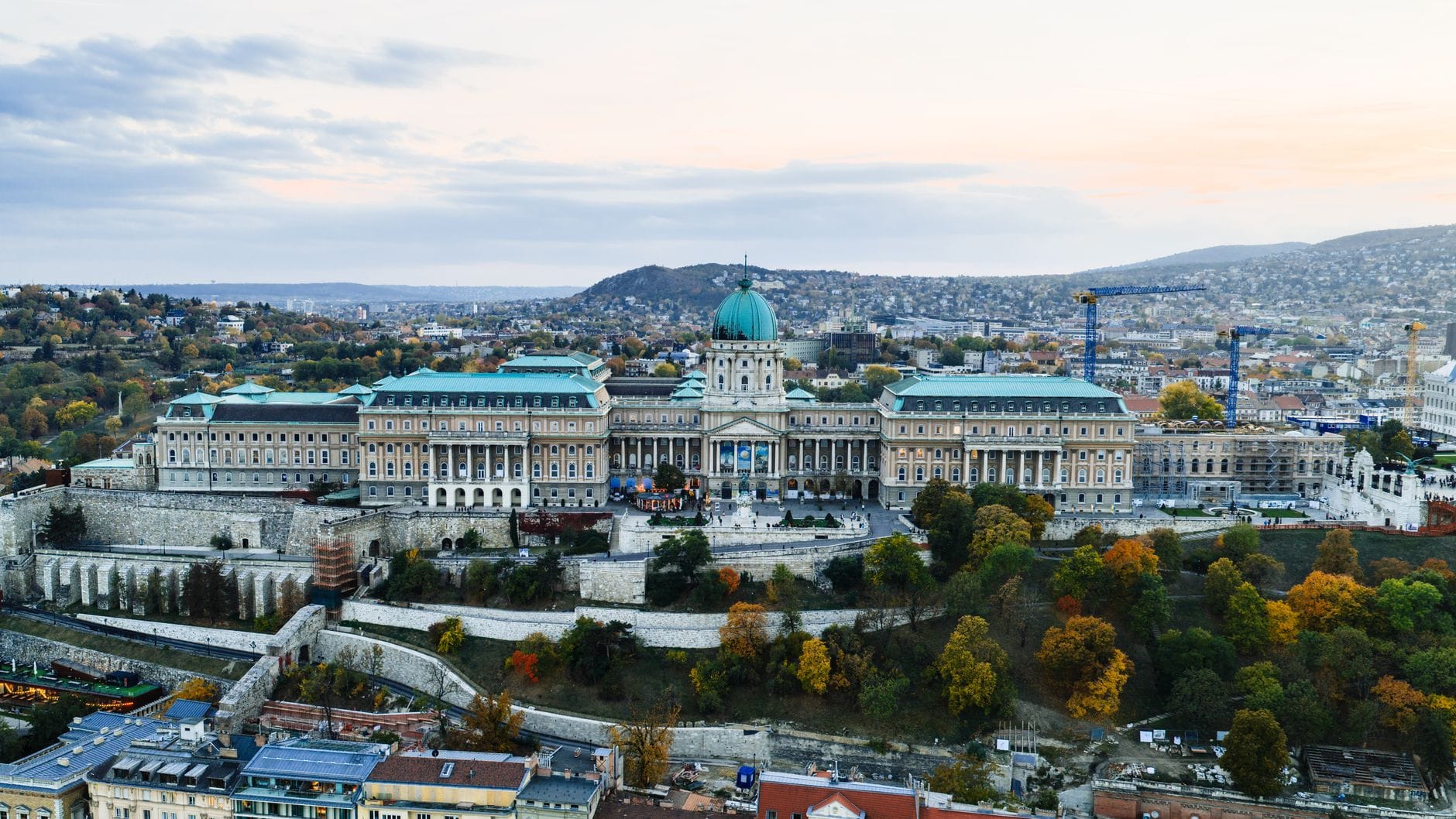
What Buda Castle Actually Is
Buda Castle (Budavári Palota) is not a single building but an entire palace complex spread across the southern tip of Castle Hill, rising about 60 metres above the Danube. What looks from Pest like one long Baroque facade is in fact a cluster of wings, courtyards, terraces, and gardens that took centuries to accumulate and several wars to half-destroy. The complex currently houses the Hungarian National Gallery, the Budapest History Museum, and the National Széchényi Library, though plans for further redevelopment of parts of the site have been ongoing.
The distinction worth understanding before you arrive: the castle grounds, courtyards, and terraces are free to enter at any hour. The palace interiors require separate tickets purchased at each institution. Many visitors spend a satisfying half-day here without ever buying a ticket, simply walking the terraces, crossing the cobbled courtyards, and taking in the panorama over the Danube.
💡 Local tip
The Budapest Card covers or discounts entry to several museums within the castle complex. If you are visiting multiple paid attractions during your trip, it may reduce total costs significantly. Check current inclusions before purchasing.
A History Built in Layers
The first fortified castle on this hill was completed in 1265 under King Béla IV, who chose the elevated position for its defensive value following the Mongol invasion of Hungary. For the next several centuries, the site grew into one of the most significant royal courts in Central Europe, reaching its first architectural peak under King Matthias Corvinus in the late 15th century, when the complex incorporated Gothic and early Renaissance elements and attracted scholars and artists from across the continent.
The Ottoman occupation of Buda from 1541 to 1686 left the buildings substantially deteriorated. After Habsburg forces retook the city, construction of the current Baroque palace began in earnest and ran from 1749 to 1769. That structure was expanded again in the late 19th and early 20th centuries, culminating in the large Neo-Baroque composition visible today. Then came the Siege of Budapest during World War II, which left the complex in ruins. The postwar reconstruction, completed under communist-era constraints, simplified many of the ornate details — which is why the exterior, while imposing, reads as somewhat austere compared to pre-war photographs.
The entire Castle Hill area, including Buda Castle, has been a UNESCO World Heritage Site since 1987, listed as part of the Budapest, including the Banks of the Danube, the Buda Castle Quarter and Andrássy Avenue designation. For deeper context on how this fits into the city's architectural story, the Budapest history guide covers the full sweep from Roman Aquincum to the present.
Tickets & tours
Live prices and dates from our booking partner. If you book, we may earn a commission at no extra cost to you.
Private Buda Castle walking tour
From 195 €Instant confirmationFree cancellationBuda Castle District Tour on MonsteRoller
From 50 €Instant confirmationFree cancellationPrivate Buda Castle walking tour and Danube river cruise with Margaret Island
From 292 €Instant confirmationFree cancellationBuda Castle 3-hour tour with a friendly historian
From 68 €Instant confirmationFree cancellation
How the Experience Changes by Time of Day
Early morning, roughly between 7 and 9 a.m., is when Castle Hill earns its reputation. The tour groups have not yet arrived from their hotels, the light comes in low and golden from the east, and the main courtyard around the Matthias Fountain is nearly empty. The stone cobbles are often still damp from overnight cleaning, and the silence is striking given that you are in the middle of a capital city. This is the best window for photography of the courtyard and the bronze equestrian statue of Prince Eugene of Savoy near the south terrace.
By 10 a.m., the funicular starts delivering its first loads of visitors and tour coaches begin parking on the hill. Between 11 a.m. and 3 p.m., the main terrace and the view over the Danube can feel genuinely crowded, especially in summer. The National Gallery and History Museum draw steady queues at peak hours during this window.
Late afternoon, from around 4 p.m. onward, the crowd noticeably thins as day-trippers and tour groups begin descending. The terrace facing Pest turns spectacular as the sun drops behind the hills to the west, throwing warm light across the Chain Bridge and the Parliament building on the opposite bank. If you want the best photographs of the Pest skyline from the castle, position yourself on the eastern terrace between 4:30 and 6 p.m. on a clear day.
After dark, the castle is floodlit and the grounds remain accessible. The view across the river to the illuminated Parliament is one of the most reproduced images of Budapest, and seeing it from the castle terrace rather than from the Pest bank offers a completely different, more elevated perspective. Evenings here are calm and the crowds are minimal.
ℹ️ Good to know
Weather note: Buda Castle sits on an exposed hilltop. Wind speed here is noticeably higher than at river level, and in winter the temperature feels several degrees colder. Bring an extra layer even if the forecast looks mild.
The Grounds: What to See Without a Ticket
The main courtyard, accessed through the Lion Gate or from Dísz tér, contains the Matthias Fountain, a large bronze sculptural group completed in 1904 depicting the legendary king on a hunt. It anchors the northern courtyard and is the natural starting point for orienting yourself within the complex. From here, paths lead south toward the main palace wings and east toward the terrace overlooking the Danube.
The Turul statue at the northwestern edge of the complex is one of the more striking details: a large bronze bird of prey with spread wings perched on a bastion wall, representing the mythological bird of Hungarian legend. Most visitors walking directly to the main courtyard miss it entirely. The terraced gardens below the southern facade descend in stages toward the Várkert Bazár (Castle Garden Bazaar), a Neo-Renaissance arcade complex built in the 1870s that now contains cafes and a covered market space and connects the castle hill to the riverbank.
The cobbled streets immediately north of the castle complex lead into the medieval town of Castle Hill proper, where the Matthias Church and Fisherman's Bastion are located roughly a 10-minute walk away. Combining all three in a single Castle Hill morning is the standard approach and makes sense logistically.
Inside the Palace: The Two Main Museums
The Hungarian National Gallery occupies wings B, C, and D of the palace and holds the country's primary collection of Hungarian fine art, running from medieval altarpieces through 19th-century academic painting and on into 20th-century works. The 19th-century rooms are the strongest, with large-scale historical canvases by painters like Mihály Munkácsy and Viktor Madarász. The gallery is open Tuesday through Sunday, 10:00 to 18:00, and is closed on Mondays; opening hours may vary on certain holidays, so check the official site before visiting. Ticket prices should be confirmed directly with the gallery, as they are updated periodically.
The Budapest History Museum (Budapesti Történeti Múzeum) is housed in wing E and provides a thorough account of the city from prehistoric times through the 20th century. Its most compelling section is the medieval palace remains uncovered during postwar reconstruction, visible in the basement levels: original Gothic halls and stonework from the 14th and 15th centuries that survived beneath the rubble. The museum opens daily except Mondays; note that in autumn and winter the closing time shifts to 16:00 rather than the summer 18:00. If you are interested in Budapest's deeper history, the Hungarian National Museum in Pest provides complementary coverage at national scale.
💡 Local tip
The medieval palace exhibition in the basement of the History Museum is genuinely worth the entrance fee. Original Gothic vaulting and carved stonework from Matthias Corvinus's 15th-century court have been preserved in situ — it is the one part of the complex where the pre-Ottoman layers are physically present, not just described.
Getting There: Your Practical Options
The most memorable approach is the Budavári Sikló, the historic funicular that runs from near the Buda end of Chain Bridge up to the castle terrace. It is a short ride but provides a satisfying sense of arrival and eliminates the steep uphill walk. The funicular operates on its own ticketing system, separate from the city's BKK transport network, so standard public-transport passes do not cover it. Fares should be confirmed at the lower station, as they are updated periodically.
Buses 16, 16A, and 116 stop at Dísz tér, which deposits you directly into the upper castle area with no significant walking. This is the most practical option if you are coming from elsewhere on Castle Hill or from the Buda side. The Castle Hill Funicular is the atmospheric choice; the bus is the efficient one.
Walking up is possible via several stairways from the Várkert Bazár at river level or through the Bécsi kapu (Vienna Gate) from the northern end. The uphill walks are steep and take 15 to 20 minutes, but they pass through quieter residential lanes and are worth doing once if you have the time and physical ability. On wet or icy days, the stone paths can be slippery, and the funicular or bus is the safer choice.
⚠️ What to skip
Wheelchair and pushchair users should note that the castle grounds contain extensive cobblestone surfaces and level changes between courtyards. The funicular and buses provide step-free access to the hilltop, but mobility within the grounds varies by route. Contact the individual museums directly for current accessibility information.
Is It Worth Your Time?
The honest answer is: it depends on what you want. As a panoramic platform over the Danube and the Pest skyline, Buda Castle is hard to beat and costs nothing. The Baroque courtyards and the scale of the complex are genuinely impressive in a way that photographs do not fully convey. If you are visiting Budapest for the first time, the castle district is worth at least two to three hours, ideally combined with Matthias Church and Fisherman's Bastion in the same half-day.
The museums add significant value for the right visitor. The National Gallery's 19th-century Hungarian painting collection is underappreciated internationally and rewards a slow visit. The History Museum's medieval basement is one of the most genuinely atmospheric spaces in the city. But if you are primarily interested in the Danube panorama and the castle's exterior presence, the grounds and terraces deliver that fully for free. For a broader view of how this fits into a trip, the 3-day Budapest itinerary maps out a logical sequence that integrates Castle Hill without overloading the day.
Who might be disappointed: visitors expecting a fully restored medieval castle interior will find instead Baroque palace architecture with simplified postwar detailing. The complex is also under gradual redevelopment, so parts of it may be fenced or restricted on any given visit. Travelers with limited mobility should research accessibility details in advance, as the site's uneven terrain is a real constraint.
Insider Tips
- The east-facing terrace near the Prince Eugene statue offers a direct sightline to the Hungarian Parliament building across the river. Arrive just before sunset on a clear day and the Parliament's dome turns deep gold — this is the shot most people only get from the Pest side.
- The Matthias Fountain courtyard is largely empty before 9 a.m. on weekdays. If you are staying on the Buda side, walking up before breakfast is a very different experience from the midday crowds.
- The Várkert Bazár at the base of the castle hill (accessible by stairs from the riverside promenade) contains a covered passageway with a lift that brings you closer to the castle grounds without the full uphill walk — useful if you want an alternative to the funicular without the steepest sections.
- The History Museum sells combination tickets that can include temporary exhibitions. Check what is running during your visit, as the castle's temporary exhibition programme occasionally includes items not usually on public display.
- Buda Castle hosts several seasonal outdoor events, including craft markets and cultural festivals. These can enliven or crowd the courtyards significantly depending on timing. Check the Budapest events calendar before planning a specific arrival time.
Who Is Buda Castle (Budavári Palota) For?
- First-time visitors to Budapest wanting the city's defining panoramic view
- History and architecture enthusiasts with time for the museum interiors
- Photographers, especially in early morning light or at sunset
- Families with older children interested in Hungarian history
- Travelers combining Castle Hill into a half-day with Matthias Church and Fisherman's Bastion
Nearby Attractions
Other things to see while in Castle Hill (Várhegy):
- Castle Hill Funicular (Budavári Sikló)
The Budavári Sikló has been hauling passengers from the Danube bank to the top of Castle Hill since 1870, making it one of Europe's oldest passenger funiculars. The ride takes just 90 seconds, but the views over the Chain Bridge and the Pest skyline make it worth every forint.
- Fisherman's Bastion (Halászbástya)
Fisherman's Bastion is a neo-Romanesque terrace on Castle Hill with seven fairy-tale towers and an unobstructed panorama over the Danube and Pest. The lower terraces are free to enter at any hour, making it one of the few world-class viewpoints in Europe you can visit without spending a forint. But timing your visit carefully makes the difference between a genuine experience and a crowded selfie queue.
- Hospital in the Rock (Sziklakórház)
Carved into the limestone beneath Buda Castle in the 1930s, the Hospital in the Rock is a remarkably preserved underground surgical hospital and Cold War nuclear bunker. Guided tours lead visitors through 2,300 square metres of tunnels, operating theatres, and wax figure displays that recreate wartime medical conditions with uncomfortable accuracy.
- Hungarian National Gallery
The Hungarian National Gallery (Magyar Nemzeti Galéria) occupies three wings of Buda Castle and houses the country's most comprehensive collection of Hungarian art, from medieval altarpieces to 20th-century masterworks. Set on Castle Hill above the Danube, it combines serious art history with one of the most dramatic building settings in Central Europe.
Planning a trip? Discover personalized activities with the Nomado app.