Váci Street (Váci utca): Budapest's Most Famous Pedestrian Street
Váci utca runs 1.2 km through the heart of Pest, connecting Vörösmarty Square to the Great Market Hall. Free to walk, open at all hours, and lined with shops, cafes, and historic architecture, it's a reliable orientation point for first-time visitors, though seasoned travelers may find it more useful as a corridor than a destination.
Quick Facts
- Location
- 1052 Budapest, Váci utca, Pest City Center (District V)
- Getting There
- M1 Vörösmarty tér (north end), M3 Ferenciek tere (mid), M4 Fővám tér (south end, by Central Market Hall)
- Time Needed
- 30–90 minutes end to end, depending on stops
- Cost
- Free to walk; shops open approx. Mon–Sat 10:00–20:00, Sun 10:00–18:00
- Best for
- First-time visitors, souvenir shopping, orientation walks, evening strolls
- Official website
- www.budapestinfo.hu/en/vaci-street
What Váci Street Actually Is
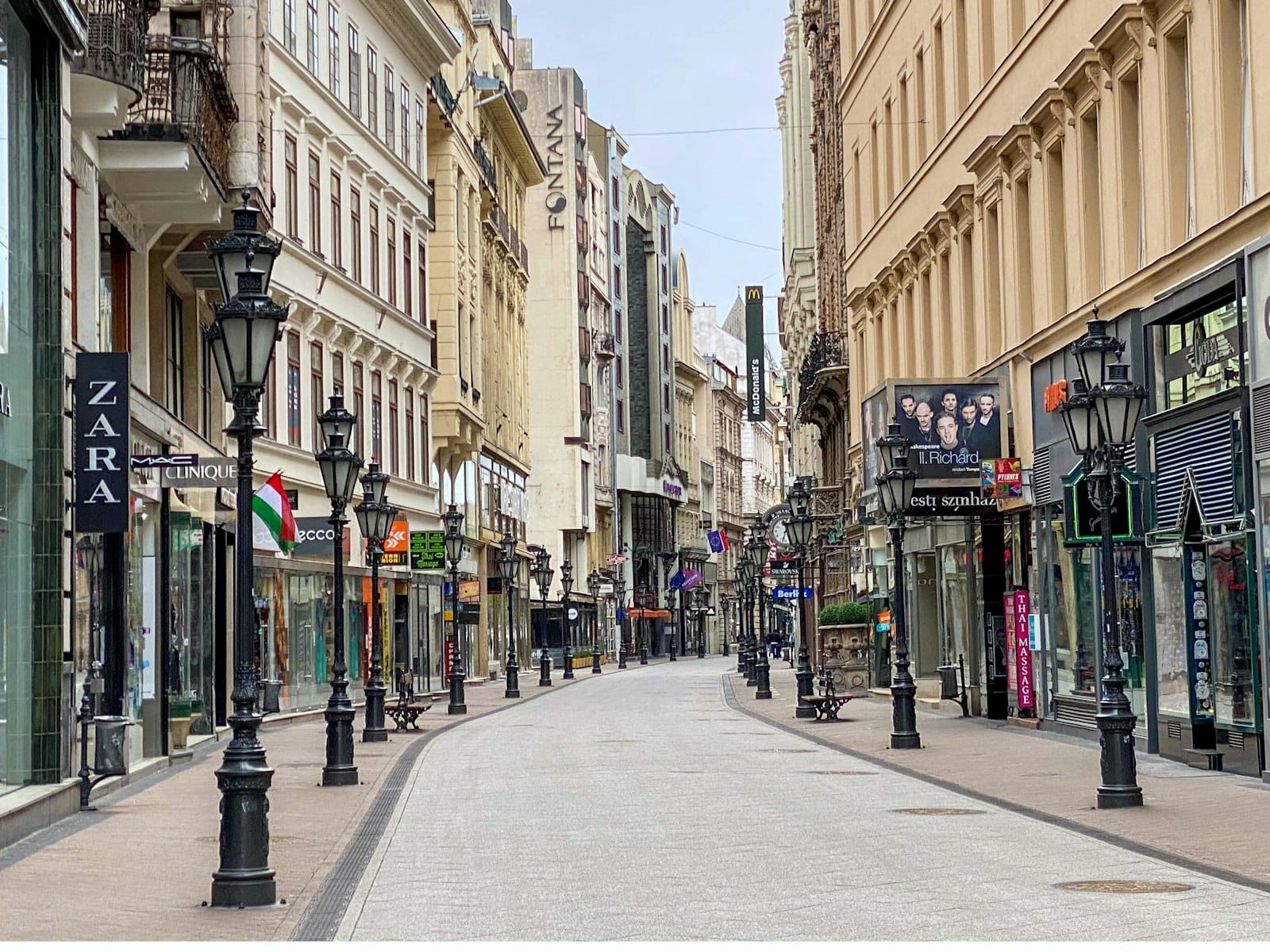
Váci utca is Budapest's best-known pedestrian shopping street, stretching approximately 1.2 km through the Belváros district of Pest, parallel to the Danube. It runs from Vörösmarty Square in the north down to Fővám tér and the Great Market Hall at its southern end, cutting a straight line through the commercial heart of District V. The street is a public thoroughfare with no entry fee and no closing time, though the shops, cafes, and restaurants along it operate on their own schedules.
The honest assessment: Váci Street is useful. It connects two of Pest's most visited landmarks, passes some genuine architectural highlights, and offers convenient access to souvenirs, international brands, and plenty of places to eat. What it is not is a discovery. Decades of foot traffic have turned the northern stretch into one of the more tourist-concentrated corridors in Central Europe, with pricing and energy to match. That said, dismissing it entirely would be a mistake, especially if you understand how to use it.
💡 Local tip
Start at the southern end near the Central Market Hall and walk north. You'll move from the more local, slightly less polished end of the street toward Vörösmarty Square, which gives the walk a natural crescendo rather than an anticlimactic finish.
A Street With Centuries Behind It
Váci utca developed as a significant urban artery during the 18th century, as Pest grew into a commercial center on the flat eastern bank of the Danube. One of the oldest surviving buildings on the street, at Váci utca 13, dates to 1805, which gives some sense of how long this corridor has anchored Pest's street life. Throughout the 19th and early 20th centuries it was among the city's most fashionable addresses, lined with coffee houses, tailors, and the kinds of establishments that defined bourgeois Budapest.
The architecture along the street reflects the layered history of District V. You'll spot Neoclassical facades from the early 1800s, Historicist and eclectic buildings from the late 19th century, and occasional modernist insertions from the Soviet period. The buildings are not uniform, and looking above the ground-floor shop fronts reveals the city's story more clearly than most. A few doorways open onto internal courtyards worth a quick look.
Váci Street sits within the broader context of Pest's city center, which underwent rapid expansion during the dual monarchy era following the unification of Buda, Óbuda, and Pest in 1873. The street's current pedestrian character is relatively recent by comparison, part of the city's 20th-century effort to reclaim central streets from vehicle traffic.
Tickets & tours
Hand-picked options from our booking partner. Prices are indicative; availability and final rates are confirmed when you complete your booking.
Budapest Guided E-Scooter Tour by Night
From 60 €Instant confirmationFree cancellationHalf-day tour to Princess Sissi's Godollő royal palace from Budapest
From 41 €Instant confirmationFree cancellationHalf-Day Countryside Wine Tour from Budapest
From 95 €Instant confirmationFree cancellation4 Course Dinner cruise with Operetta and Folk show
From 81 €Instant confirmationFree cancellation
Walking the Street: What You'll Find
The northern half, between Vörösmarty Square and roughly Párizsi utca, is where tourist density peaks. You'll encounter souvenir shops selling embroidered tablecloths, paprika sets, and Rubik's Cubes alongside international chains and a handful of Hungarian brands. The paving here is well-maintained, the street wide enough to feel comfortable even during busy midday hours, and cafes spill tables out toward the center.
The southern half, from Ferenciek tere down to Fővám tér, has a different texture. It's narrower in places, less polished, and more likely to have a pharmacy, a Hungarian-language bookshop, or a local bakery mixed in with the tourist-facing businesses. The foot traffic thins out a little here, and the gap between tourist pricing and everyday Budapest reality closes slightly. This stretch is worth walking even if you have no intention of buying anything.
The southern anchor of Váci Street is the Central Market Hall at Fővám tér, a cavernous iron-and-brick covered market from 1897 that is genuinely worth entering. The ground floor has fresh produce and butcher stalls; the upper level is where the souvenir action concentrates. It's a logical end point for the walk and a good place to buy food items to take home.
How the Street Changes Through the Day
Early mornings on Váci Street are quiet enough to hear your own footsteps on the stone paving. Before 9:30, most shops are shuttered, delivery vehicles are occasionally permitted access for restocking, and the street belongs almost entirely to joggers cutting through and hotel guests heading toward coffee. The architecture reads best at this hour, when the crowds haven't accumulated and the morning light catches the upper-floor facades.
By midday in summer, the northern section is genuinely crowded. Organized tour groups move in clusters, families with strollers occupy the center of the street, and the outdoor restaurant terraces fill up. Noise levels rise considerably. If you're heat-sensitive, note that the street gets direct afternoon sun with little natural shade; the stone paving absorbs and radiates heat noticeably in July and August.
Evenings shift the mood. After 19:00, when many shops close, the street transitions toward its restaurant and bar function. The lighting softens, the tour groups thin out, and there's a more relaxed pace. In summer, this is one of the more pleasant times to walk the length of the street without stopping, using it as a connecting route between Vörösmarty Square and the Danube riverfront.
⚠️ What to skip
In peak summer (July–August), midday temperatures on Váci Street can feel oppressive. The stone surface radiates heat, there is limited shade, and the tourist density adds to the discomfort. Plan the walk for morning or evening if you're visiting in high summer.
Getting There and Getting Around
Váci Street is accessible from three metro lines, which makes it one of the easiest points in Budapest to reach by public transport. Line M1 (the yellow line, the oldest metro in continental Europe) drops you at Vörösmarty tér for the northern entrance. Line M3 (blue line) stops at Ferenciek tere, which feeds directly into the street's midpoint. Line M4 (green line) stops at Fővám tér, placing you at the southern end near the Central Market Hall. Tram line 2 also runs along the Danube embankment to Fővám tér, which is useful if you're arriving from the direction of the Parliament.
If you're planning to use Budapest's public transport extensively during your stay, the Budapest Card covers unlimited metro, tram, and bus travel along with free entry to several museums. For a street like Váci, where the transit connections are this straightforward, it's a good investment if Váci is one stop among many in a full day of sightseeing.
The street itself is pedestrianized along most of its length, with a flat, paved surface that is generally navigable for wheelchairs and pushchairs. Individual shops and older buildings may have steps or limited accessibility at their entrances, but moving along the street itself poses no particular obstacles.
Photography Notes and Practical Details
For photography, the northern end at Vörösmarty Square offers the widest compositions, with the square opening up the view and the Gerbeaud cafe providing a Neoclassical focal point. Walking south, the narrower sections of the street create better corridor compositions when the crowds are thinner. Late afternoon light hits the western-facing facades well in the northern section.
Souvenirs here are priced at a tourist premium compared to markets elsewhere in the city. Hungarian paprika, Tokaj wine, Zsolnay porcelain, and embroidered textiles are common purchases and relatively authentic to Hungarian culture and craft tradition. Rubik's Cubes are inescapable, though the puzzle was genuinely invented in Budapest by Ernő Rubik in 1974, so there's something appropriate about the local proliferation. Compare prices at the Central Market Hall before committing at street-level shops.
If you want a fuller picture of where Váci Street fits into the city's retail and cultural geography, the Budapest shopping guide covers the range from market halls to designer boutiques to second-hand shops in the Jewish Quarter.
Who Should Reconsider Visiting
Travelers who have been to Budapest before and are looking for something beyond the well-worn tourist path will likely find the northern section of Váci Street unremarkable on a second visit. The same is true for anyone who actively dislikes crowds or tourist-facing retail. Budapest has far more interesting shopping and strolling streets with less foot traffic and more local character, including the streets around the Jewish Quarter and the Grand Boulevard area.
Those whose primary interest is Budapest's architecture would be better served spending time on Andrássy Avenue, a UNESCO World Heritage boulevard with more sustained and ambitious architecture than Váci Street offers. For ruin bars and a more authentically local nightlife scene, the ruin bars of the Jewish Quarter are a completely different proposition.
Insider Tips
- The stretch of Váci Street south of Ferenciek tere (toward the Central Market Hall) sees significantly fewer tourists and has more everyday Budapest businesses. Walk it even if you've already dismissed the northern section.
- Look up. The ground-floor shop fronts have been heavily renovated and modernized, but the upper floors of many buildings retain 19th-century facades, ornate window frames, and ironwork that tell a better architectural story.
- Gerbeaud cafe at Vörösmarty Square is the famous, expensive option at the northern end. For coffee at a fraction of the price, walk one block off Váci into the side streets, where local cafes serve the same quality without the location premium.
- The Central Market Hall at the south end has free entry and is worth at least 20 minutes inside. Go to the upper gallery for an overview of the hall's iron structure, which is impressive regardless of what you buy.
- Avoid the street between 12:00 and 15:00 on summer weekends if crowds bother you. The combination of tour groups, slow-moving visitors, and heat makes it the most uncomfortable window of the week.
Who Is Váci Street For?
- First-time visitors to Budapest wanting a straightforward orientation walk through the city center
- Shoppers looking for Hungarian food products, paprika, wine, and embroidered textiles in a concentrated area
- Travelers who want to connect Vörösmarty Square and the Central Market Hall on foot in one logical route
- Evening walkers who want a flat, well-lit, car-free corridor through central Pest
- Families with young children who need a pushchair-friendly walking route in the city center
Nearby Attractions
Other things to see while in Pest City Center (V. District):
- Central Market Hall (Nagy Vásárcsarnok)
The Central Market Hall, known locally as Nagy Vásárcsarnok, is Budapest's largest historic covered market hall. Built in 1897 to a design by architect Samu Petz, it fills three floors with fresh produce, Hungarian specialties, folk crafts, and street food. Entry is free, and it sits steps from the Liberty Bridge in the heart of Pest.
- Chain Bridge (Széchenyi Lánchíd)
The Széchenyi Chain Bridge (Széchenyi lánchíd) is one of the oldest and most recognizable bridges in Budapest, linking the historic Pest riverfront with the foot of Castle Hill. Free to cross at any hour, it rewards visitors with sweeping Danube views and a walk through 175 years of Hungarian history.
- Hungarian National Museum
The Hungarian National Museum is the oldest national history museum in Hungary, tracing the country's story from prehistoric times through the 20th century. Housed in a commanding neoclassical building from 1847, it anchors Budapest's Pest district and offers one of the most complete windows into Hungarian identity available to visitors.
- Hungarian Parliament Building
Rising from the Pest bank of the Danube in a symphony of Gothic spires and terracotta stone, the Hungarian Parliament Building is the defining landmark of Budapest. Built between 1885 and 1904, it houses the Holy Crown of Hungary and opens its gilded interior to guided tours on most days. This guide covers everything you need to visit well.