Citadella and Liberty Statue: Budapest's Hilltop Fortress with Panoramic Views
Perched atop Gellért Hill, the Citadella fortress and the 40-metre Liberty Statue together form one of Budapest's most recognizable silhouettes. Entry to the outdoor grounds is free and the site operates daily within posted opening hours rather than being open around the clock, making it one of the most accessible major landmarks in the city.
Quick Facts
- Location
- Citadella sétány 1, 1118 Budapest — summit of Gellért Hill, District XI
- Getting There
- Tram 47/49 or Metro M4 to Gellért tér (then 15–20 min walk up), or Bus 27 from Móricz Zsigmond körtér
- Time Needed
- 1–2 hours on the hill; add 30 min if walking up from the riverbank
- Cost
- Free (outdoor grounds and viewpoints). Indoor exhibitions and special lookout areas are ticketed — verify current prices at citadella.hu
- Best for
- City panoramas, photography, history enthusiasts, sunset visits
- Official website
- citadella.hu
What the Citadella Actually Is
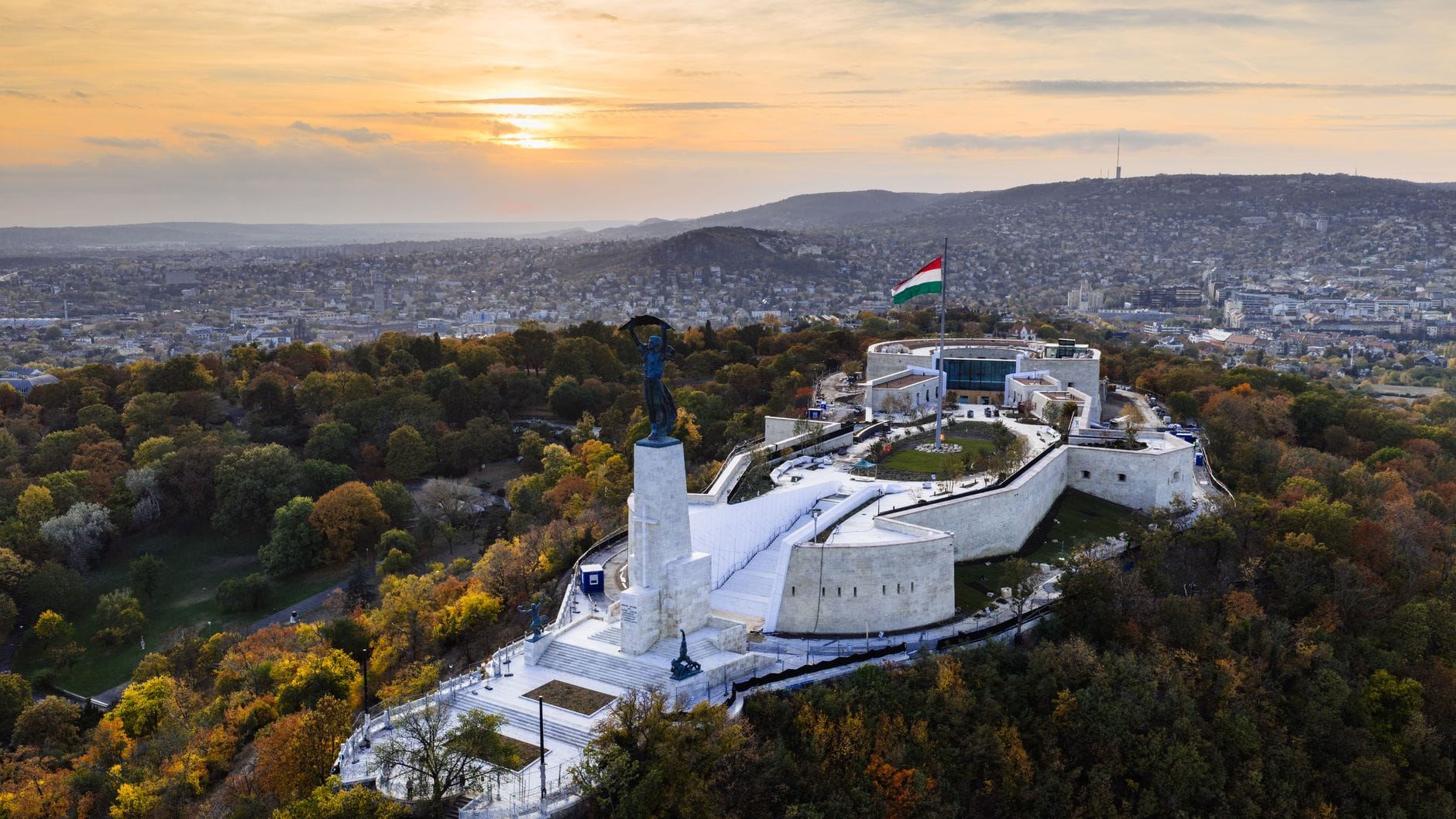
The Citadella is a Habsburg-era fortress completed in 1854, built near the 235-metre summit of Gellért Hill as a direct response to the failed Hungarian Revolution of 1848–49. Its purpose was bluntly political: the Austrian imperial administration wanted a commanding military position from which it could, if necessary, suppress the city below. The fortress is U-shaped, roughly 220 metres long and 60 metres wide, with stone walls reaching up to 4 metres in height. It never fired a shot in anger.
Beside the fortress stands the Liberty Statue, known in Hungarian as Szabadság-szobor. Erected in 1947, the roughly 14‑metre bronze figure of a woman holding a palm frond stands atop a 26‑metre pedestal, together reaching a total height of about 40 metres, and was originally commissioned to commemorate Soviet liberation at the end of World War II. The inscription and dedication were revised after 1989, but the statue itself remains, its scale still startling when seen up close. The two structures together, fortress and monument, occupy one of the most prominent hilltop sites in Central Europe.
The entire complex sits within Budapest's UNESCO World Heritage listing, which has covered the Banks of the Danube, the Buda Castle Quarter, and Andrássy Avenue since 1987. That context matters: this is not simply a scenic overlook. It is part of a layered urban landscape that also includes Buda Castle, Matthias Church, and the sweep of the Danube that has defined Budapest's identity for centuries.
The View: What You See and When It's Best
The panorama from the Citadella's ramparts is arguably the most complete view of Budapest available from any single point. Standing on the southern or eastern walls, you look across the full width of the Danube with both banks visible at once. To the north, the Hungarian Parliament Building sits on the Pest bank, its cream-coloured neo-Gothic spires distinct in clear weather. The Chain Bridge, Elizabeth Bridge, and Liberty Bridge are all visible from different angles as you walk the perimeter. Pest's flat grid spreads to the horizon; Buda's wooded hills fold away behind you.
Morning light falls on the Pest side first, making the Parliament glow warm and pale around 7–9am in summer. By midday, the stone of the fortress itself becomes uncomfortably hot underfoot in July and August, and the light is flat for photography. Late afternoon, from roughly 4pm onward, is when the city starts to take on colour again. Sunset from the eastern rampart, when the sky goes orange behind the Parliament and the bridges begin to light up, is the most photographed moment here and for good reason.
💡 Local tip
For the best sunset photography, position yourself on the eastern wall of the Citadella before the sun drops below the Buda hills. The Parliament and both riverbanks are in frame simultaneously. Arrive at least 30 minutes before sunset to secure a good spot, especially between May and September when crowds are largest.
At night the site takes on a different quality. The Liberty Statue is floodlit from below, making it visible from much of the city. The hill itself grows quiet after around 9–10pm, and the lights of the bridges and embankments reflect on the water in a way that daytime visits do not reveal. The grounds are open daily during posted hours, so a late evening visit is entirely possible, though the walk up in darkness requires some care on the less-lit paths.
Tickets & tours
Hand-picked options from our booking partner. Prices are indicative; availability and final rates are confirmed when you complete your booking.
Budapest Guided E-Scooter Tour by Night
From 60 €Instant confirmationFree cancellationHalf-day tour to Princess Sissi's Godollő royal palace from Budapest
From 41 €Instant confirmationFree cancellationHalf-Day Countryside Wine Tour from Budapest
From 95 €Instant confirmationFree cancellationWalking tour of Pest
From 10 €Instant confirmationFree cancellation
The Climb: Getting Up Gellért Hill
There is no cable car or lift to the Citadella. The two main options are walking and taking Bus 27. Most visitors walk, and the most common approach begins at Gellért tér, accessible by tram lines 47 and 49 and Metro line M4. From the square, signposted footpaths wind up through a wooded hillside park. The climb takes about 15–20 minutes at a moderate pace and involves a sustained incline with some stone steps. It is not a hike, but it is not a stroll either. Comfortable footwear matters, particularly on the stone-paved surfaces near the top.
A second approach rises from near Elizabeth Bridge, following paths along the southern face of the hill. This route is slightly steeper and less shaded. A third option, from the Buda waterfront to the north, is less direct but passes the Cave Church on the hillside. Bus 27 from Móricz Zsigmond körtér reduces the walking distance significantly, depositing passengers near the upper section of the hill, though some uphill walking remains to reach the fortress walls.
⚠️ What to skip
Visitors with limited mobility should note that all routes to the Citadella involve significant slopes and uneven surfaces. Bus 27 eases the ascent but does not eliminate it. Fully wheelchair-accessible routes are limited at present. Check citadella.hu for updated accessibility details following recent renovation work.
Crowds, Timing, and What to Expect On the Ground
The Citadella draws a steady flow of visitors year-round, but the experience varies considerably by season and time. In July and August, the upper terrace and the Liberty Statue base can feel crowded between 10am and 4pm, particularly on weekends. Groups often gather for photos at the statue, and the narrow paths along the fortress walls become congested. Outside those peak hours, even in summer, the site has stretches of quiet.
Spring (April and May) and early autumn (September and October) offer the most comfortable combination of mild temperatures and manageable crowd levels. In December and January the site is frequently empty for long stretches, the stone walls and bare trees giving the place a genuinely austere quality that matches its military origin. Snow on the ramparts and a clear view of a grey winter city is not the worst thing. Dress in proper layers: the hilltop is exposed, and the wind is sharper here than it feels down by the river.
The Citadella is a logical pairing with Gellért Thermal Bath at the hill's base — but the baths are closed for renovation until around 2028, so combine the climb with a soak at Rudas nearby or Széchenyi later rather than counting on Gellért entry. Many visitors also link it with a walk across Liberty Bridge before or after the ascent, since the bridge's green ironwork is clearly visible from the fortress walls above.
Historical and Cultural Weight
Understanding the Citadella fully requires knowing what it represents to Hungarians, not just to tourists. Built by an occupying power to intimidate and control, it was never fully accepted as a legitimate structure. Sections of the walls were symbolically demolished after the Austro-Hungarian Compromise of 1867 as a gesture of reconciliation. During World War II the hill was the site of fierce fighting as Soviet forces encircled Budapest in the winter of 1944–45, and the bunker complex beneath and within the fortress dates from that period.
The Liberty Statue carries its own complicated history. Originally conceived as a monument to Soviet liberation, it was one of the most visible symbols of the postwar political order in Hungary. After 1989, the dedication changed but the statue remained, partly because its scale makes removal impractical and partly because it has become simply part of the city's visual identity. Knowing that history does not make the statue less impressive to look at, but it gives the experience a texture that a purely aesthetic reading misses.
For a deeper engagement with Budapest's difficult 20th-century history, the Terror Háza museum in Pest and the Memento Park on the city's southwestern edge both address the Soviet era directly. The Citadella fits into the same historical conversation but does so quietly, through its architecture rather than its exhibitions.
Practical Details for Your Visit
The outdoor grounds of the Citadella are free to enter and open to the public during posted daily opening hours, every day of the year. There are no gates, no ticket booths for general access, and no need to book in advance. Indoor spaces within the fortress, including any exhibition areas and the renovated interior sections, may carry separate admission charges. Verify current prices and hours directly at citadella.hu before visiting, as the site has undergone significant renovation and offerings are subject to change.
There are benches along the ramparts and some basic facilities near the summit. A small number of food and souvenir vendors operate seasonally near the Liberty Statue, but supply is limited. Bringing water, particularly in summer when the walk up is warm, is sensible. The hilltop has no shade except where trees line the inner paths.
The best viewpoints in Budapest guide covers the Citadella alongside alternatives like Fisherman's Bastion and the Parliament rooftop tour, which is useful if you are deciding between several elevated spots. If you are working with limited time, the Citadella rewards at least 90 minutes on the hill — long enough to walk the full perimeter, spend time at the Liberty Statue, and descend at a relaxed pace.
ℹ️ Good to know
The Budapest Card covers many public transport options and selected attractions but does not specifically apply to Citadella outdoor access (which is already free). If you are visiting multiple paid sites during your stay, check the current card benefits at the official Budapest Card portal before purchasing.
Insider Tips
- The walk down is easier on the knees if you take the northern path toward the Cave Church, which switchbacks more gently than the direct routes from Gellért tér. It adds 10 minutes but is significantly kinder on descent.
- Bus 27 is a practical shortcut up, but it runs infrequently. Check the BKK timetable in advance rather than assuming frequent departures, particularly on weekends and in the evening.
- The eastern rampart wall is the primary photography spot, but walking around to the western and southern sides reveals quieter angles of the fortress structure itself and views toward the Buda hills that most visitors never see.
- If you visit at night, bring a small torch or use your phone's flashlight on the less-lit inner paths near the fortress walls. The floodlit Liberty Statue is striking from below on the hillside, not just from a distance.
- The hilltop is often breezier than street level on hot summer days thanks to its exposure and some tree cover on the paths. If Budapest is experiencing a heat wave, an early morning walk to the Citadella is one of the more comfortable outdoor options in the city.
Who Is Citadella & Liberty Statue For?
- Photographers and anyone prioritising city panoramas — the view is comprehensive and genuinely worth the climb
- History-minded travellers interested in Habsburg-era architecture and 20th-century political monuments
- Budget visitors: no admission fee and accessible by standard public transport
- Couples looking for an atmospheric sunset or evening viewpoint away from the main tourist circuit
- Travellers who want a short but rewarding walk that doubles as context for understanding Budapest's geography
Nearby Attractions
Other things to see while in Buda Waterfront & Gellért Hill:
- Gellért Thermal Bath & Hotel
The Gellért Thermal Bath is Budapest's most celebrated historic spa, housed in a sweeping Art Nouveau complex at the foot of Gellért Hill. Opened in 1918 and fed by natural geothermal springs, it combines soaking culture with genuine architectural grandeur. Note: the bath is closed for major renovation from October 2025, with a planned reopening sometime in 2028.
- Liberty Bridge (Szabadság híd)
Liberty Bridge is Budapest's shortest and arguably most striking central bridge, a 333-metre Art Nouveau iron structure painted green and crowned with mythological Turul birds. Free to cross at any hour, it connects Fővám tér on the Pest side with Szent Gellért tér on the Buda side, and doubles as one of the city's favourite informal gathering spots on warm evenings.
- Lukács Thermal Bath
Tucked along the Buda waterfront near Margaret Bridge, Lukács Thermal Bath has been drawing locals to its mineral-rich waters for centuries. Less theatrical than Széchenyi, less crowded than Gellért, it offers a quieter, more genuine introduction to Budapest's thermal bathing culture.
- Rudas Thermal Bath
Built during the Ottoman occupation and still drawing visitors after 450 years, Rudas Thermal Bath combines a 16th-century domed Turkish pool with a modern rooftop pool overlooking the Danube. It is quieter and more architecturally striking than its famous rivals, and it operates late-night sessions on weekends.