Rudas Thermal Bath: Budapest's Most Atmospheric Ottoman Bathhouse
Built during the Ottoman occupation and still drawing visitors after 450 years, Rudas Thermal Bath combines a 16th-century domed Turkish pool with a modern rooftop pool overlooking the Danube. It is quieter and more architecturally striking than its famous rivals, and it operates late-night sessions on weekends.
Quick Facts
- Location
- Döbrentei tér 9, Budapest 1013 (Buda waterfront, foot of Elizabeth Bridge)
- Getting There
- Trams 18, 19, 41 to Döbrentei tér; M4 metro to Szent Gellért tér, then 5-min walk; buses 7, 8E, 110, 112
- Time Needed
- 2–3 hours for a full session; 1.5 hours minimum for the Turkish section
- Cost
- From ~6,400 HUF (Turkish bath only, weekday); full access 9,800–13,800 HUF depending on day. Verify current prices at rudasfurdo.hu
- Best for
- Architecture lovers, solo travellers, couples on weekend evenings, anyone seeking a calmer alternative to Széchenyi
- Official website
- www.rudasfurdo.hu/en
What Rudas Thermal Bath Actually Is
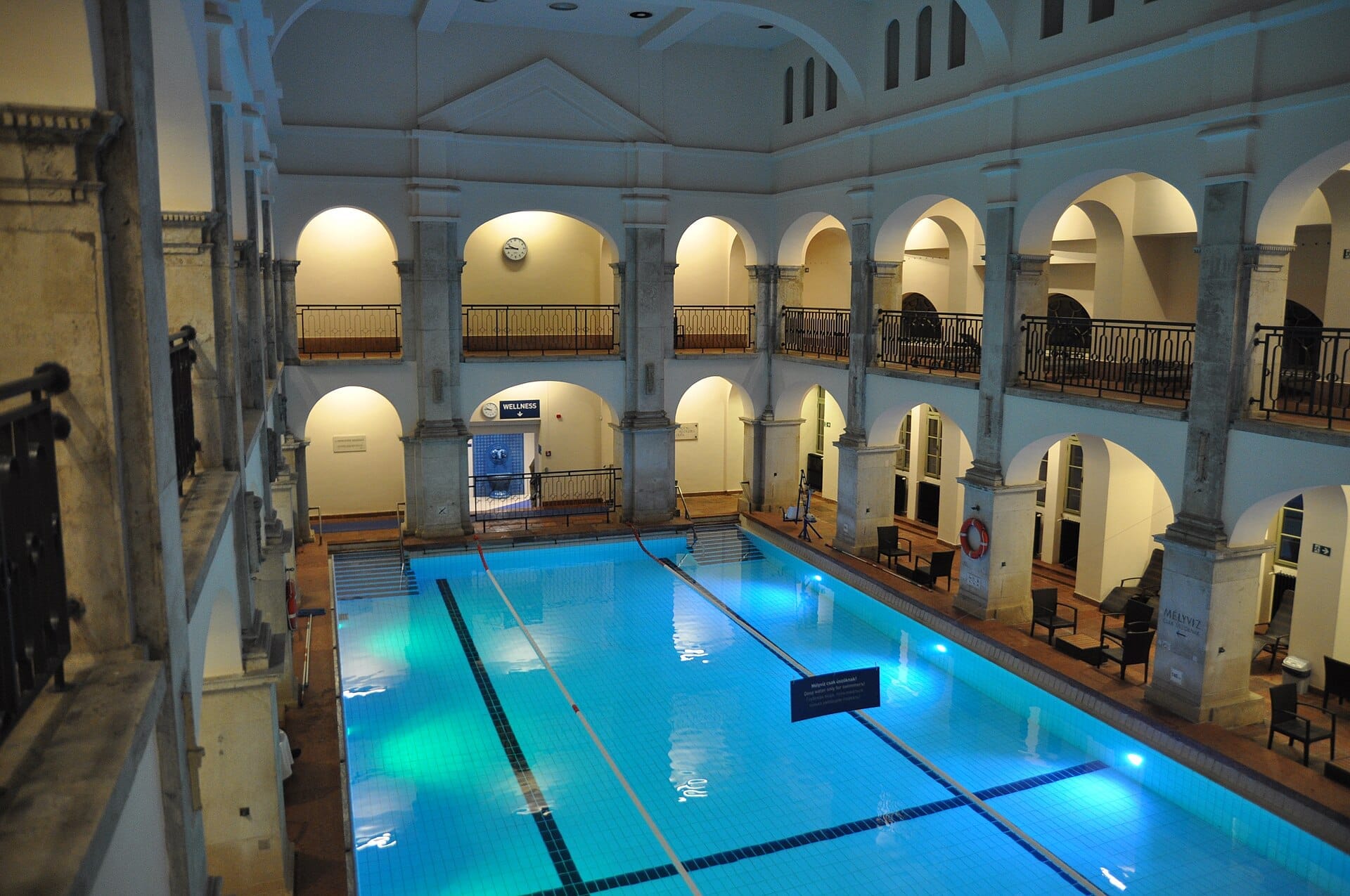
Rudas Thermal Bath, known in Hungarian as Rudas gyógyfürdő, is one of Budapest's oldest and most architecturally intact bathhouses. It sits on the Buda bank of the Danube at the foot of Gellért Hill, directly beside the Elizabeth Bridge, and has been operating continuously in some form since the 16th century. The complex combines a genuinely historic Ottoman-era core with a modern wellness wing and a rooftop pool added in the 21st century.
Unlike Széchenyi, which functions as much as a social event as a bath, Rudas is quieter and more contemplative. The star is the original Turkish pool room: an octagonal central basin roughly 10 metres across, enclosed under a ribbed stone dome punctuated with star-shaped coloured glass windows. The light that filters through those windows in the morning is worth the admission price on its own.
Rudas sits within the broader Buda waterfront stretch, a short walk from Liberty Bridge and the Gellért Thermal Bath. If you are planning a full day around Budapest's thermal culture, see our Budapest thermal baths guide for how the different complexes compare.
ℹ️ Good to know
The traditional Turkish bath section has gender-restricted days: men-only on Monday, Wednesday, and Friday; women-only on Tuesday; mixed on Monday, Thursday, Friday (co-ed in bathing suits from late morning), and all weekend and during night sessions. Always confirm the current schedule on the official website before visiting, as it can shift by season.
450 Years of Hot Water: The History Behind the Steam
The bath dates to the Ottoman occupation of Buda in the 16th century, making it more than 450 years old. It was built during the reign of Sokollu Mustafa Pasha, the Ottoman Governor of Buda, and the Turkish core has remained structurally recognisable ever since. While later centuries brought Hungarian and Austro-Hungarian modifications to the outer facilities, the original hammam structure was never demolished or substantially altered in its proportions.
Ottoman thermal culture treated bathing as a civic and spiritual act, not merely a hygienic one, and that ethos is still detectable in how the room is designed. The dome is not decorative: it regulates the interior atmosphere, trapping steam while allowing natural light in through the coloured glass oculi. The stone underfoot is worn smooth from centuries of use, and the proportions of the room are deliberately calming, with the low ring of peripheral pools surrounding the central basin.
For historical context on how Budapest developed as a city shaped by its baths, conquest, and reconstruction, the Budapest history guide covers the Ottoman period and its architectural legacy in detail.
Tickets & tours
Hand-picked options from our booking partner. Prices are indicative; availability and final rates are confirmed when you complete your booking.
Private Budapest city tour and Szechenyi thermal spa skip-the-line ticket
From 350 €Instant confirmationFree cancellationBudapest Szechenyi Thermal Bath entrance ticket
From 43 €Instant confirmationFree cancellationSelf-guided discovery walk in Budapest's Gellert Hill
From 28 €Instant confirmationFree cancellationAll-In Turkish bath with wellness and dining experience
From 66 €Instant confirmationFree cancellation
The Pools: What You Are Actually Soaking In
The complex currently contains six therapy pools and one swimming pool. Water temperatures in the thermal pools range from around 16°C to 42°C, giving you the option of a bracing cold plunge or a near-scalding soak. The thermal water rises from natural springs deep beneath the Buda hills, rich in minerals including calcium, magnesium, and hydrogen carbonate, which give it the slightly sulphurous scent that defines Budapest's bathing culture.
The swimming pool is a more conventional lane pool in the newer section of the complex. It lacks the atmosphere of the Turkish hall but is useful if you want actual exercise rather than passive soaking. The wellness wing adds saunas, steam rooms, and treatment options that can be booked separately.
The rooftop pool is the surprise. Perched above the main building with an unobstructed view over the Danube and the illuminated Pest skyline, it operates as part of the broader wellness ticket. At night on Fridays and Saturdays, the rooftop takes on a very different character: music plays, lighting shifts, and the crowd skews younger. During daytime, especially on weekday mornings, the same space is almost entirely peaceful.
💡 Local tip
For the rooftop pool experience without the noise, arrive between 10:00 and 13:00 on a weekday. You will have far fewer people and the morning light over the Danube is better than anything you will get in the evening.
When to Visit: How Rudas Changes by Time and Day
Rudas opens at 06:00 every day, closing at 22:00 on Mondays and at 20:00 on other days. The first two hours attract regular local bathers, often older men who have been coming for decades. There is a particular stillness in the Turkish hall at this hour: the steam is thicker because the room has not yet been disturbed by crowds, and the coloured window light hits the water at an angle that is genuinely beautiful. If you can tolerate an early start, this is the superior experience.
Midday on weekdays brings tour groups and a moderately busy atmosphere, but nothing like the queue-and-crowd situation you encounter at Széchenyi on a summer Saturday. Rudas simply draws fewer people, partly because it is slightly harder to find and partly because its gender-restricted days filter the Turkish section's visitor numbers.
The Friday and Saturday night sessions run from 22:00 to 03:00 and are a genuinely different product: louder, livelier, and aimed at a crowd that treats the bath as an evening out rather than a wellness ritual. The pools, lighting, and music all shift accordingly. If that sounds appealing, book in advance, as these sessions sell out. If it does not, avoid Friday and Saturday nights entirely and choose a weekday instead.
Weather affects the rooftop pool experience significantly. In winter, the contrast between the warm water and cold air is dramatic and atmospheric, but you need to be comfortable walking across an outdoor deck in a swimsuit when the temperature is near freezing. In summer the rooftop is simply pleasant, though the Danube views are better in clear conditions.
⚠️ What to skip
Children under 14 are not admitted. This is a firm policy, not a guideline. Rudas is not suitable for family visits with young children.
Practical Walkthrough: Arriving, Paying, and Getting In
The entrance is on Döbrentei tér, directly beside the Elizabeth Bridge on the Buda bank. It is not a grand entrance: a relatively modest door in a stone building that gives no indication of the space inside. You buy your ticket at the cash desk, choose your locker or private cabin, and change before entering the bathing areas. Cabin rental costs extra and is worth it for the private space, especially during busier sessions.
Towel and flip-flop rental is available if you have not brought your own. Wearing flip-flops on the wet stone floors is strongly advisable: the surfaces are slippery and some areas are very hot underfoot. A swimsuit is required for mixed and women's days; on men-only days in the Turkish section, a loin cloth (provided) is the tradition, though swimwear is also accepted.
Full access tickets covering the Turkish bath, wellness section, and swimming pool cost around 9,300 HUF on weekdays and 12,200 HUF on weekends, with higher rates on public holidays. A Turkish-bath-only ticket starts from around 6,400 HUF on weekdays. Night session tickets run approximately 12,600 HUF. All prices are in Hungarian forint and change periodically; confirm current rates on the official website before visiting.
If you hold a Budapest Card, check whether current offers include Rudas discounts; the arrangement varies by card tier and season.
Getting There and Getting Around the Neighbourhood
The most convenient public transport options are trams 19, 41, 56, and 56A, which run along the Buda riverside and stop directly at Döbrentei tér, right outside the entrance. From the Pest side, take the M4 metro to Szent Gellért tér and walk across the Elizabeth Bridge or along the riverbank; the walk takes around five minutes. Buses 7, 8E, 108E, 110, and 112 also serve the area, with night buses 907 and 973 available for late sessions.
The surrounding stretch of the Buda waterfront is worth exploring before or after your visit. The Liberty Bridge is a five-minute walk south, and the base of Gellért Thermal Bath is only slightly further. The Citadella sits on the hill above, reachable by a steep uphill walk.
Photography at Rudas
Photography inside the bathing areas is restricted and, in practice, largely prohibited out of respect for other bathers. The exterior of the building from the Danube bank and from the Elizabeth Bridge offers good angles, particularly at dawn when the stone facade catches warm light. The rooftop pool area sometimes permits photography during off-peak hours, but check with staff on arrival.
The most photographed interior element is the central dome of the Turkish hall with its star-shaped coloured glass windows. If you want to capture it, morning sessions on weekdays give you the least foot traffic in the frame, though even then photographing other bathers without consent is not appropriate.
Insider Tips
- Arrive at opening time (06:00) on a Monday or Thursday for the men-only Turkish session. Regular local bathers keep to themselves, the steam is heaviest, and the coloured dome light is at its most striking in the early morning.
- The locker system can be confusing on your first visit: staff will show you how to use the electronic wristband that functions as both your locker key and payment token inside the complex. Do not lose it.
- If you plan to use the rooftop pool, bring a second towel or a robe. The walk from the changing rooms to the rooftop involves passing through cooler air, and in winter that gap is genuinely cold.
- Weekday afternoon tickets (after 14:00) sometimes offer a slight price reduction depending on the season; check the official website's ticket categories before buying at the desk.
- The thermal bath section and the swimming pool use separate changing areas. If you plan to use both on the same visit, ask at the desk about the routing before you change, as navigating between sections mid-visit can be disorienting.
Who Is Rudas Thermal Bath For?
- Architecture enthusiasts who want to experience an authentic Ottoman hammam space, not just a spa
- Solo travellers seeking a calmer, less performative alternative to Budapest's more tourist-heavy baths
- Couples visiting on a Friday or Saturday evening for the rooftop night session atmosphere
- Early risers who want to start the day with a meditative soak before the city wakes up
- Travellers with two or more days in Budapest who have already seen the headline sights and want something with more texture
Nearby Attractions
Other things to see while in Buda Waterfront & Gellért Hill:
- Citadella & Liberty Statue
Perched atop Gellért Hill, the Citadella fortress and the 40-metre Liberty Statue together form one of Budapest's most recognizable silhouettes. Entry to the outdoor grounds is free and the site operates daily within posted opening hours rather than being open around the clock, making it one of the most accessible major landmarks in the city.
- Gellért Thermal Bath & Hotel
The Gellért Thermal Bath is Budapest's most celebrated historic spa, housed in a sweeping Art Nouveau complex at the foot of Gellért Hill. Opened in 1918 and fed by natural geothermal springs, it combines soaking culture with genuine architectural grandeur. Note: the bath is closed for major renovation from October 2025, with a planned reopening sometime in 2028.
- Liberty Bridge (Szabadság híd)
Liberty Bridge is Budapest's shortest and arguably most striking central bridge, a 333-metre Art Nouveau iron structure painted green and crowned with mythological Turul birds. Free to cross at any hour, it connects Fővám tér on the Pest side with Szent Gellért tér on the Buda side, and doubles as one of the city's favourite informal gathering spots on warm evenings.
- Lukács Thermal Bath
Tucked along the Buda waterfront near Margaret Bridge, Lukács Thermal Bath has been drawing locals to its mineral-rich waters for centuries. Less theatrical than Széchenyi, less crowded than Gellért, it offers a quieter, more genuine introduction to Budapest's thermal bathing culture.