St. Stephen's Basilica: Budapest's Grandest Church, Up Close
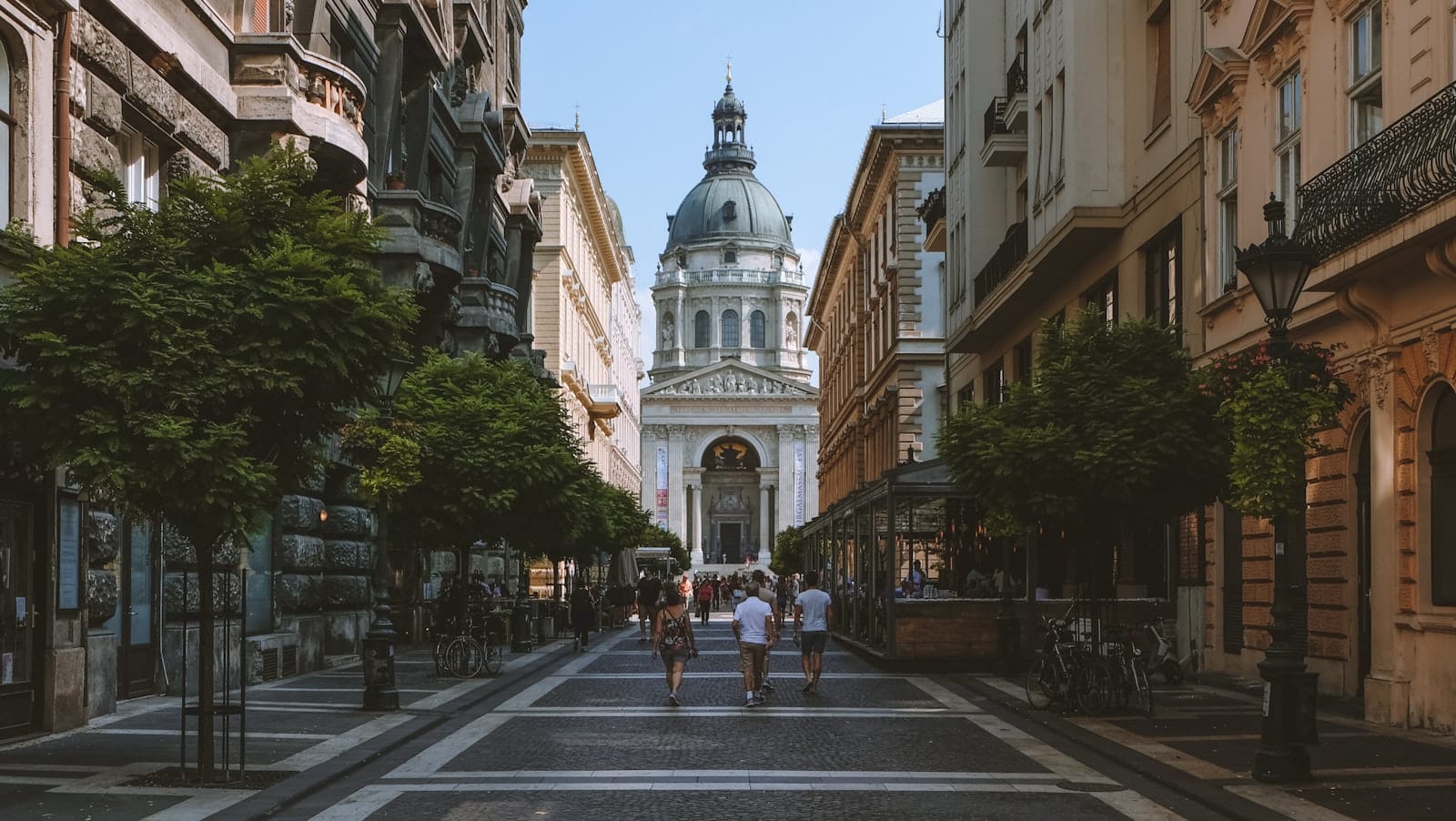
St. Stephen's Basilica (Szent István-bazilika) dominates central Pest with its 96-metre dome and neoclassical facade. Inside, gilded altars and Hungary's most venerated relic await. Climb to the observation deck for one of the best rooftop views in the city.
Quick Facts
- Location
- Szent István tér 1, 1051 Budapest (District V, Pest city centre)
- Getting There
- Bajcsy-Zsilinszky út (M1) or Arany János utca (M3), both under 5 min walk
- Time Needed
- 45–90 minutes for interior; add 30 minutes if you climb the observation deck
- Cost
- Basilica entry free with suggested donation; separate paid tickets for dome and treasury. Verify current prices on the official site.
- Best for
- Architecture lovers, history seekers, panoramic city views
- Official website
- www.ststephensbasilica.com
What Is St. Stephen's Basilica?
St. Stephen's Basilica (Szent István-bazilika) is the largest church in Budapest and one of the most architecturally significant buildings in Hungary. Its dome rises 96 metres above the city, matching the height of the Hungarian Parliament Building across the Danube.
Construction began in 1851 and took more than five decades, involving three chief architects and one catastrophic setback: the original dome collapsed in 1868, requiring a near-complete restart. The basilica was finally consecrated in 1905. The result is a neoclassical structure with Renaissance detailing, built from stone and designed to last centuries. From the square outside, the sheer weight of it is palpable — the facade is broad and symmetrical, flanked by two bell towers, with the ribbed dome rising behind.
ℹ️ Good to know
Opening hours vary by day: Monday to Friday 09:00–17:00, Saturday 09:00–13:00, Sunday 13:00–17:00. These are subject to change around religious holidays and special services — confirm on the official website before your visit.
The Interior: Gold, Marble, and a Mummified Hand
Stepping inside, your eyes adjust from bright Hungarian daylight to a cool, dim interior where the scale becomes genuinely overwhelming. The nave is enormous. Gold leaf catches the light from high windows, and the floor is a mosaic of polished stone in warm amber and cream. The air smells faintly of candle wax and cold stone, the sensory signature of large Catholic churches throughout Central Europe.
The main altar features a white marble statue of King Stephen I, Hungary's first Christian king and the basilica's namesake. Surrounding chapels are dedicated to various saints, and the side walls hold a series of paintings by Hungarian masters including Gyula Benczúr. Nothing feels rushed or decorative for its own sake — the interior has the gravity of a building that took generations to complete.
The basilica's most unusual draw is the Holy Right Hand (Szent Jobb), a relic said to be the mummified right hand of King Stephen I himself, preserved since the 11th century. It is kept in an ornate golden reliquary in the Holy Right Chapel. It draws steady crowds of pilgrims and curious visitors alike. A coin-operated light allows you to illuminate the case for a closer look. Whether you find it moving or macabre will depend entirely on your sensibility — but it is genuinely historic and unlike anything else in Budapest.
💡 Local tip
A modest entry fee applies to the church interior. If you plan to visit the treasury and observation deck too, the combo ticket offers better value. Buy at the door or check the official site for online options.
Tickets & tours
Hand-picked options from our booking partner. Prices are indicative; availability and final rates are confirmed when you complete your booking.
St.Stephen's Basilica Entrance with Grand Organ Concert
From 52 €Instant confirmationFree cancellationPrivate Budapest sightseeing tour with Etyek Wine tour and lunch
From 350 €Instant confirmationFree cancellationEscape Tour self-guided, interactive city challenge in Budapest
From 30 €Instant confirmationOrgan concert in the St Stephen's Basilica
From 38 €Instant confirmationFree cancellation
The Observation Deck: One of Pest's Best Panoramas
A lift takes visitors most of the way up inside the dome, with a short stair section near the top. The observation deck wraps around the exterior of the drum at roughly 65 metres, giving you an unobstructed 360-degree view across flat Pest and over to the Buda hills. On a clear day you can see the Parliament building to the north, the Danube bridges, and the Buda Castle complex on the opposite bank.
The deck is narrow and the railings are low by modern safety standards, so it is not ideal for visitors with a significant fear of heights or young children who cannot be closely supervised. That said, for anyone comfortable with heights, it is among the most rewarding rooftop viewpoints in the city — less crowded than the top of the Parliament and easier to reach than the Citadella on Gellért Hill. Morning visits offer softer light on the Pest skyline; late afternoon gives warmer tones toward sunset.
For a fuller picture of where to get the best views across the city, the Budapest views and viewpoints guide compares the major options across both Buda and Pest.
How It Changes Through the Day
Early mornings on weekdays are the quietest time inside the basilica. Between 09:00 and 10:30, tour groups have not yet arrived, and the interior feels genuinely contemplative. The light enters through the upper windows at a low angle and moves slowly across the mosaic floor. This is the best time to spend time in front of the main altar without crowds pressing in around you.
By late morning, the square outside (Szent István tér) fills with people. The plaza is one of the most social squares in central Pest, lined with cafe terraces that do brisk business from around 10:00 onward. Food trucks and pop-up stalls appear here during summer events. In winter, an ice rink is sometimes installed in the square, and the basilica facade serves as a backdrop for the Christmas market — one of the most atmospheric settings for that particular event in the city.
Midday sees the heaviest visitor volumes, particularly in summer. The interior stays cool even on hot days, which makes it a natural refuge from July and August heat. If you arrive between 12:00 and 14:00, expect queues at the reliquary and competition for standing space under the dome. Saturdays are busiest, partly because visiting hours are shorter (the church closes at 13:00), concentrating foot traffic into the morning.
Getting There and Practical Logistics
The basilica sits in District V, Budapest's central administrative and commercial core. It is walkable from Deák Ferenc tér (the main metro interchange, about 10 minutes on foot) and from Váci Street (around 5–7 minutes). The nearest metro stations are Bajcsy-Zsilinszky út on Line M1 and Arany János utca on Line M3, both a short walk away.
If you are combining this with other central landmarks, the Hungarian Parliament Building is about 15 minutes north on foot along the Danube embankment. The Hungarian State Opera House is roughly 10 minutes east along Andrássy Avenue.
Dress modestly for the interior: shoulders and knees should be covered. The basilica is an active place of worship, not only a tourist site. Loud conversation and photography with flash are discouraged inside, and signs remind visitors of this at the entrance. Compact cameras and phones are fine without flash.
⚠️ What to skip
The basilica closes early on Saturdays and does not open until 13:00 on Sundays. If your Budapest visit falls on a weekend, plan accordingly. Religious services take priority over visitor access.
The Budapest Card provides discounts at several city attractions and covers public transport. If you are visiting multiple sites in a short trip, the Budapest Card guide explains whether it represents genuine value for your itinerary.
Historical and Cultural Context
Stephen I (975–1038) converted Hungary to Christianity and was crowned its first king on Christmas Day in the year 1000. His canonisation in 1083 made him the patron saint of Hungary, and his image appears across the country's art, currency, and public spaces. The basilica named for him was conceived in the mid-19th century as a statement of national identity during a period of political ferment under Habsburg rule. The decades it took to build reflect both the technical ambitions of its architects and the turbulent history of the era.
The dome's height of 96 metres is not coincidental. The year 896 is when Magyar tribes are traditionally said to have settled in the Carpathian Basin, founding what would become Hungary. Both the basilica and the Parliament — also 96 metres — were designed to echo this founding date in stone. For more on the historical layers running through the city, the Budapest history guide provides useful context.
The basilica's architectural style is broadly neoclassical with Italianate Renaissance elements, a deliberate departure from the Gothic Revival popular in much of 19th-century Europe. The lead architect who completed the project, József Kauser, drew on Roman basilica proportions while accommodating the demands of a large urban church expected to hold thousands of worshippers for state occasions.
Who Might Not Enjoy This
The basilica is genuinely impressive by any measure, but a few types of visitors may find it less rewarding than expected. If you have already visited major Catholic cathedrals in Rome, Vienna, or Paris, the interior, while beautiful, may feel familiar rather than revelatory. The admission fee for what is, fundamentally, a church interior is a point of contention for some visitors who expected free entry.
Families with very young children may find the combination of required quiet, modest dress, and a narrow observation deck more stressful than enjoyable. The observation deck involves a lift but also stairs, and the exposed walkway at the top has limited space. For families looking for a more relaxed Budapest experience, there are better-suited options across the city.
Insider Tips
- Visit on a weekday between 09:00 and 10:00 for the quietest interior experience. Most organised tour groups arrive from 10:30 onward, and the atmosphere before then is noticeably different.
- The square (Szent István tér) facing the basilica's facade is one of the best spots in central Pest to sit with a coffee and watch the city move. The cafe terraces here open early and stay busy well into the evening.
- If you are visiting in late afternoon in summer, check whether any outdoor concerts or screenings are scheduled in the square. The basilica facade is used as a backdrop for projection events during certain festivals.
- For the observation deck, the lift handles the main vertical distance, but there is a short spiral staircase section before the top platform. Wear shoes you are comfortable climbing stairs in.
- The Holy Right Chapel where the relic is displayed can get very crowded around midday. The coin-operated illumination mechanism sometimes has a queue. Going first thing in the morning or late in the visiting window (15 minutes before closing) gives you more space to look properly.
Who Is St. Stephen's Basilica (Szent István Bazilika) For?
- Architecture and history enthusiasts who want to understand the visual language of 19th-century Hungarian nation-building
- Travellers seeking a panoramic city view without the longer journey to Gellért Hill or Castle Hill
- Visitors interested in Central European religious art and Catholic heritage
- Photographers wanting a landmark exterior at different times of day, including the dramatically lit facade after dark
- Anyone building a walking itinerary through District V who wants a central anchor point
Nearby Attractions
Other things to see while in Pest City Center (V. District):
- Central Market Hall (Nagy Vásárcsarnok)
The Central Market Hall, known locally as Nagy Vásárcsarnok, is Budapest's largest historic covered market hall. Built in 1897 to a design by architect Samu Petz, it fills three floors with fresh produce, Hungarian specialties, folk crafts, and street food. Entry is free, and it sits steps from the Liberty Bridge in the heart of Pest.
- Chain Bridge (Széchenyi Lánchíd)
The Széchenyi Chain Bridge (Széchenyi lánchíd) is one of the oldest and most recognizable bridges in Budapest, linking the historic Pest riverfront with the foot of Castle Hill. Free to cross at any hour, it rewards visitors with sweeping Danube views and a walk through 175 years of Hungarian history.
- Hungarian National Museum
The Hungarian National Museum is the oldest national history museum in Hungary, tracing the country's story from prehistoric times through the 20th century. Housed in a commanding neoclassical building from 1847, it anchors Budapest's Pest district and offers one of the most complete windows into Hungarian identity available to visitors.
- Hungarian Parliament Building
Rising from the Pest bank of the Danube in a symphony of Gothic spires and terracotta stone, the Hungarian Parliament Building is the defining landmark of Budapest. Built between 1885 and 1904, it houses the Holy Crown of Hungary and opens its gilded interior to guided tours on most days. This guide covers everything you need to visit well.