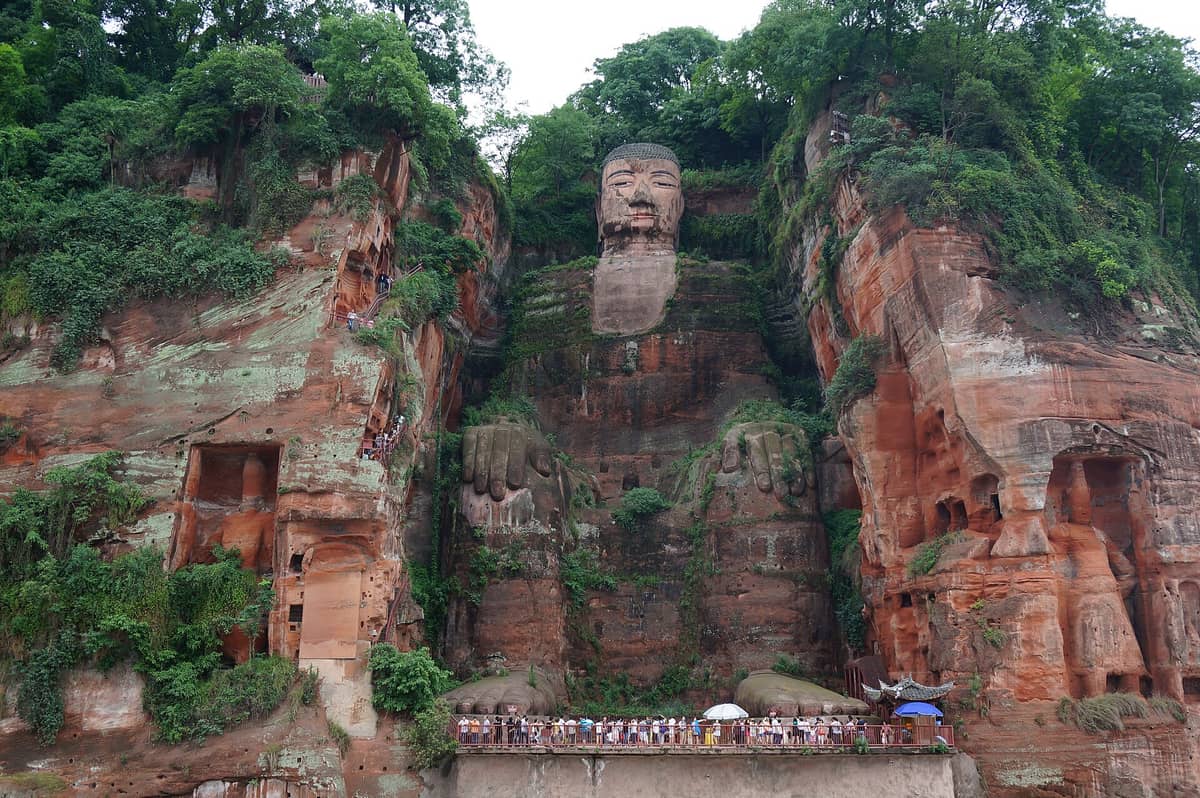
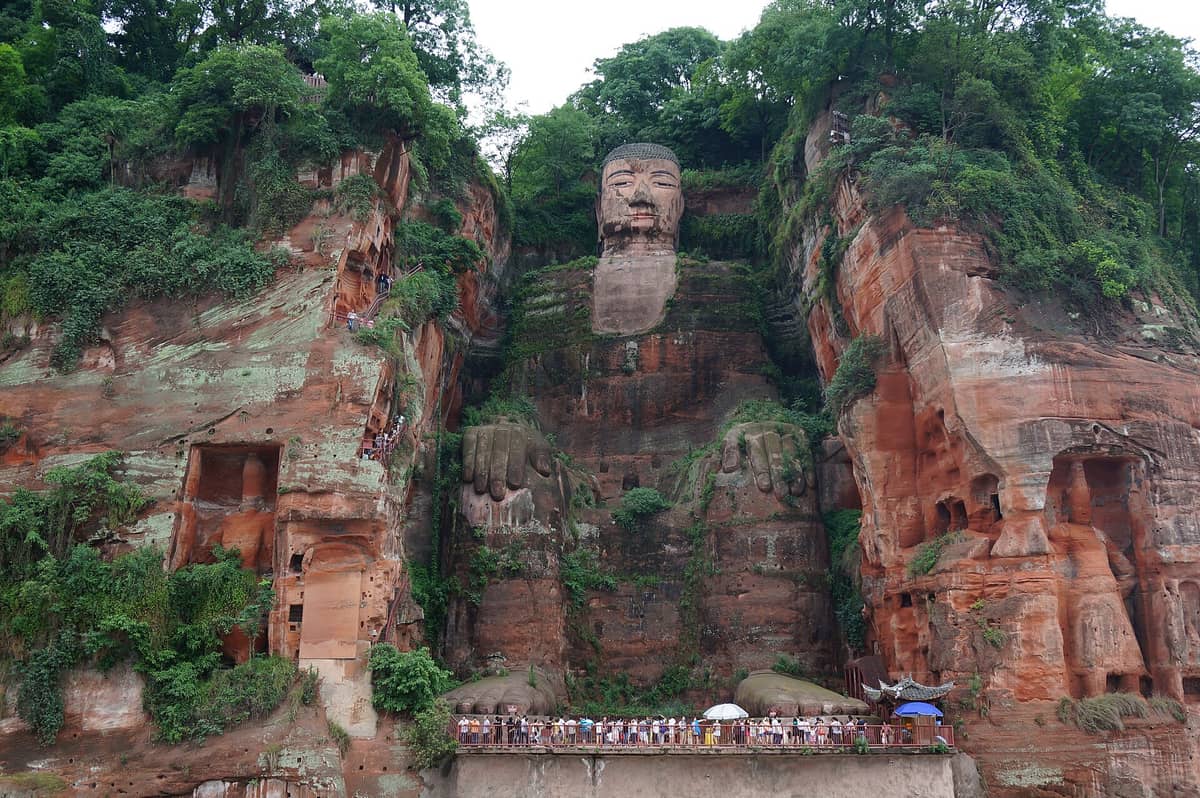
Leshan is a historic city in southern Sichuan, roughly 124 km from Chengdu, and the site of the Leshan Giant Buddha, the largest stone Buddha in the world. Most visitors arrive as a day trip from Chengdu, though the city rewards those who stay overnight. This guide covers how to get there, what to see, where to eat, and how to plan your time.
Leshan is not a neighborhood in Chengdu but a city in its own right, sitting about 124 km to the south at the confluence of the Min and Dadu rivers. Its defining landmark, the Leshan Giant Buddha, is one of the most extraordinary stone carvings on earth, and the broader city around it tells a quieter story about Buddhist heritage, river commerce, and Sichuan provincial life away from the capital's pace.
Orientation: Where Leshan Fits in the Wider Region
Leshan is a prefecture-level city in southern Sichuan, not a district or neighborhood of Chengdu. When travelers refer to visiting 'Leshan from Chengdu,' they mean a day trip or short excursion of roughly 124 km by road or rail. The main urban core is Shizhong District, which occupies a peninsula formed where the Qingyi, Min, and Dadu rivers converge. This geography is not incidental: it is precisely why the Giant Buddha was carved here in the 8th century, intended to calm the dangerous river currents that were destroying boats at the confluence.
The city of Leshan is also the most common gateway for travelers heading to Mount Emei, though the mountain itself lies to the southwest and is not within the Leshan urban area. Many visitors combine both in a single overnight trip from Chengdu, spending an afternoon at the Buddha and a full day on the mountain. If you are planning that kind of itinerary, understanding the relative distances matters: Leshan city center to the Mount Emei scenic area is another 30-plus km.
Leshan historically went by the name Jiazhou, and vestiges of its role as a regional Buddhist and commercial hub are still visible in the older lanes of Shizhong District. For travelers planning a broader Sichuan itinerary, it pairs naturally with Chengdu's own heritage sites. If you are still deciding how to structure your time, the 3-day Chengdu itinerary guide outlines how to slot Leshan into a short trip without feeling rushed.
Character and Atmosphere
Arrive in Leshan early on a weekday morning and the riverside area around Lingyun Mountain has a noticeably different texture from the tourist crush that builds by mid-morning. Street vendors set up near the bus stops, selling sesame cakes and river fish skewers. The air carries a faint dampness off the three rivers, and the sound of boat engines idling at the pier competes with temple bells from the upper slopes of Lingyun Hill. At this hour, the scale of the Buddha, which you cannot fully appreciate from street level, begins to register differently: the stone face above the treeline, just visible from the dock area, seems genuinely enormous before the crowd fills in below it.
By late morning on weekends and public holidays, the queues for the descent staircase beside the Buddha can stretch for an hour or more. The path is narrow and carved directly into the cliff face, with the figure's feet emerging at the base in a scale that is genuinely difficult to process. Afternoon light on a clear day catches the carved robes and the weathered expression of the face in ways that morning light does not, but the crowds are thicker and the heat in summer can be punishing.
Away from the Buddha's immediate precinct, Leshan's older streets in Shizhong District have the texture of a mid-sized Sichuan city that functions primarily for its own residents. Tea houses operate through the afternoon, mahjong tables are audible from open doorways, and the food scene caters heavily to locals rather than tourists. This is a genuine contrast to the more performative heritage zones in Chengdu itself, and it is one reason some travelers prefer staying overnight in Leshan rather than arriving and departing the same day.
💡 Local tip
Aim to arrive at the Giant Buddha site by 8am or earlier if visiting on a weekend or during the May 1 and October 1 golden week holidays. Queues for the descent path down the cliff can exceed 90 minutes by late morning. Weekday visits in spring or autumn are substantially more relaxed.
What to See and Do
The Leshan Giant Buddha is the reason most people come, and it justifies the journey entirely on its own terms. Carved into the red sandstone of Lingyun Mountain in the 8th century during the Tang Dynasty, it stands 71 meters tall. That number means little until you stand beside the feet, each of which is large enough to park several cars across. The seated Maitreya figure faces the confluence of the rivers, and the engineering behind it is genuinely sophisticated: an internal drainage system of gutters and channels built into the robes and hair has helped protect the stone for over 1,200 years.
The site offers two main viewing experiences. The cliff path descent takes you down the face of the mountain beside the Buddha at close range, allowing you to see the detail of the carving up close before emerging at the feet near river level. The boat tour, departing from piers near the entrance, shows you the full figure from the water and provides the only vantage point from which you can take in the entire 71-meter height in a single view. Both are worthwhile; the boat tour is especially useful for understanding the scale that the cliff path makes impossible to grasp.
Beyond the Buddha, the Lingyun Temple at the summit of Lingyun Mountain dates to the Tang era and is an active Buddhist site. The walk through the temple complex and along the hilltop paths above the Buddha gives views over the three-river confluence and across to Wuyou Temple on the adjacent island. Wuyou Temple is a quieter nearby attraction and worth the additional trip for anyone interested in Buddhist architecture and garden design.
Leshan Giant Buddha and Lingyun Mountain: the core attraction, budget 2-3 hours minimum
Boat tour of the full figure from the river: available from piers near the site entrance
Lingyun Temple: Tang-era Buddhist temple active at the summit
Wuyou Temple: quieter, connected island temple worth the detour
Shizhong District old streets: riverside lanes, tea houses, and local market activity
If you are extending the trip, Mount Emei is Leshan's natural companion. The mountain is a UNESCO World Heritage Site alongside the Giant Buddha and one of China's four sacred Buddhist mountains. A full visit requires at least one overnight stay on the mountain. The day trips from Chengdu guide covers how to plan a combined Leshan and Emei itinerary across two days.
Eating and Drinking
Leshan's food scene is anchored in Sichuan cooking but with a river-city emphasis on freshwater fish and river snacks that you will not find in exactly the same form in Chengdu. The Min River fish dishes, particularly braised and twice-cooked preparations, are a local specialty. Around the bus station and the older market streets of Shizhong District, small noodle shops open from early morning serving Leshan-style cold noodles, a dish that uses a lighter, more vinegar-forward dressing than the standard Chengdu version.
Closer to the Giant Buddha entrance area, the food options lean toward tourist-oriented snack vendors and small restaurants catering to day-trippers. Prices are reasonable by any standard, and the sesame and bean-paste pastries sold near the pier are genuinely worth trying. Further into the city center, restaurant streets around the main pedestrian area offer a wider range at lower prices, with the usual Sichuan hot pot, mapo tofu, and dry-fried dishes well represented.
If the broader question of Sichuan eating is on your mind, the Chengdu food guide and the dedicated Chengdu hot pot guide provide context for the regional cuisine that Leshan shares and riffs on.
ℹ️ Good to know
Leshan cold noodles (乐山冷面) are a local staple distinct from Chengdu-style versions. Look for small noodle shops in Shizhong District for straightforward versions. Prices change, so verify locally.
Getting There and Around
The most practical way to reach Leshan from Chengdu is by long-distance coach from Xinnanmen Bus Station, located at No. 2 Xinnan Road in the Qingyang area of central Chengdu. Buses run regularly to Leshan Xiaoba Bus Station and the journey takes approximately two hours under normal conditions. Xinnanmen Bus Station is accessible via Xinnanmen Station on Chengdu Metro Line 3, which makes getting to the departure point from most parts of central Chengdu straightforward.
High-speed rail is also an option: trains from Chengdu (primarily Chengdu East Railway Station) run to Leshan Railway Station on Baolian Road in Shizhong District, with journey times varying by service. Check current timetables on the official 12306 platform or at the station, as schedules change seasonally. Leshan Railway Station is served by multiple local bus routes including lines 1, 12, 21, 22, 304, 601, 605, and 701, which connect the station to the city center and the Giant Buddha area.
From Xiaoba Bus Station within Leshan, Bus 13 connects to the Leshan Giant Buddha scenic area. Taxis and ride-hailing via Didi are available in Leshan city but coverage and app functionality may differ from Chengdu. If you use Didi regularly in Chengdu, the same account should work, but payment setup and driver availability in a smaller city can be less consistent.
⚠️ What to skip
Bus schedules between Chengdu and Leshan, and local bus routes within Leshan, change seasonally and around public holidays. Verify departure times and the last return service before you travel, particularly if you are doing this as a same-day round trip. Getting stranded in Leshan overnight is not a problem in itself, but it helps to plan for it rather than discover it.
For a full overview of how to move around the region and plan connections to other sites, the getting around Chengdu guide covers intercity transport options in practical detail.
Where to Stay
Most first-time visitors treat Leshan as a day trip from Chengdu, which works perfectly well if you start early and are not combining it with Mount Emei on the same day. Staying overnight in Leshan is the better option if you want to visit the Giant Buddha in the early morning light before the crowds arrive, combine it with a meaningful Mount Emei visit, or simply get a feel for a Sichuan provincial city that operates at its own pace.
Accommodation in Leshan centers on Shizhong District, with options ranging from budget guesthouses near the bus station to mid-range hotels in the central commercial area. The quality and range of international-style hotel options is narrower than in Chengdu, and English-language service is less consistent. For travelers who want the full Chengdu hotel infrastructure as their base, staying in Chengdu and doing Leshan as a long day trip remains the most straightforward approach.
If you are weighing where to base yourself across the broader trip, the where to stay in Chengdu guide gives a district-by-district breakdown of Chengdu's accommodation options and which neighborhoods suit which types of traveler.
Practical Notes and Honest Drawbacks
The Giant Buddha site is genuinely crowded on weekends and during Chinese public holidays, and the cliff path descent involves narrow, steep stairs where the crowd moves at whatever pace the slowest group ahead of you sets. If you have mobility concerns or discomfort in confined spaces with large numbers of people, the boat tour from the river is a far more manageable alternative and arguably gives a better understanding of the sculpture's full scale.
The area immediately around the entrance to the site has the commercial texture of any major tourist attraction in China: souvenir stalls, overpriced snack vendors, and persistent photo opportunity vendors. This thins out noticeably once you are inside the site itself. English signage within the Giant Buddha precinct is generally adequate for navigation; outside the main site, in the city streets and on local buses, English is much less common and basic Mandarin or a translation app is useful.
Leshan is safe for independent travelers by any reasonable standard. The standard practical awareness that applies to travel anywhere in China applies here: watch your belongings in crowded tourist areas, verify transport arrangements before you go, and drink bottled or boiled water. For broader safety context across the region, the Chengdu safety and scams guide covers the most common issues travelers encounter.
ℹ️ Good to know
Leshan Giant Buddha is a UNESCO World Heritage Site, listed together with Mount Emei. Admission fees and opening hours are subject to change. Check the official site or verify through your accommodation before arrival, as golden week and seasonal hours differ significantly from standard operating days.
TL;DR
Leshan is a city 124 km south of Chengdu, not a Chengdu neighborhood: budget travel time accordingly, roughly two hours each way by coach or train.
The Leshan Giant Buddha is the primary reason to visit and fully justifies the journey: the 71-meter Tang Dynasty carving at the river confluence is among the most impressive stone monuments in Asia.
A day trip from Chengdu works well if you leave early; an overnight stay makes sense if you are also visiting Mount Emei or want to explore the city without rushing.
Weekday visits in spring (March-May) or autumn (September-November) offer the best balance of manageable crowds and decent weather; golden week and summer weekends are significantly more congested.
The city beyond the tourist precinct is a functioning Sichuan provincial city with good local food and a slower pace than Chengdu: rewarding for travelers who want more than a single attraction.
Three days is enough time to cover Chengdu's essential experiences without rushing. This itinerary balances the panda base, historic streets, Sichuan cuisine, cultural landmarks, and a day trip option, with practical notes on logistics, timing, and what to skip.
Chengdu's museum scene spans 4,500 years of Sichuan history, from mysterious Bronze Age civilizations to Tang Dynasty poets and dinosaur fossils. This guide covers the standout institutions, what to expect inside each one, and how to plan your visits efficiently.
Chengdu's temple scene spans 1,400 years of Buddhist and Taoist history, from incense-filled city monasteries to sacred peaks rising above the clouds. This guide covers the best temples in Chengdu and beyond, with honest advice on what to expect at each one.
Chengdu rewards visitors year-round, but the timing of your trip makes a real difference. This guide breaks down every season by weather, crowd levels, panda activity, and practical logistics so you can choose the window that actually suits your plans.
Chengdu is surrounded by ancient towns that most visitors completely overlook. This guide covers the five best options — Huanglongxi, Luodai, Jiezi, Anren, and Pingle — with real transport details, honest assessments, and seasonal advice to help you choose the right one for your trip.
Chinese New Year transforms Chengdu into one of China's most atmospheric festival cities, with temple fairs, lantern displays, and Sichuan folk performances across the city. But the season also brings peak crowds, tight transport, and some genuine planning challenges. This guide tells you exactly what to expect and how to prepare.
Chengdu is the capital of Sichuan Province, home to 21 million people, giant pandas, and some of the most distinctive food in China. This guide covers the practical details that actually matter for a first visit: which airport you land at, when to go, what to eat, where to stay, and how to get around without confusion.
Chengdu has a slower, more sensory side that makes it genuinely rewarding for couples. This guide covers the most romantic experiences in the city — from dawn panda visits and teahouse afternoons to Sichuan opera nights and scenic day trips — with a clear take on what's worth your time.
Hot pot is not just a meal in Chengdu — it is the social ritual that defines the city's food culture. This guide covers the best restaurants for Sichuan hot pot, exactly how to order, what to expect on the bill, and how to handle the heat without ruining your evening.
Chengdu's after-dark scene runs deeper than the typical tourist circuit. This guide breaks down the city's main nightlife districts, what each one actually offers, realistic price ranges, and how to get around after the metro stops running.
Chengdu is one of China's most rewarding cities for budget travelers. From free parks and temples to street food that costs less than a coffee back home, here's how to experience the best of Chengdu without overspending.
Chengdu is the world's foremost destination for seeing giant pandas in a conservation setting. This guide covers the Chengdu Research Base of Giant Panda Breeding in detail, how to book tickets, the best time to arrive, how to get there, and what the experience is actually like — including what most visitors get wrong.
Chengdu rewards those who step outside. This guide covers the city's best parks, gardens, riverside walks, and natural escapes, from the teahouse-dotted paths of People's Park to the forested peaks of Mount Qingcheng, an hour from the city center.
Chengdu is one of China's safest major cities for visitors, but that doesn't mean you can skip due diligence. From airport taxi scams to tea house traps, here's everything you need to stay safe, avoid getting ripped off, and travel with confidence.
Chengdu is one of southwestern China's best cities for shopping, whether you're after luxury brands, handmade Shu brocade, panda merchandise, or bulk spices for your hotpot. This guide covers the top malls, local markets, souvenir picks, and practical advice to help you spend wisely.
Chengdu is a UNESCO Creative City of Gastronomy and one of the most rewarding cities in Asia for eating on foot. This guide covers the essential Sichuan dishes, the best street food districts, practical navigation tips, and honest notes on what lives up to the hype.
Tea houses are central to daily life in Chengdu in a way that few cities can claim. This guide covers the history, etiquette, best venues, what things cost, and exactly what to expect when you sit down for tea in one of China's most relaxed cities.
The Chengdu to Chongqing route is one of southwestern China's most popular day trips or short breaks. This guide covers every transport option, station logistics, fare breakdowns, and how to make the most of your time in both cities.
Two of southwestern China's most compelling cities, separated by roughly 300 km and connected by high-speed rail. This guide breaks down what each city does best, who each suits, and whether you should bother visiting both.
Chengdu's historic core is genuinely walkable, but only if you know which clusters of sights sit close together and which require transport. This guide maps out three practical self-guided walking routes, breaks down entry costs, and flags the common mistakes that turn a pleasant city walk into an exhausting detour.
Chengdu is one of China's most family-friendly cities, pairing iconic wildlife encounters with hands-on cultural experiences, open parks, and food kids actually enjoy. This guide covers the top activities for families, practical logistics, and practical notes on what works best with children in tow.
Chengdu sits at the center of one of China's richest regions for day-trip travel. Within two hours by rail or road, you can stand before a 71-meter Tang Dynasty Buddha, hike Taoist mountain trails, and explore a 2,300-year-old irrigation system still in use today. This guide covers the best day trips from Chengdu, organized by theme.
Chengdu has two airports, an expanding metro network, and a ride-hailing app that works well once you set it up. This guide covers every transport option with real fares, practical route advice, and honest warnings about what to avoid.
Chengdu is the capital of Sichuan Province and home to giant pandas, world-class spicy food, ancient heritage, and one of China's most livable urban cultures. This guide cuts through the hype to tell you exactly what to expect, what to skip, and whether Chengdu deserves a spot on your itinerary.
Sichuan Opera is one of Chengdu's most distinctive cultural experiences, but knowing where to go, what to expect, and how to book makes a real difference. This guide covers the top venues, ticket tiers, the truth about face-changing, and practical logistics to help you plan a show worth attending.
Chengdu is one of China's most rewarding cities to explore, with a lineup that runs from giant panda encounters and 2,300-year-old irrigation systems to fiery hot pot dinners and late-night tea houses. This guide covers the best things to do in Chengdu with specific advice on timing, tickets, transport, and what to skip.
Chengdu is one of China's great eating cities, and Sichuan cuisine is far more complex than its reputation for chili heat suggests. This guide covers the essential dishes, street snacks, hot pot etiquette, price ranges, and where to actually find the best food across the city.
Choosing where to stay in Chengdu is straightforward once you understand the city's layout and metro network. This guide breaks down the top neighbourhoods by location, price range, and what kind of trip they suit best, so you can book with confidence.