Mount Emei (Emeishan): Sacred Peak, Ancient Temples, and One Unforgettable Ascent
Mount Emei, one of China's Four Sacred Buddhist Mountains, combines dramatic alpine scenery with centuries of religious architecture. A UNESCO World Heritage Site since 1996, it rewards serious hikers and casual visitors alike — provided you plan around the weather and your own fitness level.
Quick Facts
- Location
- Huangwan Town, Emeishan City, Sichuan Province — approx. 150 km southwest of Chengdu
- Getting There
- High-speed rail from Chengdu to Emeishan Station (approx. 30 min), then local bus or taxi to the scenic area visitor centre
- Time Needed
- 1 full day minimum for a cable-car ascent; 2–3 days for a serious hiking circuit
- Cost
- CNY 160 (peak season, Jan 16–Dec 14); CNY 110 (low season, Dec 15–Jan 15). Cable cars, sightseeing buses, and temple fees are additional.
- Best for
- Hikers, Buddhist cultural heritage, photography, and travellers combining with Leshan Giant Buddha
- Official website
- http://www.ems517.com
What Mount Emei Actually Is
Mount Emei — 峨眉山 (Éméi Shān) — is not a single dramatic peak you summit in a few hours. It is a forested mountain massif in Sichuan Province with a summit at 3,099 metres above sea level, an established network of paths linking dozens of Buddhist temples, and enough vertical gain to humble unprepared visitors. Since 1996 it has been jointly inscribed as a UNESCO World Heritage Site together with the Leshan Giant Buddha, recognising both its ecological significance and its role as one of China's Four Sacred Buddhist Mountains.
The mountain was designated a national scenic and historic-interest area in 1982, and Buddhist activity here dates back at least to the 1st century CE. What you see today is a layered landscape: ancient stone stairways worn smooth by pilgrim feet, temple incense smoke drifting into dense forest canopy, cable cars humming over cloud-filled valleys, and the occasional Tibetan macaque waiting boldly at the path edge. For those coming from Chengdu, the Leshan Giant Buddha is close enough to combine into a two-day circuit, and many travellers do exactly that.
ℹ️ Good to know
Opening hours: April 1–October 31, 06:00–17:00. November 1–March 31, 07:00–16:00. Holiday schedules may differ. Verify current hours and pricing at the official Emeishan Tourism website before your visit. Holiday schedules may differ. Verify current hours and pricing at the official Emeishan Tourism website before your visit.
The Ascent: Your Route Options
There is no single way up Mount Emei, which is both its appeal and its main source of confusion for first-time visitors. At the base, the scenic area's visitor centre is the hub for sightseeing buses, which ferry passengers up through the mountain's lower and middle zones, reducing the time spent on road sections and concentrating your energy on the walking paths between temples. From the upper bus terminus, most visitors continue by cable car to the Golden Summit area.
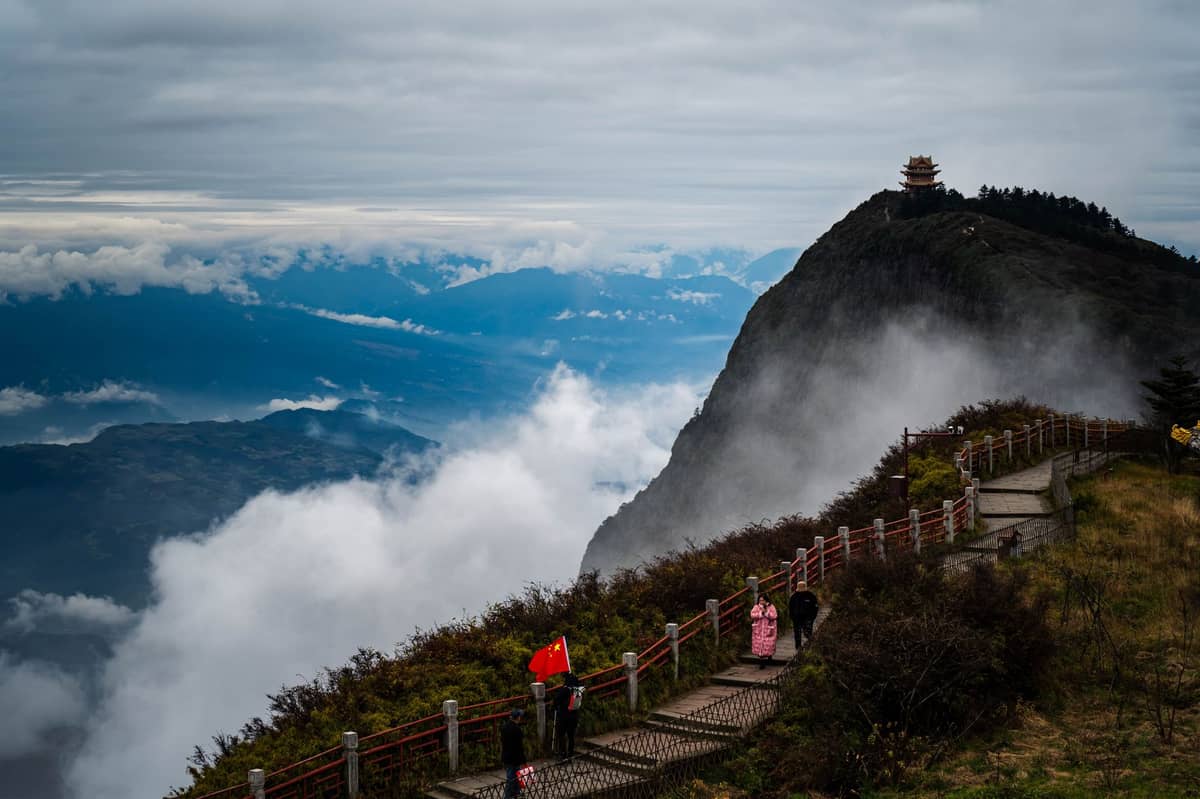
The Golden Summit (Jinding) sits at approximately 3,077 metres and is home to the Huazang Temple, a multi-tiered bronze structure that anchors the skyline. The actual highest point, Wanfo Ding at 3,099 metres, is nearby. On clear mornings — most likely in autumn — the sunrise from this elevation is sharp and immense. The cloud sea below, when conditions are right, fills the valleys completely, leaving the golden rooftops of Huazang Temple floating above a white floor. By mid-morning, cloud cover typically rolls in, and by afternoon the summit can be entirely obscured. This is not an exception to Sichuan's mountain weather; it is the norm.
For hikers, the classic multi-day route ascends through Baoguo Temple at the base, climbs through Qingyin Pavilion (where two streams converge over green-black rocks), continues to Wannian Temple, and eventually reaches the summit zone. Descents use a parallel route. Total hiking distances vary by chosen path, but covering the mountain properly on foot takes two to three days. Guesthouses operate at various elevations, including near Elephant Bathing Pool (Xixiang Chi), and staying overnight significantly improves your chances of catching sunrise before the clouds arrive.
⚠️ What to skip
The Tibetan macaques on Mount Emei are wild animals and can be aggressive, particularly around food. Do not feed them, do not make eye contact while holding food, and keep bags zipped. Bites and scratches are reported regularly. Staff at the upper cable-car station sometimes rent sticks as a deterrent.
Tickets & tours
Hand-picked options from our booking partner. Prices are indicative; availability and final rates are confirmed when you complete your booking.
Private tour from Chengdu to Mount Emei with lunch and cable car
From 471 €Instant confirmationFree cancellationPanda Base and city highlights private day tour in Chengdu
From 302 €Instant confirmationFree cancellationFull day private tour Giant Panda Base and city highlights
From 365 €Instant confirmationFree cancellationChengdu to Yibin private tour with Wuliangye Liquor Museum visit
From 300 €Instant confirmation
The Temples: More Than Decoration
The religious architecture on Mount Emei is not a backdrop to a hike — for many visitors, it is the primary reason to come. Baoguo Temple near the entrance is the largest monastery on the mountain, with a main hall housing a 3.5-metre-tall porcelain Buddha. Its courtyards are shaded by old camphor trees and in the early morning, before bus groups arrive, the sound of monks chanting carries across the stone pathways with remarkable clarity.
Wannian Temple, roughly midway up, holds a bronze statue of Puxian Bodhisattva — to whom Mount Emei is sacred — riding a six-tusked white elephant. The statue dates to the Song dynasty (960–1279 CE) and is housed in a brick dome designed to protect it from weather. The space inside is dim, cool, and smells of sandalwood and old stone. It is a genuinely affecting place, distinct from the busier summit temples.
Huazang Temple at the Golden Summit is the most photographed structure on the mountain and worth seeing for scale alone, but it draws large crowds throughout the day. If temple architecture interests you more broadly, Chengdu itself has significant religious sites: Wenshu Monastery and Qingyang Palace offer quieter, more accessible examples of classical Buddhist and Taoist architecture.
Weather, Seasons, and When to Go
Mount Emei sits in Sichuan's humid climate zone, and its upper elevations generate their own weather patterns independent of the valley below. The summit area receives significant cloud cover year-round, and rain or mist is common even in drier seasons. Visibility at the Golden Summit is clearest in autumn, roughly September through November, when post-monsoon air is sharper and overnight temperatures drop enough to produce dramatic cloud inversions at dawn.
Winter brings snow and ice to the upper mountain. The trails become genuinely hazardous without proper footwear, and the cable car may suspend operations during ice or high wind events. That said, snow-covered temple rooftops and empty paths offer a strikingly different experience for those equipped for cold-weather walking. Spring (March to May) is green, lush, and busy with domestic tourists. Summer sees the heaviest rainfall and the most visitors overall; the trails are not unpleasant in rain, but the summit is frequently socked in.
For Chengdu-based travellers planning the timing of their whole trip, the best time to visit Chengdu guide covers seasonal conditions across the region in more detail. The mountain's weather patterns broadly follow the regional calendar, but with more extremes at higher elevations.
Practical Walkthrough: Getting There and Moving Around
From Chengdu, the most efficient approach is high-speed rail from one of Chengdu's main stations to Emeishan Station, a journey of approximately 1 hour to 1 hour 30 minutes. From the station, local buses and taxis connect to the scenic area's main visitor centre at Baoguo Temple. The entire transfer from central Chengdu to the mountain entrance takes roughly one to one-and-a-half hours, depending on rail departure and local connection.
Inside the scenic area, sightseeing buses operate along the main mountain road and are included in some ticket packages or available separately. They are the standard way to reach the lower cable-car station without hiking the full mountain road on foot. The cable car then covers the steepest section to the Golden Summit area. Walking trails cross between these points at multiple levels, so you can mix hiking and transport in either direction.
Admission is CNY 160 per person during peak season (January 16 to December 14) and CNY 110 during low season (December 15 to January 15), with half-price categories available. Cable-car rides, sightseeing buses, travel insurance (sometimes included or required at purchase), and individual temple entry fees are charged separately. Budget accordingly: the full cost of a day visit including transport from Chengdu, buses, cable car, and entrance ticket can add up significantly.
💡 Local tip
Bring layers even in summer. The temperature at the Golden Summit at 3,077 metres can be 10–15°C cooler than the base. Rental jackets are available near the summit cable-car exit, but they are heavily used and the cost adds up. A compact down jacket packed in your daypack is far preferable.
Photography, Accessibility, and Honest Limitations
The best photography conditions on Mount Emei are in the very early morning at the Golden Summit, before cloud cover fills in. If you are arriving on a day trip from Chengdu, you will likely reach the summit area by late morning at the earliest, which is rarely optimal. Staying overnight near the summit — or at Elephant Bathing Pool — and rising before dawn is the standard strategy for photographers targeting the cloud sea and sunrise.
Lower on the mountain, the forest sections between Qingyin Pavilion and Wannian Temple offer excellent canopy photography and reflections in the streamside pools, and these areas receive more consistent light throughout the day. Dense forest also means interior temple courtyards are often in shade even at midday, which is useful for even exposures on architectural subjects.
Accessibility is limited in the upper areas. The cable car and summit platforms are reachable by most visitors who can manage moderate walking on paved or stone paths. However, the trails between temples involve steep steps, uneven surfaces, and in wet conditions, slippery stone. Visitors with significant mobility limitations should be aware that there is no vehicle access to many sections; sightseeing buses and the cable car go only so far. The mountain is not a venue for anyone who cannot manage stairs and slopes independently.
Travellers planning a full Sichuan heritage circuit should note that Mount Emei pairs naturally with the Leshan Giant Buddha, approximately 30 kilometres away. A two-day itinerary covering both is well-established and logistically straightforward. The broader context for day trips out of Chengdu is covered in the day trips from Chengdu guide.
Insider Tips
- Overnight near Elephant Bathing Pool (Xixiang Chi) or at a summit-area guesthouse rather than rushing up and down in a single day. Cloud inversions and sunrise at 3,000 metres are worth the extra night, and the trails are dramatically quieter after day-trip crowds leave by late afternoon.
- The sightseeing buses fill up quickly at peak times, particularly at the main lower terminus on weekends and public holidays. Arrive early or queue at least 20 minutes before your intended departure time to avoid a long wait for the next bus.
- Stone steps throughout the mountain become extremely slippery in rain or mist. Proper hiking shoes with grip are not optional — they are the single most important item you can bring. Sandals and flat-soled shoes cause most of the minor incidents on the trail.
- If you plan to visit Wannian Temple by foot rather than by the temple cable car, the path from Qingyin Pavilion through the forest is one of the most scenic sections on the whole mountain and far less trafficked than the main ascent route.
- The low-season ticket price (CNY 110) applies only between December 15 and January 15. The rest of the year, including periods many visitors might consider 'off-season', is classified as peak and priced at CNY 160. Check the current pricing at the Emeishan Tourism website before you go.
Who Is Mount Emei (Emeishan) For?
- Hikers and trekkers who want a multi-day mountain circuit with genuine elevation gain and cultural stops along the way
- Buddhist heritage travellers interested in active monastic sites with continuous religious history stretching back over a thousand years
- Photographers targeting dramatic cloud-sea landscapes from high elevation — best in autumn with an overnight stay
- Travellers combining Mount Emei with the Leshan Giant Buddha on a two-day circuit from Chengdu
- Anyone following Chengdu's broader temple and sacred-site trail, complementing urban visits to Wenshu Monastery and Qingyang Palace with mountain pilgrimage culture