Wenshu Monastery: Chengdu's Living Buddhist Heart
Wenshu Monastery (文殊院) in Qingyang District is a well-preserved and active Buddhist monastery in Chengdu. Free to enter and reachable directly by Metro Line 1, it combines genuine religious life with incense-filled courtyards, carved halls, and one of the city's most atmospheric teahouse gardens.
Quick Facts
- Location
- No. 66 Wenshuyuan Street, Qingyang District, Chengdu
- Getting There
- Metro Line 1, Wenshu Monastery Station (Exit K, approx. 150 m walk)
- Time Needed
- 1.5 to 2.5 hours for the monastery; longer if you stay for tea
- Cost
- Free general admission (CNY 0); verify before visiting as special events may have separate charges)
- Best for
- Buddhist culture, architecture, quiet mornings, teahouse atmosphere, photography
- Official website
- http://www.konglin.net/en/wscy/bsjj.html
What Wenshu Monastery Actually Is
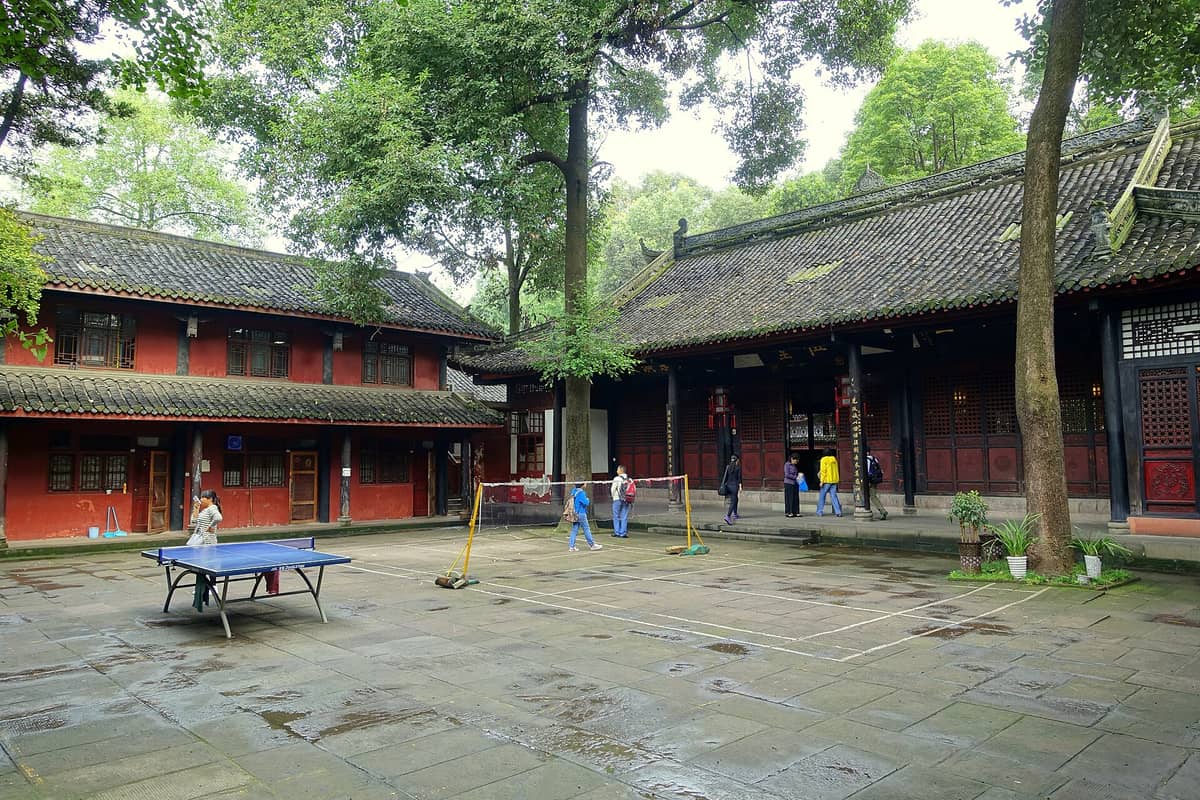
Wenshu Monastery, formally known in Chinese as 文殊院 and also called Konglin Tang (空林堂), is the largest and best-preserved Buddhist monastery in Chengdu. It is an active religious site: resident monks observe daily rituals, the smell of burning incense drifts through every courtyard, and the sound of chanting can fill the complex in the early morning. This is not a reconstructed heritage park or a commercial replica of a temple. It is a working monastery where religion comes first, and tourism is accommodated around it.
The monastery belongs to the Chan (Zen) school of Chinese Buddhism. Its predecessor, Xinxiang Monastery, is recorded by the official site as having been founded during the Daye period of the Sui dynasty, which ran from 605 to 617 CE. The current complex was substantially rebuilt during the Qing dynasty, with major reconstruction work completed around 1706. What visitors see today is largely that Qing-era architecture, maintained and used continuously since.
💡 Local tip
The monastery opens at 08:00 daily. Arriving within the first hour gives you the quietest experience: monks are active, incense is being lit, but tourist crowds have not yet arrived. Last entry is generally 16:30 and the complex closes at 17:00.
Moving Through the Complex: Hall by Hall
The monastery is laid out along a central north-south axis, a classic arrangement in Chinese Buddhist architecture. From the main gate on Wenshuyuan Street, you pass through a series of increasingly interior spaces: the outer courtyards with their towering bronze incense burners, then the succession of ceremonial halls dedicated to different aspects of Buddhist teaching.
The Heavenly Kings Hall (Tianwang Dian) greets you immediately inside the entrance, with its four guardian figures flanking the laughing Maitreya Buddha. Beyond it, the Main Hall (Daxiong Baodian) is the compositional center of the complex, a multi-tiered structure with upturned eaves and detailed wooden lattice screens. The hall dedicated to Wenshu Pusa (Manjushri Bodhisattva, the bodhisattva of wisdom for whom the monastery is named) sits further in and tends to attract the most devotional activity from local worshippers.
Beyond the main ceremonial sequence, smaller side courtyards contain additional shrines, a sutra library, monks' quarters, and corridors lined with calligraphic stone tablets. These peripheral spaces are often overlooked by visitors who move straight through the central axis and leave. Spending time in them gives a much clearer sense of the monastery as a living community rather than a set of photogenic facades.
Tickets & tours
Hand-picked options from our booking partner. Prices are indicative; availability and final rates are confirmed when you complete your booking.
Panda Base and city highlights private day tour in Chengdu
From 302 €Instant confirmationFree cancellationFull day private tour Giant Panda Base and city highlights
From 365 €Instant confirmationFree cancellationChengdu to Yibin private tour with Wuliangye Liquor Museum visit
From 300 €Instant confirmationChengdu private evening tour with hot pot dinner
From 247 €Instant confirmationFree cancellation
How the Atmosphere Changes Through the Day
Early morning, from 08:00 to around 09:30, is categorically the best time for anyone interested in Buddhist practice or quiet contemplation. The incense smoke is freshest, the light in the courtyards is soft and angled, and groups of older local residents come to pray before the tourist flow begins. The sounds are distinctive: wooden fish percussion, the low register of chanting, and the occasional ring of a large bell.
By mid-morning, domestic tour groups and weekend visitors increase the density considerably. The courtyards that felt meditative at 08:30 can feel congested by 10:30, particularly on public holidays and during the Chinese New Year period. Photography becomes harder because of crowd density, and the contemplative quality shifts toward the social.
Late afternoon, from around 15:30 to closing, brings a second quieter window. Many day visitors have moved on, and the low sun hits the rooflines and courtyard walls at a warm angle. The teahouse in the rear garden area is more relaxed at this hour, and the slower pace suits people who want to sit and absorb the setting rather than move through it.
⚠️ What to skip
During major Buddhist festivals, Chinese New Year, and Golden Week holidays, the monastery can become extremely crowded. Incense smoke concentration also increases significantly on festival days, which some visitors find uncomfortable. Plan accordingly.
The Teahouse Garden: A Separate Reason to Come
The rear section of the monastery complex contains a teahouse and garden that operates as a semi-independent attraction. Under old trees in a walled courtyard, low bamboo chairs and wooden tables are arranged for visitors to sit with a pot of tea for as long as they wish. This is not a tourist performance of tea culture; it functions more like a neighborhood teahouse that happens to occupy monastery grounds.
Local residents, retired couples, chess players, and monks on breaks from duties all share the same courtyard. The price of tea is modest. Ordering is straightforward by pointing. The atmosphere is genuinely unhurried, which makes it one of the better places in central Chengdu to decompress after a morning of sightseeing.
Chengdu has a deep teahouse culture, and Wenshu's garden is one of the most atmospheric examples in the city center. For more on what to expect from Chengdu's teahouse tradition, see the Chengdu teahouse guide.
Getting There and Practical Logistics
Wenshu Monastery is served directly by Chengdu Metro Line 1 at Wenshu Monastery Station. Exit K deposits you roughly 150 metres from the monastery entrance, with the walk along Wenshuyuan Street passing small shops selling incense, Buddhist accessories, and local snacks. Several bus routes also serve the area, including lines 16, 55, 64, 98, and 298, though the metro is the most predictable option.
General admission is free. There is no ticket booth or entry queue for the main complex. Some internal areas or special exhibitions may have separate arrangements, so verify current conditions before your visit. The monastery is open daily from 08:00 to 17:00, with last entry at approximately 16:30.
If you are planning a broader circuit of Chengdu's temples and religious heritage sites, the guide to Chengdu's best temples provides useful context for how Wenshu fits into the city's Buddhist landscape.
What to Wear and Bring
- Modest dress is appropriate: covered shoulders and knees show respect and are in keeping with the religious setting.
- Comfortable flat shoes are useful; the courtyard paving is uneven stone in places.
- A small amount of cash is helpful for the teahouse and incense vendors near the entrance.
- If you are sensitive to smoke, be aware that incense burning is continuous throughout the complex.
- Accessibility information for step-free access, ramps, or accessible toilets is not confirmed in public sources; visitors requiring those facilities should contact the monastery directly before visiting.
Photography: What Works and What Doesn't
The main halls photograph well from the courtyards, particularly in the morning when the light falls across the carved wooden eaves from the east. The incense burners in front of the main hall, when actively burning, create a photogenic haze that frames the architecture. Wide-angle compositions of the courtyard axes work best before crowds fill the foreground.
Photography inside the halls is generally not permitted during active worship, and should be avoided out of basic respect regardless of posted rules. Devotees lighting incense and prostrating in the courtyards are not subjects to photograph without consideration; this is a functioning place of worship, not a living museum. Street photography along Wenshuyuan Street approaching the entrance, with its incense shops and food vendors, is generally fine and offers a good introduction to the character of the area.
ℹ️ Good to know
The streets around the monastery, particularly Wenshuyuan Street and the lanes to the north, form a small pedestrian zone with snack stalls, calligraphy supply shops, and Buddhist bookstores. Budget an extra 20 to 30 minutes to explore them on your way in or out.
Wenshu in Context: Nearby Chengdu Attractions
Wenshu Monastery sits in Qingyang District, which concentrates a significant portion of Chengdu's older urban heritage. Qingyang Palace, one of the most important Taoist temples in southwest China, is a reasonable distance away and makes for a natural pairing if you want to compare Buddhist and Taoist temple architecture in the same visit.
The People's Park is also accessible from the same district and offers a complete contrast: open lakeside space, another famous teahouse, and a very different cross-section of Chengdu daily life. Both sites can be combined with a Wenshu visit in a single half-day or full-day itinerary.
For a broader plan covering Chengdu's central heritage sites, the 3-day Chengdu itinerary places Wenshu Monastery in a logical sequence alongside the city's other major cultural attractions.
Who Should Skip This
Visitors who are specifically interested in large-scale religious pageantry or elaborate festival rituals may find Wenshu less visually spectacular than some other major Chinese Buddhist sites. The complex is refined and well-proportioned, but it does not have the monumental scale of a mountaintop monastery or a pilgrimage destination.
Travelers on very tight schedules who have already covered Chengdu's other central attractions might reasonably deprioritize it if the choice is between the monastery and something further from the city center. However, given free admission and direct metro access, the case for skipping it is not strong unless time is severely limited.
Insider Tips
- Arrive at 08:00 on a weekday morning. The first hour is quieter, the incense smoke is freshest, and the monks are active. This window is notably different from the mid-morning tourist experience.
- The teahouse in the rear garden is priced for locals, not tourists. Sit down, order a pot of tea, and stay as long as you like. There is no pressure to move on and no minimum spend.
- The lanes immediately around the monastery, especially Wenshuyuan Street, have small vendors selling warm sesame pastries and local snacks that are easy to miss if you come up from the metro and walk straight to the entrance without looking around.
- If you visit during a Buddhist festival day, the atmosphere is more intense and more crowded simultaneously. Festival dates follow the lunar calendar, so check in advance if your visit coincides with a significant Buddhist observance.
- The monastery also has a vegetarian restaurant on the premises. It is popular with locals and can fill up quickly at midday. If you plan to eat there, arrive early or expect to wait.
Who Is Wenshu Monastery For?
- Travelers interested in living Buddhist culture rather than heritage tourism
- Architecture enthusiasts who want to see authentic Qing-dynasty temple construction in an urban setting
- Visitors who enjoy sitting in teahouse gardens without feeling rushed
- First-time visitors to Chengdu wanting a grounding in the city's religious and cultural character
- Photographers working in the early morning who want incense-filled courtyards with minimal crowds
Nearby Attractions
Other things to see while in Qingyang District:
- Chengdu Museum
Chengdu Museum sits directly west of Tianfu Square in Qingyang District and holds one of the most comprehensive collections of Sichuan civilization under one roof. Free to enter and easy to reach by metro, it covers everything from ancient Bronze Age artifacts to Sichuan opera costumes, across roughly 20,000 square meters of exhibition space. Whether you have two hours or a full day, this guide tells you exactly how to use your visit.
- Du Fu Thatched Cottage
The Chengdu Du Fu Thatched Cottage Museum preserves the site where Tang dynasty poet Du Fu lived and wrote during a period of exile in the 8th century. Set within a composed garden landscape in Qingyang District, it offers a reflective contrast to Chengdu's busier attractions — best suited to travelers who appreciate literary history, classical Chinese garden design, or simply a slower morning away from the crowds.
- Huanhua Creek Park
Huanhua Creek Park is a free, 32-hectare urban park in Qingyang District, woven around the historic creek that inspired Tang dynasty poet Du Fu. It offers shaded walkways, open lawns, lotus ponds, and a rare sense of calm within reach of central Chengdu.
- Wide and Narrow Alleys (Kuanzhai Alley)
The Wide and Narrow Alleys, known in Chinese as 宽窄巷子 (Kuanzhai Xiangzi), form one of Chengdu's most recognizable historic districts: three parallel Qing-dynasty lanes in Qingyang District packed with teahouses, Sichuan snack stalls, courtyard restaurants, and craft shops. Entry is free and the alleys are open around the clock, but the experience varies dramatically depending on when you arrive.