Wide and Narrow Alleys (Kuanzhai Alley): Chengdu's Most Famous Historic District
The Wide and Narrow Alleys, known in Chinese as 宽窄巷子 (Kuanzhai Xiangzi), form one of Chengdu's most recognizable historic districts: three parallel Qing-dynasty lanes in Qingyang District packed with teahouses, Sichuan snack stalls, courtyard restaurants, and craft shops. Entry is free and the alleys are open around the clock, but the experience varies dramatically depending on when you arrive.
Quick Facts
- Location
- Jinhe Road and Changshun Shang Street, Qingyang District, Chengdu, Sichuan
- Getting There
- Metro Line 4 – Kuanzhai Alley Station; or Metro Line 2 – People's Park Station (approx. 500 m walk north)
- Time Needed
- 1.5 to 3 hours for a relaxed walk; longer if you sit down for tea or a full meal
- Cost
- Free entry to the district; food, drinks, and shops priced separately
- Best for
- First-time visitors to Chengdu, architecture enthusiasts, food explorers, slow travelers
- Official website
- http://www.kzxz.com.cn/index.asp
What Is Kuanzhai Alley?
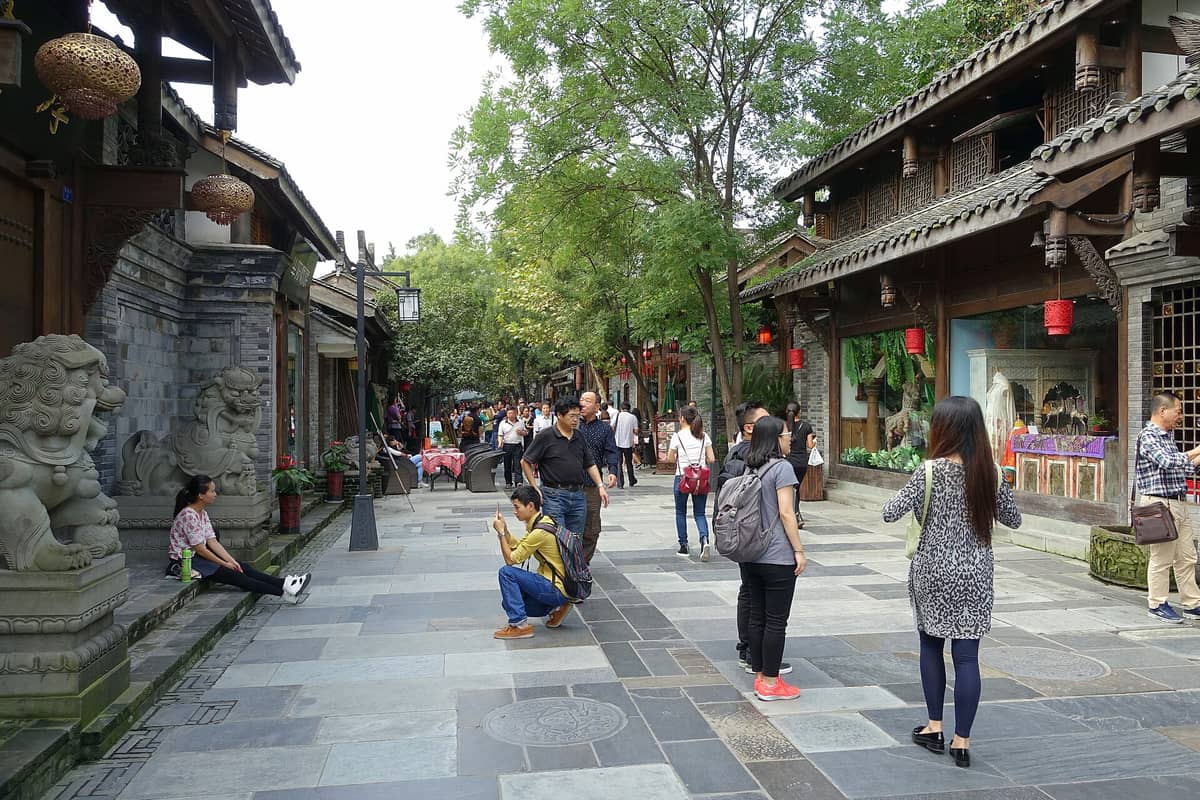
The Wide and Narrow Alleys (宽窄巷子, Kuānzhǎi Xiàngzi) are a historic pedestrian district in central Chengdu comprising Kuan Alley (宽巷子, Wide Alley), Zhai Alley (窄巷子, Narrow Alley), and the smaller Jing Alley (井巷子, Well Alley). Together they form a pedestrianized heritage district in Qingyang District, roughly 15 minutes on foot from People's Park. The district is free to enter, open 24 hours, and consistently draws large crowds, especially on weekends and public holidays.
The lanes trace their origins to the early Qing dynasty, when the Manchu Eight Banners garrison was established in this part of Chengdu. The residential compounds built for garrison families gave the area its characteristic courtyard architecture: grey brick walls, carved wooden gate frames, upturned eaves, and internal courtyards that feel deliberately separate from the street. After decades of deterioration, a protective redevelopment project began in 2003. The restored district opened to the public on 14 June 2008, just weeks before the Beijing Olympics drew international attention to China.
The result is a curated version of old Chengdu rather than a purely organic historic quarter. The architecture is genuine in character — the scale, materials, and courtyard layouts follow traditional models — but the tenants are contemporary. You will find branded teahouses, Sichuan hotpot restaurants, cocktail bars, craft stalls, and boutique hotels inside buildings that look centuries old. That tension between historic shell and modern commercial content is something worth understanding before you arrive, because it shapes what the visit actually feels like.
The Three Alleys: What Each One Offers
The three lanes have distinct characters, and walking them in sequence from north to south gives you a natural progression.
Kuan Alley (Wide Alley) is the most photographed and the most crowded. At approximately 391 meters long and 7.7 meters wide, it has enough space for the foot traffic it receives — in theory. In practice, weekend afternoons can reduce movement to a shuffle as tour groups, photo-takers, and snack vendors compete for space. The courtyard gates here are the most ornate, and several of the larger heritage compounds house sit-down restaurants serving Sichuan cuisine. The smell of chili oil and charcoal drifts from open kitchen windows in the late morning as restaurants begin prep.
Zhai Alley (Narrow Alley), at roughly 390 meters long and 6 meters wide, has a slightly more relaxed pace and tends to attract visitors interested in teahouses and slower consumption. Several traditional tea houses operate from courtyard interiors here, and the sounds shift noticeably: less cooking noise, more conversation, the occasional clink of ceramic lids on tea bowls. Zhai Alley is where you are most likely to find older Chengdu residents playing cards or mahjong in the afternoon hours.
Jing Alley (Well Alley) is the southernmost lane and the most commercially modern of the three. It functions largely as a street-food corridor and bar strip, with vendors selling local snacks, cold drinks, and skewers from carts and counters. By evening, the bars along Well Alley light up and the demographic skews younger. The atmosphere is livelier and louder than the other two alleys after dark, which makes it either the highlight or the least interesting part of the visit, depending on what you came for.
Tickets & tours
Hand-picked options from our booking partner. Prices are indicative; availability and final rates are confirmed when you complete your booking.
Panda Base and city highlights private day tour in Chengdu
From 302 €Instant confirmationFree cancellationFull day private tour Giant Panda Base and city highlights
From 365 €Instant confirmationFree cancellationChengdu to Yibin private tour with Wuliangye Liquor Museum visit
From 300 €Instant confirmationChengdu private evening tour with hot pot dinner
From 247 €Instant confirmationFree cancellation
How the Experience Changes Through the Day
💡 Local tip
Arrive before 9:00 AM on a weekday for the quietest conditions. The district is technically open 24 hours, but most shops open around 10:00 AM. Early morning gives you the architecture without the crowds.
Early morning, roughly 7:00 to 9:00 AM, is the most atmospheric time to visit. The grey-brick lanes are cool and quiet, and the low angle of the light catches the carved wooden gate details in a way that midday sun flattens entirely. Street cleaners and opening vendors are the primary other presence, and the district feels genuinely connected to a slower urban rhythm. A few older locals do morning exercises or walk small dogs through the lanes.
From around 10:00 AM onward, shops open and visitor numbers climb steadily. By noon, Kuan Alley in particular is operating at full commercial pace: queues form outside popular snack counters, tour group leaders hold up color-coded flags, and getting a seat in the courtyard teahouses without a wait becomes difficult. The mid-afternoon hours between 2:00 and 4:00 PM are typically the peak for domestic tourism, especially on weekends.
The evening shift, from around 6:00 PM onward, brings a different energy. String lights and lanterns switch on, and the softer illumination genuinely improves the look of the architecture. The food options expand as evening street-food carts set up, and the lanes feel festive rather than frantic. If you are combining Kuanzhai Alley with a Sichuan opera performance, evening is the natural timing, as several venues in the surrounding area offer shows after dinner.
Food and Drink: What to Eat and Where to Look
Kuanzhai Alley is not the cheapest place to eat in Chengdu, but it offers a concentrated introduction to Sichuan flavors for visitors who do not yet know what to order elsewhere. The snack counters along Kuan and Well Alleys sell dan dan noodles (担担面), red oil wontons (红油抄手), mung bean jelly (凉粉), and skewered meat and tofu coated in chili paste. For a more complete picture of Sichuan cooking, consult the what to eat in Chengdu guide before your visit.
The teahouses in Zhai Alley serve gaiwan tea (covered bowl tea), a Sichuan tradition with its own etiquette. The gaiwan — a small bowl with a lid and saucer — allows you to control the steeping and manage the heat. Sitting in a teahouse courtyard for an hour here is one of the more genuinely unhurried experiences the district offers. Prices vary significantly between the heritage-branded establishments and the smaller counters; a pot of jasmine or green tea at a smaller counter can cost a fraction of the tablecloth restaurants.
Hotpot restaurants in the area tend to be mid-to-upper range and are better suited for evening visits when you have time to sit. For a broader understanding of how hotpot works in Chengdu, the Sichuan hotpot guide covers the regional differences, the spice levels to expect, and how to order.
⚠️ What to skip
Some vendors and restaurants near tourist-heavy entry points charge well above local market rates. Walk further into the alleys or step one block north or south to find less tourist-priced alternatives.
History and Architectural Context
The Manchu garrison town established in Chengdu during the early Qing dynasty was a distinct administrative and residential zone, physically separated from the Han Chinese city around it. The residential compounds built inside this zone followed northern Chinese courtyard-house (siheyuan) principles, adapted to the wetter and warmer Sichuan climate with wider eaves and more permeable courtyard layouts. The arrangement of three parallel alleys connected by cross-lanes survives from this original grid.
By the 20th century, the area had absorbed Han residents and undergone gradual informal modification: courtyards subdivided, gates altered, rooflines lowered. The 2003-2008 redevelopment project worked from historical surveys and photographs to restore gate structures and courtyard proportions to their Qing-period appearance, while replacing deteriorated materials. The restored district is classified as a Historic and Cultural Protected Zone under Chengdu municipal heritage regulations.
The architectural experience here pairs naturally with a visit to the Wuhou Shrine and nearby Jinli Ancient Street in Wuhou District, which offer a different register of Chengdu historic preservation — more theatrical, more explicitly tied to the Three Kingdoms period, but equally instructive about how Chengdu manages its heritage zones commercially.
Getting There, Getting Around, and Practical Notes
The most direct metro option is Line 4 to Kuanzhai Alley Station, which places you at the eastern edge of the district within a few minutes' walk. Metro Line 2 to People's Park Station also works: exit the station and walk approximately 500 meters north along Changshun Shang Street. Multiple bus routes including 62, 70, 93, 126, 127, 163, and 340 serve the Kuanzhai Alley and Changshun Shang Street stops. Ride-hailing via Didi is straightforward from the city center.
The lanes themselves are flat, paved pedestrian streets with no vehicle traffic. The main alleys are wide enough for wheelchair navigation in principle, though some courtyard entrances have threshold steps and individual businesses vary in accessibility. The area is entirely outdoors between the lanes; courtyard restaurants and teahouses provide covered seating.
Weather affects the visit more than many travelers anticipate. Chengdu summers (June through August) can reach 31°C with high humidity, and the district offers little shade outside of courtyard interiors. Rain, which is most frequent from June through September, makes the grey-brick lanes slick and photography challenging, though it also reduces crowd density. Spring and autumn visits, roughly March through May and September through November, tend to offer more comfortable walking conditions.
For practical context on Chengdu's seasonal conditions, see the best time to visit Chengdu guide, which covers temperature ranges, rainfall patterns, and public-holiday crowd surges that affect major attractions including Kuanzhai Alley.
Is It Worth It? An Honest Assessment
Kuanzhai Alley is genuinely worth visiting, but it rewards visitors who come with realistic expectations. The architecture is the real thing: the scale, the gate carvings, the courtyard proportions, and the spatial rhythm of the lanes carry actual historical weight. Sitting in a teahouse courtyard on a quiet morning, with the sound of birdsong from a nearby cage and the smell of jasmine tea, is a legitimate Chengdu experience that cannot be manufactured anywhere else.
At the same time, this is a commercially developed heritage zone, not an untouched historic neighborhood. Many of the shops sell souvenirs and branded products that are identical to what you will find at the airport. Weekend afternoons in peak season are genuinely crowded to a degree that makes it difficult to appreciate the architecture. Visitors who arrive expecting an authentic residential lane from the Qing dynasty will be disappointed; visitors who understand what they are looking at and calibrate their timing accordingly will find it well worth the stop.
Those who strongly dislike tourist-oriented commercial zones, or who have limited time in Chengdu and are choosing between this and a longer day trip, may find better use of an afternoon at Du Fu Thatched Cottage or Qingyang Palace, both of which are within easy reach of Qingyang District and have lighter foot traffic for most of the year.
Insider Tips
- Walk all three alleys from north (Kuan) to south (Well) in sequence before doubling back to eat or drink. The layout makes more sense as a whole, and you will spot the courtyard or teahouse you actually want to return to rather than settling for the first one you see.
- The best photography light falls on Kuan Alley's north-facing gates in the morning. After 11:00 AM, direct overhead light flattens the carved gate details and increases lens flare from glass shopfronts.
- Jing Alley (Well Alley) has a long sculpted relief wall running its length on the south side, depicting scenes from old Chengdu street life. Most visitors walk past it without stopping; it is one of the more considered pieces of public art in the district.
- If you want to sit in a courtyard teahouse without a long wait, aim for Zhai Alley on a weekday morning and look for the smaller, less prominently branded establishments. They frequently have tables available when the famous-name teahouses on Kuan Alley have queues.
- The district connects on its eastern edge to Tongrenlu, a street with several independent restaurants and bars popular with local residents rather than tour groups. If you finish the alleys and want to eat without tourist-zone pricing, turn east on this street.
Who Is Wide and Narrow Alleys (Kuanzhai Alley) For?
- First-time visitors to Chengdu looking for an introduction to the city's historic architecture and food culture in one walkable area
- Travelers with a half-day to spare who want to combine a heritage walk with a sit-down teahouse experience
- Photography enthusiasts interested in Qing-dynasty courtyard architecture, especially in early morning light
- Food explorers wanting to sample multiple Sichuan snacks in a concentrated area before seeking out deeper experiences elsewhere in the city
- Couples or small groups who want a relaxed evening walk with dining and bar options within the same district
Nearby Attractions
Other things to see while in Qingyang District:
- Chengdu Museum
Chengdu Museum sits directly west of Tianfu Square in Qingyang District and holds one of the most comprehensive collections of Sichuan civilization under one roof. Free to enter and easy to reach by metro, it covers everything from ancient Bronze Age artifacts to Sichuan opera costumes, across roughly 20,000 square meters of exhibition space. Whether you have two hours or a full day, this guide tells you exactly how to use your visit.
- Du Fu Thatched Cottage
The Chengdu Du Fu Thatched Cottage Museum preserves the site where Tang dynasty poet Du Fu lived and wrote during a period of exile in the 8th century. Set within a composed garden landscape in Qingyang District, it offers a reflective contrast to Chengdu's busier attractions — best suited to travelers who appreciate literary history, classical Chinese garden design, or simply a slower morning away from the crowds.
- Huanhua Creek Park
Huanhua Creek Park is a free, 32-hectare urban park in Qingyang District, woven around the historic creek that inspired Tang dynasty poet Du Fu. It offers shaded walkways, open lawns, lotus ponds, and a rare sense of calm within reach of central Chengdu.
- People's Park
People's Park (成都市人民公园) is a free public park in central Qingyang District where Chengdu residents come to drink tea, dance, play mahjong, and arrange marriages. It offers an unfiltered look at daily life in one of China's most relaxed cities, and no tour guide is required.