Wuhou Shrine: Chengdu's Window into the Three Kingdoms Era
The Chengdu Wuhou Shrine Museum is one of China's most significant sites commemorating the Three Kingdoms period, dedicated to strategist Zhuge Liang and the Shu Han imperial lineage. Set across a large landscaped complex in Wuhou District, it combines temple halls, sculpted galleries, and the adjoining Jinli pedestrian street into a half-day experience that rewards both history enthusiasts and casual visitors.
Quick Facts
- Location
- No. 231 Wuhouci Street, Wuhou District, Chengdu, Sichuan
- Getting There
- Metro Line 10 to Wuhou Shrine Station. Or Lines 3/5 to Gaoshengqiao Station.
- Time Needed
- 2 to 3.5 hours for the shrine complex; add 1 hour for Jinli Street
- Cost
- ¥50 full price / ¥25 half price / ¥100 annual pass. ¥50 full price / ¥25 half price / ¥100 annual pass. Official sources currently show differing hours; check before visiting.
- Best for
- History and Chinese culture, dynasty-era architecture, photography, family visits
- Official website
- www.wuhouci.net.cn
What Wuhou Shrine Actually Is
The Chengdu Wuhou Shrine Museum — officially 成都武侯祠博物馆 — is a layered complex comprising the cultural-relics area, western area, and adjoining Jinli, with memorial halls, galleries, gardens, and Liu Bei’s Huiling mausoleum. It is Chengdu's premier site for understanding the Three Kingdoms period (roughly 220–280 CE), particularly the Shu Han kingdom centered on this region. The complex commemorates two figures above all: Liu Bei, founding emperor of Shu Han, and Zhuge Liang, the strategist and chancellor whose reputation for wisdom and loyalty has made him one of the most venerated figures in Chinese cultural memory. It is Chengdu's premier site for understanding the Three Kingdoms period (roughly 220–280 CE), particularly the Shu Han kingdom centered on this region. The complex commemorates two figures above all: Liu Bei, founding emperor of Shu Han, and Zhuge Liang, the strategist and chancellor whose reputation for wisdom and loyalty has made him one of the most venerated figures in Chinese cultural memory.
What distinguishes this site from a typical memorial park is the depth of the sculpture program. The main halls contain dozens of painted clay statues depicting generals, ministers, and imperial family members with identifying plaques. These are not generic dynastic carvings; each figure is individually named, and many have distinct biographical narratives attached to them. Visitors who arrive with even a basic knowledge of the Romance of the Three Kingdoms will find the experience considerably richer.
💡 Local tip
Pick up a site map at the main gate. The complex is larger than it looks from the entrance, and the Liu Bei Mausoleum (Huiling) tucked toward the rear is frequently missed by visitors who leave after the main halls.
Moving Through the Complex: A Practical Walkthrough
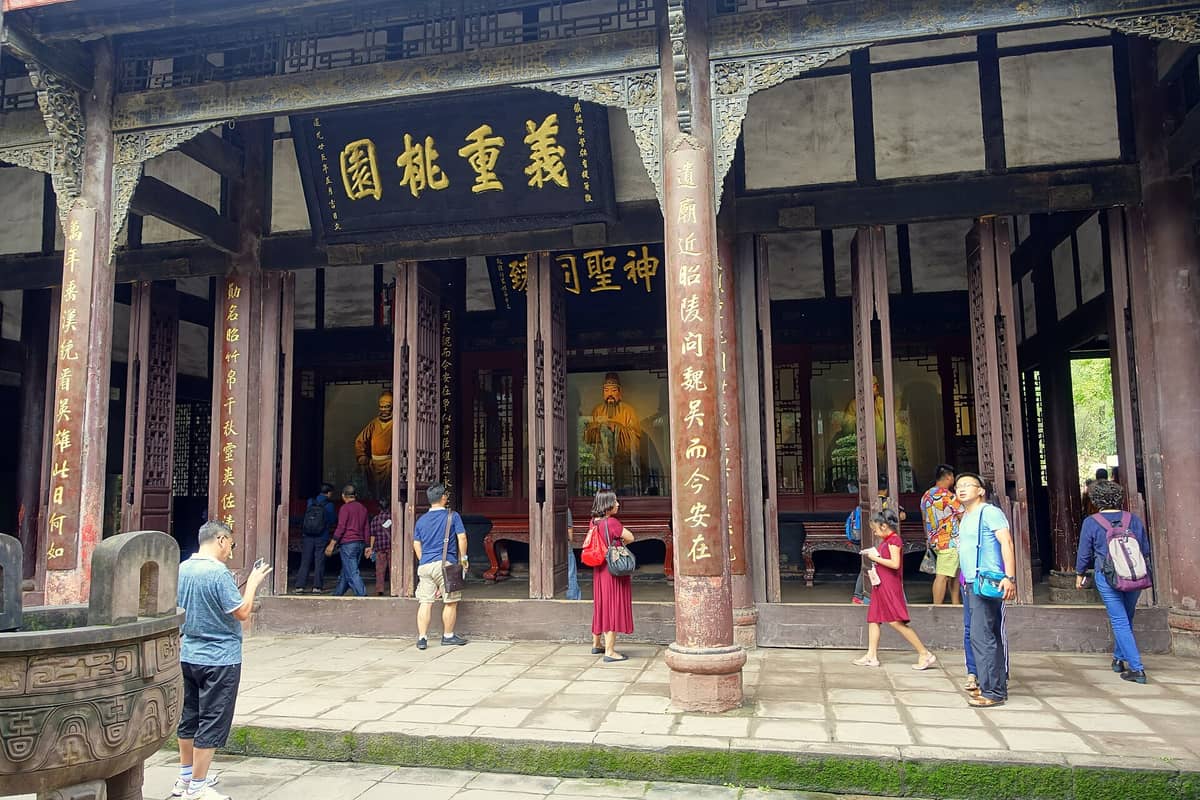
Entering from the main gate on Wuhouci Street, visitors pass through a sequence of ceremonial courtyards before reaching the twin focal points: the Han Zhaolie Temple (dedicated to Liu Bei) and the Wuhou Shrine proper (dedicated to Zhuge Liang). The layout is intentional, reflecting a historical hierarchy that once sparked controversy: a prime minister enshrined alongside, and in some interpretations beside, his emperor. The two halls are connected by covered walkways lined with stone tablet inscriptions, the most celebrated of which is the Tang-dynasty Tang Stele, also known as the “Three Wonders Stele,” praised in classical Chinese literary tradition for the quality of its calligraphy, prose composition, and stone carving simultaneously., praised in classical Chinese literary tradition for the quality of its calligraphy, prose composition, and stone carving simultaneously.
Beyond the main memorial halls, a path leads through bamboo groves and secondary garden sections to the Liu Bei Mausoleum, known as Huiling. The mound itself is a large earthen tumulus, its exterior planted with old trees that have created a dense canopy overhead. The air here is noticeably cooler and quieter than near the entrance. Audio in this section drops sharply, replaced by birdsong and the occasional creak of bamboo in wind — a genuinely different sensory register from the more frequented halls.
The corridor galleries running along the inner perimeter walls display the full sculpted roster of Shu Han officials and military figures. This is where the visit becomes slow in the best sense: each niche contains a figure in ceremonial or battle dress, with a plaque describing their role. For visitors planning to explore the broader temple and heritage sites across Chengdu, this gallery corridor provides a useful reference point for understanding how Sichuan's history is commemorated through sculptural tradition.
Tickets & tours
Hand-picked options from our booking partner. Prices are indicative; availability and final rates are confirmed when you complete your booking.
Panda Base and city highlights private day tour in Chengdu
From 302 €Instant confirmationFree cancellationFull day private tour Giant Panda Base and city highlights
From 365 €Instant confirmationFree cancellationChengdu to Yibin private tour with Wuliangye Liquor Museum visit
From 300 €Instant confirmationChengdu private evening tour with hot pot dinner
From 247 €Instant confirmationFree cancellation
How the Experience Changes by Time of Day
Early morning, between 09:00 and 10:30, is when the light falls at the most flattering angle through the compound's old cypress trees, and domestic tour groups have not yet arrived in force. The courtyards in front of the Liu Bei and Zhuge Liang halls are genuinely quiet at this hour — you can read the stele inscriptions without people pressing against you, and the smell of incense from the worship areas drifts softly rather than accumulating.
By late morning, organized tour groups from within China make up the majority of visitors, and the main halls develop a steady noise level. This is not unpleasant but does affect the contemplative quality of the experience near the tablets and sculpture galleries. The mausoleum area at the rear remains quieter throughout the day and is worth prioritizing before touring the halls if you arrive after 10:30.
On weekends and during national holidays — especially the Golden Week periods in early October and late January to February — the site draws very large crowds. The ticketing plaza fills quickly, and the main halls can become congested around the central altars. Weekday mornings outside of public holidays are the most comfortable time to visit.
⚠️ What to skip
Opening hours (09:00–18:00, last admission 17:00) and ticket prices (¥50 full / ¥25 half) are verified as of September 2026 but may change for public holidays or special events. Check the official site at wuhouci.net.cn before you go.
Cultural and Historical Context
The Three Kingdoms period occupies an outsized place in Chinese cultural identity relative to its brief historical duration. The Shu Han kingdom, ruling from Chengdu, was the smallest and ultimately least successful of the three competing states, yet it produced the characters most celebrated in Chinese literature and popular storytelling. Zhuge Liang in particular became a symbol of moral integrity, strategic brilliance, and devoted service — an archetype referenced repeatedly in Chinese political and literary culture across centuries.
The shrine complex as it stands today reflects reconstructions and restorations across multiple dynasties rather than original Three Kingdoms-era structures. The architectural character is primarily consistent with later imperial construction traditions, with the characteristic heavy tiled rooflines, red lacquered columns, and formal symmetry of a major memorial complex. Understanding this helps calibrate expectations: you are visiting a living memorial site that has been continually maintained and reinterpreted, not a ruin preserved in its ancient state.
For visitors interested in how this period shaped regional identity, the Jinli Ancient Street immediately adjacent to the compound exit extends the Three Kingdoms theme into a commercial street format, with snacks, crafts, and architecture styled after Shu Han period aesthetics. It is explicitly a modern reconstruction but offers a good transition space between the shrine's gravity and the surrounding city.
Photography, What to Wear, and Practical Details
Photography is permitted throughout the complex without restriction in most areas. The most photogenic spots are the main gate façade in early morning light, the bamboo corridor approaching the mausoleum, and the long east-west sculpture gallery where the clay figures are lit by diffused daylight from above. Bring a wide-angle option if possible: the main courtyard forecourts are broad and the architectural lines reward a wider composition than a standard phone lens captures.
Dress modestly for this site. It functions as both a museum and an active place of worship, and visitors paying respects at the altar areas should avoid wearing sleeveless or very short clothing. Comfortable walking shoes matter here more than at many Chengdu attractions, given the combination of stone-paved paths, uneven ground near the mausoleum earthwork, and the total walking distance across the full complex.
Summer visits (June through August) bring heat and humidity. The bamboo and tree cover in the mausoleum section provides genuine shade, but the main courtyards are exposed. Carry water. In the rainy season, the garden paths can become slick. Winter visits (December through February) are quieter and the low winter light suits the dark timber architecture well, though temperatures can drop to 6–8°C.
ℹ️ Good to know
Accessibility arrangements are not fully documented in public-facing materials. The site has an integrated visitor services window at the entrance. If you have specific accessibility needs, contact the museum directly before visiting to confirm current conditions.
Getting There and the Surrounding Area
The most straightforward route is Chengdu Metro Line 10 to Wuhou Shrine Station, followed by a short walk to the museum. Alternatively, Lines 3 or 5 to Gaoshengqiao Station also serve the area. Bus routes 1, 57, 82, 334, 335, and G97 also serve the area. Taxis and Didi ride-hailing drop off directly on Wuhouci Street outside the main entrance. The surrounding Wuhou District is one of Chengdu's more walkable southwestern neighborhoods, with the shrine complex at its cultural center.
Wuhou Shrine sits within easy reach of several other significant sites. Du Fu Thatched Cottage is located roughly 2 kilometers to the northwest and makes a natural pairing for a half-day of heritage visits. The Qingyang Palace Taoist temple complex is also reachable by metro or a short taxi ride for visitors building a broader cultural itinerary.
If the Three Kingdoms theme interests you as a wider Chengdu subject, the city's broader things to do in Chengdu include a number of sites that connect to different layers of Sichuan's long history — from prehistoric finds to Tang dynasty poetry.
Insider Tips
- Walk the full perimeter of the site before doubling back to the main halls. The rear mausoleum area and the bamboo-lined paths are consistently quieter than the central courtyards and reward a slower pace.
- The Sanjue Stele near the main hall complex is famous in classical Chinese literary culture for being praised simultaneously for its calligraphy, prose, and stone carving. It is easy to walk past without registering its significance — look for the stone tablet in a covered pavilion and read the accompanying information.
- Jinli Ancient Street shares a wall with the shrine's east perimeter and is accessible from inside the complex near the exit. Visit it last to avoid the temptation of stopping for street food before you have covered the quieter mausoleum section.
- The sculpture gallery corridors along the inner walls are less crowded than the main altars and contain some of the most detailed individual figures in the complex. Budget at least 20 minutes specifically for this section.
- If you are visiting during a weekday outside school-holiday periods, the site is calm enough in the late afternoon (after 15:30) that the light through the cypress trees becomes particularly good for photography — most large tour groups leave before this point.
Who Is Wuhou Shrine For?
- Travelers interested in Chinese history, dynasty-era politics, and the cultural legacy of the Three Kingdoms period
- Architecture and heritage visitors who appreciate formal memorial complex design and large-scale sculptural programs
- Families with older children (roughly 10+) who have encountered the Romance of the Three Kingdoms in school or popular media
- Photographers seeking well-preserved dark timber architecture, bamboo groves, and ceremonial courtyards
- Visitors pairing the site with Jinli Street for a combined half-day covering both cultural heritage and local food and craft markets
Nearby Attractions
Other things to see while in Wuhou District:
- Jinli Ancient Street
Jinli Ancient Street (锦里古街) is a 550-metre pedestrian lane of reconstructed traditional-style architecture in Wuhou District, free to enter and open all day. It runs along the eastern flank of Wuhou Shrine and draws visitors with Sichuan street food, craft shops, and one of the city's better lantern-lit night atmospheres.