Jinli Ancient Street: Chengdu's Best Evening Street Food Walk
Jinli Ancient Street (锦里古街) is a 550-metre pedestrian lane of reconstructed traditional-style architecture in Wuhou District, free to enter and open all day. It runs along the eastern flank of Wuhou Shrine and draws visitors with Sichuan street food, craft shops, and one of the city's better lantern-lit night atmospheres.
Quick Facts
- Location
- No. 231 Wuhouci Street, Wuhou District, Chengdu
- Getting There
- Gaoshengqiao Station (Metro), then approx. 10–15-min walk; buses 1, 57, 82, 334, and 301 serve the area
- Time Needed
- 1–2 hours daytime; 2–3 hours in the evening
- Cost
- Free entry (CNY ¥0); food and shopping extra
- Best for
- Evening food walks, lantern photography, Sichuan snack tasting
- Official website
- http://www.cdjinli.com
What Jinli Ancient Street Actually Is
Jinli Ancient Street, or 锦里古街 (Jǐnlǐ Gǔjiē), is a purpose-built heritage street designed in the architectural style of the Qing Dynasty. Its first phase opened in October 2004; a second phase was completed before the 2009 Spring Festival. The finished lane stretches roughly 550 metres and runs along the eastern edge of Wuhou Shrine in Wuhou District.
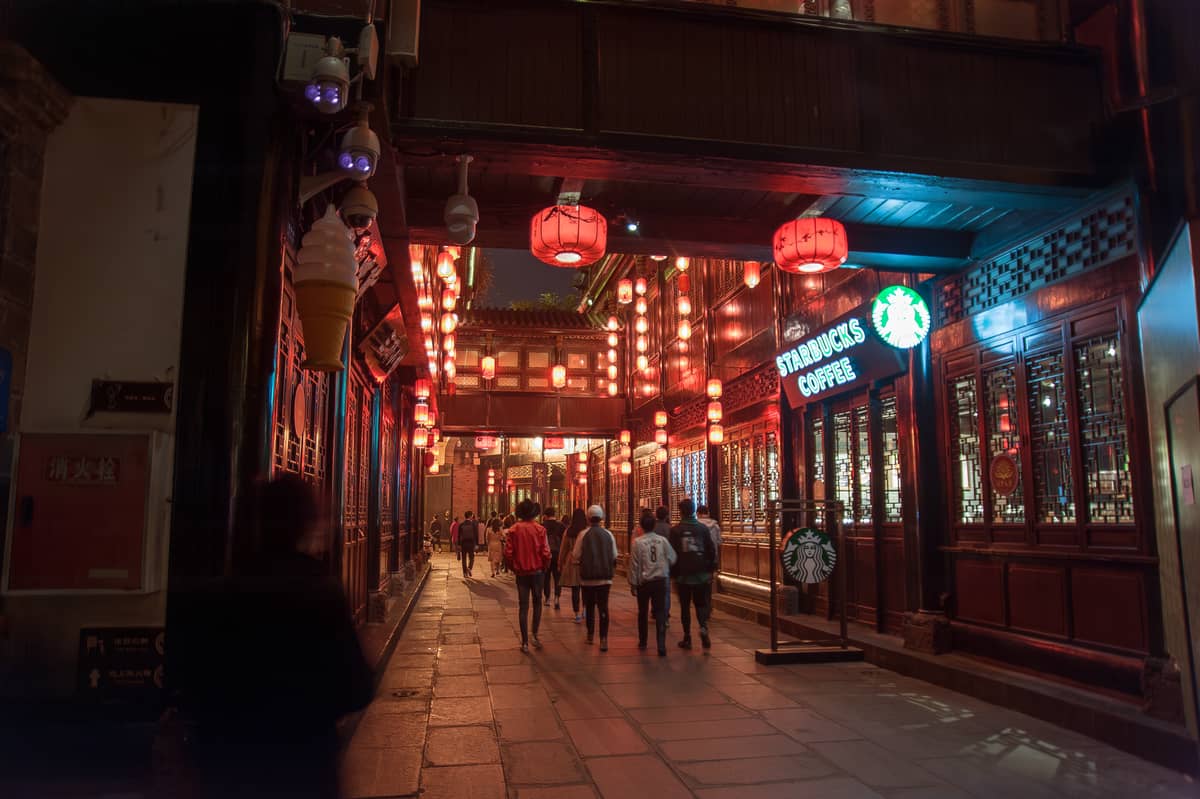
It is not an excavated historic district in the way that a genuinely ancient quarter would be. That distinction matters for visitors managing expectations. What Jinli offers is a well-maintained, atmospheric reconstruction rather than a surviving piece of old Chengdu. The grey-tile rooflines, red lanterns, and timber shop fronts are convincingly done, and the craftsmanship is solid enough that the effect works especially well after dark. Travelers who arrive expecting an unreconstructed Ming-Qing streetscape may feel short-changed, but those who treat it as a curated evening experience usually leave satisfied.
ℹ️ Good to know
Admission is free under normal operation. Temporary entry fees may apply during major festivals or temple-fair events. Verify at cdjinli.com before visiting during Chinese New Year or Golden Week.
How the Street Changes Through the Day
Jinli is open all day, although many shops and stalls begin operating around 09:00. The food stalls are still setting up, sweepers are working through the lane, and the architecture is visible without a wall of shoulders in the way. Daylight reveals the construction in detail — not unflattering, but definitely less magical than the night version. If you're visiting primarily for photography of the structures themselves, 08:00–09:30 gives clean sight lines.
Midday brings a steady flow of domestic tour groups, particularly on weekends. The food vendors are all operational by 10:00, and the narrow central lane can become genuinely congested between 11:00 and 14:00. Noise levels rise considerably: recorded folk music competes with vendor calls, and the smell of chili oil and sesame paste carries from one end of the street to the other. Whether that's appealing or overwhelming depends on your tolerance for sensory intensity.
The lanterns switch on at approximately 19:00 in summer and 18:00 in winter, and this is when Jinli earns its reputation. Red paper lanterns hung at intervals along the eaves glow against the darkening sky, the more aggressive tour-group traffic has thinned, and the food and drink stalls switch from snack mode to something closer to an outdoor evening market. Plan to arrive just before lighting-up time to catch the transition from dusk to fully lit — this is the visual peak. The lanterns switch on at approximately 19:00 in summer and 18:00 in winter, and this is when Jinli earns its reputation. Red paper lanterns hung at intervals along the eaves glow against the darkening sky, the more aggressive tour-group traffic has thinned, and the food and drink stalls switch from snack mode to something closer to an outdoor evening market. Plan to arrive just before lighting-up time to catch the transition from dusk to fully lit — this is the visual peak. Most shops and stalls close around 22:00, while the street itself remains open all day.
Tickets & tours
Hand-picked options from our booking partner. Prices are indicative; availability and final rates are confirmed when you complete your booking.
Panda Base and city highlights private day tour in Chengdu
From 302 €Instant confirmationFree cancellationFull day private tour Giant Panda Base and city highlights
From 365 €Instant confirmationFree cancellationChengdu to Yibin private tour with Wuliangye Liquor Museum visit
From 300 €Instant confirmationChengdu private evening tour with hot pot dinner
From 247 €Instant confirmationFree cancellation
The Food: What to Eat and What to Skip
Food is the primary reason most visitors walk the length of Jinli more than once. The snack options are heavily Sichuan-focused: skewers of rabbit offal, spicy beef rolls, tangyuan (glutinous rice balls) in various sauces, three-cannon sticky rice desserts, and hand-held portions of mapo tofu served in small clay bowls. Stall holders generally display photo menus or have English labels on the more popular items, which makes ordering manageable even without Mandarin.
Prices are tourist-market rates, meaning noticeably higher than what you'd pay for the same food in a local neighborhood canteen. A stick of rabbit skewers runs roughly CNY ¥8–15 depending on the vendor and the season. For a broader understanding of Sichuan flavors before or after visiting Jinli, the Chengdu street food guide covers the city's more authentic food streets alongside the tourist-facing ones.
Tea houses occupy several of the larger buildings on the western side of the lane, and stopping at one for a pot of Mengding green tea or jasmine hua cha is worth the time. These are sit-down establishments with wooden tables and chairs overlooking a small courtyard or the lane itself. They operate slower and quieter than the food stalls, and the contrast in atmosphere is noticeable.
💡 Local tip
Eat before you arrive if you want to graze rather than fill up on the first stall. Jinli rewards slow wandering and small bites from multiple vendors rather than committing to one large order at the entrance.
Shopping and Craft Stalls
The shops lining Jinli sell a mix of Sichuan-specific crafts and generic tourist goods. Shu embroidery pieces — the traditional Sichuan needlework style — are sold in several dedicated shops and range from small framed pieces to large silk panels. Shadow puppets, lacquerware, handmade masks used in Sichuan opera face-changing performances, and locally produced spice packets (doubanjiang, Sichuan peppercorn mixes) make for more distinctive purchases than the keychain-and-magnet stalls that also occupy space here.
Quality varies considerably between shops. Fixed-price tags are common in the craft boutiques; informal stalls may allow bargaining, though the scope for it is narrower than at a traditional market. If shopping is a priority during your Chengdu visit, the Chengdu shopping guide helps calibrate what to buy where and what to expect in terms of pricing and authenticity.
Wuhou Shrine and the Surrounding Area
Jinli sits directly beside Wuhou Shrine, the memorial complex dedicated to Zhuge Liang, the revered Three Kingdoms strategist, and Liu Bei, the founding emperor of Shu Han. The shrine itself requires a separate entrance ticket and is a substantively different kind of visit: quieter, more formal, with ancient cypress trees, carved stone tablets, and gilded statues inside a series of walled courtyards. Many visitors combine the two in a single afternoon-into-evening outing, using the shrine as the cultural anchor and Jinli as the food and atmosphere portion.
The wider Wuhou District has a different character from the central shopping districts around Chunxi Road. It is less commercial at street level and has a higher concentration of university campuses and residential blocks. This makes the area feel more like actual Chengdu rather than the polished retail surfaces of the city center, which some visitors find more interesting to walk through on the way to and from Jinli.
Practical Details: Getting There, Weather, and Accessibility
Jinli is open all day. The closest commonly used metro station is Gaoshengqiao on the Chengdu Metro network, from which the walk to the entrance takes roughly 10–15 minutes. City buses including Routes 1, 57, 82, 334, and 301 serve the area near Wuhouci Street. Taxis and Didi rides drop off near the entrance; the address is No. 231 Wuhouci Street, Wuhou District.
Chengdu's rainy season runs from June through September, and the lane's stone pavement becomes slippery when wet. Wear shoes with grip if you're visiting in summer. Umbrellas are more practical than ponchos in the narrow lane. Autumn and spring, broadly March to May and September to November, offer the most comfortable temperatures. For a fuller picture of when to time a Chengdu trip, see the best time to visit Chengdu guide.
Accessibility information is limited in official sources. The lane is a pedestrian street with relatively flat paving, but the cobblestone surface and occasional steps at shop entrances may present difficulties for wheelchair users. Verify current conditions directly with the management at cdjinli.com before visiting if step-free access is a requirement.
⚠️ What to skip
Golden Week (early October) and Chinese New Year push visitor numbers to their highest levels of the year. The lane becomes extremely crowded during peak evening hours on these dates. If you visit during a major holiday, go in the morning or accept that the atmosphere will be noticeably different from what photos suggest.
Who Should Reconsider This Stop
Travelers who have already visited Kuanzhai Alley — Kuanzhai Alley — will find Jinli familiar in format: reconstructed Qing-style architecture, souvenir shops, and Sichuan snack vendors. The two streets serve a similar function and repeat the same core experience. If your time in Chengdu is short, choose the one that fits better geographically into your itinerary and treat the second as optional.
Visitors who prioritize authentic, everyday Chengdu over tourist-facing commercial streets may find Jinli disappointing regardless of when they visit. It is designed for tourism and makes no pretense otherwise. The architecture is a reconstruction, the prices reflect tourist demand, and the atmosphere after dark is partly manufactured through lighting and music. None of that is a reason to avoid it — but it is context that helps set honest expectations before the visit.
Insider Tips
- Arrive at dusk, 15–20 minutes before the lanterns switch on. You get the quieter late-afternoon crowd and then watch the street transform as the light fades. This is the single best time-of-day choice for both atmosphere and photographs.
- The tea houses on the western side of the lane are genuine sit-down operations, not grab-and-go stalls. Spending 30–40 minutes at a courtyard table is a better use of time than rushing through all 550 metres twice.
- Wuhou Shrine closes earlier than Jinli. If you want to combine both in one outing, enter the shrine first and finish with the street food walk as the sun drops.
- The north entrance (closer to Wuhouci Street) is less congested than the main south entrance during peak hours. Use it to enter from the quieter end and work toward the denser food stall section.
- Some of the spice and condiment shops near the middle of the lane sell vacuum-packed doubanjiang and Sichuan peppercorns. These are genuinely useful food souvenirs and travel well. Avoid buying loose spices that cannot be resealed for the flight home.
Who Is Jinli Ancient Street For?
- First-time visitors wanting an accessible introduction to Sichuan food culture in a single focused walk
- Evening entertainment after a day of museum or temple visits in the Wuhou District
- Families with children who respond well to food variety, color, and open pedestrian space
- Photographers working on lantern and night-market compositions
- Travelers combining a visit with Wuhou Shrine for a half-day culture-and-food outing
Nearby Attractions
Other things to see while in Wuhou District:
- Wuhou Shrine
The Chengdu Wuhou Shrine Museum is one of China's most significant sites commemorating the Three Kingdoms period, dedicated to strategist Zhuge Liang and the Shu Han imperial lineage. Set across a large landscaped complex in Wuhou District, it combines temple halls, sculpted galleries, and the adjoining Jinli pedestrian street into a half-day experience that rewards both history enthusiasts and casual visitors.