Du Fu Thatched Cottage: Chengdu's Quiet Tribute to a Tang Dynasty Poet
The Chengdu Du Fu Thatched Cottage Museum preserves the site where Tang dynasty poet Du Fu lived and wrote during a period of exile in the 8th century. Set within a composed garden landscape in Qingyang District, it offers a reflective contrast to Chengdu's busier attractions — best suited to travelers who appreciate literary history, classical Chinese garden design, or simply a slower morning away from the crowds.
Quick Facts
- Location
- No. 37 Qinghua Road, Qingyang District, Chengdu
- Getting There
- Caotang North Road Station, Metro Line 4 (short walk)
- Time Needed
- 1.5 to 2.5 hours
- Cost
- CNY ¥50 adult; CNY ¥25 half-price; CNY ¥100 annual pass
- Best for
- Literary travelers, garden walkers, cultural history enthusiasts
- Official website
- www.cddfct.cn
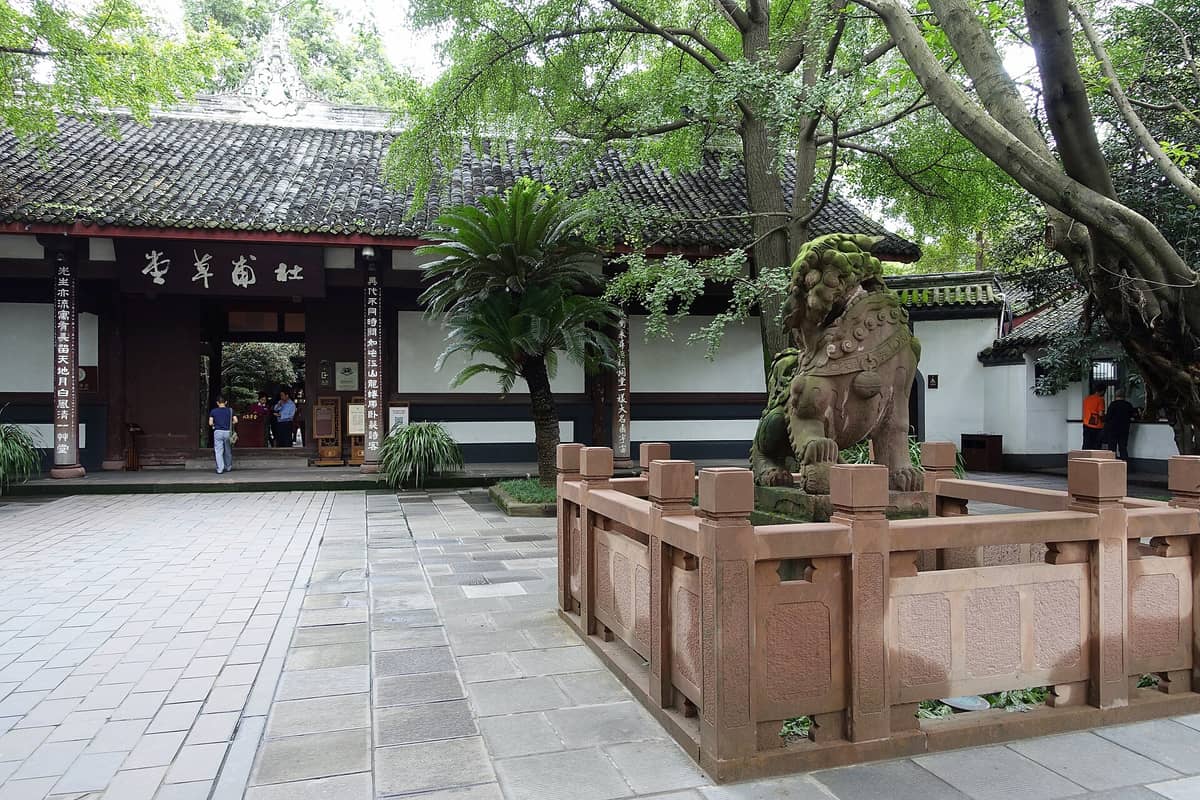
What Is Du Fu Thatched Cottage?
The Chengdu Du Fu Thatched Cottage Museum — known in Chinese as 成都杜甫草堂博物馆 — is a heritage site and museum dedicated to Du Fu, one of the most celebrated poets in Chinese literary history. It marks the location where Du Fu lived for roughly four years during the Tang dynasty, having fled the chaos of the An Lushan Rebellion. During that time, he wrote over 240 poems, many of which became foundational texts in the classical Chinese canon.
The site today is not a reconstruction of a single humble hut. It has evolved over centuries — through Song, Ming, and Qing dynasty reconstructions and expansions — into a substantial garden complex of pavilions, covered corridors, bamboo groves, water features, and museum exhibition halls. The original cottage itself is long gone, but the layered history of commemoration is part of what makes this place worth understanding.
ℹ️ Good to know
Opening hours are generally 09:00–18:00, with ticket sales ending at 17:00. Verify current hours at cddfct.cn before your visit.
The Experience: Gardens, Pavilions, and the Weight of History
Entering through the main gate on Qinghua Road, the shift in atmosphere is immediate. The sound of city traffic drops away within a few steps, replaced by birdsong, rustling bamboo, and the low murmur of water moving through the garden channels. The grounds are extensive enough that the visitor density, even on weekday mornings, feels manageable.
The garden is composed around a series of low structures, covered walkways, and water features, with dense planting of bamboo, ancient trees, and seasonal flowers between them. Paths are mostly paved with stone, and the overall design is in the tradition of classical Chinese landscape gardens — space organized to create a series of distinct 'scenes' as you move through. Stone stelae inscribed with Du Fu's poems appear at intervals, functioning as both decoration and quiet prompts to slow down.
The central focus of the complex is the Gong Bu Ci (工部祠), the ancestral shrine hall dedicated to Du Fu, referred to by his official title of Gong Bu. This compact, darkened hall contains a statue of the poet flanked by two other poets, with incense smoke and dim lighting creating a genuinely atmospheric interior. It is small, and visitors tend to move through quickly — but a few minutes spent here provides the clearest sense of how Du Fu has been venerated across Chinese culture.
Tickets & tours
Hand-picked options from our booking partner. Prices are indicative; availability and final rates are confirmed when you complete your booking.
Panda Base and city highlights private day tour in Chengdu
From 302 €Instant confirmationFree cancellationFull day private tour Giant Panda Base and city highlights
From 365 €Instant confirmationFree cancellationChengdu to Yibin private tour with Wuliangye Liquor Museum visit
From 300 €Instant confirmationChengdu private evening tour with hot pot dinner
From 247 €Instant confirmationFree cancellation
How the Site Changes Through the Day
Early morning, between opening and around 10:00, the garden is at its quietest. Local residents sometimes enter for a slow walk before the main tourist groups arrive. The light filtering through the bamboo is particularly good in this window, and the covered walkways have a stillness that mid-morning crowds break.
By mid-morning, school groups and tour groups with guides carrying microphones become more common, particularly on weekends. The main path from the entrance to the Gong Bu Ci can feel narrow with group traffic. If you visit on a weekend or holiday, arriving at opening is a noticeably better experience than arriving mid-morning.
Afternoons in summer are warm and humid — Chengdu sits in the Sichuan Basin and summer temperatures regularly reach the high 20s to low 30s Celsius. The garden's tree canopy provides shade along most paths, but the more open museum exhibition halls are air-conditioned, which makes them a practical refuge as much as a cultural one. Late afternoon light hits the water features and wooden pavilions at an angle that rewards photographers with patience.
💡 Local tip
Weekday mornings between 09:00 and 10:30 offer the most peaceful experience. If you are visiting during a national holiday, expect significantly higher crowds across the entire complex.
Du Fu: Why This Site Matters
Du Fu (712–770 CE) is often paired with Li Bai as the two poles of Tang dynasty poetry. Where Li Bai is associated with Daoist romanticism and lyrical freedom, Du Fu is known for his moral seriousness, technical precision, and unflinching attention to social suffering. He wrote about war, famine, displacement, and the ordinary lives of people caught in the collapse of imperial order — subjects that gave his work an enduring relevance across Chinese literary culture.
His years in Chengdu, roughly 759 to 765 CE, were paradoxically among his most productive. He arrived poor and in uncertain health, was supported by a local official friend, and built a simple thatched dwelling on the western outskirts of the city near Huanhua Creek. The poems he wrote here range from precise descriptions of his small garden — noting individual plants, birds, and the quality of light — to broader elegies about the war-torn empire he had left behind.
For visitors with a deep interest in Chinese literary history, the museum's exhibition halls contain calligraphy, historical editions of Du Fu's collected works, and contextual displays. For those less familiar with classical Chinese poetry, the gardens and shrine remain worth visiting as an example of how Chinese culture preserves and elevates its literary figures. You can find more context on Chengdu's broader cultural landscape in the Chengdu first-timer guide.
Practical Walkthrough: Getting There and Moving Around
The museum is located at No. 37 Qinghua Road in Qingyang District, a central-western part of the city. The most straightforward public transport option is Metro Line 4, alighting at Caotang North Road Station and walking to the main entrance. The walk is short and largely flat.
Ride-hailing via Didi is practical from most central Chengdu locations. Foreign visitors should confirm payment method compatibility before relying on Didi; some configurations require a Chinese payment wallet. Hotels can often assist with booking or provide alternatives.
Inside the complex, paths are mostly stone-paved. The ground is generally level with some gentle rises, but the official information available does not detail step-free routes, wheelchair access, or accessible toilet locations. Visitors with mobility requirements should contact the museum directly before visiting: the ticket consultation hotline is 028-68921800.
The museum sits within a short distance of several other significant sites in Qingyang District. Qingyang Palace, one of Chengdu's most important Daoist temples, is nearby, making it feasible to combine both in a half-day circuit. Huanhua Creek Park adjoins the museum grounds and provides an easy extension for those wanting more outdoor walking time.
Photography, Dress, and What to Bring
Photography is permitted throughout the garden and most public areas. The bamboo groves photograph well in any season, but are particularly dense and green in summer. The Gong Bu Ci shrine interior is dim — a phone with a decent low-light mode will produce better results than a flash, which is both disruptive and ineffective at distance.
Dress practically for the season. Summer visits call for light clothing, sun protection, and water. Chengdu summers are humid and warm, and the garden, while largely shaded, is still outdoor walking. Spring and autumn are the most physically comfortable visiting windows. Modest dress is appropriate for the shrine hall, though there is no enforced dress code.
Chengdu's climate is worth understanding before planning your wider itinerary. The best time to visit Chengdu guide breaks down seasonal conditions in detail.
Who This Attraction Suits — and Who Might Want to Skip It
Du Fu Thatched Cottage rewards visitors who bring some curiosity about Chinese literary history or classical garden design. The site is unhurried and composed, and moving through it thoughtfully takes around two hours. For that kind of traveler, it ranks among the more genuinely distinctive cultural experiences in Chengdu.
Visitors looking primarily for spectacular architecture or dramatic visual set pieces may find the scale modest compared to, say, Wuhou Shrine or the Sichuan Provincial Museum. The buildings here are deliberately understated — the significance is historical and literary rather than visually grand.
Families with young children may find the garden enjoyable as a walking space, but the content of the exhibition halls assumes either prior knowledge of Du Fu or a willingness to read interpretive panels slowly. There is no immersive or interactive experience designed for children. Travelers with very limited time in Chengdu and a preference for faster-paced sightseeing are likely better served by other priorities first.
Insider Tips
- The area near Huanhua Creek, which borders the museum grounds, is worth a short detour after your visit. The creek appears directly in several of Du Fu's Chengdu poems, and walking along it gives a small sense of the landscape he was describing — even if the surroundings have changed considerably.
- The museum has an in-house bookshop that stocks editions of Du Fu's collected works, including bilingual versions and scholarly translations. If you have any interest in taking the poetry home with you, this is a better source than general bookshops in the city center.
- Stone stelae with inscribed poems are scattered throughout the garden. Many visitors walk past them quickly, but if you can read Chinese characters — or travel with someone who can — reading a poem in the location where it was written adds a different layer to the visit.
- During national holidays and Golden Week, the site becomes significantly busier. The experience changes considerably — the reflective quality of the garden competes with crowd noise and queues at key photo points. If your travel dates include a national holiday, arriving exactly at opening (or visiting Qingyang Palace first and arriving here later in the afternoon) helps manage crowd density.
- The annual pass at CNY ¥100 represents strong value if you plan to visit more than twice or if you are spending an extended period in Chengdu. For a single visit, the CNY ¥50 standard admission is reasonable given the size of the complex.
Who Is Du Fu Thatched Cottage For?
- Travelers with an interest in classical Chinese literature or Tang dynasty history
- Garden and landscape photography enthusiasts
- Visitors seeking a slower, reflective alternative to Chengdu's busier cultural sites
- Those combining a half-day circuit with nearby Qingyang District attractions
- Repeat visitors to Chengdu looking beyond the standard highlights
Nearby Attractions
Other things to see while in Qingyang District:
- Chengdu Museum
Chengdu Museum sits directly west of Tianfu Square in Qingyang District and holds one of the most comprehensive collections of Sichuan civilization under one roof. Free to enter and easy to reach by metro, it covers everything from ancient Bronze Age artifacts to Sichuan opera costumes, across roughly 20,000 square meters of exhibition space. Whether you have two hours or a full day, this guide tells you exactly how to use your visit.
- Huanhua Creek Park
Huanhua Creek Park is a free, 32-hectare urban park in Qingyang District, woven around the historic creek that inspired Tang dynasty poet Du Fu. It offers shaded walkways, open lawns, lotus ponds, and a rare sense of calm within reach of central Chengdu.
- Wide and Narrow Alleys (Kuanzhai Alley)
The Wide and Narrow Alleys, known in Chinese as 宽窄巷子 (Kuanzhai Xiangzi), form one of Chengdu's most recognizable historic districts: three parallel Qing-dynasty lanes in Qingyang District packed with teahouses, Sichuan snack stalls, courtyard restaurants, and craft shops. Entry is free and the alleys are open around the clock, but the experience varies dramatically depending on when you arrive.
- People's Park
People's Park (成都市人民公园) is a free public park in central Qingyang District where Chengdu residents come to drink tea, dance, play mahjong, and arrange marriages. It offers an unfiltered look at daily life in one of China's most relaxed cities, and no tour guide is required.