Qingyang Palace: Chengdu's Ancient Taoist Heart
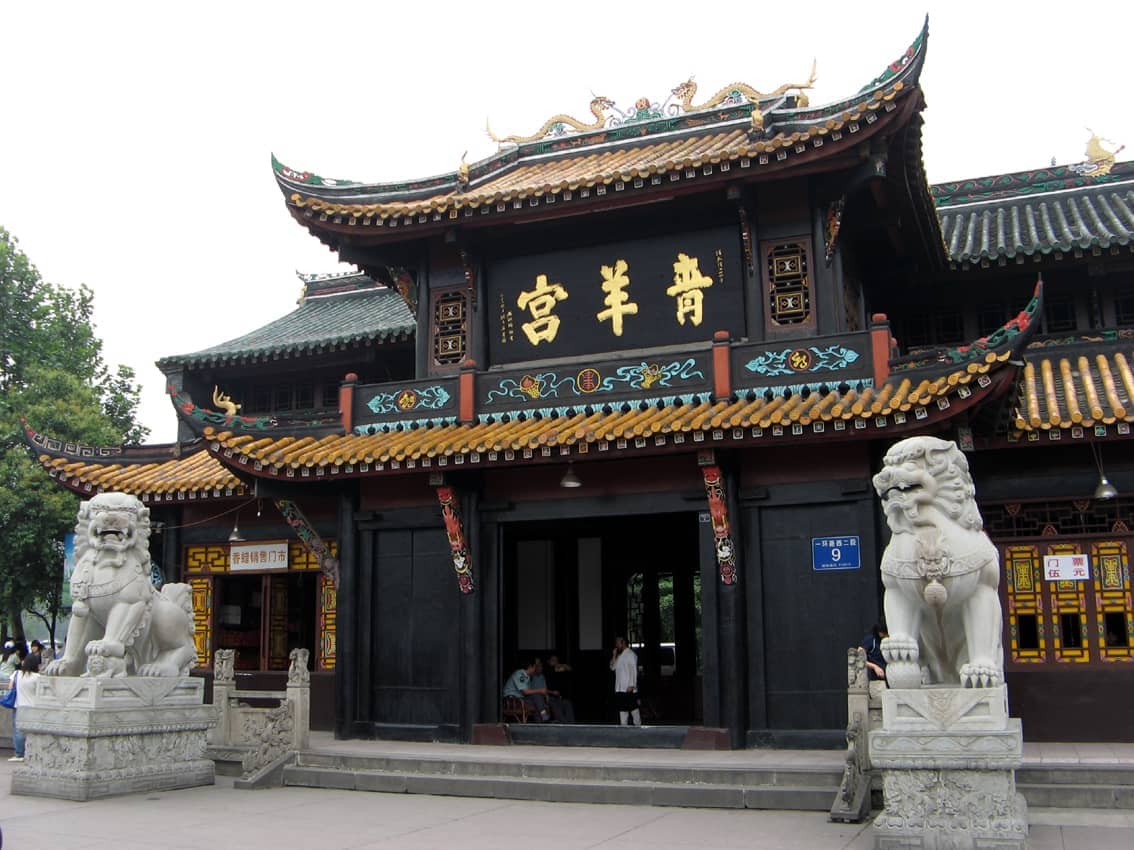
Qingyang Palace (青羊宫) is the oldest and most significant Taoist temple in Chengdu, with origins traced back to the Zhou dynasty. Set inside Qingyang District, the complex draws both devoted worshippers and curious travelers with its incense-laced courtyards, bronze goat statues, and layered architectural history. Admission is just CNY 10, making it one of the city's most rewarding low-cost visits.
Quick Facts
- Location
- No. 9, West Section 2, First Ring Road, Qingyang District, Chengdu
- Getting There
- Qingyang Palace Station, Metro Line 5
- Time Needed
- 1 to 2 hours
- Cost
- CNY 10 adults; free for ages 60+ and children under 1.2 m (verify at ticket office)
- Best for
- History, religious culture, photography, quiet morning walks
- Official website
- www.qingyanggong.org
What Is Qingyang Palace?
Qingyang Palace, known in Chinese as 青羊宫 (Qingyang Gong), is the most important Taoist temple in Chengdu and one of the oldest continuously active places of Taoist worship in southwestern China. The complex sits on First Ring Road in Qingyang District, occupying a remarkably calm footprint given how close it sits to the urban core.
The site's traditional origins are placed in the Zhou dynasty, making it among the oldest sacred sites in the Chengdu basin. During the Tang dynasty it was known as Xuanzhong Guan before eventually taking the name Qingyang Gong. The temple's long history means most of what visitors see today reflects later Ming and Qing dynasty construction and renovation, with the architectural vocabulary of those periods layered over a much older foundation. If you want broader context on the city's historical and religious landscape, the guide to Chengdu's best temples places Qingyang Palace in useful comparison with other sites across the city.
💡 Local tip
Opening hours are commonly listed as 08:00–17:00 daily. Confirm current hours at the ticket office or via the official site before visiting, especially around public holidays.
The Atmosphere at Different Times of Day
Arriving early, between 8:00 and 9:30 in the morning, is the clearest way to experience the temple on its own terms. In those first hours, the courtyards fill with the smell of burning incense from tall bronze censers, and the sound is a mix of low chanting, the clinking of small ritual bells, and birdsong from the trees overhead. Local worshippers, many of them older residents from the surrounding neighborhood, move between the halls with practiced purpose, kneeling, placing offerings, and lighting fresh sticks of incense without any self-consciousness about the small number of tourists also present.
By mid-morning the character shifts. Tour groups, school parties, and solo travelers begin to fill the central axis, and the sound of guided commentary competes with the ambient calm. The incense haze remains, catching the light at certain angles in a way that photographs well, but the meditative quiet of the early hours is harder to find. If you are visiting primarily for the atmosphere rather than architectural study, the difference between 8:30 and 11:00 is substantial.
Afternoons are quieter again in a different way: the tour groups cycle out, but the light inside the main halls becomes flat and the heat in summer can be uncomfortable in the open-air sections. Late afternoon in spring or autumn, roughly 15:00 to 17:00, offers a reasonable balance of good light, moderate crowds, and cooler temperatures.
Tickets & tours
Hand-picked options from our booking partner. Prices are indicative; availability and final rates are confirmed when you complete your booking.
Panda Base and city highlights private day tour in Chengdu
From 302 €Instant confirmationFree cancellationFull day private tour Giant Panda Base and city highlights
From 365 €Instant confirmationFree cancellationChengdu to Yibin private tour with Wuliangye Liquor Museum visit
From 300 €Instant confirmationChengdu private evening tour with hot pot dinner
From 247 €Instant confirmationFree cancellation
What You Actually See: The Architecture and the Bronze Goats
The layout follows a traditional north-south central axis with a succession of courtyards and halls. The entrance leads through a screen wall and past the first ceremonial gates into the main open courtyard, which is anchored by a large incense burner. The stone paving here is worn smooth in places, and the tree canopy overhead is generous enough to provide real shade.
The most photographed objects in the temple are two bronze goat statues that stand inside one of the main halls. These are the objects that give the palace its name: 'Qingyang' translates roughly as 'green' or 'blue-green goat.' The statues are genuinely interesting up close. One is a composite creature built from the twelve animals of the Chinese zodiac, incorporating features from each, while the other is a more conventionally rendered goat. Visitors rub the statues for good fortune, and the wear on certain spots, the ears, the back, the tail, is visibly different from the rest of the patinated surface.
The八卦 (Bagua) Pavilion, a multi-tiered wooden structure on the western side of the complex, is architecturally the most unusual building on the site. Its octagonal form references the eight trigrams of Taoist cosmology, and the layering of its eaves creates strong geometric shadow lines that shift across the day. The interior contains a large statue of Laozi, the foundational figure of Taoism, depicted riding an ox. The hall is dim and incense-heavy; give your eyes a moment to adjust before trying to take in the detail.
The Doumu Hall and the Sanqing Hall are among the other major structures along the central axis, each dedicated to different aspects of the Taoist pantheon. English signage is limited but present in key locations. The architectural quality of individual halls varies; some have been more sympathetically restored than others.
Historical and Cultural Context
Taoism has deep roots in Sichuan. The tradition associated with Zhang Daoling, one of Taoism's foundational figures, developed partly in this region in the second century CE, and Qingyang Palace sits within that longer story of Taoist practice in southwestern China. The temple is not simply a heritage site: it remains an active place of Taoist worship and is administered by the Chinese Taoist Association. Ceremonies and observances continue on the traditional calendar.
For visitors interested in the cultural dimensions of Chengdu beyond its modern commercial face, Qingyang Palace offers something that is straightforwardly genuine rather than staged for tourism. Pair it with a visit to Du Fu Thatched Cottage, which is just a short walk west along the same stretch of First Ring Road, and you have the core of a coherent half-day in Qingyang District that covers both Taoist heritage and Tang dynasty literary history.
ℹ️ Good to know
Qingyang Palace and Du Fu Thatched Cottage are within easy walking distance of each other. Combining both visits in a single morning is a practical and thematically coherent plan.
Getting There and Getting Around the Complex
The most straightforward public transport option is Chengdu Metro Line 5 to Qingyang Palace Station, which is named directly for the temple. The walk from the station exit to the temple gate is short and well-signed. Multiple bus routes also serve the area. Ride-hailing via Didi is practical if you are combining visits across the city.
The complex itself is walkable in 45 minutes if you move through it systematically, but an hour to 90 minutes is more realistic if you stop to look carefully at individual halls and the courtyard spaces between them. The ground surfaces are mostly paved stone with some steps between levels. Public listings do not specify step-free access, lifts, or accessible toilet provision; if these details matter to your visit, contact the temple directly before arriving.
Admission is CNY 10 for adults. Visitors aged 60 and over and children under 1.2 m in height are reported to enter free. These figures should be confirmed at the ticket window, particularly around national holidays when pricing or access conditions can change.
Photography Conditions and Practical Details
Photography is permitted throughout most of the complex. The incense smoke in the main courtyards creates natural atmospheric diffusion that can be effective in certain lighting conditions, particularly with backlit morning sun. The Bagua Pavilion's layered eaves photograph well from the courtyard below in the first half of the morning, when the sun is at a favorable angle. The bronze goat statues are in a hall with relatively low interior light; a camera with decent low-light capability will produce better results than a phone in auto mode.
Wear comfortable walking shoes rather than sandals; the stone paving can be uneven in older sections. In summer, bring water and wear clothing that covers the shoulders and knees out of respect for the active religious use of the site. There are small vendor stalls near the entrance selling incense and religious items; purchasing incense to light at the main censer is a common visitor activity that does not require any particular religious knowledge or commitment.
If you are planning a broader itinerary around Qingyang District, the People's Park is nearby and combines well as an afternoon counterpart to the temple's more contemplative atmosphere. For a complete picture of how to structure time in this part of the city, the Chengdu first-timer guide covers practical sequencing across neighborhoods.
Honest Assessment: Is It Worth Your Time?
At CNY 10, Qingyang Palace is one of the most accessible major heritage sites in Chengdu. For travelers with genuine interest in religious architecture, Taoist history, or the texture of everyday Chinese religious life, it is a straightforward yes. The space is genuine, the admission is low, and the combination with Du Fu Thatched Cottage makes for a coherent half-day without long transit distances.
Visitors who are primarily motivated by dramatic visual spectacle may find the complex understated compared to large Buddhist monastery complexes in other parts of China. There are no dramatic mountain backdrops, no large crowds in festive dress on ordinary days, and no singular iconic structure that functions as a single focal point. The appeal is cumulative and atmospheric rather than immediate. Travelers looking for stimulation rather than contemplation may find an hour here is sufficient.
Travelers with children who are not yet interested in religious or architectural history may find the visit short on interactive content. For family-oriented alternatives nearby, the guide to Chengdu with kids covers more suitable options across the city.
Insider Tips
- Arrive before 9:00 to observe morning prayer rituals without the competition of tour groups. The sensory experience, incense, chanting, and light through the trees, is at its most concentrated in that window.
- The composite bronze goat that incorporates all twelve zodiac animals is easy to overlook because the two statues look similar at a glance. Look carefully at the ears, hooves, and tail of the left-hand figure to spot the incorporated animal features.
- The courtyard near the Bagua Pavilion has wooden benches under established trees that are rarely crowded even when the main axis is busy. It is a practical place to pause if you want to read or sketch.
- On the 1st and 15th of the lunar calendar, the temple is significantly busier with local worshippers observing traditional observance days. The atmosphere is richer but the space is more crowded.
- Small candles and incense sticks are sold at the entrance for a few yuan. Lighting incense at the main censer is a participatory gesture that most visitors overlook; it is not restricted to Taoist practitioners.
Who Is Qingyang Palace For?
- Travelers with an interest in Taoist religious culture and Chinese architectural history
- Photographers looking for atmospheric interior and courtyard scenes with natural incense diffusion
- Half-day itinerary builders pairing with Du Fu Thatched Cottage in the same district
- Budget-conscious visitors seeking substantive cultural heritage at very low cost
- Early risers wanting a calm, contemplative start before the city's main tourist sites get busy
Nearby Attractions
Other things to see while in Qingyang District:
- Chengdu Museum
Chengdu Museum sits directly west of Tianfu Square in Qingyang District and holds one of the most comprehensive collections of Sichuan civilization under one roof. Free to enter and easy to reach by metro, it covers everything from ancient Bronze Age artifacts to Sichuan opera costumes, across roughly 20,000 square meters of exhibition space. Whether you have two hours or a full day, this guide tells you exactly how to use your visit.
- Du Fu Thatched Cottage
The Chengdu Du Fu Thatched Cottage Museum preserves the site where Tang dynasty poet Du Fu lived and wrote during a period of exile in the 8th century. Set within a composed garden landscape in Qingyang District, it offers a reflective contrast to Chengdu's busier attractions — best suited to travelers who appreciate literary history, classical Chinese garden design, or simply a slower morning away from the crowds.
- Huanhua Creek Park
Huanhua Creek Park is a free, 32-hectare urban park in Qingyang District, woven around the historic creek that inspired Tang dynasty poet Du Fu. It offers shaded walkways, open lawns, lotus ponds, and a rare sense of calm within reach of central Chengdu.
- Wide and Narrow Alleys (Kuanzhai Alley)
The Wide and Narrow Alleys, known in Chinese as 宽窄巷子 (Kuanzhai Xiangzi), form one of Chengdu's most recognizable historic districts: three parallel Qing-dynasty lanes in Qingyang District packed with teahouses, Sichuan snack stalls, courtyard restaurants, and craft shops. Entry is free and the alleys are open around the clock, but the experience varies dramatically depending on when you arrive.