Chengdu Museum: What to Expect, How to Get There, and Whether It's Worth Your Time
Chengdu Museum sits directly west of Tianfu Square in Qingyang District and holds one of the most comprehensive collections of Sichuan civilization under one roof. Free to enter and easy to reach by metro, it covers everything from ancient Bronze Age artifacts to Sichuan opera costumes, across roughly 20,000 square meters of exhibition space. Whether you have two hours or a full day, this guide tells you exactly how to use your visit.
Quick Facts
- Location
- No. 1 Xiaohe Street, Qingyang District, Chengdu — west side of Tianfu Square
- Getting There
- Tianfu Square Station, Metro Lines 1 or 2 — use Exit West 1 (North or South)
- Time Needed
- 2–4 hours for a focused visit; a full day if you explore every floor
- Cost
- Free (advance reservation may be required — check the official website before visiting)
- Best for
- History enthusiasts, rainy-day visits, travelers wanting cultural context for Sichuan
- Official website
- www.cdmuseum.com/en
What Is Chengdu Museum?
Chengdu Museum (成都博物馆) is the principal civic museum of Chengdu, a city of over 21 million people and the provincial capital of Sichuan. The current building, which opened to the public in 2016 after decades in smaller premises, occupies around 65,000 square meters of total floor area, with approximately 20,000 square meters devoted to exhibition space across multiple floors. Its predecessor institution traces back to September 15, 1958, when the Preparatory Committee of the Chengdu Chorographic Museum was formally established.
The museum covers the full arc of Chengdu's human history, from Neolithic settlements and Bronze Age Sanxingdui-era culture through the Three Kingdoms period, Tang Dynasty prosperity, and into the modern era. It also has dedicated galleries for intangible cultural heritage: Sichuan opera, shadow puppetry, lacquerware, and local folk traditions are all treated with the same seriousness as the bronze vessels and stone carvings.
For travelers wanting to understand what makes Sichuan culturally distinct before heading out to specific sites, the museum functions as a kind of orientation layer. If you plan to visit the Wuhou Shrine or the Sanxingdui Museum, spending a morning here first gives you the context that plaques and signs at those sites often assume you already have.
💡 Local tip
Admission is free, but advance reservation may be required, especially on weekends and public holidays. Check the museum’s official visitor information and reservation channels before your visit to avoid arriving without a slot.
The Building Itself
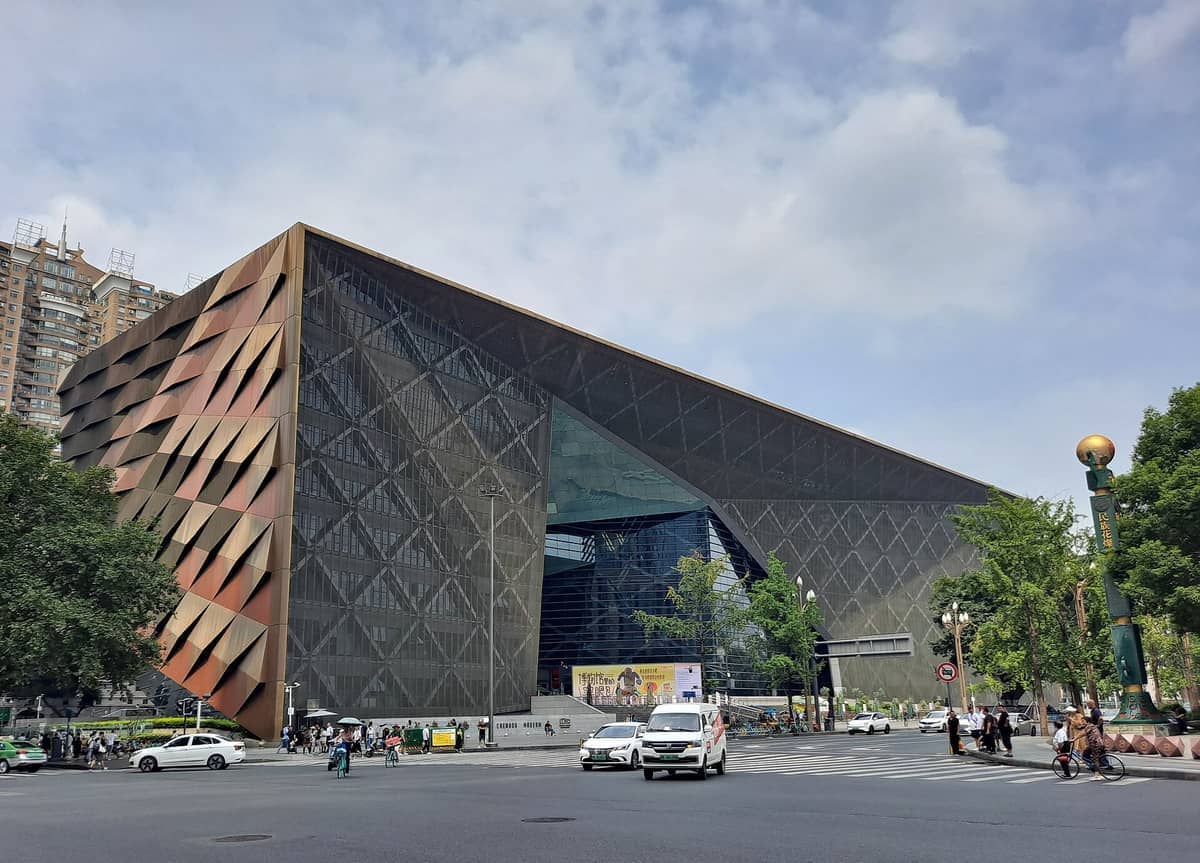
The museum building is worth noting before you even step inside. The exterior is a substantial contemporary structure designed to reference traditional Sichuan architectural forms, using stacked horizontal volumes and deep overhanging eaves rendered in pale stone and metal. From Tianfu Square, the west facade reads as deliberately monumental, which can feel slightly austere, but the interior court spaces open things up considerably once you're through the entrance.
The atrium is high-ceilinged and uses natural light well, which is a practical detail that matters after you've been walking between dense display cases for two hours. The building sits on roughly 17 mu of land at the western edge of Tianfu Square, making it physically proximate to the center of civic Chengdu in a way that reinforces its institutional authority.
Tickets & tours
Hand-picked options from our booking partner. Prices are indicative; availability and final rates are confirmed when you complete your booking.
Panda Base and city highlights private day tour in Chengdu
From 302 €Instant confirmationFree cancellationChengdu to Yibin private tour with Wuliangye Liquor Museum visit
From 300 €Instant confirmationChengdu private evening tour with hot pot dinner
From 247 €Instant confirmationFree cancellationGiant Buddha and Huanglongxi Old Town private day tour from Chengdu
From 368 €Instant confirmationFree cancellation
What You'll Actually See Inside
The permanent collection is organized chronologically and thematically across multiple floors. The ancient history galleries are the core draw for most international visitors. Bronze vessels, jade objects, lacquerware, and stone sculptures from the Chengdu Plain's pre-Qin, Han, and Tang periods are displayed with care, and the labeling is available in English, which is not a given at provincial museums of this scale in China.
The intangible heritage section is less expected and more memorable than many visitors anticipate. Sichuan opera costumes, face-changing masks, puppets, and shadow-play figures are displayed in ways that give a sense of how these traditions actually function rather than just what they look like frozen in a case. If you are planning to attend a performance, this gallery makes it considerably richer.
The museum also has galleries on folk crafts, religious sculpture, and local social history, covering periods that tend to get compressed or skipped in general China travel narratives. Taken together, the permanent collection makes a credible argument that Sichuan's cultural history is distinct from the Beijing-centered or Yangtze River narratives that dominate most English-language museum storytelling. For more on how to approach Sichuan's cultural landmarks as a group, the best museums in Chengdu guide puts this collection in useful comparative context.
ℹ️ Good to know
The Weekend Children's Museum operates on Fridays and Saturdays with extended hours until 20:30 (last entry 20:00 per the English visitor guide, though the Chinese notice lists 19:30 — confirm at booking). Regular days run 09:00–17:00, last entry 16:30 (English guide) or 16:00 (Chinese notice). The museum is closed on Mondays except public holidays.
How the Experience Changes by Time of Day
Arriving when the doors open at 09:00 on a weekday gives you the quietest experience, particularly in the ancient artifact galleries on the lower floors. By mid-morning on weekends, school groups arrive in significant numbers and the noise level rises substantially in the open-plan sections. If your priority is careful reading of exhibition text and close examination of objects, a Tuesday or Wednesday morning is the most comfortable option.
The extended Friday and Saturday evening hours are a genuinely useful option that many visitors miss. After 17:00, the daytime crowds have thinned and the museum takes on a different atmosphere: quieter, more contemplative, with the artificial lighting in the artifact galleries creating a focused quality that the bright midday visit doesn't have. Evening visits work particularly well for the decorative arts and opera heritage sections, where the display lighting is already designed for dramatic effect.
Rainy days in Chengdu push significant crowds into the museum, particularly during the June-to-September wet season. If you arrive during rainfall without a reservation and find the entrance queue backed up, consider coming back on a dry afternoon later in the week when outdoor attractions draw people away.
Getting There and Practical Logistics
The museum is directly accessible from Tianfu Square Station on Metro Lines 1 and 2. Use Exit West 1 and follow the signs to the building. This is one of the most straightforward transit connections of any major Chengdu attraction, which removes any excuse for skipping it on a tight itinerary.This is one of the most straightforward transit connections of any major Chengdu attraction, which removes any excuse for skipping it on a tight itinerary.
Bus routes 13, 30, 43, 47, 64, and 78 stop at Xiyu Street and serve the immediate area. Ride-hailing via Didi works well if you are coming from a hotel not on the metro network. The address for navigation purposes is No. 1 Xiaohe Street, Qingyang District. If you are staying near Kuanzhai Alley or in the Qingyang area more broadly, the museum is walkable in around 15 minutes depending on your starting point.
💡 Local tip
The museum's contact number is +86-28-6291-5593. Accessibility arrangements including elevators, wheelchair access, and accessible restrooms are not fully detailed on the official English site. Call ahead or check at the entrance if you have specific requirements.
There is no admission charge, but the museum does not have unlimited daily capacity. On public holidays and Golden Week periods, reservation slots can fill in advance. The free-admission policy applies to the main permanent collection. Temporary exhibitions may operate under separate terms — check the official site when planning.
Photography and What to Bring
Photography for personal use is generally permitted in the permanent galleries, though flash is prohibited around sensitive objects and some temporary exhibitions post no-photography notices at the entrance. The bronze and lacquerware galleries have dramatic directional lighting that photographs well on a standard camera phone without flash. The atrium and architectural interior are also worth documenting, particularly the view from the upper balconies looking down toward the ground floor.
Bring a portable charger if you plan a long visit. Bag storage is available for oversized items. The museum has a cafe and a shop selling reproductions, books, and design objects based on the collection — the shop quality is notably above average for a civic museum and worth a few minutes even if you're not a habitual souvenir buyer.
If you're building a full cultural day around the museum, the surrounding Tianfu Square area and Qingyang District have considerable depth. Qingyang Palace, one of Chengdu's most significant Taoist temple complexes, is roughly 20 minutes on foot to the west, and Du Fu Thatched Cottage is a short taxi ride away, offering a quieter, garden-centered complement to the museum's indoor focus.
Who Should Reconsider
Travelers who are primarily in Chengdu for outdoor experiences, pandas, or food will not find this museum a natural fit unless they have a genuine interest in material culture and history. The collection is substantial and the building is well-maintained, but it asks for sustained attention. Visitors who find museums generally tedious will not be converted here, and given that admission is free, there is no financial loss in deciding to skip it.
Children under around 10 may find the permanent collection galleries slow-going outside the dedicated children's section. Families visiting primarily for the younger-audience programming should aim for the Friday or Saturday evening slot when the Weekend Children's Museum is running. For broader family activity ideas in Chengdu, the Chengdu with kids guide covers options across the city in more detail.
Insider Tips
- Tuesday and Wednesday mornings are the least crowded days. Arrive at 09:00 and you can move through the ancient artifact galleries at your own pace without competing for space in front of display cases.
- The Friday and Saturday evening extension to 20:30 is underused by visitors who don't check the hours carefully. Evening light in the bronze and lacquerware galleries is noticeably better than midday conditions.
- The museum shop carries a small but well-curated selection of books on Sichuan history and archaeology in both Chinese and English. If you're heading out to Sanxingdui or the Sichuan Provincial Museum afterward, picking up a reference volume here is useful.
- The atrium cafe on the upper floors is quieter than the ground-floor areas and has a good view of the building's interior structure. It's a practical rest stop mid-visit rather than a destination in itself.
- If you're visiting during Golden Week (National Day in early October or Chinese New Year in January or February), book your reservation slot as early as possible. Weekday slots during these periods can fill faster than weekend slots due to group tour logistics.
Who Is Chengdu Museum For?
- Travelers who want to understand Sichuan's cultural and historical context before visiting individual heritage sites
- History and archaeology enthusiasts interested in Bronze Age, Han Dynasty, and Tang Dynasty material culture
- Visitors on a rainy day looking for a full-morning or full-afternoon indoor experience
- Families with older children (roughly 10 and up) who engage with artifact-based displays
- Anyone curious about Sichuan opera and intangible cultural heritage beyond a performance ticket
Nearby Attractions
Other things to see while in Qingyang District:
- Du Fu Thatched Cottage
The Chengdu Du Fu Thatched Cottage Museum preserves the site where Tang dynasty poet Du Fu lived and wrote during a period of exile in the 8th century. Set within a composed garden landscape in Qingyang District, it offers a reflective contrast to Chengdu's busier attractions — best suited to travelers who appreciate literary history, classical Chinese garden design, or simply a slower morning away from the crowds.
- Huanhua Creek Park
Huanhua Creek Park is a free, 32-hectare urban park in Qingyang District, woven around the historic creek that inspired Tang dynasty poet Du Fu. It offers shaded walkways, open lawns, lotus ponds, and a rare sense of calm within reach of central Chengdu.
- Wide and Narrow Alleys (Kuanzhai Alley)
The Wide and Narrow Alleys, known in Chinese as 宽窄巷子 (Kuanzhai Xiangzi), form one of Chengdu's most recognizable historic districts: three parallel Qing-dynasty lanes in Qingyang District packed with teahouses, Sichuan snack stalls, courtyard restaurants, and craft shops. Entry is free and the alleys are open around the clock, but the experience varies dramatically depending on when you arrive.
- People's Park
People's Park (成都市人民公园) is a free public park in central Qingyang District where Chengdu residents come to drink tea, dance, play mahjong, and arrange marriages. It offers an unfiltered look at daily life in one of China's most relaxed cities, and no tour guide is required.