Sanxingdui Museum: The Ancient Civilization That Rewrote Chinese History
Sanxingdui Museum, located in Guanghan about 40 km north of Chengdu, houses one of the most extraordinary archaeological collections in the world. Massive bronze masks with protruding eyes, a 3,000-year-old gold staff, and towering ritual trees pull you into a Bronze Age civilization that developed entirely outside the Yellow River narrative. This is not background-reading history — it is confrontational and genuinely strange.
Quick Facts
- Location
- No. 133 Xi'an Road, Sanxingdui Ruin Site, Guanghan, Deyang, Sichuan — approx. 40 km north of central Chengdu
- Getting There
- High-speed rail from Chengdu to Guanghan North station, then taxi or local shuttle to the museum site
- Time Needed
- 2.5 to 4 hours for both galleries; allow extra time if you read exhibit panels thoroughly
- Cost
- Currently ¥72 adult / ¥36 student; children under 1.3 m often enter free. Confirm on the official WeChat booking page before visiting.
- Best for
- History enthusiasts, archaeology buffs, travelers seeking context beyond the Silk Road narrative, and anyone who enjoyed the Chengdu Museum's ancient Shu wing
- Official website
- www.sxd.cn/en
Why Sanxingdui Stops Visitors Cold
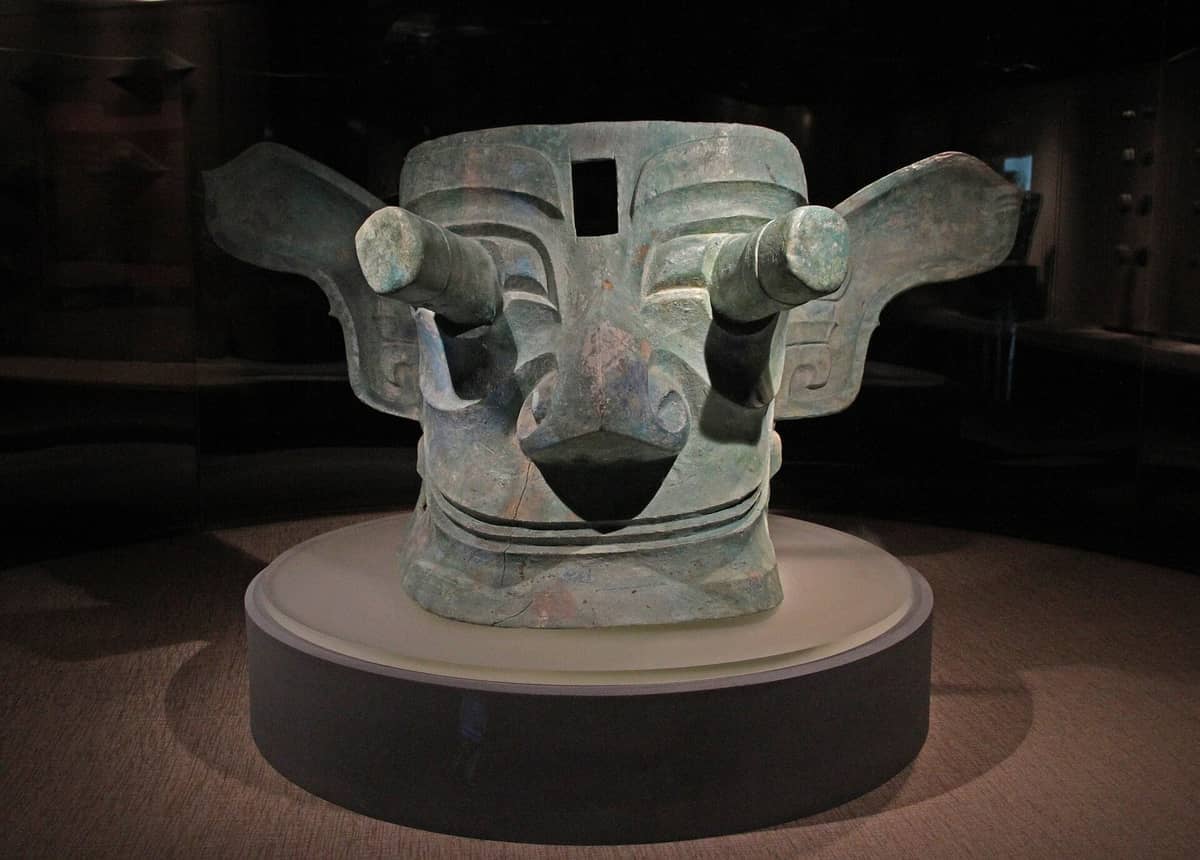
The Sanxingdui Museum is one of those rare places where the objects on display genuinely do not look like they belong to any civilization you already know. The signature pieces — bronze masks with eyes that bulge forward on stalks, a human figure standing almost 2.6 meters tall on a ceremonial base, a bronze tree nearly four meters high — share almost nothing stylistically with the jade and pottery of the Central Plains cultures that dominate most accounts of early China. Scholars still debate what religious purposes these objects served and why the Shu people buried them in ritual pits rather than tombs. Walking through the galleries, you feel that uncertainty as something productive rather than frustrating.
The site sits in Guanghan, a mid-sized Sichuan city about 40 km north of Chengdu. It is a day trip from the capital, comfortable to reach and easy to pair with a morning or afternoon in the city. The museum itself has expanded significantly in recent years, with a new building opened in 2023 to house finds from the six newly excavated sacrificial pits discovered after 2019. That second phase of excavation attracted global attention and produced thousands of additional artifacts, many still under study. What you see in the galleries today represents only a portion of what has been found.
💡 Local tip
Book tickets online in advance, particularly for weekends and national holidays. Walk-up tickets are sometimes available, but the museum can reach capacity. Ticket sales close at 17:00 regardless of how full the site is.
The Two Galleries: What Each One Contains
The museum is currently organized across two primary exhibition buildings. The Comprehensive Gallery (sometimes called the综合馆) opens at 08:30 and closes at 18:00. The Bronze Gallery closes thirty minutes later, at 18:30. Check the ticket conditions when booking if you want to visit both buildings. Each building has a different atmosphere and a different phase of the collection.
The Bronze Gallery is where most visitors spend the majority of their time. The large ceremonial objects — the protruding-eye masks, the standing bronze figure, the sacred tree — are displayed with high ceilings and careful lighting that emphasizes their scale. The room is dim enough that the bronze surfaces, ranging from dark olive-green to mottled grey, seem to absorb the space around them. If you arrive early in the morning, the gallery is quiet enough that you can stand in front of the largest pieces without a crowd pressing behind you. By late morning on weekends, it fills considerably.
The Comprehensive Gallery provides the stratigraphic and contextual framing: how the site was discovered, how the sacrificial pits were excavated, what the radiocarbon dates suggest about the timeline, and how Sanxingdui fits alongside other Bronze Age cultures in the Sichuan Basin. There are gold artifacts here as well, including the gold scepter and gold face covers that were placed over bronze masks. If you are visiting with children or with someone less interested in the bronze objects specifically, this building tends to hold attention through its interactive displays and reconstructed excavation scenes.
Tickets & tours
Hand-picked options from our booking partner. Prices are indicative; availability and final rates are confirmed when you complete your booking.
Sanxingdui immersive private tour
From 304 €Instant confirmationFree cancellationPanda Base and city highlights private day tour in Chengdu
From 302 €Instant confirmationFree cancellationFull day private tour Giant Panda Base and city highlights
From 365 €Instant confirmationFree cancellationChengdu to Yibin private tour with Wuliangye Liquor Museum visit
From 300 €Instant confirmation
Historical Context: Who Built Sanxingdui, and When
The Sanxingdui culture is associated with the ancient Shu people, who inhabited the Chengdu Plain during the Bronze Age. The ruin site covers a substantial area, and the walled settlement it contains dates back roughly 4,000 years, with the peak of the culture associated with the Shang dynasty period (roughly 1600 to 1046 BCE) in central China. The critical point is that the Shu civilization was developing its own sophisticated metallurgy, ritual systems, and urban organization simultaneously with — but largely independently of — the Shang culture along the Yellow River.
The first major sacrificial pits were found in 1986 during construction work, and the objects they contained were so unusual that initial announcements attracted international skepticism. The scale of bronze-casting, the non-Chinese visual vocabulary of the masks and figures, and the complete absence of writing on any of the objects made Sanxingdui genuinely difficult to categorize. Excavations beginning in 2019 added six more pits and thousands of additional pieces, including silk remnants and ivory fragments. The museum reflects this ongoing story: some exhibits clearly note which findings remain under analysis.
For visitors who want to understand how Sanxingdui fits into a broader Chengdu itinerary, the Chengdu Museum in central Chengdu has a dedicated ancient Shu section that provides good preparation. Seeing that material first, then making the trip to Guanghan, helps anchor what the artifacts represent within Sichuan's longer historical arc.
How the Experience Changes by Time of Day
Opening time, around 08:30, is the most rewarding entry point. Tour groups from Chengdu typically arrive by mid-morning, and the difference in atmosphere between 09:00 and 11:00 is significant. In the early hour, the Bronze Gallery is cool and nearly silent. The air carries a faint mineral smell from the climate-controlled cases, and the footfall echoes just enough to register. The protruding-eye masks look more unsettling when you are the only person standing in front of them.
Midday from roughly 10:30 to 13:30 is the peak crowd window on weekends and during national holiday periods. The main hall becomes dense with tour groups, and the interpretive panels near the bronze tree are difficult to read without jostling for position. If you arrive during this window, consider starting in the Comprehensive Gallery rather than the Bronze Gallery. The crowds cycle through the most photographed pieces quickly and thin out over the course of an hour.
Afternoons after 14:30 see a second, gentler crowd as independent travelers arrive. The light through the gallery windows shifts slightly and the space feels less pressured. The closing times of 18:00 and 18:30 respectively mean a late afternoon visit is entirely viable, though you should not plan to arrive after 16:30 if you want enough time to do both buildings properly.
ℹ️ Good to know
The museum is generally open every day except the morning of Chinese New Year's Eve. Extended holiday hours sometimes apply during Golden Week and Spring Festival; check the official website at sxd.cn before planning your visit around a public holiday.
Getting There from Chengdu
The most reliable public-transport route is high-speed rail from Chengdu to Guanghan North railway station, which takes under 30 minutes. From Guanghan North, the museum is accessible by taxi or local bus; published visitor guidance puts the onward trip at approximately 10–15 minutes. The rail option is faster and more predictable than road transport, which can slow considerably during holiday periods when traffic out of Chengdu builds on the expressway.
Renting a car or booking a private driver is the most flexible option, especially if you want to combine the museum with other sites in the Guanghan area. Organized day tours departing from Chengdu also serve Sanxingdui, often combined with a stop at Dujiangyan or Qingcheng Mountain, though the pairings can feel rushed if you take the museum seriously.
If you are planning a broader day trip circuit from Chengdu, the day trips from Chengdu guide covers transport logistics, timing options, and how to sequence multiple sites. Sanxingdui works well as a standalone full morning, leaving the afternoon free for Guanghan town or a return to Chengdu.
Practical Details and On-Site Logistics
The museum grounds are spread out, with the two gallery buildings separated by a walkway and open outdoor space. Wear comfortable shoes; the distance between buildings is not extreme but the interior floors are hard and you will be on your feet for several hours. In summer, the walk between buildings in full sun can be uncomfortably hot, so plan the transition accordingly. In winter, the galleries themselves are heated, but the outdoor sections can be cold and occasionally foggy — Sichuan Basin winter fog is not unusual in this part of the province.
Photography is generally permitted in the main galleries without flash. The glass cases on many artifacts make flash photography counterproductive regardless, and the curatorial lighting is calibrated for natural-looking images if you use a higher ISO setting. The most photographed piece in the museum is the large bronze mask with protruding eyes; expect other visitors to be waiting for the same clear shot. The bronze standing figure and the sacred tree, positioned slightly further into the gallery, often have shorter queues and photograph as dramatically.
An audio guide and dedicated English-language panels are available, though the depth of English text varies by section. The newer displays related to the post-2019 excavations tend to have more comprehensive bilingual labeling. The museum has a cafe and a gift shop with reproduction artifacts and books; the reproductions are reasonably priced and considerably more interesting than most souvenir options in the region.
⚠️ What to skip
Visitors with disabilities are reported to receive free admission, but the official materials do not detail specific wheelchair routes, accessible toilet locations, or adapted transport from the station. Contact the museum directly via sxd.cn before visiting to confirm arrangements.
Honest Assessment: Who Will Love It and Who Might Not
Sanxingdui is one of the most genuinely important archaeological museums in Asia, and the core objects are extraordinary by any standard. That said, if you have no prior interest in Bronze Age archaeology and prefer museums with immersive storytelling or interactive technology, the experience may feel slow. Much of the interpretive content is text-heavy, some of the display design is dated in the older wing, and the sheer strangeness of the objects — which is the point — requires a willingness to sit with ambiguity.
Children who respond to big, unusual objects often find the museum genuinely compelling, particularly the large bronze pieces. Very young children will find it less engaging, and the distance involved in the day trip adds logistical weight for families with toddlers. Travelers who already visited the ancient Shu section of the Chengdu Museum and wanted more will find Sanxingdui deeply satisfying.
If your interest in Chengdu's ancient history extends to temple complexes and living heritage sites, the Wenshu Monastery and Qingyang Palace offer a different kind of historical depth within the city itself — useful complements to a day at Sanxingdui.
For first-time visitors to Chengdu building an itinerary from scratch, the Chengdu first-timer guide helps prioritize Sanxingdui within a broader city schedule — it works best as a dedicated half-day rather than squeezed between two other attractions.
Insider Tips
- Arrive at or just after 08:30 on a weekday. Tour groups from Chengdu typically do not arrive until 10:00 or later, giving you at least 90 minutes of relative quiet in the Bronze Gallery.
- Start in the Bronze Gallery if you arrive early. The Comprehensive Gallery is better tolerated with crowds because its layout disperses visitors across multiple rooms. The Bronze Gallery's main hall gets dense fast.
- The gift shop sells high-quality reproduction masks and figurines at prices far below what you would pay for similar items in Chengdu's tourist zones. The small resin versions of the protruding-eye mask are legitimately good souvenirs.
- If you read Chinese, the Chinese-language panels consistently contain more detail than the English translations. For non-Chinese readers, downloading a background article about Sanxingdui before your visit substantially enriches the experience.
- The outdoor space between the two gallery buildings has a reasonable view of the excavation-area landscape. It is worth pausing here to orient yourself to the scale of the ruin site, which is much larger than the museum footprint suggests.
Who Is Sanxingdui Museum For?
- Archaeology and ancient history enthusiasts who want to see Bronze Age China outside the standard Zhou and Han narratives
- Repeat visitors to Chengdu looking for a day trip that goes beyond panda bases and food streets
- Travelers who enjoyed the Chengdu Museum's ancient Shu exhibits and want to go further
- Photographers interested in dramatic, unusual subjects with strong sculptural form
- Families with older children who can engage with the visual strangeness of the collection
Nearby Attractions
Combine your visit with:
- Chengdu Botanical Garden
Established in 1983, the Chengdu Botanical Garden spans 42 hectares. At ¥10 entry, it offers a rare combination of scientific plant collections, seasonal blooms, and genuine quiet within a city of 21 million people.
- Huanglongxi Ancient Town
Huanglongxi Ancient Town, located in Shuangliu District of Chengdu, is a historic river town in Sichuan. With free entry to the main street area, Ming and Qing dynasty architecture, three riverside temples, and traditional snack vendors lining cobbled lanes, it offers a more relaxed alternative to the city's more commercialized historic quarters.
- Luodai Ancient Town
Luodai Ancient Town (洛带古镇) sits about 30 km east of central Chengdu in Longquanyi District and preserves one of China's most intact Hakka communities outside Guangdong. Entry is free, the main stone-paved street is walkable in a morning, and the food alone justifies the bus ride.
- Sichuan Opera (Bianlian Face-Changing)
Sichuan Opera is one of Chengdu's most distinctive cultural experiences, best known for its jaw-dropping Bianlian face-changing sequences where performers swap ornate masks in fractions of a second. Evening shows run at multiple venues across the city, blending acrobatics, fire-breathing, and traditional music into a 90-minute performance unlike anything else in China.