Sichuan Opera (Bianlian Face-Changing): What to Expect at a Live Show in Chengdu
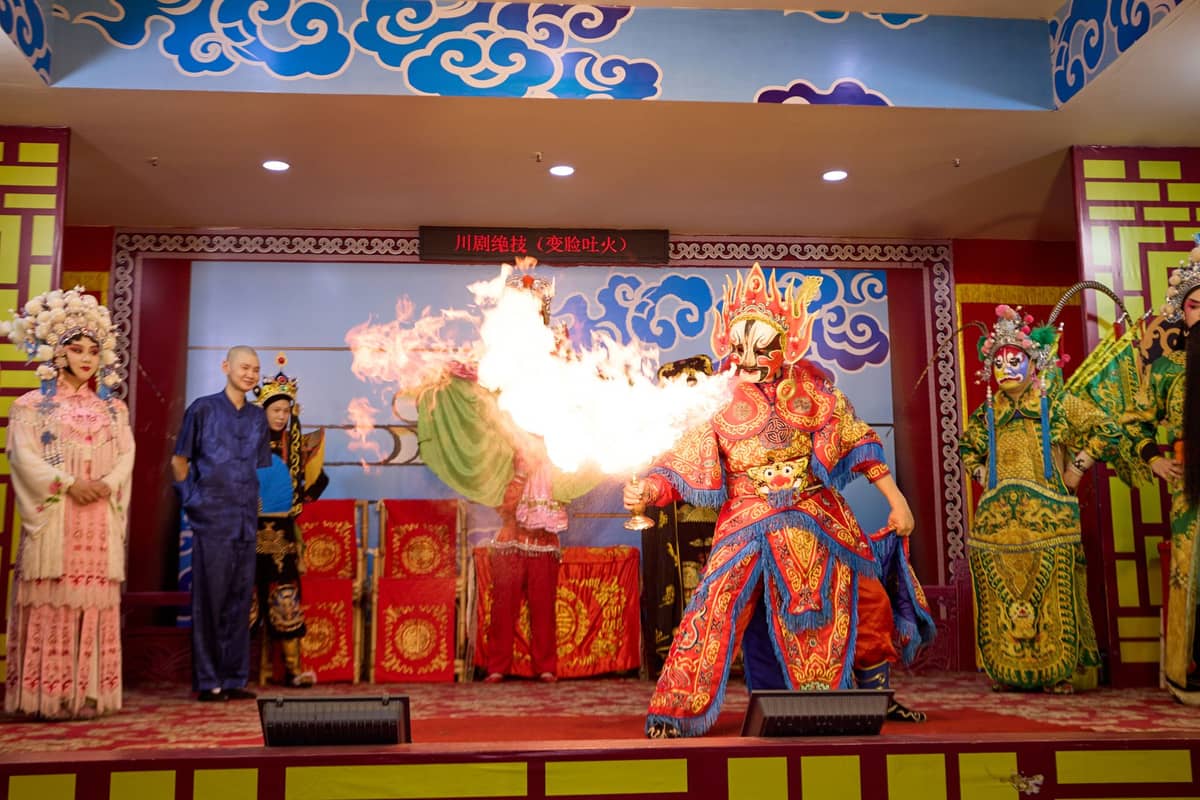
Sichuan Opera is one of Chengdu's most distinctive cultural experiences, best known for its jaw-dropping Bianlian face-changing sequences where performers swap ornate masks in fractions of a second. Evening shows run at multiple venues across the city, blending acrobatics, fire-breathing, and traditional music into a 90-minute performance unlike anything else in China.
Quick Facts
- Location
- Multiple venues: Shufeng Yayun (132 Qintai Road, Qingyang District) and Furong Guocui (108 Zhihui Street, Jinjiang District)
- Getting There
- Tonghuimen Station (Metro Line 2) for Shufeng Yayun; Jinjiang Hotel Station (Metro Line 1) for Furong Guocui
- Time Needed
- Approximately 90 minutes per performance
- Cost
- CNY 148–308 per person depending on venue, seat tier, and date (verify before booking)
- Best for
- First-time visitors to Chengdu, culture lovers, families with older children, couples looking for a memorable evening
- Official website
- chengdusichuanopera.com
What Sichuan Opera Actually Is
Sichuan Opera, or Chuanju in Mandarin, is one of China's oldest regional performance traditions, developed over several centuries in the Sichuan Basin. It draws on storytelling, acrobatics, puppetry, clowning, and music rooted in local folk traditions rather than the more austere conventions of Beijing Opera. Where Beijing Opera is stately and formal, Sichuan Opera tends toward humor, spectacle, and audience interaction — performers sometimes banter with the front rows directly.
The form most visitors come for is Bianlian, the face-changing technique in which performers in elaborate costumes and painted masks switch their mask designs in what appears to be less than a second. The speed is not an illusion of lighting or camera tricks: the technique involves hidden mechanisms and precisely practiced movements. The exact method is a closely guarded trade secret passed down through the opera lineage, which makes watching it live all the more disorienting. You will see it happen multiple times in a single performance and still be unable to catch the mechanism.
ℹ️ Good to know
Bianlian is only one segment of a full Sichuan Opera evening. Most shows also include fire-breathing, shadow puppetry, hand-shadow sequences, acrobatic face-spinning, and comedy skits. If you specifically want the face-changing segment, arriving on time for the full program matters — it often comes mid-show or toward the finale.
The Two Main Venues: What Differs Between Them
Chengdu has several venues staging Sichuan Opera for visitors, but two are consistently cited for quality and accessibility. Shufeng Yayun, located on Qintai Road in Qingyang District, is widely considered the more traditional option. The theater itself is set within a classical Sichuan-style garden complex, and arriving early means you walk through covered wooden walkways and a teahouse environment before the show begins. The smell of jasmine tea, the sound of backstage rehearsal bleeding faintly through old walls, and the sight of elderly locals settling in for the performance create a different atmosphere than a modern performing arts venue.
Furong Guocui, based near Zhihui Street in Jinjiang District, is newer and tends to attract a higher proportion of international tour groups. The production values are polished and the seating is more clearly tiered and labeled, which makes the booking process simpler if you are arranging tickets independently. The trade-off is that the cultural texture before and after the show is thinner: less of the teahouse atmosphere, more of a structured entertainment venue.
Both venues are reachable on the Chengdu Metro. Shufeng Yayun is closest to Tonghuimen Station on Line 2; Furong Guocui is near Jinjiang Hotel Station on Line 1. For a broader sense of how to navigate the city's transport options, the getting around Chengdu guide covers metro lines, ride-hailing, and practical tips for evening travel.
Tickets & tours
Hand-picked options from our booking partner. Prices are indicative; availability and final rates are confirmed when you complete your booking.
Panda Base and city highlights private day tour in Chengdu
From 302 €Instant confirmationFree cancellationFull day private tour Giant Panda Base and city highlights
From 365 €Instant confirmationFree cancellationChengdu to Yibin private tour with Wuliangye Liquor Museum visit
From 300 €Instant confirmationChengdu private evening tour with hot pot dinner
From 247 €Instant confirmationFree cancellation
What the Evening Actually Looks Like
Performances at Shufeng Yayun typically begin at 20:00; an additional 18:00 show may be offered on holidays, and they run approximately 90 minutes. Arriving 30 to 45 minutes early is worth doing, not just for seating, but because many venues operate a pre-show teahouse experience in the foyer or courtyard. Tea is served at your seat or at low tables outside, and the ambient noise shifts as the theater fills: chatter in Sichuanese, the distant plucking of traditional string instruments warming up, and the occasional sharp crack of a performer testing equipment backstage.
The show typically opens with ensemble pieces showcasing traditional instruments, including the erhu, pipa, and Sichuan gong. The pace then alternates between slower story-based segments and high-energy spectacle numbers. Fire-breathing tends to draw audible reactions from even quiet audiences: performers blow jets of flame from close range, the heat is real and visible to the first several rows, and the smell of whatever accelerant is used lingers briefly in the air. The Bianlian segments, usually arriving two to three times across the show, generate the loudest responses.
The final act frequently involves direct audience participation in some form, whether a performer coming into the seating area for a close-up demonstration or a volunteer being invited to attempt a simplified version of a skill. The atmosphere by this point is generally relaxed and warm. Audiences skew toward a mix of Chinese domestic tourists, families, and international visitors; the show format does not require any Mandarin comprehension to follow.
💡 Local tip
Sit in the middle tiers rather than the very front for face-changing sequences. Performers sometimes walk into the aisle or approach the front rows closely, which can make watching the mask mechanism slightly easier to study, but the best overall view of the full costume and movement is from slightly farther back.
Tickets, Prices, and Seat Tiers
Pricing is tiered by seat location and venue. Published listings for 2026 show a range of approximately CNY 148 to CNY 308 per person, with higher-tier SVIP seats sometimes including tea service, a closer position to the stage, or a post-show photo opportunity with performers in full costume. Budget and mid-range seats still provide a full view of the show; the main practical difference is sightline quality and any included extras.
Tickets can be booked through international platforms including Klook, GetYourGuide, and Viator, or directly at the venue box office. Booking in advance is advisable during public holidays, Golden Week periods (early October and early May), and the summer high season. Walk-up availability exists on quieter weeknights but cannot be guaranteed. All prices should be verified before purchasing, as schedules and tier pricing adjust seasonally.
If you are planning a broader Chengdu itinerary and want to see where an opera evening fits best, the 3-day Chengdu itinerary positions the opera as a natural finale to a day that might include the Wuhou Shrine or a walk through Jinli Ancient Street nearby.
Cultural Context: Why This Performance Form Survived
Sichuan Opera has a complicated modern history. Like many regional performance traditions in China, it faced serious disruption during the Cultural Revolution and subsequent decades, when many forms of classical art were suppressed, reformatted, or lost entirely. Its revival since the 1980s has been partly driven by state cultural preservation efforts and partly by genuine popular demand, particularly from domestic tourists who view Sichuan Opera as a regional identity marker alongside hotpot and tea culture.
The face-changing technique specifically is classified as an intangible cultural heritage by Chinese authorities. The secrecy surrounding the method is not theatrical marketing; it is a structural feature of the transmission system, where knowledge passes from master to student under strict lineage rules. This means the number of people who can perform Bianlian at a high level is genuinely limited, and what you see at a live show represents years of specialized training.
For travelers interested in Chengdu's broader performing arts and temple scene, the complete Sichuan Opera guide covers the full history, performance styles, and venue comparisons in more depth.
Practical Notes: What to Know Before You Go
Shows are held in the evening; there is no meaningful weather consideration for the performance itself since both major venues are fully indoors. The courtyard areas at Shufeng Yayun can feel cool in winter evenings, so bringing a light layer is sensible if you plan to arrive early and spend time outside before the doors open.
Photography policies vary by venue. Still photography is generally permitted during the show; flash photography is typically prohibited and is also counterproductive for capturing the costume detail. Video recording is often restricted or discouraged for commercial reasons, though the rules are not always strictly enforced. Check the venue policy when purchasing your ticket.
Wheelchair accessibility varies between venues and has not been consistent across listings. The Jinjiang Theater venue has been listed as not wheelchair accessible; other venues list stroller access but do not address step-free access clearly. Anyone with mobility requirements should contact the specific venue directly before booking to confirm current arrangements.
⚠️ What to skip
Some street-side touts near tourist areas offer Sichuan Opera tickets at heavily discounted prices. These may be genuine (unsold seats pushed through unofficial channels) or may be for lower-quality productions marketed to tourists. Booking through the venue directly or a recognized international platform avoids this uncertainty.
Who This Is Right For, and Who Might Leave Underwhelmed
The face-changing show works well for first-time visitors to Chengdu, travelers who want a single concentrated experience of local cultural performance, and families with children old enough to sit through a 90-minute show. The fire-breathing and acrobatic elements hold attention without requiring any prior knowledge of Chinese opera.
Travelers who have already seen Sichuan Opera at a high-quality venue, or those whose primary interest is in scholarly or traditional opera rather than spectacle, may find the tourist-oriented shows feel somewhat compressed. The format is designed for accessibility rather than immersion. If you are spending more than a few days in Chengdu and want to go deeper into the city's cultural calendar, the Chengdu nightlife guide and the teahouse guide offer alternatives that complement rather than replicate the opera experience.
Very young children may find the fire sequences startling. The shows are loud at certain points, with percussion-heavy passages and dramatic sound effects. The content is not frightening in a narrative sense, but parents of sensitive toddlers should factor this in.
Insider Tips
- Ask about pre-show tea service when booking. Several venues include complimentary tea for higher-tier seats; at Shufeng Yayun the teahouse environment is part of the experience and arriving early adds significant atmosphere that the show itself does not provide.
- The face-changing mechanism is most visible from a 45-degree angle rather than directly front-on. If you have flexibility in seat choice, a slightly off-center position in the mid-section gives a different viewing angle that some observers find more revealing.
- Bring CNY cash for in-venue extras such as programs, souvenir fans, or tea top-ups. Venue concession areas do not always accept international cards, and QR code payments via WeChat or Alipay may require a linked Chinese bank account.
- If you are visiting during Golden Week (October 1 to 7 or the May holiday week), book at least one to two weeks in advance. These periods see some of the heaviest domestic tourism in Chengdu and shows regularly sell out.
- A post-show walk through the surrounding neighborhood is worth planning in advance. The Qintai Road area near Shufeng Yayun has street food stalls and tea vendors active until late evening, and the atmosphere of Chengdu at night around a cultural venue is quite different from the daytime tourist circuit.
Who Is Sichuan Opera (Bianlian Face-Changing) For?
- First-time visitors to Chengdu who want a concentrated cultural highlight in a single evening
- Families with children aged roughly 6 and older who can manage a 90-minute seated show
- Couples looking for a distinctive evening alternative to dining and nightlife
- Travelers curious about intangible cultural heritage and living performance traditions
- Anyone on a short itinerary who wants one experience that is specific to Sichuan and unavailable elsewhere in China
Nearby Attractions
Combine your visit with:
- Chengdu Botanical Garden
Established in 1983, the Chengdu Botanical Garden spans 42 hectares. At ¥10 entry, it offers a rare combination of scientific plant collections, seasonal blooms, and genuine quiet within a city of 21 million people.
- Huanglongxi Ancient Town
Huanglongxi Ancient Town, located in Shuangliu District of Chengdu, is a historic river town in Sichuan. With free entry to the main street area, Ming and Qing dynasty architecture, three riverside temples, and traditional snack vendors lining cobbled lanes, it offers a more relaxed alternative to the city's more commercialized historic quarters.
- Luodai Ancient Town
Luodai Ancient Town (洛带古镇) sits about 30 km east of central Chengdu in Longquanyi District and preserves one of China's most intact Hakka communities outside Guangdong. Entry is free, the main stone-paved street is walkable in a morning, and the food alone justifies the bus ride.
- Sanxingdui Museum
Sanxingdui Museum, located in Guanghan about 40 km north of Chengdu, houses one of the most extraordinary archaeological collections in the world. Massive bronze masks with protruding eyes, a 3,000-year-old gold staff, and towering ritual trees pull you into a Bronze Age civilization that developed entirely outside the Yellow River narrative. This is not background-reading history — it is confrontational and genuinely strange.