Luodai Ancient Town: Chengdu's Living Hakka Quarter
Luodai Ancient Town (洛带古镇) sits about 30 km east of central Chengdu in Longquanyi District and preserves one of China's most intact Hakka communities outside Guangdong. Entry is free, the main stone-paved street is walkable in a morning, and the food alone justifies the bus ride.
Quick Facts
- Location
- No. 999 San'e Street, Luodai Town, Longquanyi District, Chengdu
- Getting There
- Metro Line 4 to Xihe Station, then Bus 219 to Luodai Passenger Transport Center; or bus from Wuguiqiao Bus Station
- Time Needed
- 2–3 hours for a relaxed visit; half a day if you eat well and explore the clan halls
- Cost
- Free entry to the town; individual halls and museums may charge separately
- Best for
- History, architecture, Hakka culture, street food, photography
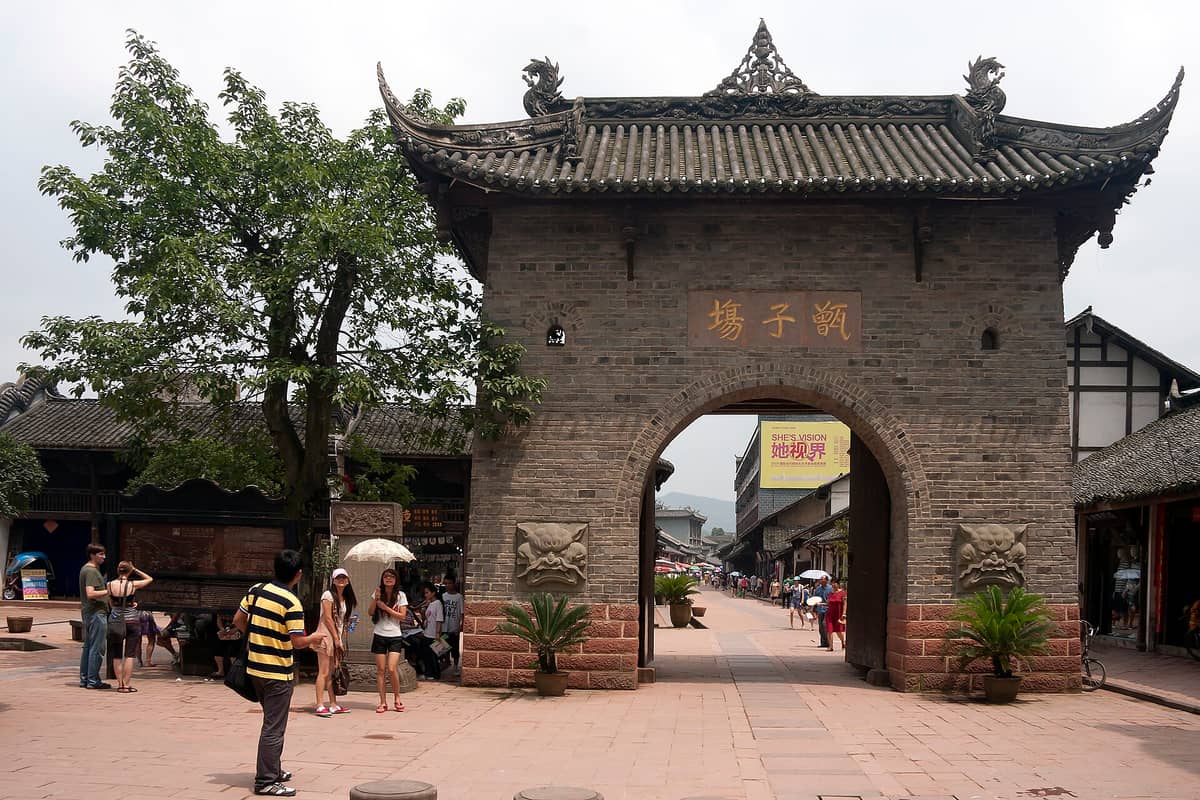
What Luodai Actually Is
Luodai Ancient Town — officially 洛带古镇 (Luòdài Gǔzhèn) — is a well-preserved market town with roots that local records trace to the Three Kingdoms period (220–280 CE), when the street was reportedly called Wanfu Street. Its current identity, however, is inseparable from a much later migration: the mass resettlement of Hakka people from Guangdong, Fujian, and Jiangxi provinces into Sichuan during the Qing dynasty, particularly in the late 17th and early 18th centuries. The result is a town that looks and sounds different from anywhere else in the Chengdu basin.
The Hakka brought their own dialects, clan structures, food traditions, and architectural styles. Four major clan guildhalls — the Guangdong, Jiangxi, Huguang, and Chuan North halls — still stand in various states of restoration along the main street. These are not reconstructions built for tourism. They are working cultural buildings that host festivals, clan gatherings, and local ceremonies.
ℹ️ Good to know
Entry to the town itself is free. Some individual clan halls and small museums inside charge a modest fee. Verify current prices at the gate, as fees change.
The Main Street: What You Will See
The spine of Luodai is its long stone-paved main street, flanked by single- and double-story timber-framed shop-houses with overhanging eaves that shade the pavement below. The construction style mixes Sichuan vernacular with Hakka detail: notice the carved wooden brackets, the narrow frontages opening into surprisingly deep courtyards, and the occasional red-painted doorframe typical of Hakka religious aesthetics.
Street-level commerce ranges from tea shops and snack stalls to small antique sellers and souvenir vendors. The commercial layer is dense, especially on weekends. Peel away from the main drag down any of the perpendicular lanes and the tourist density drops immediately. Side alleys reveal crumbling courtyard houses still in residential use, old men playing cards on low stools, and the occasional smell of fermented doubanjiang paste drifting from a kitchen window.
The four clan guildhalls are the architectural anchors. The Guangdong Hall (广东会馆) is typically cited as the most elaborate, with a decorated opera stage and interior courtyard that rewards a slow look. Visit the halls even if you bypass the entry fee exhibitions inside — much of the exterior detailing is visible from the street or courtyard thresholds.
Tickets & tours
Hand-picked options from our booking partner. Prices are indicative; availability and final rates are confirmed when you complete your booking.
Giant Buddha and Huanglongxi Old Town private day tour from Chengdu
From 368 €Instant confirmationFree cancellationPanda Base and city highlights private day tour in Chengdu
From 302 €Instant confirmationFree cancellationFull day private tour Giant Panda Base and city highlights
From 365 €Instant confirmationFree cancellationChengdu to Yibin private tour with Wuliangye Liquor Museum visit
From 300 €Instant confirmation
How the Atmosphere Changes Through the Day
Arriving before 9:00 gives you the town largely to yourself. The stone street is damp with morning dew, a few tea houses are already open with elderly locals settled inside, and the smell of fried dough and sweet rice wine from breakfast stalls is genuinely good. The light at this hour is soft and even, which makes the timber facades and carved stonework easier to photograph without harsh shadow.
By 10:30, group tours begin arriving by bus, and the main street becomes congested by midday on weekends and public holidays. The food stalls are operating at full volume from about 11:00, which is when the visit becomes more about eating than exploring architecture. If you want both, do architecture first.
Afternoons during the week are noticeably quieter, and the late afternoon light hitting the west-facing eaves creates good photographic conditions around 16:00 in summer. The town has no fixed closing time, and a handful of teahouses and restaurants stay open into the evening, though the main commercial energy has wound down by 18:00.
💡 Local tip
Weekday mornings between 8:30 and 11:00 offer the most atmospheric experience with the fewest crowds. Avoid the town on major national holidays, when the main street becomes genuinely difficult to move through.
The Food: What to Eat and Where to Look
Hakka cuisine is distinct from standard Sichuan cooking. The flavors lean toward preserved ingredients, slow-braised meats, and fermented sauces rather than the tongue-numbing spice that defines most Chengdu food. Look for braised pork belly (扣肉, kòu ròu) prepared with dried vegetables, and stuffed tofu (酿豆腐, niàng dòufu). These are Hakka staples rarely found elsewhere in Chengdu.
That said, Luodai also does a brisk trade in standard Sichuan street snacks aimed at day-trippers: cold noodles, spicy rabbit head, and various skewered meats over charcoal. The street-food quality is generally good because competition is high and repeat-customer culture keeps standards up. Glutinous rice rolls (糍粑, cíbā) sold fresh and hot from roadside griddles are a reliable choice.
For context on Chengdu's wider food landscape, the Chengdu street food guide covers the city's snack culture in detail, which pairs usefully with a Luodai visit.
Getting There: The Practical Route
Luodai sits approximately 30 km east of Chengdu's city center in Longquanyi District. The standard public-transit approach is to take Chengdu Metro Line 4 to Xihe Station, then transfer to Bus 219 toward Luodai Passenger Transport Center. Luodai sits approximately 30 km east of Chengdu's city center in Longquanyi District. The standard public-transit approach is to take Chengdu Metro Line 4 to Xihe Station, then transfer to Bus 219 toward Luodai Passenger Transport Center. Journey time from central Chengdu varies with connection timing. The alternative is to travel to Wuguiqiao Bus Station and board a Luodai-bound bus from there.
A Didi ride from central Chengdu is straightforward and faster, typically 35–50 minutes depending on traffic, though you will hit more variability during morning and evening peak hours. This is the most convenient option for visitors with limited time or those traveling with children or heavy bags.
There is no direct metro station at the town itself. Verify current Bus 219 schedules at the Xihe Station bus stop, as service frequency can change. There is no direct metro station at the town itself. Verify current Bus 219 schedules at the Xihe Station bus stop, as service frequency can change. The bus ride from Xihe to Luodai varies with traffic and service conditions.
⚠️ What to skip
Accessibility note: The town's stone-paved main street is uneven in places. Wheelchair access has not been verified by available sources. Visitors with mobility concerns should check current conditions before traveling.
Cultural Context: Why the Hakka Heritage Matters
The Hakka people — the name means roughly 'guest families' in Cantonese — are a Han Chinese subgroup with a distinct cultural and linguistic identity formed over centuries of migration across southern China. Their arrival in Sichuan was part of a deliberate Qing dynasty repopulation policy following the devastation of the Sichuan region by decades of war and famine in the late Ming and early Qing periods. Population estimates for this migration vary, but it fundamentally reshaped the cultural makeup of the Chengdu basin.
The guildhalls at Luodai were not just social clubs. They functioned as mutual aid societies, dispute arbitration bodies, and ceremonial centers for communities far from their ancestral provinces. The opera stages built into several of the halls were used to stage performances that maintained cultural memory — the same function they serve during festival seasons today.
If Luodai's historical townscape interests you, it fits into a broader context of preserved ancient towns in the Chengdu region. The Chengdu ancient towns guide covers several comparable sites with different characters and distances from the city center.
Honest Assessment: Who This Suits and Who Might Be Disappointed
Luodai is genuinely worth the trip for visitors with an interest in Chinese vernacular architecture, minority Han cultural traditions, or food history. The clan halls are the real draw, and they are architecturally distinct from anything at the city-center heritage sites like Kuanzhai Alley or Jinli. The town feels less engineered for tourism than those two spots, though it is by no means undiscovered.
Visitors who have already seen the polished, high-budget presentation of Jinli Ancient Street or Kuanzhai Alley should know that Luodai is less curated but more authentic in its daily rhythms. The flip side: some sections of the main street are worn down and the signage for individual halls is inconsistent in English.
Visitors seeking high-impact visual spectacle or a packed itinerary of ticketed exhibitions will likely find Luodai low-key to the point of underwhelming. It rewards slow walking, spontaneous conversation, and a genuine interest in what you are looking at. If your trip to Chengdu is three days or fewer and you have not yet seen the panda base, the museum district, or the main temple sites, those are higher priorities.
For first-time visitors trying to prioritize, the Chengdu first-timer guide lays out a logical order for the main attractions, with Luodai positioned as a half-day extension rather than a core-itinerary stop.
Photography and Practical Notes
The best photography in Luodai is in the courtyard interiors of the clan halls, where the overhanging roof tiles frame the sky in interesting ways, and in the side lanes where the unrestored residential architecture has real texture. Avoid photographing local residents without consent, particularly in the smaller alleyways where people are going about ordinary daily life.
Wear comfortable shoes with some grip. The stone pavement is smooth and can be slippery after rain. Chengdu's rainy season runs roughly June through September, and the town's open street layout means you will get wet without a compact umbrella. The climate in the Chengdu basin means overcast skies are common even outside the rainy months, which actually produces even, diffused light that is good for architectural photography.
English-language menus and signage are sparse. A translation app on your phone is more useful here than in central Chengdu. Cash is still accepted widely at street food stalls, though most vendors also accept Alipay and WeChat Pay.
Insider Tips
- Head directly to the Guangdong Hall courtyard when you arrive, before the tour groups fill it. The opera stage at the back of the courtyard is often empty in the morning and gives you the architectural detail of the hall without the crowd.
- The side street running parallel to the main street on the eastern side has a cluster of tea houses frequented almost entirely by locals. The tea is cheap, the chairs are plastic, and the conversation from neighboring tables is a reasonable introduction to Sichuanese spoken at full speed.
- If you are visiting in October during the Golden Autumn Longquan Mountain tourism season, the surrounding Longquanyi District hosts fruit harvesting events and the crowds at Luodai spike accordingly. It is lively but congested — worth knowing in advance.
- The bus stop for the return journey is a short walk from the main entrance. Confirm the stop location with a local or shopkeeper rather than relying on mapping apps, which sometimes return ambiguous results for smaller stops in this area.
- A few small shops on the main street sell vacuum-packed Hakka preserved vegetables and braised meat products that travel well as food souvenirs. Quality varies but the better-looking shops with visible kitchen operations are generally reliable.
Who Is Luodai Ancient Town For?
- Architecture and heritage enthusiasts interested in Hakka culture and Qing-dynasty clan hall design
- Food-curious travelers wanting a break from standard Sichuan spice profiles
- Photographers looking for textured, unpolished townscape without the staged feel of central Chengdu's tourist streets
- Repeat visitors to Chengdu who have already covered the major central attractions
- Travelers combining the visit with other Longquanyi District sights as a themed half-day east of the city
Nearby Attractions
Combine your visit with:
- Chengdu Botanical Garden
Established in 1983, the Chengdu Botanical Garden spans 42 hectares. At ¥10 entry, it offers a rare combination of scientific plant collections, seasonal blooms, and genuine quiet within a city of 21 million people.
- Huanglongxi Ancient Town
Huanglongxi Ancient Town, located in Shuangliu District of Chengdu, is a historic river town in Sichuan. With free entry to the main street area, Ming and Qing dynasty architecture, three riverside temples, and traditional snack vendors lining cobbled lanes, it offers a more relaxed alternative to the city's more commercialized historic quarters.
- Sanxingdui Museum
Sanxingdui Museum, located in Guanghan about 40 km north of Chengdu, houses one of the most extraordinary archaeological collections in the world. Massive bronze masks with protruding eyes, a 3,000-year-old gold staff, and towering ritual trees pull you into a Bronze Age civilization that developed entirely outside the Yellow River narrative. This is not background-reading history — it is confrontational and genuinely strange.
- Sichuan Opera (Bianlian Face-Changing)
Sichuan Opera is one of Chengdu's most distinctive cultural experiences, best known for its jaw-dropping Bianlian face-changing sequences where performers swap ornate masks in fractions of a second. Evening shows run at multiple venues across the city, blending acrobatics, fire-breathing, and traditional music into a 90-minute performance unlike anything else in China.