Sichuan Provincial Museum: The Deepest Dive into Sichuan's Past
The Sichuan Provincial Museum (四川博物院) is Chengdu's flagship cultural institution, housing one of China's most significant collections of Bronze Age relics, Buddhist sculpture, and dynastic art. Free to enter and rarely as crowded as the city's outdoor attractions, it rewards visitors who want substance alongside spectacle.
Quick Facts
- Location
- No. 251 Huanhua South Road, Qingyang District, Chengdu
- Getting There
- Bus routes 35, 58, 82, 151, 165, or 170 — alight at Songxianqiao (送仙桥) or South Huanhua Road
- Time Needed
- 2–3 hours for highlights; half-day for thorough exploration
- Cost
- Free (advance reservation via the official WeChat account is required; bring a valid identity document)
- Best for
- History enthusiasts, art lovers, rainy-day itineraries, families with older children
- Official website
- www.scmuseum.cn
What the Sichuan Provincial Museum Actually Is
The Sichuan Provincial Museum — officially 四川博物院 — is the largest comprehensive museum in Sichuan Province and the primary repository for the region's archaeological and artistic heritage. It is not a niche specialist collection or a tourism afterthought. The permanent galleries span Bronze Age ritual bronzes from the Sanxingdui and Jinsha civilizations, Tang dynasty Buddhist stone sculpture, ancient Sichuan silk, calligraphy, and ceramics across thousands of years of continuous civilization.
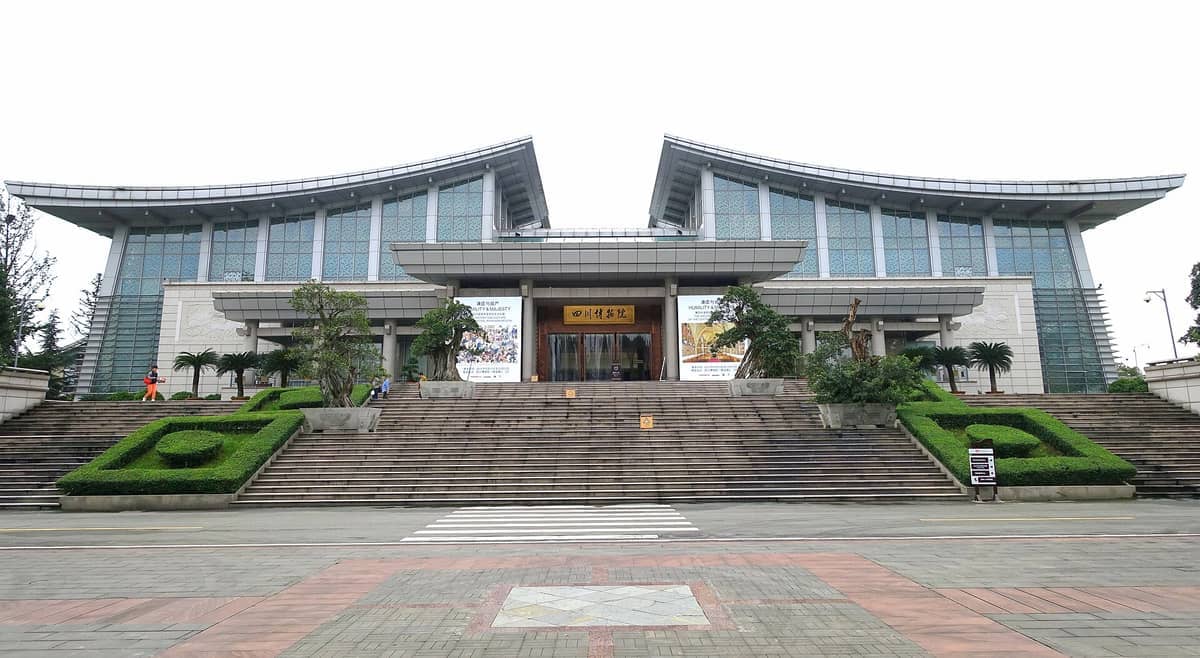
The building itself is a large contemporary structure set on Huanhua South Road, within easy walking distance of Du Fu's Thatched Cottage and Huanhua Creek Park. The surrounding area has a particular character: quieter than the commercial core of the city, shaded by mature trees, and oriented toward cultural institutions rather than shopping streets. It is one of the more contemplative corners of central Chengdu.
ℹ️ Good to know
Admission is free, but you will likely need to reserve in advance through the museum's official WeChat account and present a valid passport or government-issued ID at the entrance. Plan ahead, especially on weekends and public holidays.
The Collections: What You Come For
The Bronze Age material is the museum's most globally significant holding. Sichuan was home to the Sanxingdui culture (roughly 1700–1100 BCE), a civilization that operated in parallel with the Shang dynasty of the Yellow River basin but produced ritual bronzes of an entirely different visual language: elongated human figures with exaggerated eyes, ceremonial masks of a scale that feels almost theatrical, and tree sculptures combining bronze and jade. If you have already visited the Sanxingdui Museum northeast of Chengdu, the Sichuan Provincial Museum offers complementary pieces and interpretive context that fill gaps the Sanxingdui site museum leaves open.
The Tibetan Buddhist art collection is another reason to come. Sichuan has historically been a cultural and religious corridor between the Tibetan plateau and central China, and the museum's holdings reflect that exchange with exceptional tangkas, ritual objects, and statuary. Visitors interested in this overlap between regional cultures will find depth here that is difficult to locate elsewhere in Chengdu. For a wider look at how Sichuan's history fits together, the Chengdu Museum near Tianfu Square focuses specifically on urban Chengdu's own history, and the two institutions make a logical pair on a multi-day itinerary.
The ceramics and painting galleries are less dramatic but consistently strong. The Han dynasty tomb offerings — pottery figures of musicians, acrobats, and farmyard animals — communicate daily life across two millennia more vividly than any text panel can. These rooms tend to be quieter than the bronze halls, which makes them useful if you arrive during a school-group peak hour and want to retreat to something calmer.
Tickets & tours
Hand-picked options from our booking partner. Prices are indicative; availability and final rates are confirmed when you complete your booking.
Panda Base and city highlights private day tour in Chengdu
From 302 €Instant confirmationFree cancellationFull day private tour Giant Panda Base and city highlights
From 365 €Instant confirmationFree cancellationChengdu to Yibin private tour with Wuliangye Liquor Museum visit
From 300 €Instant confirmationChengdu private evening tour with hot pot dinner
From 247 €Instant confirmationFree cancellation
How the Experience Changes Through the Day
The museum opens at 09:00 and normally closes at 17:00. Arriving shortly after opening on a weekday gives you the best light in the entrance halls and the fewest people in front of the major display cases. The bronze galleries in particular benefit from low crowd density: the pieces are detailed enough that crowding around glass cases quickly becomes frustrating. By mid-morning, tour groups begin arriving in earnest, and the sound level in the main halls rises noticeably.
Early afternoon, roughly 12:00–14:00, sees a dip in visitor numbers as domestic tour groups break for lunch. This is one of the better windows for unhurried viewing of the Buddhist sculpture collection. The light from external windows in certain galleries shifts through the afternoon and creates different moods across the stone work — worth noting if photography is a priority.
The museum generally operates 09:00–17:00, with last admission at 16:00. Hours are subject to change, so confirm the schedule before you go.
💡 Local tip
Last admission is at 16:00 on standard-hours days. If you are pairing this with a morning at Du Fu's Thatched Cottage next door, plan the museum for the afternoon and arrive no later than 15:00 to allow meaningful time inside.
Getting There and the Surrounding Area
The museum sits on Huanhua South Road in Qingyang District, a part of Chengdu that rewards walking. Multiple bus routes serve the area, including routes 35, 58, 82, 151, 165, and 170, with Songxianqiao and South Huanhua Road stops nearby. Ride-hailing via Didi is straightforward from most central hotels and deposits you at the main entrance without navigational difficulty. The address to input is No. 251 Huanhua South Road (浣花南路251号).
The museum's immediate neighbors amplify its value as a half-day destination. Du Fu's Thatched Cottage is a short walk away — a memorial park built on the site where the Tang poet Du Fu lived during his years in Chengdu. Huanhua Creek Park runs alongside, providing a shaded route between the two sites. Combining the museum with these neighbors makes for a half-day in Qingyang District that covers both ancient history and classical Chinese literary culture without requiring a taxi between stops.
If you are building a broader museum day across Chengdu, the best museums in Chengdu guide covers how the Provincial Museum fits alongside the Chengdu Museum, the Natural History Museum, and the Sanxingdui site, including realistic time estimates for each.
Practical Notes for Visiting
The museum is free to enter, but this does not mean walk-in is guaranteed. Weekend and holiday demand can fill the daily visitor quota. Reservations through the official WeChat account (搜索四川博物院 or scan the QR code at the official site) are the standard process for securing entry. Non-Chinese phone numbers can sometimes complicate WeChat registration; if this is an issue, ask your hotel front desk for assistance a day in advance. Weekend and holiday demand can fill the daily visitor quota. Reservations through the official WeChat account (搜索四川博物院 or scan the QR code at the official site) are the standard process for securing entry. Non-Chinese phone numbers can sometimes complicate WeChat registration; if this is an issue, ask your hotel front desk for assistance a day in advance.
Bring your passport. Chinese museums with free admission operate identity-verification systems at the entrance, and a hotel key card or driving license will not substitute. Photography is generally permitted in the permanent galleries without flash; some special exhibitions restrict it entirely. Signage on individual cases makes the rules clear.
The museum is closed on Mondays, except when a Monday falls on a national public holiday. Monday-only visitors to Chengdu should schedule the museum on a different day or verify the specific calendar before planning around it.
⚠️ What to skip
Accessibility information for the museum is not comprehensively published in English-language sources. If you have mobility requirements — step-free access, lifts between floors, accessible toilets — contact the museum directly before your visit to confirm current arrangements.
Weather affects the experience indirectly. Chengdu's summers are warm and humid, with the rainy season running roughly June through September. On wet days the museum makes an obvious indoor alternative to outdoor attractions. If you are planning around Chengdu's best outdoor windows, the best time to visit Chengdu guide covers seasonal conditions across the city.
Who This Museum Is and Is Not For
The Sichuan Provincial Museum is well-suited to visitors who want to understand the region they are traveling through, not just photograph it. The Bronze Age collections stand alongside anything in China's major national museums for significance, and the Tibetan art section is unusually strong for an institution outside Tibet or Beijing. History enthusiasts, art researchers, and travelers who have already done the more famous outdoor sites will find this genuinely satisfying.
Visitors looking for a quick Instagram stop or a crowd-pleasing spectacle may find the pace too methodical. The collections reward close reading of the labels, and while the major bronzes have visual impact, this is fundamentally a serious museum. Children under around ten years old may struggle to sustain interest beyond the first gallery or two unless they have a strong prior interest in ancient objects. Older children who have visited a dinosaur museum or similar science institution and come away wanting more will likely engage well.
The museum is not a substitute for visiting the Sanxingdui Museum if you have time for a day trip. The Sanxingdui site northeast of Chengdu holds the bulk of the most spectacular bronzes in a dedicated facility built around the excavation itself. The two museums overlap thematically but are not redundant, and the Sanxingdui experience is more immersive for the site-specific context it provides.
Insider Tips
- The Tibetan Buddhist art galleries on the upper floors draw fewer visitors than the bronze halls. If you only have 90 minutes, consider starting there and working downward — you will hit the busiest crowds after the quieter rooms, not before.
- The museum's audio guide app (available in Mandarin; English coverage may be limited) can be downloaded before arrival on the official website. Check availability ahead of time rather than relying on Wi-Fi inside the building.
- Huanhua Creek Park, immediately adjacent to the museum compound, has benches and shade along the water. It is a good decompression stop between the museum and Du Fu's Thatched Cottage — particularly useful on summer afternoons when the heat is at its peak.
- Extended evening hours (until 21:00 in summer) are genuinely useful: the building is cooler, the crowds are smaller, and the galleries feel different in artificial light versus afternoon sun. Check the current schedule before planning around it.
- The museum gift shop stocks reproduction bronzes and scholarly publications on Sichuan archaeology that are difficult to find in general bookshops. If you are interested in taking something substantive home, leave time at the end.
Who Is Sichuan Provincial Museum For?
- History and archaeology enthusiasts wanting context for Bronze Age Sichuan
- Art travelers interested in Tibetan Buddhist material culture
- Rainy-day or summer-heat itineraries needing a serious indoor option
- Repeat Chengdu visitors who have already covered the main outdoor sites
- Travelers pairing a half-day in Qingyang District with Du Fu's Thatched Cottage
Nearby Attractions
Other things to see while in Qingyang District:
- Chengdu Museum
Chengdu Museum sits directly west of Tianfu Square in Qingyang District and holds one of the most comprehensive collections of Sichuan civilization under one roof. Free to enter and easy to reach by metro, it covers everything from ancient Bronze Age artifacts to Sichuan opera costumes, across roughly 20,000 square meters of exhibition space. Whether you have two hours or a full day, this guide tells you exactly how to use your visit.
- Du Fu Thatched Cottage
The Chengdu Du Fu Thatched Cottage Museum preserves the site where Tang dynasty poet Du Fu lived and wrote during a period of exile in the 8th century. Set within a composed garden landscape in Qingyang District, it offers a reflective contrast to Chengdu's busier attractions — best suited to travelers who appreciate literary history, classical Chinese garden design, or simply a slower morning away from the crowds.
- Huanhua Creek Park
Huanhua Creek Park is a free, 32-hectare urban park in Qingyang District, woven around the historic creek that inspired Tang dynasty poet Du Fu. It offers shaded walkways, open lawns, lotus ponds, and a rare sense of calm within reach of central Chengdu.
- Wide and Narrow Alleys (Kuanzhai Alley)
The Wide and Narrow Alleys, known in Chinese as 宽窄巷子 (Kuanzhai Xiangzi), form one of Chengdu's most recognizable historic districts: three parallel Qing-dynasty lanes in Qingyang District packed with teahouses, Sichuan snack stalls, courtyard restaurants, and craft shops. Entry is free and the alleys are open around the clock, but the experience varies dramatically depending on when you arrive.