Leshan Giant Buddha: What to Know Before You Visit
Carved into a red sandstone cliff at the confluence of three rivers, the Leshan Giant Buddha stands 71 meters tall and took nearly a century to complete during the Tang dynasty. This UNESCO World Heritage Site is one of the most extraordinary feats of ancient stone carving in the world, and understanding how to navigate the site makes all the difference to your experience.
Quick Facts
- Location
- 2435 Lingyun Road, Shizhong District, Leshan, Sichuan, China
- Getting There
- High-speed train from Chengdu East Railway Station to Leshan Station (approx. 40–50 min), then local bus or taxi to the scenic area. Multiple entrance options: North and South visitor centers.
- Time Needed
- 3–4 hours minimum; allow a full day if combining with the river boat view
- Cost
- CNY ¥80 standard; CNY ¥40 half-price (eligible visitors). Children under 1.2m or aged 6 and under: free. CNY ¥80 standard; CNY ¥40 half-price (eligible visitors). Children under 1.2m or aged 6 and under: free.
- Best for
- History enthusiasts, photographers, families, travelers combining with Mount Emei
- Official website
- lsdf.leshan.gov.cn
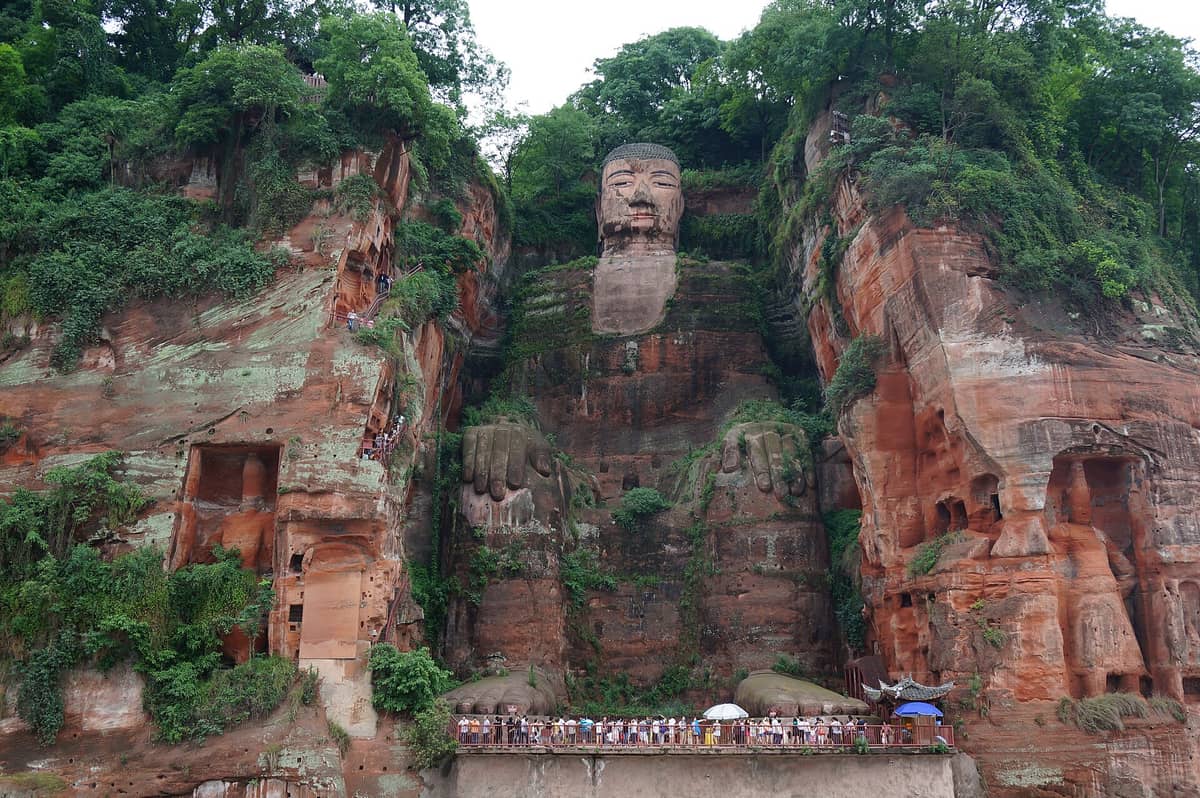
What You Are Actually Looking At
The Leshan Giant Buddha (乐山大佛) is not a monument in the conventional sense. It is a figure cut directly into the face of Lingyun Mountain, at the point where the Minjiang, Dadu, and Qingyi rivers converge. From the river, the scale registers slowly: what looks at first like a textured cliff gradually resolves into a seated figure so large that its shoulders are 28 meters wide and its feet alone are 8.5 meters long. At 71 meters from crown to foot, it is the tallest pre-modern stone Buddha statue in the world.
Construction began in 712 CE under the supervision of a monk named Haitong, who believed a protective deity carved into the cliffside would calm the turbulent waters below and reduce the number of boats lost at the confluence. The project outlived Haitong and was completed in 803 or 804 CE, during the Tang dynasty, after nearly 90 years of work. The volume of rock removed during carving was deposited into the river, which did in fact alter the currents and reduce flooding, though whether by divine intervention or hydraulic engineering remains a matter of interpretation.
ℹ️ Good to know
Opening hours vary by season: April 1 to October 7, the site is open 07:30–18:30. From October 8 to March 31, hours are 08:00–17:30. Arriving close to opening time significantly reduces queue times at the descent staircase.
Two Ways to See the Buddha, and Why Both Matter
Most visitors enter through either the North or South gate of the scenic area and walk through forest paths toward the viewing platforms and cliff staircase. The cliff route takes you from the head of the statue down a narrow staircase cut into the rock face, passing the shoulders and torso, and deposits you at the feet. This is the view that photographs cannot capture: you are standing on a stone plinth next to a toe that reaches your chest, looking up at a figure whose face is 14.7 meters tall. The scale only becomes real at this distance.
The second way is from the water. Tourist boats depart from the Leshan riverbank and circle the base of the cliffs, allowing a frontal view of the full statue from the river. This is the only way to see the Buddha in its entirety in a single frame, which is why river photos dominate most travel coverage of the site. If your itinerary allows, doing both — the river view first for context, then the cliff descent for scale — gives the most complete experience. The boats are operated separately from the scenic area and have their own ticketing.
⚠️ What to skip
The cliff staircase is narrow, steep, and can be extremely slow during peak periods. In high season, queue times at the staircase entrance can exceed two hours. Visit on weekdays, arrive at opening time, or accept the wait as part of the experience.
Tickets & tours
Hand-picked options from our booking partner. Prices are indicative; availability and final rates are confirmed when you complete your booking.
Full day private tour of Panda Base and Leshan Giant Buddha
From 495 €Instant confirmationFree cancellationPrivate tour to the Leshan Giant Buddha with lunch and boat ride
From 354 €Instant confirmationFree cancellationLeshan Giant Buddha private tour and Jurassic expedition
From 382 €Instant confirmationFree cancellationGiant Buddha and Huanglongxi Old Town private day tour from Chengdu
From 368 €Instant confirmationFree cancellation
How the Experience Changes by Time of Day
Morning arrivals, particularly in the first hour after opening, move through the site with far less crowding. The forest paths are cool, the light is soft, and the river below often carries a faint mist that diffuses the distant view. Photographers working with natural light will find the statue lit from the east in the morning, which brings out the texture of the stone and the carved drapery of the robes. By midmorning the crowds on the staircase have thickened considerably.
Midday is objectively the worst time to attempt the descent staircase in summer. Temperatures at the cliff face are high, there is little shade on the lower sections, and queue movement slows to a shuffle. That said, the flat forest areas, the temple halls, and the river-viewing pavilions at the top remain comfortable and are worth exploring while you wait for the afternoon to cool.
Late afternoon brings a shift in light quality and a gradual thinning of day-trip crowds. The statue faces west across the river, which means the later sun catches the face at a low angle in autumn and winter. On clear days in October and November, the late-afternoon light on the stone can be striking. In summer, afternoon thunderstorms are possible; check conditions before heading down the staircase, as the stone steps can become slippery.
Navigating the Scenic Area
The Leshan Giant Buddha Scenic Area is larger than most visitors expect. Beyond the Buddha itself, the site includes Lingyun Temple (a Tang dynasty Buddhist temple complex on the hillside), several smaller carved figures, and forested walking paths connecting the North and South entrances. A straightforward visit, entering from one gate and exiting from the other, covers the main route including the Buddha staircase and takes roughly two to three hours at a moderate pace. Allowing additional time for the temple halls and secondary paths brings the total to a comfortable half-day.
Tickets are available at the North, South, and West entrance windows, and through the official WeChat or Douyin channels under the name 大佛旅游. If you are combining this visit with Mount Emei, note that Emei is managed separately and requires its own ticket. A combined visit in a single day is possible but demanding; most travelers find it more comfortable spread across two days.
The site has food and drink vendors near both entrance areas, and the North entrance zone has more developed facilities. Bring water, particularly in summer. The footpaths are uneven in places and involve significant elevation change. Wear shoes with proper grip. The stone steps on the cliff staircase are worn smooth in parts, which matters on wet days.
💡 Local tip
To navigate the scenic area efficiently: enter from the North gate, walk to the top viewing platform first for the best overview of the full Buddha, then queue for the cliff staircase descent. After reaching the feet, exit through the South gate. This linear route avoids backtracking.
Getting There from Chengdu
Leshan is approximately 120 kilometers south of central Chengdu. The most practical approach for most travelers is the high-speed train from Chengdu East Railway Station to Leshan Station, a journey that typically takes around 40 to 50 minutes. From Leshan Station, the scenic area is accessible by local bus or taxi. This makes the Leshan Giant Buddha one of the most achievable day trips from Chengdu, though the full experience rewards an early start.
If traveling independently, book your train tickets in advance through the 12306 platform or app, particularly during national holidays and Golden Week periods when trains fill quickly. Return trains to Chengdu in the late afternoon also sell out on busy days. Organized day tours from Chengdu exist and often include transport, a guide, and combined entry to both Leshan and Emei in a single trip, though the pace is typically rushed.
What the Guidebooks Understate
The physical condition of the statue has been a documented concern for conservators for decades. Moisture, weathering, and vegetation growth have damaged sections of the surface, particularly the lower body and feet. Restoration work has been ongoing, and some sections may be screened off or under scaffolding at any given time. This is worth knowing before you visit, because the feet platform is the primary close-up viewpoint, and scaffolding there can limit photography.
The crowds at peak times are significant, and the experience is genuinely different from an early weekday morning versus a national holiday afternoon. The site appears on most major China itineraries, and the cliff staircase, which accommodates only two or three people abreast, creates a natural bottleneck. None of this diminishes the impact of the statue itself, but visitors who expect a quiet contemplative experience may find the peak-season reality jarring.
If you are building a Chengdu itinerary around this visit, the 3-day Chengdu itinerary typically places Leshan on day two or three, often combined with Emei. If you are traveling with children, the site is manageable but requires realistic planning: the staircase descent is not suitable for strollers, and the queue can be difficult with young children in heat. The Chengdu with kids guide covers logistics worth reviewing before the trip.
Accessibility and Practical Considerations
The cliff staircase and much of the scenic area involves steps, uneven stone paths, and elevation changes that are not accessible to wheelchair users or those with significant mobility limitations. The official ticket guidance does not publish detailed wheelchair-accessibility information. Visitors requiring step-free access are strongly advised to confirm current conditions directly with the scenic area management at +86-833-2302048 before making the journey.
The river boat option offers a view of the full statue without any cliff climbing, and may be a more practical choice for visitors who cannot manage the staircase. However, the boat experience and the close-up foot-level platform are genuinely different, and the most complete understanding of the site comes from both.
The best time of year to visit, in terms of weather and crowd balance, is September through November. Temperatures are moderate, rainfall has decreased from the summer peak, and weekday visits in October (outside Golden Week, which typically runs October 1–7 and brings very large crowds) offer a good balance of conditions. For broader Chengdu trip planning context, the best time to visit Chengdu guide covers seasonal patterns in detail.
Insider Tips
- Queue for the cliff staircase immediately after the temple complex, not at the main staircase head. The line moves faster when approached from the upper temple courtyard side, and you avoid the main tourist flow merging in from the pavilion.
- The river boat view is typically included in separate ticketing from riverfront operators near the Leshan waterfront, not through the scenic area ticket. Confirm current pricing and departure points locally, as operators and schedules change seasonally.
- Carry cash in small denominations. While the official ticket channels accept digital payment, smaller vendors inside the site and near the riverfront boat operators may prefer cash.
- In summer, the stone steps on the cliff face absorb considerable heat. Descending in the late afternoon rather than midday makes the physical experience noticeably more comfortable, and the lower sun angle improves photographs of the statue face.
- The temple complex on Lingyun Mountain above the Buddha is frequently bypassed by visitors rushing to the staircase. The Tang dynasty halls and the cliff-edge views from the temple terrace are worth the extra 20 minutes and are far less crowded than the staircase queue.
Who Is Leshan Giant Buddha For?
- History and archaeology travelers with an interest in Tang dynasty culture and ancient engineering
- Photographers seeking both close-up stone texture shots and wide river-level compositions
- Families with older children who can manage a steep staircase and several hours of walking
- Travelers combining a visit with Mount Emei on a two-day excursion from Chengdu
- UNESCO World Heritage Site collectors for whom this is one of the most significant sites in China