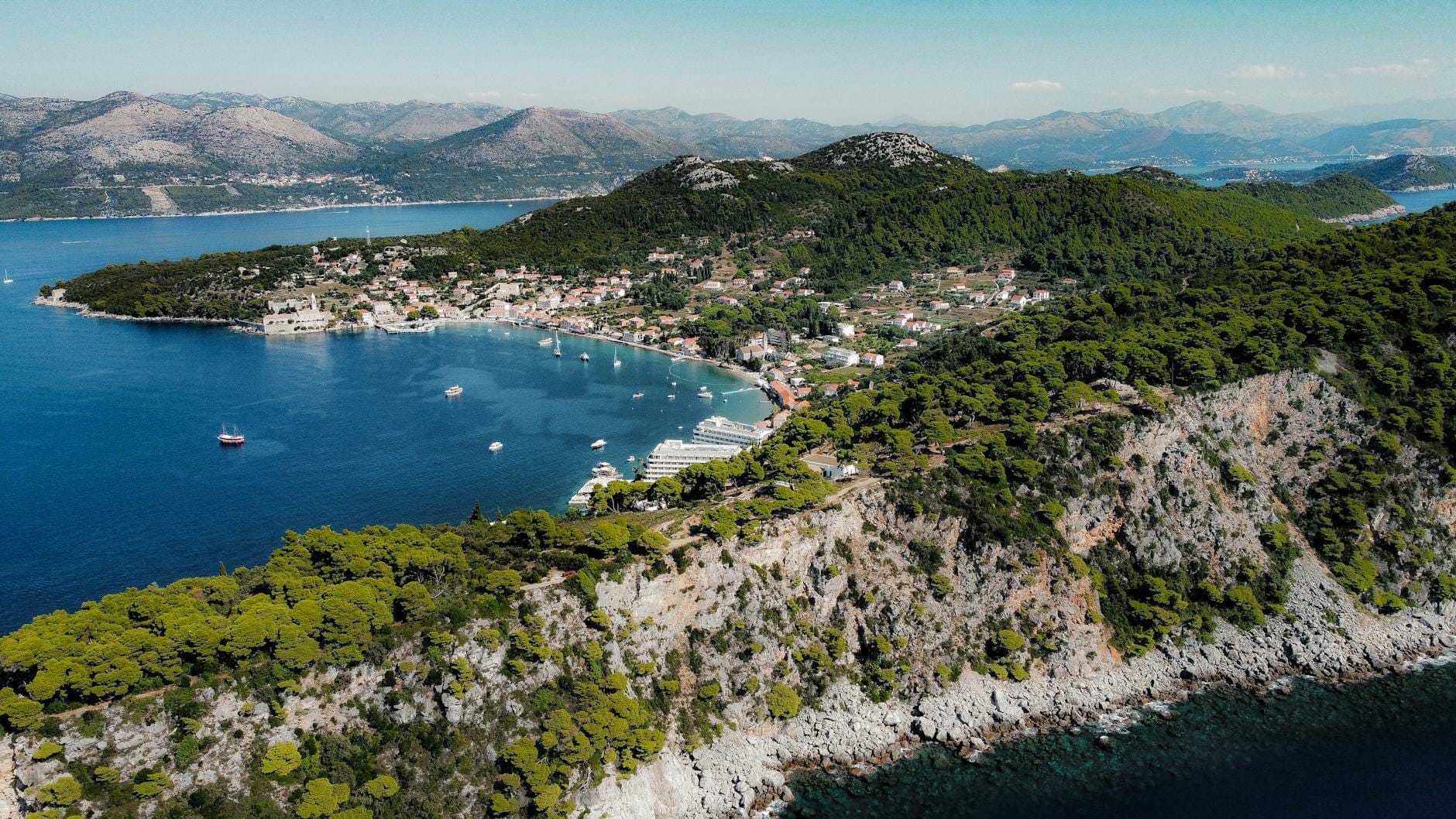
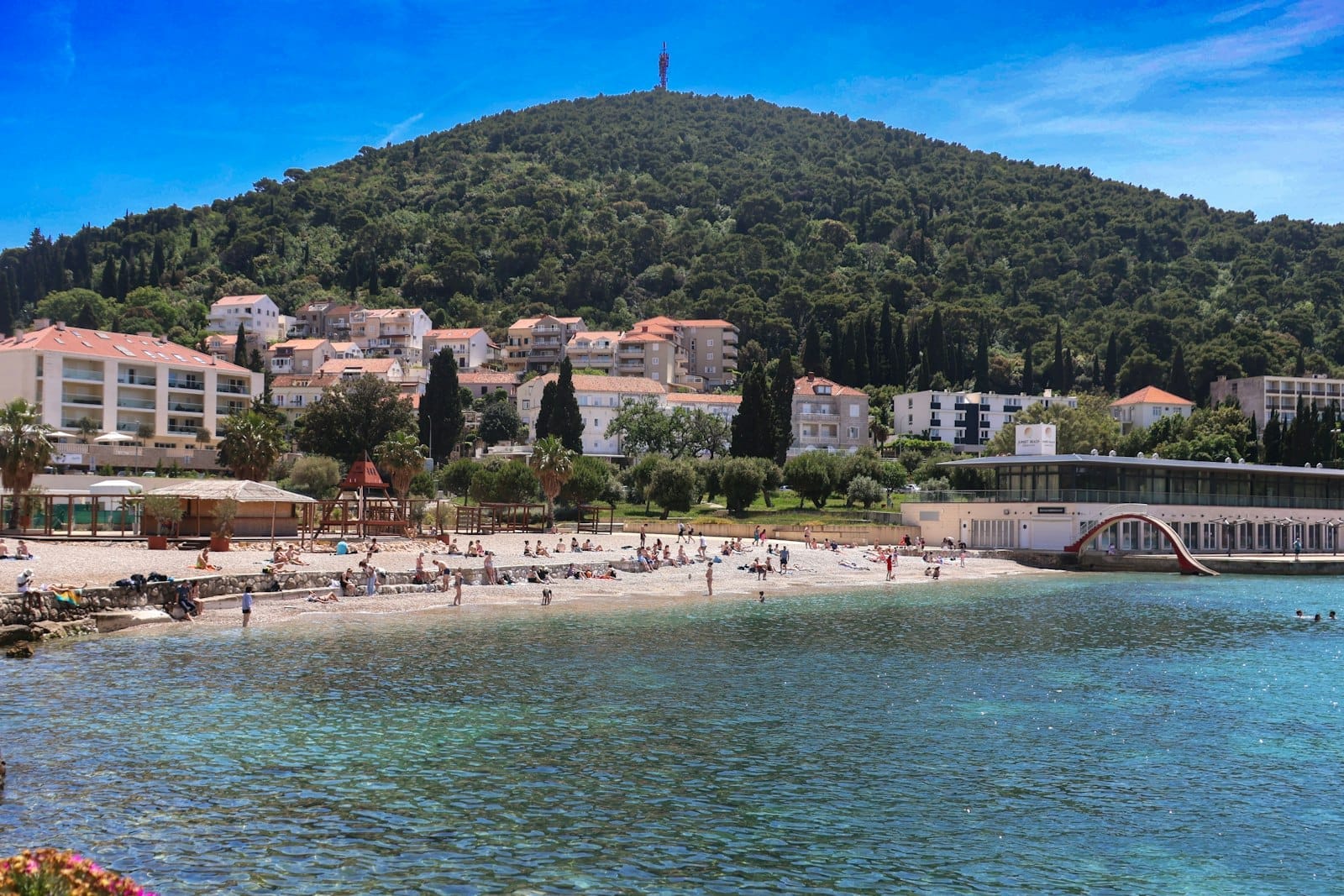
Lapad is a green, beach-facing peninsula about 3 kilometres northwest of Dubrovnik's Old City. It offers a slower pace than the historic core, with family-friendly beaches, a laid-back promenade, and a wide range of hotels at more accessible price points. For travelers who want the Dubrovnik experience without sleeping inside a tourist pressure cooker, Lapad makes a compelling base.
Lapad is the part of Dubrovnik where people actually live. Spread across a pine-shaded peninsula northwest of the Old City, it trades medieval drama for sea-facing promenades, sandy coves, and the kind of café culture that runs on its own schedule rather than the cruise ship timetable. It is not as photogenic as the walled city, but for many travelers it is a far more comfortable place to spend a week.
Orientation
Lapad occupies a peninsula that juts southwest into the Adriatic, roughly 3 kilometres from Pile Gate at the western entrance to Dubrovnik's Old City. The peninsula is bounded by the Bay of Lapad (Uvala Lapad) on its southern side and by the Rijeka Dubrovačka inlet to the north. At its eastern base, the suburb connects to the Gruž harbor district via a short uphill stretch called Batala, which follows what was once a creek between the two areas.
Thinking about Lapad spatially: the spine of the peninsula is Šetalište kralja Zvonimira, a promenade-style road that runs roughly east to west and serves as the social and commercial core of the neighborhood. Hotels, restaurants, and shops line this road. Walking south from Šetalište brings you downhill through residential streets toward the bay and the beach at Uvala Lapad. Walking north leads into quieter residential zones with views across the inlet toward Gruž. The Gruž harbor and ferry terminal sits just beyond the eastern edge of Lapad, making the two districts functionally adjacent for anyone arriving by sea.
Lapad is not a compact neighborhood you can circle in 20 minutes. The peninsula is wide enough that the walk from the northern shoreline to the southern beach takes a solid 15 to 20 minutes on foot, and some of the larger hotel complexes are spread across its flanks. First-time visitors sometimes underestimate how much ground they are covering. Good orientation landmarks: the DOC Dubrovnik shopping center marks the eastern entry point near Batala, while the Hotel Dubrovnik Palace at the peninsula's tip is the furthest western point most visitors reach.
Character & Atmosphere
Lapad is a neighborhood of different tempos depending on the hour. Early mornings belong to locals: elderly residents walking dogs along the promenade, café owners stacking chairs, delivery trucks threading through streets that are genuinely narrow in places. The light at this hour is flat and soft, filtering through umbrella pines and the Mediterranean scrub that lines the hillsides. There is a distinct smell of warm stone and dry vegetation, particularly on the residential streets above the bay.
By mid-morning the hotels have released their guests and the promenade fills with families, couples, and the slow parade of tourists gravitating toward the beach. Šetalište kralja Zvonimira takes on the feel of a resort town main street: ice cream vendors, sunscreen-smelling crowds, café terraces filling up. It is not overcrowded in the way the Stradun in the Old City gets crowded, but it is unmistakably a tourist zone during peak summer months.
Afternoons in Lapad are dominated by the beach. The bay scoops inward to form a sheltered cove, which keeps the water calm and warm. The beach itself is a mix of concrete platforms, pebbles, and a small sandy stretch, with the usual Adriatic infrastructure of sun loungers and beach bars. Umbrella pines provide real shade for those who prefer not to roast. By about 4pm, some of the heat eases and the promenade fills again, this time with an earlier, more local crowd.
After dark, Lapad is noticeably quieter than the Old City. The restaurants along the promenade do steady business through dinner but the neighborhood is not a late-night destination. Most bars close by midnight or 1am. For travelers who find the Old City's summer nightlife exhausting or simply want to get up early for a swim, this is a genuine advantage rather than a drawback.
ℹ️ Good to know
Lapad is noticeably less crowded than the Old City from late September through early November. The promenade cafés stay open, the water is still warm enough to swim, and the hotel prices drop significantly. If your schedule is flexible, this is arguably the best time to base yourself here.
What to See & Do
The central attraction of Lapad is straightforward: Uvala Lapad beach and the surrounding bay. The sheltered cove is one of the calmer swimming spots in Dubrovnik, with gentle entry into clear water and a beach area that can absorb a reasonable crowd without feeling oppressive. The promenade wrapping the bay is pleasant for walking, particularly in the early morning or late afternoon when the light is better and the temperature more forgiving.
The Gradski stadion Lapad is a small piece of local history that most visitors walk past without registering. Built in 1919, this 3,000-capacity football ground has been home to NK GOŠK Dubrovnik for over a century, and it sits in an unlikely position tucked among the residential streets, surrounded by palms and stone walls. If there is a match on during your visit, attending is a genuinely local experience with no tourist industry around it.
Lapad is also one of the better bases for day trips. The Gruž ferry terminal is a short bus or taxi ride from most of Lapad's hotels, giving straightforward access to the Elaphiti Islands and to Lokrum. The cable car to Mount Srđ and the Old City walls are both reachable within 20 to 25 minutes by bus.
Uvala Lapad: the bay beach, best in morning and late afternoon
Šetalište kralja Zvonimira: the main promenade, lined with cafés and restaurants
Gradski stadion Lapad: one of Croatia's oldest football grounds, dating to 1919
DOC Dubrovnik shopping center: useful for practical shopping, not a destination in itself
Local churches: Crkva BDM Žalosna and Crkva Sv Dominik mark the older residential fabric of the neighborhood
For those using Lapad as a base to explore the wider city, the 3-day Dubrovnik itinerary works well from here. You can structure mornings around Old City sites and return to Lapad for afternoon swims, avoiding the worst of the heat and the crowds simultaneously.
Eating & Drinking
The eating options in Lapad are more practical than spectacular, but that is not necessarily a criticism. The promenade along Šetalište kralja Zvonimira has a dense string of restaurant terraces offering seafood, grilled meats, pizza, and the kind of Dalmatian cooking that appears on every menu from Split to Dubrovnik: fresh fish, peka (slow-cooked lamb or octopus under an iron bell), brudet (fish stew), and grilled squid. Quality is uneven, and the places closest to the beach tend to be the most tourist-oriented.
The better approach is to walk a few streets back from the promenade into the residential blocks, where smaller konobas cater more to locals and offer more honest pricing. These are the places where you can eat a proper two-course meal with house wine for a reasonable sum, without a server in a branded polo shirt pressing you to order dessert. Croatian konoba cooking at its unpretentious best: thick bread, olive oil, grilled fish with Swiss chard and boiled potato, a carafe of local Plavac Mali wine.
For a broader sense of what to order across Dubrovnik's food scene, the guide to Dubrovnik's local food covers the essential dishes. In Lapad specifically, look for fresh fish sold by the kilogram rather than fixed-price set menus, which usually signals a kitchen that is buying from that day's market rather than pulling from a frozen stock.
Coffee culture in Lapad operates on Croatian time, meaning that a morning kava at a promenade café is more of a 45-minute social ritual than a quick stop. Espresso is the default; flat whites and oat milk are available at more international-facing spots but do not expect them everywhere. In the evenings, the same café terraces transition into aperitivo territory, with local beers, Aperol spritz, and the occasional glass of prosek (Dalmatian sweet wine).
💡 Local tip
Avoid restaurants that display photographs of every dish on laminated menus out front. These are reliable indicators of tourist pricing and reheated cooking. Walk an extra two or three minutes into the residential streets and the quality-to-price ratio improves significantly.
Getting There & Around
Lapad is served by Dubrovnik's Libertas bus network, which connects it to the Old City at Pile Gate and to the Gruž ferry terminal. The most useful lines for visitors are those running along the main coastal road linking Lapad with Pile Gate, a journey that takes roughly 15 to 20 minutes depending on traffic. During July and August, buses on this route can be crowded to the point of discomfort at peak times (9 to 11am outbound, 3 to 6pm returning). A full guide to getting around Dubrovnik covers all the bus lines and ticketing options in detail.
Tickets can be bought directly from the driver in cash or via the Libertas app. A single ride costs around 2 EUR; a day pass makes sense if you are making multiple trips. Taxis and Uber are both available and reliable from Lapad, with fares to Pile Gate typically running in the 8 to 12 EUR range depending on exact pickup location and time of day.
On foot, Lapad to Pile Gate is walkable in roughly 35 to 45 minutes along the coastal road, though the route is not particularly scenic for most of it. It is a reasonable walk in the early morning or late evening, but not during the midday heat of July and August. Within Lapad itself, the promenade and main streets are entirely walkable, and most hotels are within 10 to 15 minutes of the bay beach on foot.
Dubrovnik Airport (DBV) is approximately 20 kilometres southeast of Lapad. The Libertas airport bus connects the airport to the Old City via the main coastal road, with a stop accessible from or near the Gruž area; from there, a connecting bus to Lapad takes around 10 minutes. A taxi or shuttle directly from the airport to a Lapad hotel runs approximately 30 to 45 EUR, though prices fluctuate and should be confirmed at time of booking.
⚠️ What to skip
Bus frequency drops sharply after 9pm, and some night connections require changes at Pile Gate. If you are planning a late dinner in the Old City and returning to Lapad, factor in a taxi for the return leg, especially if you have children or heavy bags.
Where to Stay
Lapad holds more hotel beds than any other part of Dubrovnik outside the Old City, and the range runs from large international-style resort complexes on the peninsula's tip to small family-run guesthouses tucked into the residential streets. For a detailed overview of how Lapad compares with other neighborhoods as a base, the Dubrovnik neighborhood guide for accommodation covers the tradeoffs clearly.
For families, Lapad is the most practical base in Dubrovnik. The beach is flat and accessible, the streets around the promenade are car-light, playgrounds exist in the residential interior, and the hotel complexes typically have pools. The bus connection to the Old City is reliable enough for day trips, and returning to Lapad after a hot afternoon at the walls feels like an escape rather than a compromise.
For couples or solo travelers whose priority is access to the Old City, Lapad requires more planning. The bus is fine for a 9am departure but less appealing at 11pm after dinner. Staying in the eastern part of Lapad, closer to the Batala connection with Gruž, shortens the effective distance and gives better bus options. The western tip of the peninsula near Hotel Dubrovnik Palace is the most scenic but also the furthest from everything else.
Accommodation prices in Lapad are generally lower than equivalent quality inside or immediately adjacent to the Old City. Private apartments and smaller pensions along the hillside streets above the bay offer particularly good value, with sea views from upper-floor rooms that rival anything the expensive hotels are selling.
ℹ️ Good to know
Travelers with mobility considerations should note that Lapad's terrain is genuinely hilly in places. The streets between the promenade and the upper residential areas involve significant inclines and steps. Choose accommodation on or very near the promenade level if flat access is a priority.
Honest Assessment: Who Lapad Is For
Lapad is not Dubrovnik's most dramatic neighborhood. It does not have the walled medieval streets, the marble-paved main boulevard, or the baroque churches that make the Old City so arresting. What it has instead is a functioning, human-scaled suburb with decent beaches, lower prices, and enough separation from the tourist machinery to feel like a place rather than a stage set.
For travelers who want to use Dubrovnik as a base for exploring the wider Dalmatian coast, including island hopping from Dubrovnik or day trips to places like Mostar and the Elaphiti Islands, Lapad's proximity to Gruž port makes it logistically smart. You can roll out of your hotel, catch a 10-minute bus to the ferry terminal, and be on a boat before 9am without the Old City crowds getting in your way.
The tradeoff is that Lapad requires more effort to reach the things that make Dubrovnik famous. Every visit to the City Walls, the Stradun, the Rector's Palace, or the Franciscan Monastery involves a bus ride or a 40-minute walk. That is not a dealbreaker, but it is real, and travelers who want to wander the Old City at odd hours without logistical overhead will be better served by staying closer to Pile Gate.
TL;DR
Lapad is a green, beach-facing peninsula suburb about 3 kilometres northwest of Dubrovnik's Old City, connected by regular Libertas buses.
Best for: families, budget-conscious travelers, and anyone who values a quieter base with real beach access over maximum proximity to the historic core.
The promenade along Šetalište kralja Zvonimira is the social spine: cafés, restaurants, and shops within a five-minute walk of the bay beach.
Proximity to Gruž ferry terminal makes Lapad a practical base for island day trips and onward travel along the Dalmatian coast.
Not ideal for travelers who want spontaneous late-night access to the Old City or who find resort-town atmospheres unappealing; the bus stops running frequently after 9pm and the neighborhood quiets down well before midnight.
Choosing the best time to visit Dubrovnik shapes your entire trip. This guide breaks down every season honestly, covering weather, crowds, costs, and what's actually worth doing in each period, so you can plan around your priorities rather than tourist brochure hype.
Buza Bar is Dubrovnik's most atmospheric drinking spot, clinging to the rocks outside the southern city walls with direct access to the Adriatic. This guide covers both locations, how to find them, what things cost, the truth about sunset views, and everything else you need before you go.
Dubrovnik rewards slow exploration, but the surrounding region is packed with destinations worth a full day out. These are the best day trips from Dubrovnik, covering Adriatic islands, Bosnian towns, coastal nature, and a UNESCO-listed arboretum.
Dubrovnik's coastline offers far more than one famous beach. From the postcard views at Banje to the calm lagoon on Lokrum Island and the car-free sandy shore of Lopud, here is where to swim, sunbathe, and cool off around the city.
The Dubrovnik Cable Car is the fastest way to reach Mount Srđ and its 412-metre panorama above the Old Town. This guide covers tickets, seasonal hours, crowd patterns, what to expect at the summit, and honest advice on whether it's worth the fare.
The Dubrovnik Pass promises free entry to the City Walls, Rector's Palace, six museums, skip-the-line access, and bus rides. But does the math work out? This guide breaks down every included attraction, the real savings by pass type, and exactly who should (and shouldn't) buy one.
The Dubrovnik City Walls are the single most impressive feature of this UNESCO-listed old city: a nearly 2 km loop of medieval fortifications with uninterrupted views over the Adriatic. This guide covers ticket prices, entry points, the best time to go, and everything the official site doesn't tell you.
Cruise ships dock at Port Gruž, roughly 3km from Dubrovnik's Old Town. This guide covers exactly how to get there, what to expect on arrival, how to spend your time ashore, and how to avoid the most common mistakes cruise passengers make.
Most visitors to Dubrovnik walk the walls, photograph the Stradun, and leave. But the city rewards those who look further. From cliff-side bars and car-free islands to a centuries-old arboretum and a wartime fortress on the hill above the city, these are the experiences that make Dubrovnik far more than its postcard image.
Dubrovnik is one of the Adriatic's most photogenic cities, and for couples it delivers something genuinely special: medieval stone streets, cliff-top bars with open sea views, private boat tours, and candlelit waterfront dining. This guide covers the most romantic things to do in Dubrovnik, the best times to visit as a couple, and practical advice that saves you from the tourist-trap pitfalls.
The Elaphiti Islands sit just off Dubrovnik's coast and offer everything the city lacks in summer: quiet coves, car-free lanes, and unhurried lunches. This guide covers ferry logistics, guided tours, what each island is actually like, and how to make the most of a day on the water.
Three days is enough to see the best of Dubrovnik without rushing. This itinerary covers the City Walls, Old Town highlights, a day trip to the islands, and practical advice on timing, pricing, and what to skip.
Paddling the Adriatic Sea along Dubrovnik's UNESCO-listed city walls is one of the most visually striking experiences the Croatian coast offers. This guide covers every sea kayak tour option, honest pricing, the best routes, top operators, and what to expect on the water.
Dubrovnik after dark is more layered than its reputation suggests. This guide covers the top things to do in Dubrovnik at night — cliff-side cocktails, beach clubs, a 16th-century fortress turned dance floor, and the quieter bars most tourists walk past. Includes prices, seasonal notes, and what to skip.
Dubrovnik has a reputation as one of Croatia's priciest destinations, and it earns it. But budget-conscious travelers still make it work every year. This guide breaks down real costs, seasonal pricing shifts, and the specific decisions that separate a €70/day trip from a €200/day one.
Dubrovnik is one of the most photogenic cities in Europe, but great shots require more than just showing up. This guide covers the best photography spots in Dubrovnik, including exact vantage points, optimal timing by season, entry costs, and honest advice on which locations are worth the effort.
Dubrovnik ranks among Croatia's safest cities, but its popularity brings a predictable set of tourist-targeted scams. This guide breaks down exactly what to watch for, where risks concentrate, and how to travel confidently without falling for overcharges, fake taxis, or phishing QR codes.
Running for 47 days across 16+ historic venues each summer, the Dubrovnik Summer Festival transforms the Old Town into an open-air cultural stage. This guide covers dates, ticket booking, the best performances to catch, and how to plan your visit without the headaches.
Walk Dubrovnik's UNESCO-listed Old Town on your own terms. This guide covers the full route from Pile Gate to the Clock Tower, every major stop along the way, the best apps to use, and honest advice on timing, crowds, and what to skip.
Dubrovnik's Mediterranean climate means sun-drenched summers, mild winters, and two golden shoulder seasons. This guide breaks down temperatures, rainfall, sea conditions, and crowd levels for every month so you can choose the visit that suits you best.
Dubrovnik is more family-friendly than its reputation suggests, but it rewards planning. This guide covers the best beaches, activities for children of all ages, seasonal timing, and practical logistics so your family trip actually works.
Dubrovnik has a reputation for being expensive, but plenty of its best experiences cost nothing at all. From wandering the Stradun to hiking Mount Srđ for panoramic views, here are the top free things to do in Dubrovnik.
Dubrovnik's Old Town doubled as King's Landing for eight seasons of Game of Thrones, and the locations are remarkably easy to visit on foot. This guide covers every major filming site, honest advice on tours versus self-guided walks, seasonal crowd warnings, and current pricing so you can plan without surprises.
Dubrovnik's Old Town is car-free, hilly, and can swallow an afternoon if you don't know the bus routes. This guide covers every transport option in the city: Libertas buses, airport shuttles, taxis, the cable car, and the Dubrovnik Pass, with real fares and honest advice on what to skip.
Dubrovnik gets more attention than almost any city its size. But does it live up to the hype? This guide cuts through the marketing noise with honest answers on costs, crowds, timing, and what makes the city genuinely special — plus what to watch out for.
Dubrovnik punches well above its size when it comes to luxury travel. This guide covers the best 5-star hotels on the Adriatic, where to eat well without the tourist markup, and how to get the most out of one of Europe's most dramatic coastal cities — without overpaying for it.
Three routes connect Split and Dubrovnik, each with a different trade-off between cost, comfort, and scenery. This guide breaks down the ferry, bus, and driving options with real pricing, seasonal schedules, and honest advice on which to choose.
St Blaise Church stands at the heart of Dubrovnik's Old Town, a Baroque masterpiece dedicated to the city's patron saint. This guide covers its architecture, the remarkable silver statue, practical visiting advice, and the annual February celebrations that bring the church to life.
Dubrovnik rewards visitors who go beyond the obvious. This guide covers the top things to do in Dubrovnik, Croatia, from the iconic City Walls walk and cable car summit to sea kayaking, island hopping, and the local spots most guides skip. Includes real prices, crowd timing, and honest take on what's worth it.
Dubrovnik's food scene runs much deeper than tourist-trap menus on the Stradun. This guide covers the essential Dalmatian dishes every visitor should try, where to actually eat them, and how to avoid wasting a meal on overpriced mediocrity.
Dubrovnik is perched on a narrow coastal promontory in southeastern Croatia, roughly 42.64° N, 18.11° E, with the Adriatic Sea on one side and the bare limestone mass of Mount Srđ on the other. This guide covers the city's precise geography, its distinct neighborhoods, the best routes in, and the seasonal realities that shape every visit.
Dubrovnik's dining scene runs from rooftop fine dining above limestone walls to burek shops wedged into medieval alleyways. This guide cuts through the tourist-trap noise to tell you exactly where to eat, what to order, and how much to pay — by neighbourhood, budget, and occasion.
Choosing where to stay in Dubrovnik shapes your entire experience. This guide covers every major neighbourhood, from the medieval Old Town to the resort strip of Lapad, with honest advice on who each area suits, what to expect, and how to avoid common booking mistakes.