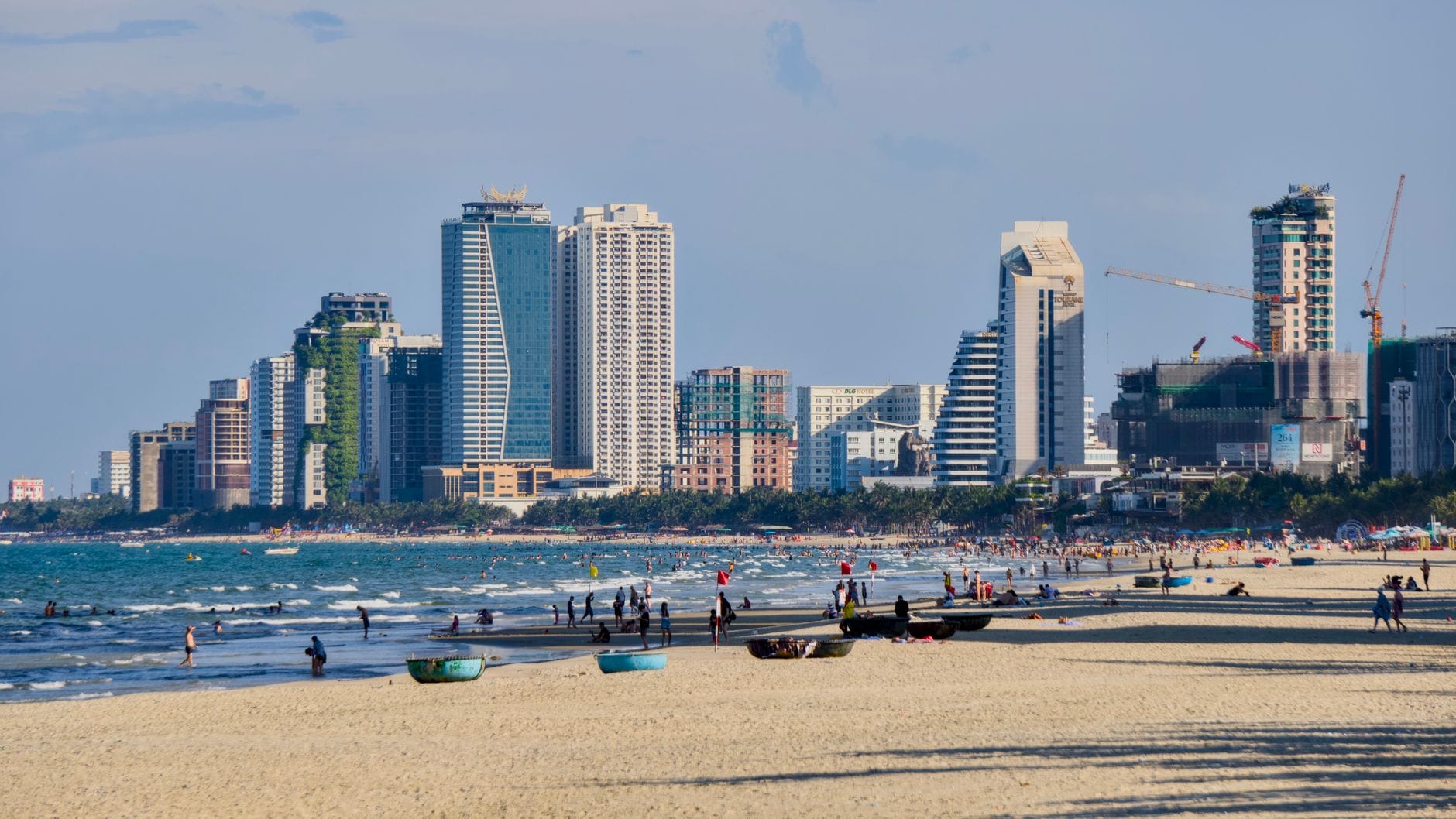
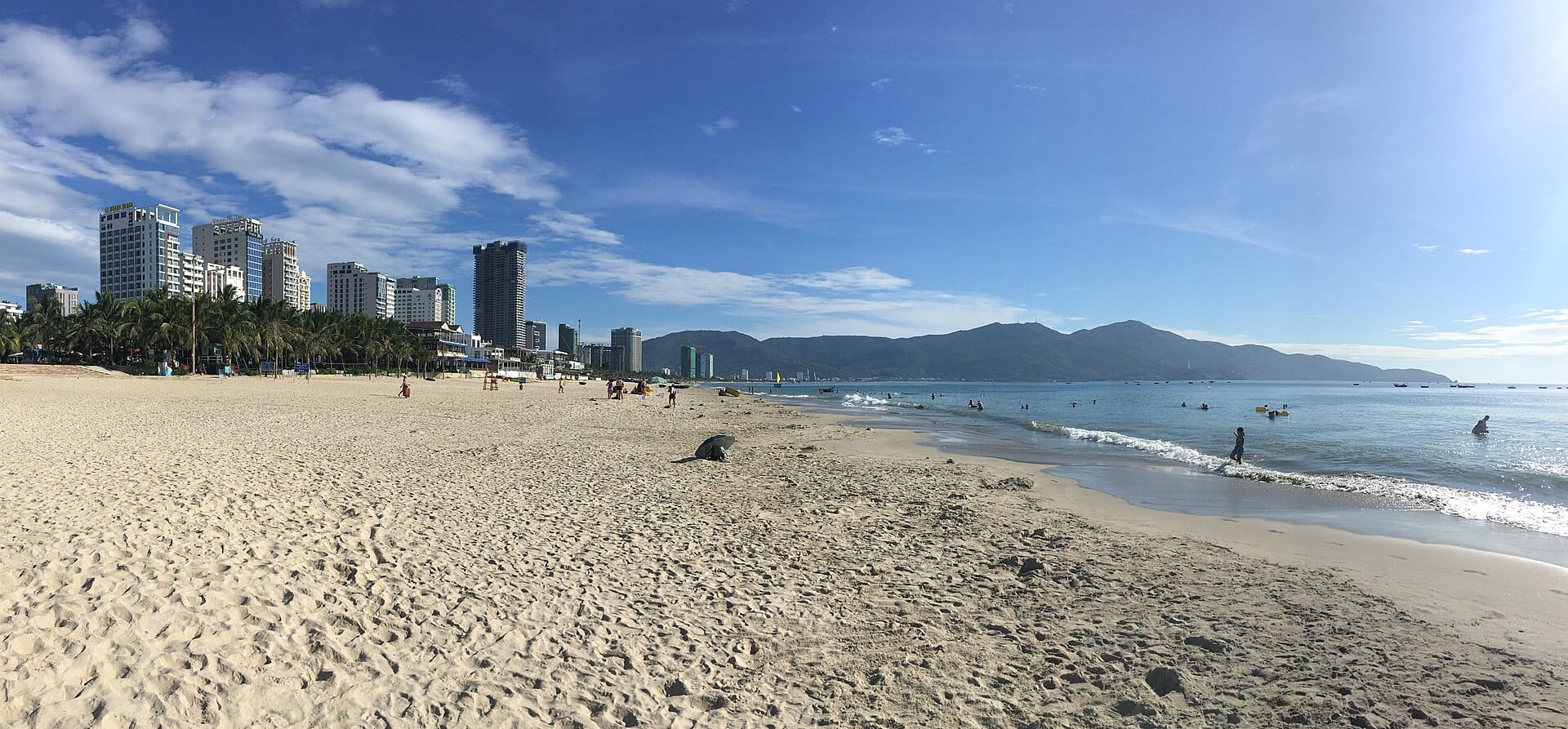
My Khe Beach is Da Nang's defining coastal strip, running roughly 10 km along Vo Nguyen Giap Street in Phuoc My Ward, Son Tra District. Backed by hotels, seafood restaurants, and open-air cafés, it draws both local families and international visitors looking for a beach that functions as a full neighborhood rather than a day-trip destination.
My Khe Beach is where Da Nang faces the sea. Stretching along Vo Nguyen Giap Street in Phuoc My Ward, Son Tra District, this is the city's primary beach zone: a wide arc of white sand with the Marble Mountains visible to the south, the Son Tra Peninsula rising to the north, and a dense strip of hotels and restaurants separating the shore from the rest of the city. It's cosmopolitan enough for resort stays, local enough that Vietnamese families still claim their stretch of sand every morning.
Orientation
My Khe Beach sits in Phuoc My Ward in Son Tra District on Da Nang's eastern coastline, separated from the city center by the Han River. The straight-line distance from the beach to the downtown core of Hai Chau District is roughly 3 km, though by road the journey is closer to 5 km because you need to cross one of the Han River bridges.
The spine of the neighborhood is Vo Nguyen Giap Street, a wide coastal boulevard that runs parallel to the sand for the entire length of the beach strip. The core public beach section — the stretch most commonly referred to when locals say 'My Khe' — runs approximately 900 to 1,000 meters from the Pham Van Dong Street junction in the north down to the Nguyen Van Thoai Street area near T20 Beach in the south. But the wider coastline branded as My Khe extends far beyond that core, running around 10 km south toward Non Nuoc Beach and the Marble Mountains in Ngu Hanh Son District.
To the north, the beach ends where the land rises into the Son Tra Peninsula. To the south, it transitions through My An Beach before reaching Non Nuoc. East Sea Park and the Whale Temple Park (Ca Ong Park) mark the northern anchor of the main strip. The area is administratively split between Phuoc My and Ngu Hanh Son wards, but this distinction matters very little on the ground — for visitors, Vo Nguyen Giap Street is the organizing axis, and everything of note sits within a few hundred meters of it.
My Khe Beach is roughly 5 km by road from Da Nang Railway Station, which puts it outside comfortable walking distance from the downtown transport hub. The Han River downtown area and the iconic Dragon Bridge are among the quickest reference points for orienting yourself — cross the Dragon Bridge heading east, and you arrive directly at the northern end of the My Khe strip.
Character & Atmosphere
The My Khe Beach area operates on a rhythm that most coastal neighborhoods only dream about. By 5:30 in the morning, the beach is already in use. Vietnamese locals arrive in numbers — older residents walking the tideline for exercise, groups doing tai chi on the sand, and fishermen returning from overnight trips in traditional round basket boats called thung chai. The light at this hour is flat and silver, the sea a pale blue-green. It is genuinely one of the better times to visit, before the heat arrives.
By mid-morning, the dynamic shifts. The designated swimming zones — marked T18, T20, and the numbered Beach 1, 2, and 3 sections — fill with families and resort guests. Umbrella and chair rental operators set up along the beach access points. The beach itself is wide enough that even during peak season it doesn't feel oppressively crowded, though weekends in June and July bring significantly more people than weekdays in shoulder months.
Afternoons in high summer (June through August) are intense. The sun reflects off both the sand and the glass facades of the hotels lining Vo Nguyen Giap, and the temperature regularly climbs above 35°C. Most experienced visitors retreat to hotel pools or air-conditioned cafés between noon and 3 pm. The beach revives in late afternoon, when the angle of the sun drops and the sea breeze picks up. Sunset here faces west — behind the city rather than over the water — so the evening light catches the waves from behind the peninsula rather than dying directly over the horizon.
After dark, the street-level energy concentrates along Vo Nguyen Giap and the lanes running parallel to it. Seafood restaurants fill up, motorbikes park in dense rows, and the area around An Thuong tourist street becomes the social center of the neighborhood. The beach itself goes quiet after sunset — swimming after dark is neither advised nor permitted within the official zones — but the strip behind it stays active until well past midnight on weekends.
ℹ️ Good to know
Forbes once listed My Khe among the world's most attractive beaches, and it appears regularly on Vietnamese national tourism rankings. While marketing language can overstate things, the sand quality and water clarity are genuinely impressive by any regional standard.
What to See & Do
The beach itself is the primary draw, and it delivers. The sand is fine and pale, the gradient into the water is gentle, and — within the designated zones — the waves are generally manageable for average swimmers. The main swimming areas are marked with flag systems: pay attention to them. Outside the flagged zones or during rough weather, currents can be unpredictable. My Khe BeachThe beach itself is the primary draw, and it delivers. The sand is fine and pale, the gradient into the water is gentle, and — within the designated zones — the waves are generally manageable for average swimmers. The main swimming areas are marked with flag systems: pay attention to them. Outside the flagged zones or during rough weather, currents can be unpredictable. My Khe Beach is best experienced early morning or late afternoon rather than in the midday heat.
Beyond swimming, water sports operators along the beach offer jet skiing, banana boat rides, and stand-up paddleboarding. For something more substantial, the northern end of the strip is a short ride from the foot of the Son Tra Peninsula, where forested roads climb to viewpoints and the Lady Buddha statue at Linh Ung Pagoda stands about 67 meters tall on Son Tra’s western slope. The contrast between beach and mountain within a 20-minute ride is one of the more underappreciated aspects of staying in this part of Da Nang.
Heading south from the main My Khe strip, the road along Vo Nguyen Giap eventually reaches Non Nuoc Beach and the Marble Mountains — a cluster of five limestone formations with active temples, caves, and viewpoints that reward an hour or two of exploration. The Non Nuoc stone carving village nearby is worth a brief stop if you're interested in traditional Vietnamese craft.
Swimming and sunbathing at designated T18, T20, and Beach 1–3 zones along Vo Nguyen Giap
Water sports: jet skiing, paddleboarding, and banana boat rides from operators along the beach
Morning beach walks from Pham Van Dong Park south toward My An
Day trips north to Son Tra Peninsula and Lady Buddha statue
Day trips south to the Marble Mountains and Non Nuoc Beach
Evening walk along the beachfront boulevard as the temperature drops
Eating & Drinking
The food scene along the My Khe strip is dominated by seafood, and for good reason. The restaurants lining Vo Nguyen Giap and its side streets specialize in grilled fish, prawns, crab, and shellfish priced by weight. Ordering involves picking from tanks or displays at the entrance, agreeing on a price, then waiting while it's cooked to order. It's an experience as much as a meal. For a broader overview of what to eat while in the city, the Da Nang food guide covers the full range of local dishes worth seeking out.
The An Thuong area — a cluster of streets running inland from the mid-section of Vo Nguyen Giap — functions as the neighborhood's main dining and social district. An Thuong tourist street The An Thuong area — a cluster of streets running inland from the mid-section of Vo Nguyen Giap — functions as the neighborhood's main dining and social district. An Thuong has a concentration of international restaurants, bars, and cafés that cater primarily to foreign visitors and Da Nang's expat community. You'll find everything from wood-fired pizza to Vietnamese pho here, and the price range is wider than the beachfront hotels would suggest. A full dinner for two at a mid-range restaurant in An Thuong typically costs between 300,000 and 600,000 VND.
Da Nang has developed a genuine coffee culture, and the My Khe strip reflects it. Several multi-story cafés along Vo Nguyen Giap offer sea views from upper floors, and smaller independent spots along the An Thuong lanes serve good Vietnamese iced coffee (cà phê sữa đá) at local prices. The Da Nang coffee guide is a useful reference for tracking down the best spots.
For street food, the lanes running perpendicular to Vo Nguyen Giap — particularly those between Vo Van Kiet and the beach — have banh mi carts, bun cha stalls, and bánh xèo (Vietnamese sizzling crepes) vendors operating from mid-morning through late evening. These are significantly cheaper than the sit-down restaurants: a banh mi costs around 20,000–35,000 VND, a bowl of noodles around 30,000–60,000 VND.
💡 Local tip
At seafood restaurants along Vo Nguyen Giap, always confirm the price per kilogram before ordering. Prices can vary significantly between restaurants, and what appears to be a similar setup can have very different pricing structures. Pointing at the tank and asking 'bao nhieu?' (how much?) is perfectly normal.
Getting There & Around
From Da Nang International Airport (IATA: DAD), the My Khe Beach area is approximately 6–8 km by road, depending on which part of the strip you're heading to. A taxi or ride-hailing app (Grab is widely used in Da Nang) is the most practical option for airport arrivals with luggage. The journey typically takes 15 to 25 minutes depending on traffic.
From downtown Da Nang, crossing the Han River via the Dragon Bridge or the Tran Thi Ly Bridge puts you directly onto the streets feeding into Vo Nguyen Giap. A Grab car from downtown takes around 10–15 minutes and costs relatively little. The city operates local bus services along Vo Nguyen Giap and connecting corridors including Pham Van Dong and Vo Van Kiet, which are an economical option for those comfortable navigating the system. Da Nang does not have a metro network. For a full breakdown of how to move around the city, the Da Nang transport guide covers all your options.
Within the My Khe strip itself, most destinations are walkable along Vo Nguyen Giap. The core beach zone from Pham Van Dong south to Nguyen Van Thoai is under a kilometer on foot, and the An Thuong area is just a few minutes' walk inland. Motorbike rentals are available throughout the neighborhood and give you the flexibility to explore the Son Tra Peninsula or head south to the Marble Mountains at your own pace. Rentals typically run 100,000–150,000 VND per day for a basic scooter.
⚠️ What to skip
Parking along Vo Nguyen Giap fills quickly on weekend afternoons during peak season (June–August). If you're arriving by taxi or ride-hail during busy periods, dropping off on a side street and walking the final 200–300 meters to the beach is faster than waiting for beachfront parking to clear.
Where to Stay
My Khe Beach is Da Nang's main hotel corridor. Accommodation ranges from budget guesthouses in the lanes behind Vo Nguyen Giap to large international resort properties directly on the beach. The concentration of options makes it the most competitive hotel market in the city, which generally keeps prices reasonable for the quality on offer. For a structured comparison of Da Nang's neighborhoods as places to base yourself, the Da Nang accommodation guide covers each area in detail.
The stretch of Vo Nguyen Giap between Pham Van Dong and Vo Van Kiet has the highest density of mid-range and upscale hotels, most with direct beach access or at least sea-view rooms. Beachfront rooms command a premium but deliver genuinely impressive views, especially from higher floors. If you're traveling on a budget, the best value is found one or two streets back from the seafront, where smaller guesthouses offer decent rooms at significantly lower prices than the beachfront properties.
Couples and honeymooners tend to gravitate toward the resort properties in the southern section of the strip, near My An Beach, which is slightly quieter than the main My Khe core. Families with young children benefit most from the northern and central sections, where beach access points are frequent and the swimming zones are well-marked and patrolled. Digital nomads and longer-term visitors often prefer the An Thuong area for its café density and walkable dining options. The Da Nang digital nomad guide has specific accommodation recommendations for remote workers.
For those wanting a more luxurious stay, a few five-star properties along this strip include spa facilities, rooftop pools, and private beach sections. The Da Nang luxury travel guide covers the top-end options in more detail.
Safety & Practical Notes
Swimming at My Khe is managed more carefully than at many Southeast Asian beach destinations. Lifeguards are on duty during permitted swimming hours — generally from early morning to early evening, with the specific window varying slightly by season. A color-coded flag system marks safe zones: follow it. Stay within the supervised swimming area, especially during the rainy season between September and March.
Do not swim after dark, and avoid entering the water outside the flagged zones. During the rainy season, waves increase significantly and rip currents become a genuine hazard. If you're visiting between September and December, check conditions before going in. The city safety guide has broader advice on staying safe in the city and on the water. The Da Nang safety guide has broader advice on staying safe in the city and on the water.
The neighborhood is generally safe for walking at night, including along Vo Nguyen Giap and in the An Thuong area. Standard urban caution applies: keep bags secure, be aware of motorbike traffic when crossing roads, and use Grab rather than unmarked taxis if you're unsure about pricing. The beach access points are lit at night but the beach itself is dark, and petty theft on unlit stretches of sand does occur occasionally. Leave valuables in your hotel.
⚠️ What to skip
Vietnam's sun at this latitude is significantly stronger than visitors from temperate climates expect. The UV index at My Khe regularly hits 11 or above between 10 am and 3 pm from April through August. High-SPF sunscreen, a hat, and shade time are not optional — they're the difference between a good beach day and a miserable one.
Is My Khe Beach Area Right for You?
My Khe is the right base if you want to spend significant time on the beach and want your accommodation, food, and evening entertainment all within walking distance of the sand. It is less suitable if you're primarily interested in the city's cultural sites — the Han Market, Da Nang Cathedral, and the Museum of Cham Sculpture are all across the river, adding travel time to every city-center excursion.
The neighborhood isn't particularly atmospheric in the way that older Vietnamese neighborhoods can be — Vo Nguyen Giap is a wide, modern boulevard lined with hotel towers, and some sections feel more like a resort corridor than a living urban district. If that aesthetic bothers you, consider staying downtown and visiting the beach as a half-day trip. But if beach access is your priority, My Khe delivers consistently, and the quality of the swimming, the range of accommodation, and the concentration of good seafood restaurants make it one of the stronger city beach propositions in Vietnam. The Da Nang beaches guide compares My Khe with the city's other coastal options to help you decide.
TL;DR
My Khe Beach runs roughly 10 km along Vo Nguyen Giap Street in Phuoc My Ward, Son Tra District, about 3 km east of the city center across the Han River.
Best for: beach-focused travelers, families, couples, and longer-stay visitors who want resort facilities alongside easy access to the rest of Da Nang.
Avoid if: your main interest is Da Nang's cultural or downtown scene — the cross-river journey adds friction to every city-center trip.
Swimming is managed with lifeguards and flag zones; follow the rules, avoid the water outside permitted hours and after dark, and be cautious during the September–March rainy season.
The An Thuong area inland from Vo Nguyen Giap gives the neighborhood a genuine social life beyond the hotel strip, with cafés, international restaurants, and bars within easy walking distance of the beach.
Three days is exactly enough time to cover Da Nang's best beaches, cultural landmarks, and day trips without rushing. This itinerary breaks it down day by day — with practical logistics, honest crowd and timing advice, and links to deeper guides for every stop.
Ba Na Hills is a high-altitude resort complex sitting at 1,487 metres above sea level, about 25 km southwest of Da Nang. This guide covers everything from ticket prices and cable car logistics to seasonal conditions, crowd patterns, and what the French Village is really like.
Da Nang's climate divides into a sunny dry season and a stormy wet season, but the best time to visit depends on what you want from the trip. This guide breaks down weather patterns, crowd levels, and pricing across every season so you can plan with confidence.
Central Vietnam's Da Nang–Hoi An–Hue corridor packs beaches, UNESCO heritage, and mountain scenery into a compact region. This guide gives you the routes, timings, seasonal advice, and practical details to plan a trip that actually works.
Da Nang International Airport (DAD) is one of the most conveniently located airports in Southeast Asia, sitting roughly 3–5 km from downtown. This guide covers the arrivals process, visa on arrival requirements, every transfer option to the city, and how to reach Hoi An from the airport.
Da Nang sits on roughly 70–75 km of coastline, with a core run of public beaches that rival anything in Southeast Asia. This guide covers every significant beach from Nam O in the north to Non Nuoc in the south, with practical advice on the best swimming seasons, safety, crowd patterns, and how much to budget.
Da Nang's coffee scene runs deeper than beach cafés and tourist menus. This guide covers everything from traditional Vietnamese street coffee to specialty roasters, with real prices, neighborhood breakdowns, and tips on when and where to go.
Da Nang has become one of Southeast Asia's most practical bases for remote workers, with fast fiber internet, low costs, and a beach at the end of the street. This guide covers everything you actually need: realistic budgets, visa rules, the best neighborhoods, coworking options, and the seasonal realities that can make or break a long stay.
The Da Nang International Fireworks Festival is Vietnam's largest pyrotechnic competition, running across multiple nights from late May to mid-July over the Han River. This guide covers tickets, viewing spots, accommodation strategy, and everything else you need to plan your visit.
Da Nang punches well above its weight as a romantic destination. With a scenic riverfront, long stretches of beach, cloud-capped mountains, and easy access to Hoi An, it offers couples genuine variety — whether you want candlelit dinners, spa retreats, or mountain adventures. This guide covers the best romantic experiences in Da Nang, with practical timing, pricing context, and honest takes on what's worth your time.
Da Nang has quietly become one of Southeast Asia's most compelling luxury destinations, offering five-star beachfront resorts, world-class golf, and refined dining at prices that significantly undercut Bali and Phuket. This guide covers where to stay, when to book, what to spend, and how to get the most from a high-end trip to central Vietnam.
Da Nang is better known for its beaches, but the mountains surrounding the city offer some of central Vietnam's most rewarding day trips. This guide covers every major peak, trail, and viewpoint within reach, with practical advice on difficulty, access, and the best time to go.
Da Nang nightlife runs the spectrum from riverfront rooftop bars and late-night expat clubs to grilled seafood markets and the weekly Dragon Bridge fire show. This guide covers every zone, venue type, and practical detail you need to plan your evenings well.
Da Nang has one of the lowest crime rates of any major Vietnamese city, but a handful of persistent scams catch visitors off guard every year. This guide breaks down the real risks, the tourist traps worth avoiding, and the practical steps that keep you safe from arrival to departure.
Da Nang shopping splits neatly into two worlds: lively traditional markets where bargaining is expected, and modern air-conditioned malls with fixed prices. This guide covers the key venues, the best souvenirs, realistic price ranges, and the common mistakes that cost visitors money.
Da Nang's wellness scene spans budget walk-in parlors, boutique treatment centers, and full resort spas open around the clock. This guide breaks down the best options by price tier, location, and treatment type — with practical advice on when to book ahead and what to skip.
The trip from Da Nang to Hoi An is only around 30 km, but with no airport or train station in Hoi An, road is your only option. This guide breaks down every transport choice, with current prices, journey times, and practical advice on which option suits your situation.
Da Nang punches well above its size when it comes to scenery. The city sits between jungle-covered mountains, a long arc of coastline, and a river lined with illuminated bridges — all of which create extraordinary viewpoints at every elevation. This guide covers the best of them, from free hilltop lookouts to ticketed cable-car rides above the clouds.
Da Nang is one of Southeast Asia's most practical destinations for families. Short distances between attractions, calm traffic, wide sandy beaches, and a mix of theme parks, cultural sites, and day trips make it genuinely easy with children in tow. This guide covers when to go, what to skip, and how to make the most of 3-5 days.
Da Nang sits at the centre of one of Southeast Asia's most rewarding travel corridors. Within a two-hour radius you have UNESCO World Heritage sites, a French-colonial hilltop resort, ancient Cham towers, and one of Vietnam's most scenic mountain passes. This guide covers every worthwhile day trip with real distances, 2026 pricing, and straight talk about what is actually worth your time.
Da Nang is one of Vietnam's most navigable cities, with most tourist areas packed into a 5–15 km radius. This guide breaks down every way to get around, from Grab bikes to city buses, with real fare ranges, key routes, and practical advice on what to avoid.
Da Nang sits roughly midway between Hanoi and Ho Chi Minh City, making it one of the easiest destinations in Vietnam to reach. This guide covers every practical option: domestic flights, overnight trains, prices, journey times, and what to know before you book.
Hoi An's Full Moon Lantern Festival happens every lunar month, and Da Nang is the ideal base for a same-day trip. This guide covers exactly how to get there, when to arrive, what things cost, and what no one tells you before you go.
Da Nang sits at the heart of central Vietnam, offering long sandy beaches, world-class day trips, and a food scene that punches well above its weight. Here is everything you need to know to decide whether it belongs on your itinerary.
Da Nang is central Vietnam's most livable city and one of its most rewarding to explore. This guide covers the best things to do in Da Nang across beaches, landmarks, food, day trips, and culture, with practical advice on timing, costs, and what to skip.
Da Nang's food scene runs far deeper than seafood. This guide covers the essential dishes, where to find them, what to pay, and when to show up — written for travelers who want to eat like a local, not a tourist.
Da Nang splits cleanly into three distinct stay zones: the beachside strip around My Khe, the city-centre Han River district, and the secluded Son Tra Peninsula. This guide breaks down each area by price, vibe, and access to attractions so you can choose the right base for your trip.