Marble Mountains (Ngu Hanh Son): What to Expect Before You Climb
The Marble Mountains, or Ngu Hanh Son, are a cluster of five marble and limestone hills rising from the coastal plain between Da Nang and Hoi An. Each peak holds caves, temples, and carved shrines layered across centuries of Cham, Vietnamese, and Buddhist history. This guide covers what you will actually find there, how long to spend, and how to get the most out of the visit.
Quick Facts
- Location
- 81 Huyền Trân Công Chúa St, Hòa Hải Ward, Ngu Hanh Son District, Da Nang. About 8–9 km south of Da Nang city center on the road to Hoi An.
- Getting There
- Grab taxi or motorbike from central Da Nang (15–20 min). Easily combined with a Hoi An day trip — the mountains sit directly on the main Da Nang–Hoi An route.
- Time Needed
- 2–3 hours for a thorough visit of Thuy Son. เผื่อ 30 extra minutes if you plan to visit Am Phu Cave separately.
- Cost
- Thuy Son entry: 40,000 VND adults, 10,000 VND students, free under 6. Am Phu Cave: 20,000 VND adults and children above 6. Elevator (optional): 15,000 VND one-way, 30,000 VND return.
- Best for
- History and temple lovers, photographers, travelers combining Da Nang with Hoi An, anyone interested in Vietnamese Buddhist architecture.
- Official website
- danangfantasticity.com/en/marble-mountains
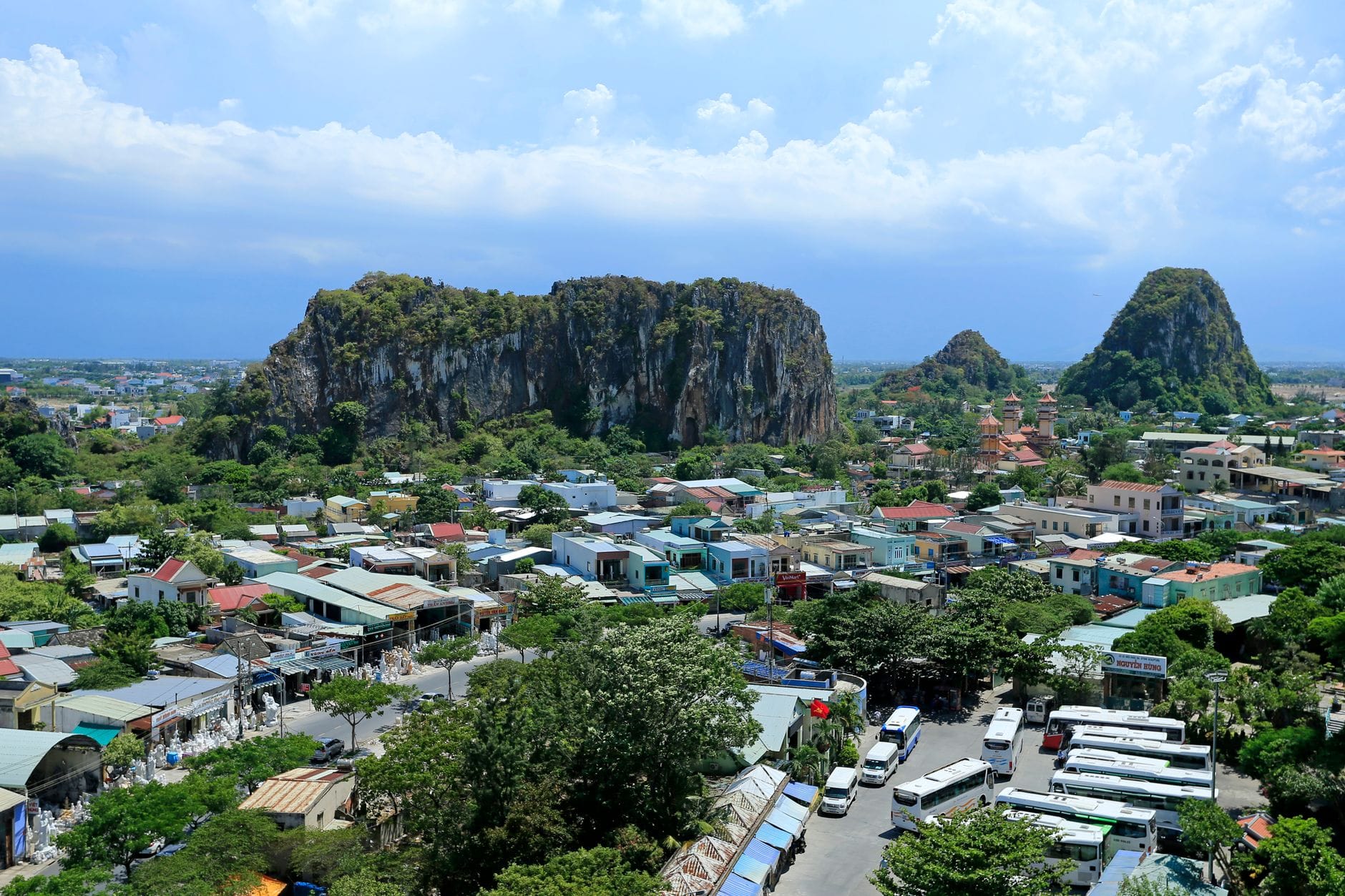
What the Marble Mountains Actually Are
The Marble Mountains, known in Vietnamese as Ngũ Hành Sơn, are five distinct marble and limestone peaks rising abruptly from the flat coastal plain south of Da Nang. Their Vietnamese name translates loosely to the Mountains of the Five Elements, a reference to the classical elemental system: Thủy (Water), Hỏa (Fire), Mộc (Wood), Kim (Metal), and Thổ (Earth). Emperor Minh Mạng formally assigned these elemental names in 1825, though the mountains had already held religious significance for centuries before that.
The peaks are not large by any conventional measure, but they rise sharply enough to feel dramatic from the road. Thuy Son, the Water Mountain, is the only one open to tourists and the largest of the five. It holds the majority of what visitors come to see: a network of natural caves converted into shrines, several active Buddhist pagodas, and viewpoints looking out toward the coast and the distant city skyline. The stone you walk on and the carvings you pass were shaped over generations, and the layers of history here are considerably more complex than most beach-town day trips.
ℹ️ Good to know
Opening hours: daily 07:00–17:30. The site is officially managed as part of Da Nang's tourism infrastructure. Arrive before 09:00 to explore the upper pagodas with fewer crowds and better light in the caves.
Getting There and First Impressions
The main tourist entrance is at 81 Huyền Trân Công Chúa Street in the Hòa Hải Ward of Ngu Hanh Son District. From central Da Nang, a Grab car or taxi takes around 15 to 20 minutes and costs a modest fare. Because the mountains sit directly on National Route 1A between Da Nang and Hoi An, many travelers stop here in one direction on a combined day trip rather than making a dedicated round trip.
The approach from the road is immediate: the stone carving workshops that line the street leading to the entrance belong to the Non Nuoc Stone Carving Village, a craft community that has operated in the shadow of the mountains for generations. The clinking of chisels on marble is audible before you even reach the ticket gate. It is worth slowing down here even briefly, as the quality of work ranges from mass-produced souvenirs to genuinely skilled sculpture.
After buying tickets at the base, you face a choice: climb the roughly 156 steps to the main Tam Thai Pagoda entrance, or pay an additional 15,000 VND for the elevator that lifts you partway up the eastern face. Most visitors who are reasonably mobile take the stairs up and the elevator down, or skip the elevator entirely. The staircase, while steep in places, is well-maintained and gives you a more gradual sense of ascending into the site.
Tickets & tours
Live prices and dates from our booking partner. If you book, we may earn a commission at no extra cost to you.
Marble Mountains and My Son sanctuary full-day tour with lunch
From 86 €Instant confirmationFree cancellationLady Buddha, Marble Mountains, and Hoi An City Tour from Da Nang
From 48 €Instant confirmationFree cancellationFull-day Marble Mountains and Lang Co Beach tour from Danang
From 71 €Instant confirmationFree cancellationMonkey and Marble Mountains, Coconut Basket Boat and Hoi An City Tour
From 68 €Instant confirmationFree cancellation
Inside Thuy Son: Pagodas, Caves, and Stone Altars
Once you pass through the main gate, the path branches into a small network of trails connecting the site's main features. Tam Thai Pagoda is typically the first major structure you encounter: a multi-tiered Buddhist temple actively used for worship, with incense smoke drifting through the surrounding trees. The smell of sandalwood and joss sticks is present throughout the upper section of the mountain, particularly in the morning.
The most compelling spaces on the mountain are its natural caves, which have been converted into sacred spaces over centuries. Huyen Khong Cave is the largest, a cathedral-scale chamber where filtered light enters through openings in the rock ceiling and falls across altars and Buddha statues below. The effect is theatrical in the best sense, particularly in the late morning when the light shafts are most visible. The stone interior is cool even in the hottest months, and the scale of the space tends to quiet down even large tour groups for a moment.
Smaller caves, including Tang Chon and Linh Nham, require ducking through narrow passages and sometimes using a phone torch to see clearly. These less-visited chambers are where the site feels most like genuine exploration rather than organized tourism. The carvings inside vary from ancient Buddhist iconography to more recent additions, and not all are labeled, which adds to the atmosphere if you are comfortable exploring without a script.
💡 Local tip
Bring a small torch or use your phone flashlight. Some of the interior cave passages are poorly lit and the floor surfaces are uneven. Wear closed shoes with grip, not sandals or flip-flops.
Am Phu Cave: The Hell Cave
Am Phu Cave, known colloquially as the Hell Cave, requires a separate ticket (20,000 VND for adults) and is located at a different entrance point from the main Thuy Son site. The cave is a theatrical walk-through depicting Buddhist cosmology around death and the afterlife, with sculptural scenes carved directly into the rock showing the journey of souls through various realms.
It is notably different in tone from the rest of the mountain. Where Thuy Son feels genuinely ancient and spiritually layered, Am Phu Cave is more deliberately designed for visitors, with good lighting, clear paths, and explanatory signage. Families with children tend to find it engaging, and the sculptural work is more intricate than you might expect. It is worth including if you have the time, but if you are choosing between the two, Thuy Son should be the priority.
Views and the Time of Day
From the upper platforms of Thuy Son, the view north takes in the coastal plain, the outer edge of Non Nuoc Beach, and on clear days the hazy outline of Da Nang's urban skyline. The view is good, not spectacular, and the platform can get congested mid-morning when tour buses arrive in volume.
Early morning, ideally at 07:00 when the site opens, is significantly better. The caves are cooler, the incense is freshest at the morning worship sessions, and the upper viewpoints are clear of the midday haze that frequently settles over the coast. The area near the mountains connects to Non Nuoc Beach, which is a five-minute walk from the base and makes a natural follow-up if you want to combine the visit with time at the water.
Afternoon visits are workable but come with direct sun on the exposed sections and heavier tourist traffic. The light inside Huyen Khong Cave is best before 11:00, when the sun angle aligns with the cave's natural openings. After about 14:00, the interior light flattens and the effect is considerably less dramatic.
⚠️ What to skip
Dress code is enforced at the pagoda areas. Cover shoulders and knees. Scarves or wraps are available to borrow at some pagoda entrances, but carrying your own is more reliable.
Historical and Cultural Context
The Marble Mountains have been a site of religious activity since at least the Cham period, and several of the caves show evidence of Cham-era Hindu worship before they were repurposed as Buddhist spaces following Vietnamese expansion southward in the 15th and 16th centuries. The layering of Cham and Vietnamese Buddhist traditions in a single site is one of the more historically interesting aspects of the place, even if it is not always explained clearly on-site.
During the American War (known in Vietnam as the Resistance War against America), the caves and tunnels of the Marble Mountains were used as field hospitals and military shelters by the North Vietnamese Army and Viet Cong forces. The proximity of the mountains to what was then a significant American military presence in Da Nang made them strategically important. This wartime history is referenced in the site's small museum near the base, and it provides useful context for understanding why these caves are so elaborately constructed and deep. For a broader picture of how Da Nang fits into central Vietnam's history, the Museum of Cham Sculpture in central Da Nang is the most authoritative place in the region to understand the Cham civilization that originally shaped this coastline.
Practical Notes for Your Visit
The site is open daily from 07:00 to 17:30. Tickets for Thuy Son cost 40,000 VND for adults, 10,000 VND for students with valid ID, and are free for children under 6. Am Phu Cave charges an additional 20,000 VND for adults and children above 6. The elevator to the upper level costs 15,000 VND one-way or 30,000 VND for a return trip.
There are no large food options inside the site, though vendors at the base sell water and snacks. Bring water, especially in the dry season months from April through August when temperatures at the exposed sections can be significant. The best time to visit Da Nang for outdoor sites like this is generally March through May or September through October, when temperatures are manageable and rainfall is lower.
Accessibility is limited. The standard route involves steep stairways, uneven cave floors, and passages that require stooping. The elevator provides partial access for those with mobility difficulties, but the cave interiors and upper pagoda areas are not wheelchair accessible. Visitors with serious mobility limitations will find the experience frustrating and potentially unsafe.
If you are planning a broader itinerary through central Vietnam, the Marble Mountains work well as a half-day addition to a Da Nang to Hoi An journey, as the site is directly on the route. Many travelers combine it with a stop at Non Nuoc Beach immediately afterward.
Who This Attraction Is Not For
Travelers looking purely for beach time or nightlife will find this a detour that does not repay the effort. If ancient temples and cave shrines do not hold your attention, two to three hours here will feel long. The Marble Mountains are also not suitable as a primary activity for visitors with mobility issues, young children who are not yet comfortable on steep stairs, or anyone in poor footwear. The site can be overcrowded from around 09:30 to 13:00, particularly when large tour buses arrive from Hoi An, and the atmosphere at peak times shifts from contemplative to chaotic fairly quickly.
Insider Tips
- Arrive at exactly 07:00 when the gate opens. The first 90 minutes before tour groups arrive is qualitatively different from a midday visit: quieter, cooler, and the light shafts in Huyen Khong Cave are at their best before 10:00.
- The elevator is worth taking on the way down, not up. The staircase ascent gives a better sense of the site's scale, and your legs will thank you for saving the descent.
- Walk the street of stone carving workshops before or after your visit, not just past them. This is the Non Nuoc Stone Carving Village, one of Vietnam's recognized traditional craft villages, and the skill level varies enormously from stall to stall. Pieces bought directly from carvers at workshop level are priced more fairly than those at souvenir shops near the entrance.
- The smaller caves (Tang Chon, Linh Nham) see a fraction of the visitors that Huyen Khong does. They are darker and require more effort to navigate, but that is precisely why they are worth finding. Ask for a site map or follow the less-trafficked paths from the main pagoda area.
- Combine the morning at the Marble Mountains with the afternoon at Non Nuoc Beach, which is a five-minute walk from the base. The beach here is quieter than My Khe and has a more local atmosphere, particularly on weekday afternoons.
Who Is Marble Mountains (Ngu Hanh Son) For?
- History and culture travelers who want more than surface-level temple visits
- Photographers, particularly those interested in cave light and religious architecture
- Travelers on the Da Nang to Hoi An route looking for a meaningful stop between the two cities
- Families with children aged 8 and up who can manage stairs confidently
- Anyone interested in the intersection of Cham, Vietnamese Buddhist, and wartime history in a single site
Nearby Attractions
Other things to see while in Marble Mountains (Ngu Hanh Son):
- Linh Ung Pagoda (Marble Mountains)
Founded in 1825–1826 during the Nguyen Dynasty and designated a national historical and cultural site, Linh Ung Pagoda sits on the eastern slope of Thuy Son (Water Mountain) within the Marble Mountains complex. It is older than its more famous namesake on Son Tra Peninsula and rewarding for anyone who has made the climb to explore the caves and terraces above.
- Non Nuoc Beach
Non Nuoc Beach (Bãi biển Non Nước) runs for roughly 5–8 kilometres along the Ngu Hanh Son coastline in southern Da Nang, backed by the stone formations of the Marble Mountains. Free to enter and open around the clock, it offers cleaner sightlines, softer crowds, and a more contemplative atmosphere than the city's more famous strips of sand.
- Non Nuoc Stone Carving Village
Non Nuoc Stone Carving Village sits at the base of the Marble Mountains in Da Nang's Ngu Hanh Son District, where artisans have shaped marble, granite, and sandstone into sculpture for nearly four centuries. Entry is free, the workshops are open to visitors, and the scale of production — hundreds of open-fronted studios lining the streets — is unlike anything you'll find in a gallery or market.
Planning a trip? Discover personalized activities with the Nomado app.