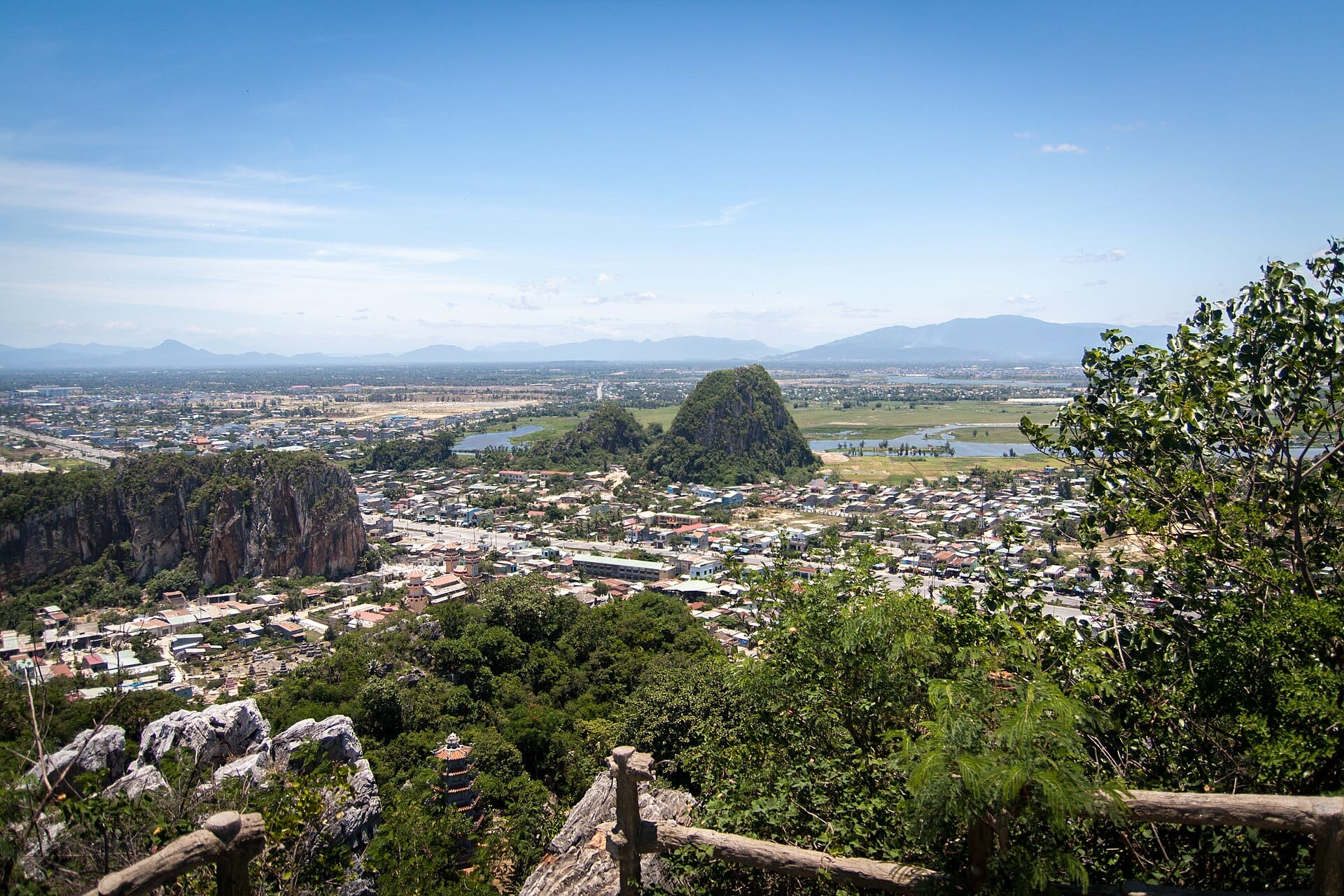
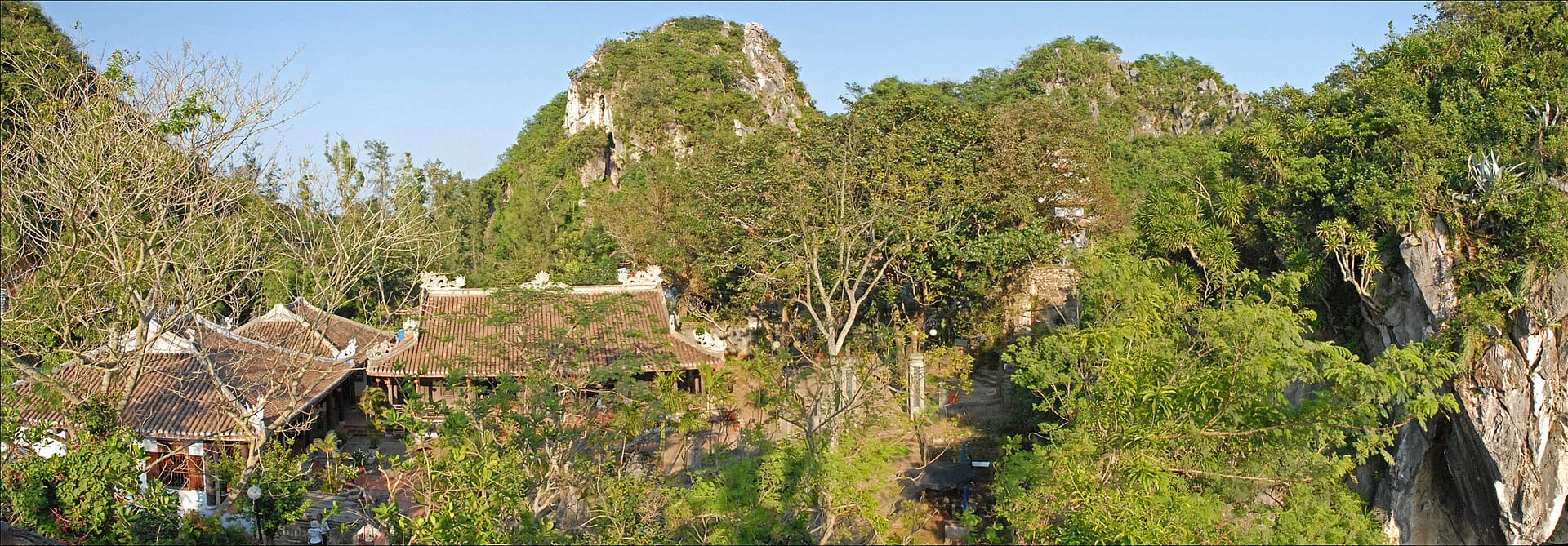
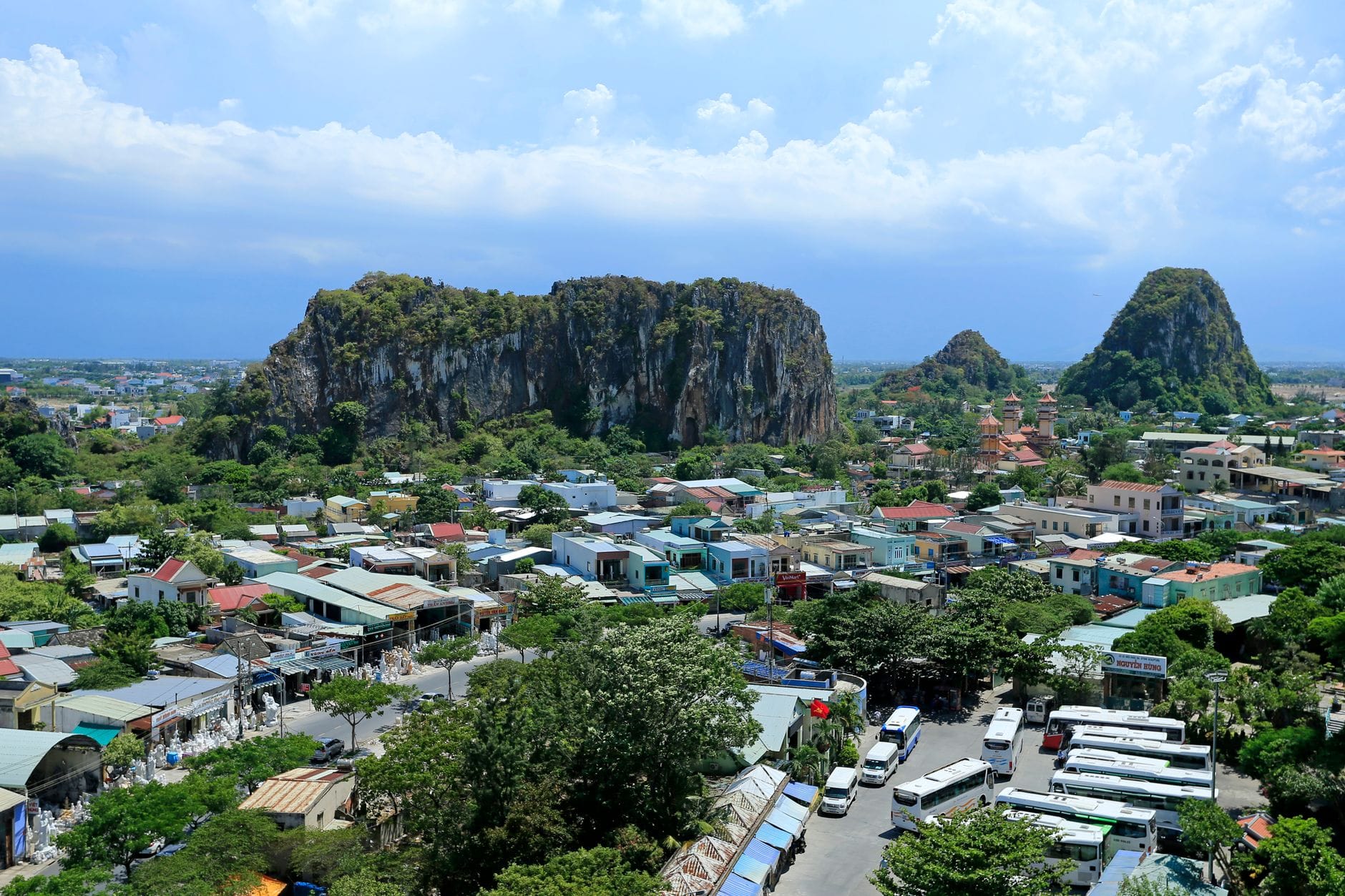
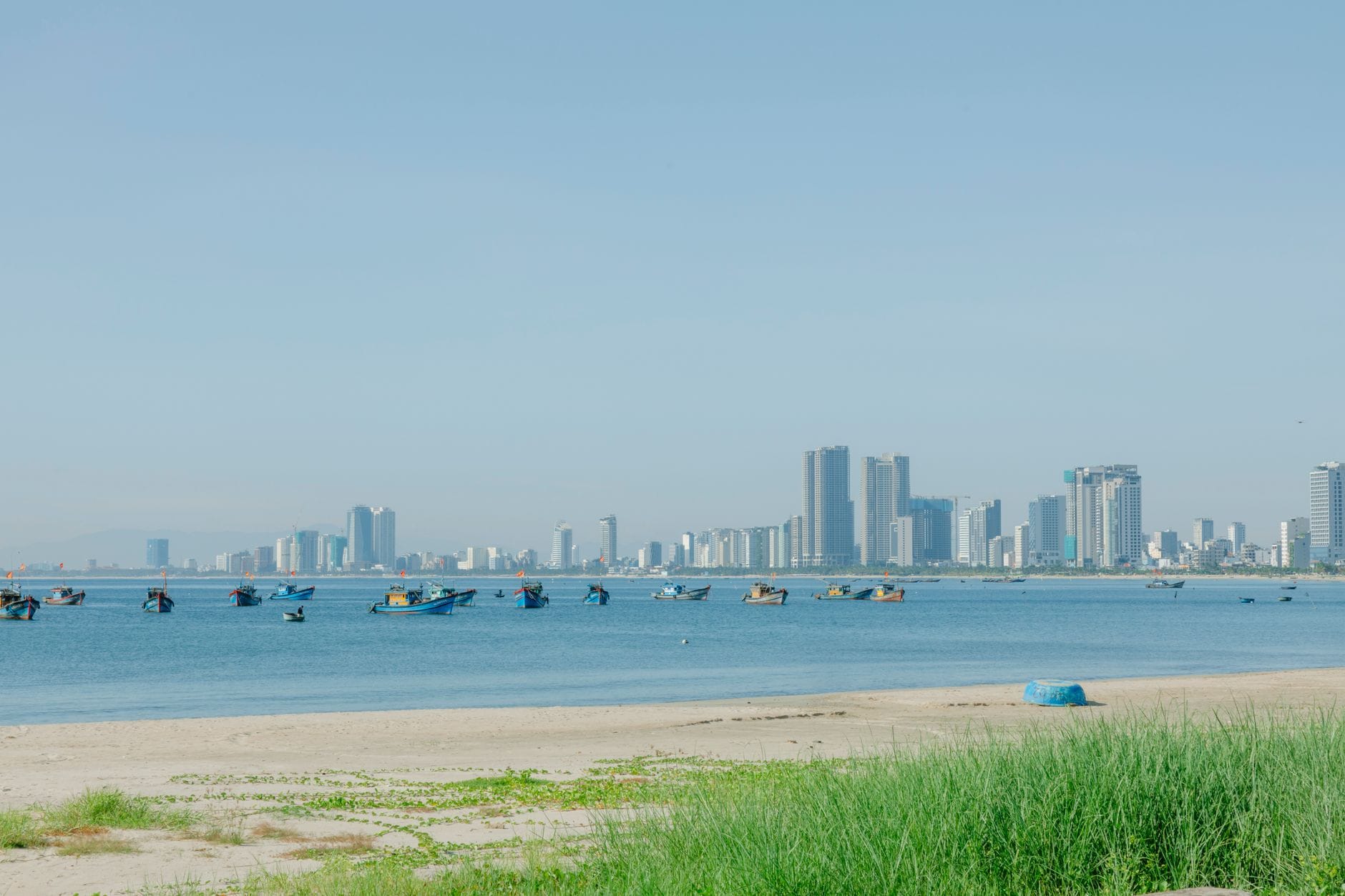
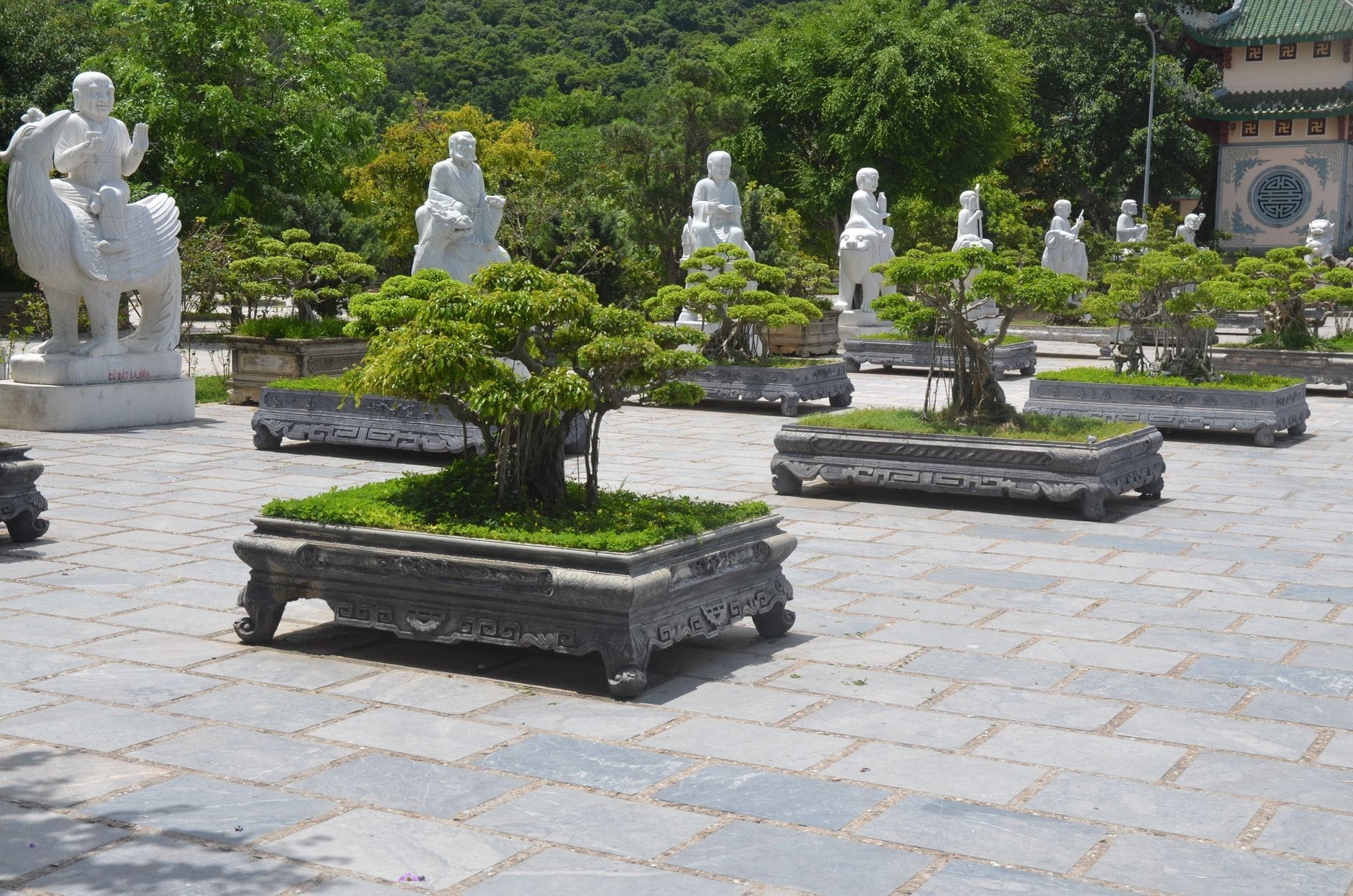
The Marble Mountains, known in Vietnamese as Ngũ Hành Sơn, are five limestone and marble hills rising from the coastal plain of Ngu Hanh Son District, about 8 km southeast of central Da Nang. Long considered a sacred landscape by Cham and Vietnamese Buddhist communities, the cluster holds caves, pagodas, tunnels, and hilltop viewpoints that stretch from the city skyline to the East Sea. It is one of Da Nang's most visited cultural sites, and the surrounding district has grown into a distinct neighborhood with its own character: part pilgrimage zone, part stone-carving workshop district, part gateway to the beach.
The Marble Mountains are five marble and limestone peaks that have served as a place of pilgrimage, military shelter, and spiritual retreat for centuries. They sit at the edge of the coastal plain in Ngu Hanh Son District, where the city gives way to the sea, and they offer something genuinely different from the beach resorts and riverside bars that define much of Da Nang.
Orientation
The Marble Mountains are located in Ngu Hanh Son District (Quận Ngũ Hành Sơn), roughly 7 to 8 km southeast of Da Nang's Hai Chau district center. The official address of the main site is 81 Huyen Tran Cong Chua Street, Hoa Hai Ward. This puts the mountains on Da Nang's southeastern edge, where the city's grid of hotels and apartment blocks gradually gives way to a more open coastal landscape.
The five peaks occupy roughly 2 square kilometers of sandy terrain between My Khe Beach to the north and Non Nuoc Beach to the south. The coastal road running south from Da Nang passes directly through the district, making the mountains a logical stop on the route between the city and Hoi An, which lies about 20 km further south. Most visitors approach from the north via Le Van Hien Street after crossing the Han River bridges from downtown Da Nang.
To the east, the flat Non Nuoc Beach runs parallel to the peaks, close enough that you can hear the surf from the upper trails on quiet mornings. To the west, Cam Le District marks the city's inland expansion. Understanding this geography is important: the Marble Mountains are not in the tourist center of Da Nang, they are at the city's coastal southern edge, and the trip here takes you through a different, more local-feeling part of the city.
Character and Atmosphere
Arriving at the Marble Mountains early in the morning, before the tour buses pull in, gives you a much clearer read on the place. The smell of incense drifts down from the pagodas above, mixing with the dust from the stone-carving workshops that line Huyen Tran Cong Chua Street. The sound of chisels on marble is constant in this neighborhood: Non Nuoc Stone Carving Village, one of Vietnam's most recognized traditional craft villages, flanks the site and has operated here for generations. Artisans carve everything from small Buddha figures to full-scale marble lions, and the clinking of tools begins well before the tourist entrance opens.
By mid-morning, the atmosphere shifts. Groups arrive with guides, vendors set up near the entrance, and the main path up Thuy Son becomes genuinely crowded. The Marble Mountains draw over two million visitors per year, and this concentration is most visible between 9 AM and noon. The paths narrow as they move uphill, and popular spots like the viewpoint terraces and the cave mouths can feel congested. This is the reality of visiting one of Da Nang's most recognized sites, and anyone expecting solitude during peak hours will be disappointed.
By late afternoon, the crowd thins noticeably. The light falls at an angle that catches the weathered stone of the pagodas and illuminates the cave interiors differently than midday. Local Buddhist worshippers come up in the late afternoon to pray at the shrines, and the site takes on a more contemplative character. The mountains close at 5:30 PM, so there is no evening access, which keeps the area relatively calm by nightfall. The surrounding streets, however, stay active with local restaurants and small guesthouses drawing in travelers who base themselves here.
💡 Local tip
Arrive by 7:30 AM to beat the first wave of tour groups. The caves and pagodas on Thuy Son feel completely different with only a handful of visitors, and the morning light through the cave openings is at its best in the first two hours after sunrise.
What to See and Do
The Marble Mountains correspond to five natural elements in Vietnamese cosmology: Kim Son (Metal), Moc Son (Wood), Hoa Son (Fire, comprising Duong Hoa Son and Am Hoa Son), Tho Son (Earth), and Thuy Son (Water). Of these, Thuy Son is the largest, the most developed for tourism, and the only one most visitors will climb. The other four peaks are smaller, less accessible, and largely unmarked for independent exploration.
Thuy Son rewards several hours of exploration. The main staircase leads up to a system of pagodas, cave shrines, and interconnected paths that weave through crevices in the rock. Linh Ung Pagoda and Tam Thai Pagoda are among the most significant Buddhist structures on the mountain, and both have been active places of worship for centuries. Am Phu Cave, which requires a separate ticket purchased at the entrance, takes visitors through a dramatically staged series of chambers that reference Buddhist cosmology, with carvings depicting judgment and the afterlife.
The viewpoint terraces near the summit of Thuy Son are among the best elevated perspectives in the Da Nang area. On a clear day, you can see across Non Nuoc Beach to the south, the Da Nang city skyline to the north, and the first ridgelines of the Truong Son range to the west. The view is referenced in several regional guides as one of the better coastal panoramas in central Vietnam.
Just outside the main ticket gate, Non Nuoc Stone Carving Village is worth at least an hour of your time. Workshops line the street in both directions from the ticket office, and artisans are generally open to visitors watching them work. The range in quality and scale is wide, from mass-produced decorative items to serious sculptural work. Larger pieces can be arranged for international shipping, though this adds significant complexity.
Thuy Son: pagodas, cave shrines, Am Phu Cave, and coastal viewpoints
Linh Ung Pagoda and Tam Thai Pagoda on Thuy Son
Am Phu Cave (separate entrance ticket required)
Non Nuoc Stone Carving Village along Huyen Tran Cong Chua Street
Non Nuoc Beach, a short walk east from the base of the mountains
Elevator option on Thuy Son for visitors who want to avoid the main staircase
⚠️ What to skip
The paths on Thuy Son involve steep, uneven stone stairs and low cave passages. Sandals and flip-flops are a genuine hazard on the wet or mossy sections. Wear closed shoes with grip, especially if you plan to explore the caves. The site also requires modest dress at the pagodas: carry a light layer or scarf to cover shoulders and knees.
Eating and Drinking
The immediate area around the Marble Mountains entrance is not a destination dining neighborhood. The food options clustered near the ticket office cater mainly to day-trippers looking for a quick lunch between the mountains and the beach, and quality varies considerably. That said, Hoa Hai Ward has enough local eating options along the surrounding streets to feed you well if you know where to look.
Local Vietnamese staples like bun bo (spicy beef noodle soup), com tam (broken rice with grilled pork), and fresh seafood are all available within a few blocks of the main entrance. The seafood options improve as you move closer to Non Nuoc Beach, where a handful of open-air restaurants serve grilled fish and shellfish to both locals and tourists. Prices here are generally lower than in the tourist center of Da Nang, which is one of the practical benefits of basing yourself in this part of the city.
For coffee, Da Nang's café culture extends into this district, though on a smaller scale than the city center. Independent Vietnamese-style cafés are scattered along the side streets. If you want a deeper read on the city's coffee scene before visiting, Da Nang's coffee guide covers the city's café culture in detail.
ℹ️ Good to know
The vendors immediately outside the Marble Mountains entrance sell drinks, snacks, and souvenirs at prices that tend to be higher than nearby shops. Walk a block or two from the main gate for better-value food and water.
Getting There and Around
The Marble Mountains sit about 7 to 8 km from central Da Nang and are not within walking distance of any major hotel cluster. The most practical options for most visitors are ride-hailing apps (Grab is widely available in Da Nang), taxis, or motorbike rental. The ride from the Han River area downtown takes roughly 20 to 25 minutes depending on traffic, and costs via Grab are typically low by international standards.
Motorbike is the most flexible option if you are comfortable on two wheels. Riding south from downtown, you cross one of the Han River bridges and follow Le Van Hien Street and then the coastal road south toward Hoa Hai Ward. This route also passes My Khe Beach, which makes it easy to combine both in a morning. The road is well-marked and the terrain is flat.
The Marble Mountains are also a natural stop on the route between Da Nang and Hoi An. If you are traveling south by private car, taxi, or motorbike, the site is directly on the way. Several operators run half-day or full-day tours combining the mountains with Hoi An. For details on making that trip independently, the Da Nang to Hoi An guide covers your options.
Public city buses do run in Da Nang, and routes connecting the city center to Ngu Hanh Son District exist, but specific stop names, schedules, and real-time reliability are not consistently documented in publicly available tourism sources. For independent travelers without a motorbike, Grab or a negotiated taxi fare is the more predictable choice for a first visit.
Within the Marble Mountains site itself, an elevator on the north face of Thuy Son carries visitors up to the main pagoda level, bypassing the steepest section of the main staircase. It costs a small additional fee on top of the site entrance. As of current information, the entrance ticket for Thuy Son is 40,000 VND, the elevator is 15,000 VND per ride, and opening hours are 7:00 AM to 5:30 PM daily; check locally for any updates before visiting. The Da Nang transport guide covers city-wide mobility in more detail.
Where to Stay
Ngu Hanh Son District has a growing accommodation scene that offers a genuine alternative to the more concentrated hotel strips near My Khe Beach or downtown. The main draw is proximity to both the Marble Mountains and Non Nuoc Beach, the latter of which tends to be quieter and less crowded than the central beach sections further north. The Da Nang neighborhood guide compares this district against the other main accommodation zones if you are deciding where to base yourself.
The area suits travelers who want easy access to the mountains and beach without paying a premium for a central Da Nang address. Mid-range guesthouses and smaller resort-style properties operate along the coastal strip near Non Nuoc Beach, catering to both Vietnamese domestic tourists and international visitors. The neighborhood is quieter at night than the Han River area or the An Thuong tourist street zone, which is either a drawcard or a limitation depending on your priorities.
Digital nomads and longer-stay visitors sometimes base themselves here for the lower costs and beach access, though the café-coworking infrastructure is thinner than in central Da Nang. If remote work is a priority, the Da Nang digital nomad guide is worth reading before committing to this part of the city.
Context and History
The Marble Mountains have been considered sacred for far longer than Da Nang has existed as a modern city. The Cham civilization, which dominated central Vietnam for centuries before Vietnamese expansion southward, used the caves as places of worship, and traces of Cham religious art and inscription survive in some of the cave chambers. Later, Vietnamese Buddhist communities established pagodas on the peaks from at least the 17th century onward, and the mountains became one of the most significant pilgrimage sites in central Vietnam.
The caves also have a more recent history that often surprises visitors. During the American War, Viet Cong forces used the cave systems as a field hospital and staging ground, exploiting the natural cover of the rock formations. Given that a US military base, Marble Mountain Air Facility, was located immediately adjacent during the conflict, this created an unusual and historically dense geography. The layered history of the site, from Cham sacred space to Buddhist pilgrimage site to wartime shelter, gives it a depth that goes beyond the view from the top. The Museum of Cham Sculpture in downtown Da Nang provides essential context on the Cham civilization if you want to understand that layer of the mountains' history before visiting.
The stone-carving tradition around Non Nuoc Village grew directly from the availability of marble quarried from the mountains themselves. Quarrying has since been restricted to protect the site, but the craft village has continued using imported stone and recycled material, maintaining a trade that has employed local families for generations.
Practical Considerations
The Marble Mountains are a daytime attraction, full stop. The site closes in the late afternoon and there is no evening or night access. This means you are planning a specific daytime excursion, not something to work in spontaneously after dinner. Budget at least two to three hours on site if you want to explore Thuy Son properly, including the cave system and viewpoints. Add more time if you plan to browse Non Nuoc Village or spend time at Non Nuoc Beach afterward.
The tropical heat is a real factor between April and August. Thuy Son has limited shade on the upper paths, and the stone surfaces absorb and radiate heat. Carry water, start early, and consider whether midday in peak summer is the best window. The best time to visit Da Nang guide covers seasonal patterns across the city, including what the Ngu Hanh Son area is like during the wet season, when some paths can be slippery.
If you are combining the Marble Mountains with other major Da Nang attractions in a single day, a logical route pairs the mountains with a morning at Non Nuoc Beach afterward, or includes the site as part of a south-to-north day that starts in Hoi An and ends in Da Nang. The 3-day Da Nang itinerary maps out how to fit the mountains into a broader city visit without backtracking.
TL;DR
The Marble Mountains (Ngũ Hành Sơn) are five limestone peaks in Ngu Hanh Son District, about 8 km southeast of central Da Nang, holding pagodas, cave shrines, and coastal viewpoints built up over centuries of Buddhist and Cham use.
Thuy Son is the main peak open to visitors; expect steep stairs, cave passages, and real crowds between 9 AM and noon — arrive early to avoid the worst of it.
The surrounding area includes Non Nuoc Stone Carving Village, Non Nuoc Beach, and a quieter, more affordable accommodation zone than central Da Nang.
Access is by ride-hail app, taxi, or motorbike from downtown Da Nang (around 20-25 minutes); the site sits directly on the Da Nang to Hoi An coastal route, making it a natural stop between the two cities.
Best for travelers who want cultural and historical depth alongside beach access; less suited to those looking for nightlife, a full dining scene, or walkable city-center convenience.
Top Attractions in Marble Mountains (Ngu Hanh Son)
Three days is exactly enough time to cover Da Nang's best beaches, cultural landmarks, and day trips without rushing. This itinerary breaks it down day by day — with practical logistics, honest crowd and timing advice, and links to deeper guides for every stop.
Ba Na Hills is a high-altitude resort complex sitting at 1,487 metres above sea level, about 25 km southwest of Da Nang. This guide covers everything from ticket prices and cable car logistics to seasonal conditions, crowd patterns, and what the French Village is really like.
Da Nang's climate divides into a sunny dry season and a stormy wet season, but the best time to visit depends on what you want from the trip. This guide breaks down weather patterns, crowd levels, and pricing across every season so you can plan with confidence.
Central Vietnam's Da Nang–Hoi An–Hue corridor packs beaches, UNESCO heritage, and mountain scenery into a compact region. This guide gives you the routes, timings, seasonal advice, and practical details to plan a trip that actually works.
Da Nang International Airport (DAD) is one of the most conveniently located airports in Southeast Asia, sitting roughly 3–5 km from downtown. This guide covers the arrivals process, visa on arrival requirements, every transfer option to the city, and how to reach Hoi An from the airport.
Da Nang sits on roughly 70–75 km of coastline, with a core run of public beaches that rival anything in Southeast Asia. This guide covers every significant beach from Nam O in the north to Non Nuoc in the south, with practical advice on the best swimming seasons, safety, crowd patterns, and how much to budget.
Da Nang's coffee scene runs deeper than beach cafés and tourist menus. This guide covers everything from traditional Vietnamese street coffee to specialty roasters, with real prices, neighborhood breakdowns, and tips on when and where to go.
Da Nang has become one of Southeast Asia's most practical bases for remote workers, with fast fiber internet, low costs, and a beach at the end of the street. This guide covers everything you actually need: realistic budgets, visa rules, the best neighborhoods, coworking options, and the seasonal realities that can make or break a long stay.
The Da Nang International Fireworks Festival is Vietnam's largest pyrotechnic competition, running across multiple nights from late May to mid-July over the Han River. This guide covers tickets, viewing spots, accommodation strategy, and everything else you need to plan your visit.
Da Nang punches well above its weight as a romantic destination. With a scenic riverfront, long stretches of beach, cloud-capped mountains, and easy access to Hoi An, it offers couples genuine variety — whether you want candlelit dinners, spa retreats, or mountain adventures. This guide covers the best romantic experiences in Da Nang, with practical timing, pricing context, and honest takes on what's worth your time.
Da Nang has quietly become one of Southeast Asia's most compelling luxury destinations, offering five-star beachfront resorts, world-class golf, and refined dining at prices that significantly undercut Bali and Phuket. This guide covers where to stay, when to book, what to spend, and how to get the most from a high-end trip to central Vietnam.
Da Nang is better known for its beaches, but the mountains surrounding the city offer some of central Vietnam's most rewarding day trips. This guide covers every major peak, trail, and viewpoint within reach, with practical advice on difficulty, access, and the best time to go.
Da Nang nightlife runs the spectrum from riverfront rooftop bars and late-night expat clubs to grilled seafood markets and the weekly Dragon Bridge fire show. This guide covers every zone, venue type, and practical detail you need to plan your evenings well.
Da Nang has one of the lowest crime rates of any major Vietnamese city, but a handful of persistent scams catch visitors off guard every year. This guide breaks down the real risks, the tourist traps worth avoiding, and the practical steps that keep you safe from arrival to departure.
Da Nang shopping splits neatly into two worlds: lively traditional markets where bargaining is expected, and modern air-conditioned malls with fixed prices. This guide covers the key venues, the best souvenirs, realistic price ranges, and the common mistakes that cost visitors money.
Da Nang's wellness scene spans budget walk-in parlors, boutique treatment centers, and full resort spas open around the clock. This guide breaks down the best options by price tier, location, and treatment type — with practical advice on when to book ahead and what to skip.
The trip from Da Nang to Hoi An is only around 30 km, but with no airport or train station in Hoi An, road is your only option. This guide breaks down every transport choice, with current prices, journey times, and practical advice on which option suits your situation.
Da Nang punches well above its size when it comes to scenery. The city sits between jungle-covered mountains, a long arc of coastline, and a river lined with illuminated bridges — all of which create extraordinary viewpoints at every elevation. This guide covers the best of them, from free hilltop lookouts to ticketed cable-car rides above the clouds.
Da Nang is one of Southeast Asia's most practical destinations for families. Short distances between attractions, calm traffic, wide sandy beaches, and a mix of theme parks, cultural sites, and day trips make it genuinely easy with children in tow. This guide covers when to go, what to skip, and how to make the most of 3-5 days.
Da Nang sits at the centre of one of Southeast Asia's most rewarding travel corridors. Within a two-hour radius you have UNESCO World Heritage sites, a French-colonial hilltop resort, ancient Cham towers, and one of Vietnam's most scenic mountain passes. This guide covers every worthwhile day trip with real distances, 2026 pricing, and straight talk about what is actually worth your time.
Da Nang is one of Vietnam's most navigable cities, with most tourist areas packed into a 5–15 km radius. This guide breaks down every way to get around, from Grab bikes to city buses, with real fare ranges, key routes, and practical advice on what to avoid.
Da Nang sits roughly midway between Hanoi and Ho Chi Minh City, making it one of the easiest destinations in Vietnam to reach. This guide covers every practical option: domestic flights, overnight trains, prices, journey times, and what to know before you book.
Hoi An's Full Moon Lantern Festival happens every lunar month, and Da Nang is the ideal base for a same-day trip. This guide covers exactly how to get there, when to arrive, what things cost, and what no one tells you before you go.
Da Nang sits at the heart of central Vietnam, offering long sandy beaches, world-class day trips, and a food scene that punches well above its weight. Here is everything you need to know to decide whether it belongs on your itinerary.
Da Nang is central Vietnam's most livable city and one of its most rewarding to explore. This guide covers the best things to do in Da Nang across beaches, landmarks, food, day trips, and culture, with practical advice on timing, costs, and what to skip.
Da Nang's food scene runs far deeper than seafood. This guide covers the essential dishes, where to find them, what to pay, and when to show up — written for travelers who want to eat like a local, not a tourist.
Da Nang splits cleanly into three distinct stay zones: the beachside strip around My Khe, the city-centre Han River district, and the secluded Son Tra Peninsula. This guide breaks down each area by price, vibe, and access to attractions so you can choose the right base for your trip.