Museum of Cham Sculpture: Da Nang's Window into a Lost Kingdom
Opened in 1919, the Museum of Cham Sculpture in Da Nang holds the world's largest collection of Cham artifacts. With over 500 pieces on display across 2,000 square meters of gallery space, it offers a rare and serious look at a civilization that shaped central Vietnam for centuries.
Quick Facts
- Location
- 2 Tháng 9 Street, Hai Chau District, Da Nang (near Dragon Bridge roundabout)
- Getting There
- Taxi or ride-hailing app from central Da Nang; walkable from Dragon Bridge. No metro in Da Nang.
- Time Needed
- 1.5 to 2.5 hours
- Cost
- Approx. 60,000 VND for adults (confirm on arrival, prices vary by source)
- Best for
- History travelers, art lovers, architecture enthusiasts, anyone on the Da Nang–Hoi An corridor
- Official website
- http://chammuseum.vn
What the Museum of Cham Sculpture Actually Is
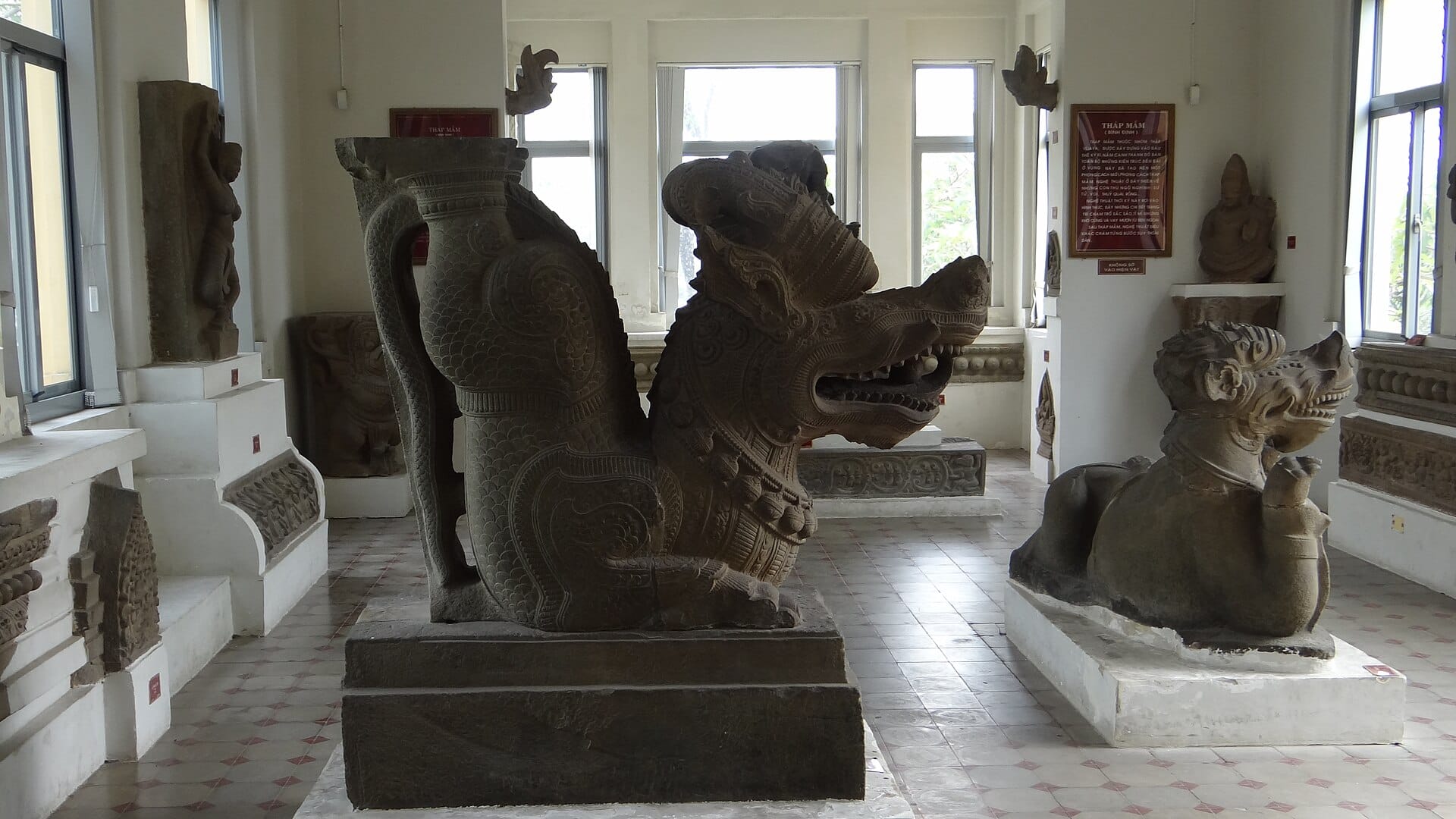
The Da Nang Museum of Cham Sculpture, known locally as Bảo tàng Điêu khắc Chăm Đà Nẵng, is not a typical city museum with a mixed bag of regional relics. It has a single, focused mission: to preserve and display the sculptural legacy of the Cham people, who built a powerful Indianized kingdom called Champa across central and southern Vietnam roughly between the 2nd and 19th centuries CE. The result is the largest collection of Cham artifacts in the world, held in one place, purpose-built for exactly this content.
The building itself opened in 1919, making it the oldest museum in Da Nang. It was constructed between 1915 and 1919 under French colonial administration, in a hybrid style that blends French colonial structure with Cham decorative motifs on the facade. The architects clearly understood that the container should echo the contents. In 2016, the Vietnamese government elevated its status to a first-class national museum, the country's highest institutional classification for cultural heritage sites.
The total site covers 6,673 square meters, with approximately 2,000 square meters of dedicated gallery space. The collection holds over 2,000 artifacts in total, with around 500 on public display at any given time. These include stone linga and yoni, towering sandstone figures of Shiva, Vishnu, and Brahma, intricate reliefs depicting scenes from Hindu mythology, and decorative architectural fragments salvaged from Cham temple complexes across the region.
ℹ️ Good to know
Hours and ticket prices: The museum is generally open 07:30–11:00 and 13:00–17:00, and is closed on Mondays. Admission is commonly reported at around 60,000 VND for adults. Confirm current hours and pricing at the door or via chammuseum.vn before visiting, as these details can shift.
The Cham Civilization: Why This Collection Matters
The Kingdom of Champa is one of Southeast Asia's most significant yet under-discussed civilizations. At its peak it controlled the central Vietnamese coastline, trading extensively with India, China, Java, and Khmer Cambodia. Champa was a Hindu kingdom — later incorporating Buddhist influences — and its artistic output reflected deep engagement with Indic religious traditions, filtered through local Southeast Asian sensibilities.
Unlike the Khmer temples of Angkor, which largely survive intact in Cambodia, most Cham temple complexes in Vietnam exist only as ruins or scattered fragments. My Son, the closest major Cham sanctuary to Da Nang and now a UNESCO World Heritage Site, gives a sense of the architecture, but much of its sculpture was removed, damaged in the American War, or deteriorated over time. The museum fills that gap. Pieces here were recovered from sites across central Vietnam, including My Son, Dong Duong, Khuong My, Thap Mam, and others, spanning roughly the 7th to 15th centuries.
If you are planning a visit to My Son after Da Nang, the museum is genuinely useful preparation. Seeing the detail of Cham stone carving up close, at eye level, in good light, gives you context that the outdoor temple ruins cannot always provide. For ideas on how to combine this with a broader regional itinerary, the central Vietnam itinerary guide covers how to sequence Da Nang, Hoi An, and the surrounding heritage sites.
Tickets & tours
Live prices and dates from our booking partner. If you book, we may earn a commission at no extra cost to you.
My Son Marvels and Champa Culture 4-Hour Tour from Hoi An or Da Nang
From 59 €Instant confirmationCham Spa & Massage Experience in Da Nang
From 15 €Instant confirmationFree cancellationMy Son Sanctuary and the ancient kingdom of Champa tour
From 46 €Instant confirmationFree cancellationMy Son Sanctuary and the ancient kingdom of Champa small group tour from Hoi An
From 39 €Instant confirmationFree cancellation
Navigating the Galleries: Rooms, Periods, and What to Look For
The galleries are organized primarily by geographic origin rather than strict chronology, which reflects the fact that different Cham regions developed distinct artistic styles. Each room is named after the site where its pieces were excavated: My Son, Tra Kieu, Dong Duong, Thap Mam, and others. This organization rewards visitors who take time to read the room labels, because the visual differences between a 9th-century My Son altar piece and a 12th-century Thap Mam figure are genuinely striking.
The Tra Kieu room is often singled out by art historians for containing some of the most accomplished Cham carving ever found. The altar pedestal from Tra Kieu, dating to around the 10th century, is covered in layered relief scenes of extraordinary density and precision. Standing in front of it, you realize how far the craftsmen pushed sandstone as a medium. The Dong Duong room, by contrast, reflects a period of intense Buddhist influence and contains figures with an almost archaic stillness that differs markedly from the animated Hindu iconography elsewhere.
The largest sculptures, some standing over two meters, are displayed in the open courtyard areas and the central hall where ceiling height accommodates them properly. Smaller decorative fragments and architectural elements are in the enclosed side rooms. A floor plan is usually available at the entrance ticket desk, and English-language labels accompany most major pieces, though their depth varies considerably. Some labels give rich archaeological context; others are brief to the point of frustrating.
💡 Local tip
Photography tip: The museum allows photography without flash. Morning light through the courtyard is the best natural light for shooting the outdoor pieces. The enclosed gallery rooms are moderately lit — a phone camera on a steady surface or a mirrorless camera with a fast lens will serve you better than a DSLR with a heavy flash rig.
Visiting by Time of Day: When to Go and What Changes
Early morning, between opening and 09:00, is the quietest window. The galleries are cool from the overnight air, the stone sculptures catch the low-angle light filtering through courtyard openings, and you can stand in front of major pieces without other visitors crowding the sightline. This is the hour for anyone who wants a contemplative experience rather than a tour group experience.
By mid-morning, particularly between 09:30 and 11:00, the museum sees its highest visitor density. Cruise ship passengers, school groups from within Vietnam, and organized day-tour groups from Hoi An tend to arrive during this window. The indoor galleries, which rely on air conditioning, become crowded and the noise level rises noticeably. The courtyard areas, where large sculptures are displayed outdoors, remain more spacious even at peak times.
The post-lunch slot, from 13:00 onward if the museum operates split hours, is often overlooked by tour operators and is typically calmer than mid-morning. The heat of early afternoon in Da Nang can be intense from April through August, but the interior galleries are air-conditioned, making the museum one of the more sensible ways to spend the hottest part of a dry-season day. Aim to arrive by 15:30 at the latest to allow time before closing.
⚠️ What to skip
Weather note: Da Nang's rainy season runs roughly September through March. The museum's indoor galleries are unaffected by rain, making it an excellent wet-weather option. However, the outdoor courtyard pieces are best appreciated in dry conditions. If you are visiting in the wet season, the enclosed rooms alone justify the ticket price.
Getting There and the Surrounding Area
The museum sits at 2 Tháng 9 Street in Hai Chau District, near the large roundabout at the western end of Dragon Bridge. This is one of Da Nang's most central intersections, which means reaching the museum from almost anywhere in the city is straightforward. A taxi or Grab ride from the beachfront My Khe area takes roughly 10 to 15 minutes depending on traffic, and from central hotels near the Han River, the museum is within walking distance for anyone comfortable with a 15 to 20 minute walk in the heat.
The area immediately around the museum connects naturally to Da Nang's downtown riverfront. The Dragon Bridge is a short walk away and provides a useful visual landmark for orientation. The Han River promenade, Bach Dang walking street, and the main commercial corridor are all within the same district, making it easy to combine the museum with a broader exploration of the Han River downtown area.
There is no metro in Da Nang. The practical options are taxi, Grab (ride-hailing), motorbike taxi, or rental motorbike. Parking for self-drive motorbikes and vehicles is available directly in front of the museum on 2 Tháng 9 Street. The footpath along this road is paved and even, and vehicle drop-off at the entrance is easy. Visitors with mobility limitations should be aware that detailed accessibility information for the interior galleries, including wheelchair access specifications, is not clearly documented, and it is worth calling ahead or checking at arrival.
Practical Considerations Before You Go
Dress code here is not as strict as at active religious sites, but modest clothing is appropriate given the cultural context. The interior galleries are air-conditioned, so a light layer is useful if you are sensitive to cold. Bring cash in Vietnamese dong for the entrance fee; card payment availability is not consistently confirmed across sources. The museum does not appear to have a significant on-site cafe, so plan meals or drinks before or after your visit rather than expecting refreshments inside.
The museum is easily combined with a day that includes the Marble Mountains, located about 9 kilometers to the south. The Marble Mountains have Cham connections of their own, with Hindu and Buddhist sanctuaries carved into the rock over centuries. Combining both sites gives a more layered picture of the Cham legacy across Da Nang's geography. If you are thinking about how to structure a full day or multi-day visit, the 3 days in Da Nang guide includes suggestions for pairing these heritage sites efficiently.
The museum is approximately 28 kilometers from Hoi An, making it a logical stop for travelers moving between the two cities rather than a detour. Most Hoi An to Da Nang transfers pass within minutes of 2 Tháng 9 Street. If you are self-driving or hiring a private vehicle, factoring in a 90-minute museum visit adds very little travel time to the journey.
Who This Museum Is Not For
Travelers with very limited time in Da Nang and no particular interest in pre-modern history or religious art may find the museum underwhelming compared to the city's outdoor and beach attractions. The collection is deep and serious, but it rewards curiosity. Visitors who rush through without reading labels or engaging with the material are unlikely to appreciate what makes this collection significant. Young children may struggle with the pace and content, though the large outdoor sculptures in the courtyard tend to hold their attention better than the enclosed gallery rooms.
If your primary interest is beaches, nightlife, or outdoor adventure, other parts of Da Nang will compete more directly for your time. The full Da Nang attractions guide covers how the museum fits alongside the city's broader range of experiences, so you can decide how to prioritize your itinerary.
Insider Tips
- Arrive within the first hour of opening on weekdays. This is when staff are most available and the galleries are empty enough to hear the ambient quiet of the courtyard, which changes the experience of the space entirely.
- Ask at the ticket desk whether an English-speaking guide is available. On some days, staff members with good English offer informal walkthroughs for a small additional cost or voluntarily. The extra context on individual pieces is worth considerably more than the time it takes to ask.
- The Tra Kieu room deserves at least 20 minutes on its own. Most visitors spend three to four minutes per room and miss the quality of the carving entirely. Get close to the altar pedestal surface and look at the layering of figures in the relief work.
- If you plan to visit My Son Sanctuary afterward, note which iconographic forms appear repeatedly in the museum. Recognizing Shiva's trident, Ganesha, and the naga serpent in the museum makes the ruins at My Son significantly more legible.
- The museum shop near the entrance sells academic catalogs and postcards. The catalogs, while not cheap, are among the few serious English-language resources on Cham sculpture available outside university libraries.
Who Is Museum of Cham Sculpture For?
- History and archaeology travelers who want to understand the cultural layers beneath central Vietnam's modern landscape
- Art and architecture enthusiasts drawn to Indic sculptural traditions and how they evolved in Southeast Asian contexts
- Travelers on the Da Nang to Hoi An corridor looking for a substantive cultural stop that does not require a full day
- Visitors seeking indoor, air-conditioned activity during the heat of Da Nang's dry season or rain during the wet season
- Anyone preparing for or following up a visit to My Son Sanctuary who wants deeper context for the Cham world
Nearby Attractions
Other things to see while in Han River & Downtown:
- Asia Park & Sun Wheel
Asia Park, home to the 115-metre Sun Wheel Ferris wheel, is Da Nang's most recognizable evening landmark. Open from late afternoon into the night, it offers sweeping city views, a modest collection of rides, and an easy, affordable few hours on the western bank of the Han River.
- Bach Dang Walking Street
Opened in June 2024, Bach Dang Walking Street runs along the west bank of the Han River between Dragon Bridge and Tran Thi Ly Bridge. Free to enter, it operates daily from mid‑afternoon to midnight, with stricter vehicle bans on weekend evenings, and offers food kiosks, live performances, and unobstructed river views — making it one of the most accessible evening destinations in central Da Nang.
- Con Market
Con Market, known locally as Chợ Cồn, is the beating commercial heart of central Da Nang. Covering around 14,000 square metres in Hai Chau District, this sprawling market has served the city since at least the 1950s and remains the place where locals actually shop. Entry is free, the food is exceptional, and the atmosphere changes completely depending on what time you arrive.
- Da Nang Cathedral (Pink Church)
Built in 1923 by French priest Louis Vallet, Da Nang Cathedral is the city's only surviving French colonial-era church. Officially the Sacred Heart of Jesus Cathedral, it stands nearly 70 meters tall on Tran Phu Street in Hai Chau District, painted an unmistakable shade of rose pink and crowned by a rooster-shaped weathervane that gives it a second, more affectionate nickname: Nha Tho Con Ga.
Planning a trip? Discover personalized activities with the Nomado app.