Da Nang Cathedral (Pink Church): The Rooster Church of Hai Chau
Built in 1923 by French priest Louis Vallet, Da Nang Cathedral is the city's only surviving French colonial-era church. Officially the Sacred Heart of Jesus Cathedral, it stands nearly 70 meters tall on Tran Phu Street in Hai Chau District, painted an unmistakable shade of rose pink and crowned by a rooster-shaped weathervane that gives it a second, more affectionate nickname: Nha Tho Con Ga.
Quick Facts
- Location
- 156 Tran Phu, Hai Chau 1 Ward, Hai Chau District, Da Nang
- Getting There
- Walkable from Dragon Bridge (~700 m) or Han River Bridge (~1 km); taxi and ride-hailing apps readily available citywide
- Time Needed
- 30–60 minutes for exterior and courtyard; longer if attending Mass
- Cost
- Free entry, no ticket required
- Best for
- Architecture lovers, photography, cultural history, Catholics attending Sunday English Mass
- Official website
- giaoxuchinhtoadanang.org
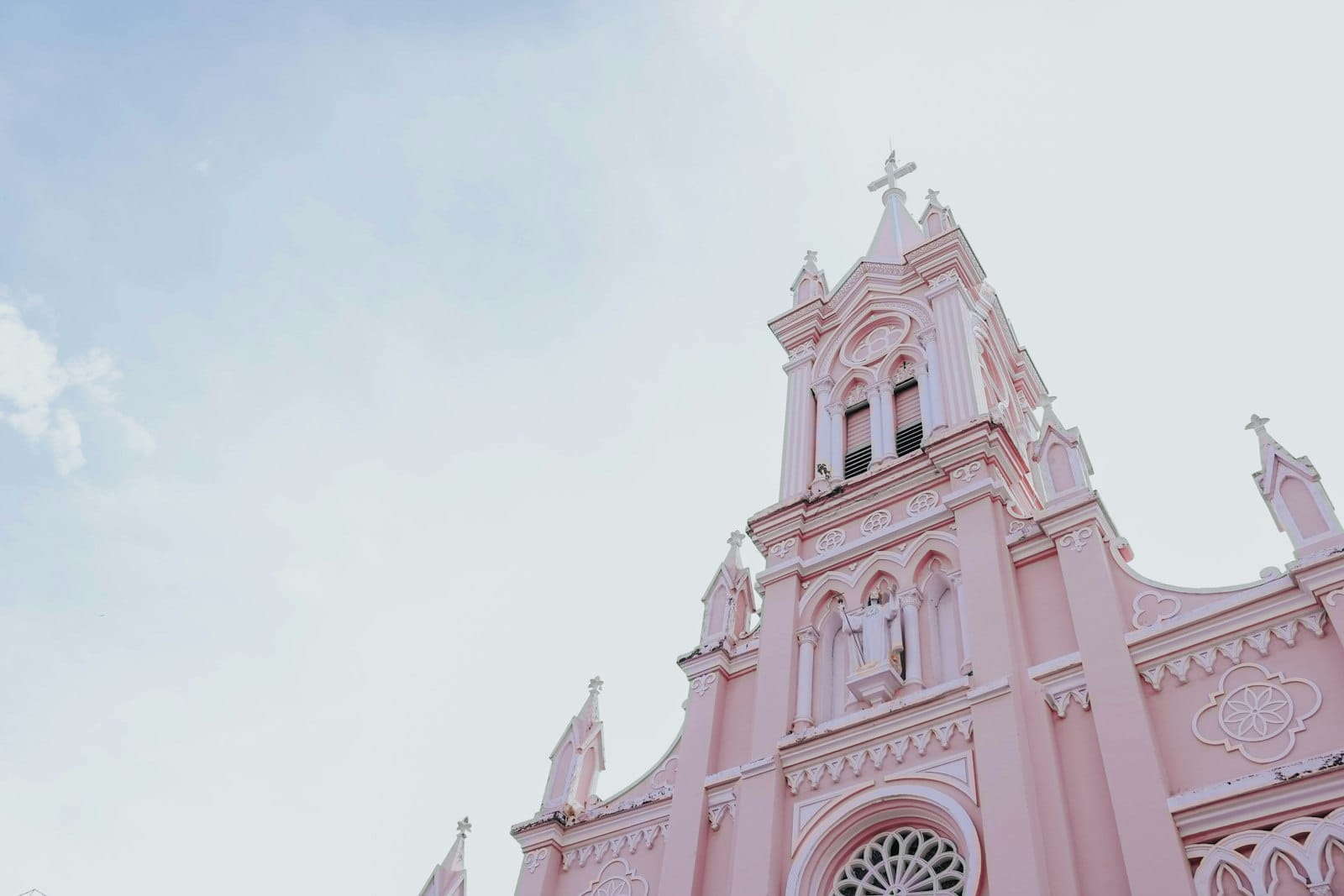
First Impressions: What You See When You Arrive
Da Nang Cathedral announces itself from half a block away. The building is painted a warm dusty rose, somewhere between peach and coral, and it catches the morning light in a way that makes the stone work glow. The spire climbs nearly 70 meters above Tran Phu Street, and at its very tip sits a small rooster weathervane, the detail that earned the church its Vietnamese nickname: Nha Tho Con Ga, literally the Rooster Church.
The cathedral occupies a full urban block bounded by Tran Phu, Yen Bai, Tran Quoc Toan, and Nguyen Thai Hoc streets. A low wall and iron gate set the building back from the footpath, creating a compact forecourt with a small garden. Step through the gate and the noise of the street drops noticeably. A gravel path leads to the main entrance, and the facade becomes fully visible: three lancet arches over the doors, narrow stained-glass windows climbing the nave walls, and the spire framed cleanly against the sky.
💡 Local tip
Visiting hours for sightseeing are Monday to Saturday, 08:00–11:30 and 13:30–16:30. The cathedral is generally closed to tourists on Sundays, when it operates for worship only. Arrive within the first hour of opening to avoid school and tour groups.
History and Architecture: Da Nang's Only French Colonial Church
Construction began in 1923 under the direction of French priest Louis Vallet, and the cathedral was completed and inaugurated in 1924. This makes it the only church built in Da Nang during the French colonial period, a fact that gives it a particular weight in the city's architectural history. While many Vietnamese cities have older religious structures, Da Nang's rapid modernization has erased much of its colonial fabric, which makes the cathedral's survival all the more significant.
The architectural style draws clearly from French Gothic: pointed arches, a vertical emphasis that draws the eye upward, and windows positioned to channel filtered light into the interior. The Gothic vocabulary was a deliberate choice in colonial Catholic architecture across Indochina, a way of asserting institutional permanence through a European aesthetic tradition. The pink color, however, is distinctly local in character, and locals rarely describe it as garish. In the context of Da Nang's streetscape, it reads as dignified and warm rather than theatrical.
The official dedication is the Sacred Heart of Jesus Cathedral, and the building serves as the seat of the Diocese of Da Nang. It is an active parish church, not a museum. That distinction matters: visitors are welcome during designated hours, but the space is used continuously for worship, and the atmosphere inside reflects that.
Tickets & tours
Live prices and dates from our booking partner. If you book, we may earn a commission at no extra cost to you.
Da Nang Airport Pick-Up or Drop-Off Transfer Service
From 7 €Instant confirmationFree cancellationFull-day Hoi An city and My Son sanctuary tour from Danang
From 88 €Instant confirmationFree cancellationFull-day Ba Na Hills exploration from Da Nang
From 112 €Instant confirmationFree cancellationBach Ma National Park trekking day tour from Danang
From 109 €Instant confirmationFree cancellation
Inside the Cathedral: Light, Scale, and Atmosphere
The interior is relatively austere compared to older cathedrals in Hanoi or Ho Chi Minh City. The nave is long and narrow, with wooden pews arranged in two rows facing the altar. Stained glass windows filter the sunlight into bands of colored light that shift across the floor as the morning progresses. The effect is most pronounced between 08:00 and 10:00, when eastern light enters at a low angle and the reds and blues in the glass are most saturated.
The altar area is modest but carefully maintained, with fresh flowers typically arranged at the base of the statues. The ceiling vaults are painted in pale tones that keep the space feeling light rather than heavy. Acoustically, the cathedral is quiet in the hours between masses, with occasional footsteps echoing on the tile floor the dominant sound. If you visit during a weekday morning Mass at 05:00 or 17:15, expect the building to feel completely different: candlelit, attended by local parishioners, and genuinely contemplative.
ℹ️ Good to know
An English-language Mass is held every Sunday morning, making Da Nang Cathedral one of the few Catholic churches in central Vietnam with a regular English service. Visitors wishing to attend are welcome, but dress modestly: shoulders and knees covered.
How the Experience Changes by Time of Day
Early morning, before 09:00, is the most rewarding time to visit. The street outside is active with motorbikes and coffee drinkers, but the forecourt is usually empty or nearly so. The pink facade catches the low eastern light directly, and without a crowd in the frame, photographs are straightforward. The air at this hour still carries the faint smell of incense from the previous evening's Mass.
By mid-morning, tour groups from nearby hotels begin to arrive, typically between 09:30 and 11:00. The forecourt becomes noticeably busier, with visitors photographing the facade and guides delivering briefings in Vietnamese, English, and Korean. The dynamic is relaxed rather than chaotic, but it is a different experience from the quiet of the early hours.
Afternoon visits, particularly in the 13:30 to 15:00 window, tend to be quieter again. The midday heat discourages casual foot traffic, and the light on the western-facing sections of the building is strong and flat, less ideal for photography. The interior, however, is cool and pleasant regardless of the hour, making an afternoon stop worthwhile if you want to sit quietly inside.
Evening visits to the exterior are possible but informal. The cathedral is lit at night, and the pink walls take on a warmer, softer tone under artificial light. The surrounding streets, including nearby Bach Dang along the Han River, are active in the evening, making a combined walk natural.
Getting There and Getting Around
The cathedral sits at 156 Tran Phu in Hai Chau District, which is the commercial and administrative core of Da Nang. It is walkable from most of the central riverfront hotels in around 10 to 20 minutes. From Dragon Bridge, follow Bach Dang Street south for approximately 700 meters, then cut inland along Pham Phu Thu to Tran Phu. From Han River Bridge, turn left onto Yen Bai and walk roughly 1 kilometer to Tran Phu.
Grab and other ride-hailing apps are the easiest option if you are coming from farther away, including from the beach areas around My Khe Beach. A ride from the beach strip to the cathedral takes around 15 to 20 minutes depending on traffic and costs a small amount in local currency. Metered taxis are also widely available throughout Hai Chau. There is no formal parking area at the cathedral, so drivers typically drop off on Tran Phu and circle. For guidance on moving around the wider city, see the Da Nang transport guide.
Photography Tips and Practical Notes
The most photogenic angle is from the forecourt gate looking directly at the main facade. A wide-angle lens or the ultra-wide mode on a phone camera captures the full height of the spire without distortion. The rooster weathervane at the top is small and easy to miss in wide shots; a telephoto crop or zoom brings it into view clearly.
Interior photography is generally permitted during non-Mass visiting hours, but be discreet and avoid flash near the altar. If a prayer service or private ceremony is in progress when you enter, wait near the entrance or return later. The stained glass is best captured from the nave looking toward the windows, with the morning light behind the glass rather than in front of it.
⚠️ What to skip
Dress modestly before entering: shoulders covered, no short shorts or short skirts. This is an active place of worship, not a tourist attraction in the conventional sense. Visitors who arrive in beachwear are sometimes asked to wait outside or declined entry.
The cathedral sits on flat pavement with no significant steps at the forecourt entry. The main entrance doors have a low threshold. Interior navigation is straightforward for most visitors, though detailed accessibility information for wheelchair users is not published officially; it is worth confirming with the parish directly if this is a concern.
Practical Assessment: Is It Worth Your Time?
Da Nang Cathedral is not a grand cathedral by international standards. It will not compete with Saigon's Notre-Dame Basilica in scale or decorative richness. If you have visited many historic Catholic churches elsewhere in the world, the interior may feel relatively simple. What makes this building interesting is its context: it is the only French colonial-era church in a city that has modernized rapidly, and understanding that context gives it genuine historical weight. Paired with a visit to the Da Nang Museum or the Museum of Cham Sculpture, it makes sense as part of a half-day loop through Hai Chau District's cultural sites.
For travelers whose primary interest is beaches, adventure activities, or the broader central Vietnam landscape, the cathedral can reasonably be skipped in favor of sites like the Marble Mountains or the Son Tra Peninsula. But for anyone spending more than two days in Da Nang and interested in the city's history or architecture, the free entry and short visit time make it an easy addition to a morning in the city center.
Insider Tips
- Visit between 08:00 and 09:00 on a weekday for the quietest forecourt and the best morning light on the pink facade. Tour groups typically arrive after 09:30.
- Look up at the very tip of the spire before you enter: the small metal rooster weathervane is easy to miss but is the detail that gives the church its most-used local name, Nha Tho Con Ga.
- If you want to experience the cathedral as locals do rather than as tourists, attend the weekday 17:15 Mass. The evening light through the stained glass and the small congregation of neighborhood residents create a completely different atmosphere from daytime visits.
- The streets immediately surrounding the cathedral, particularly Yen Bai and Tran Quoc Toan, have several small Vietnamese coffee shops where you can sit with a ca phe sua da and look back at the spire over the rooftops. This is a more relaxed way to appreciate the building's scale than standing directly in front of it.
- Sunday is officially closed for tourism but the English Mass at 10:00 is open to all. If you want to attend, arrive by 09:45, dress conservatively, and take a seat at the back to avoid disrupting the service.
Who Is Da Nang Cathedral (Pink Church) For?
- Architecture and history travelers interested in French colonial building in central Vietnam
- Photographers looking for a photogenic facade with context, particularly in morning light
- Catholic visitors seeking an English-language Sunday Mass in Da Nang
- Travelers building a Hai Chau District cultural morning alongside nearby museums
- Couples and solo travelers who want a short, free, low-effort cultural stop in the city center
Nearby Attractions
Other things to see while in Han River & Downtown:
- Asia Park & Sun Wheel
Asia Park, home to the 115-metre Sun Wheel Ferris wheel, is Da Nang's most recognizable evening landmark. Open from late afternoon into the night, it offers sweeping city views, a modest collection of rides, and an easy, affordable few hours on the western bank of the Han River.
- Bach Dang Walking Street
Opened in June 2024, Bach Dang Walking Street runs along the west bank of the Han River between Dragon Bridge and Tran Thi Ly Bridge. Free to enter, it operates daily from mid‑afternoon to midnight, with stricter vehicle bans on weekend evenings, and offers food kiosks, live performances, and unobstructed river views — making it one of the most accessible evening destinations in central Da Nang.
- Con Market
Con Market, known locally as Chợ Cồn, is the beating commercial heart of central Da Nang. Covering around 14,000 square metres in Hai Chau District, this sprawling market has served the city since at least the 1950s and remains the place where locals actually shop. Entry is free, the food is exceptional, and the atmosphere changes completely depending on what time you arrive.
- Da Nang Fine Arts Museum
The Da Nang Fine Arts Museum holds more than 1,000 works of Vietnamese art and traditional handicrafts across three floors in central Hai Chau District. Entry costs 20,000 VND, hours are daily 8am to 5pm, and the whole experience typically takes about 1 to 2 hours. It rewards curious visitors — but those expecting a world-class collection may need to adjust expectations.
Planning a trip? Discover personalized activities with the Nomado app.